
Class 10 Political Science Chapter 3: Gender, Religion and Caste Notes
This chapter in five lines
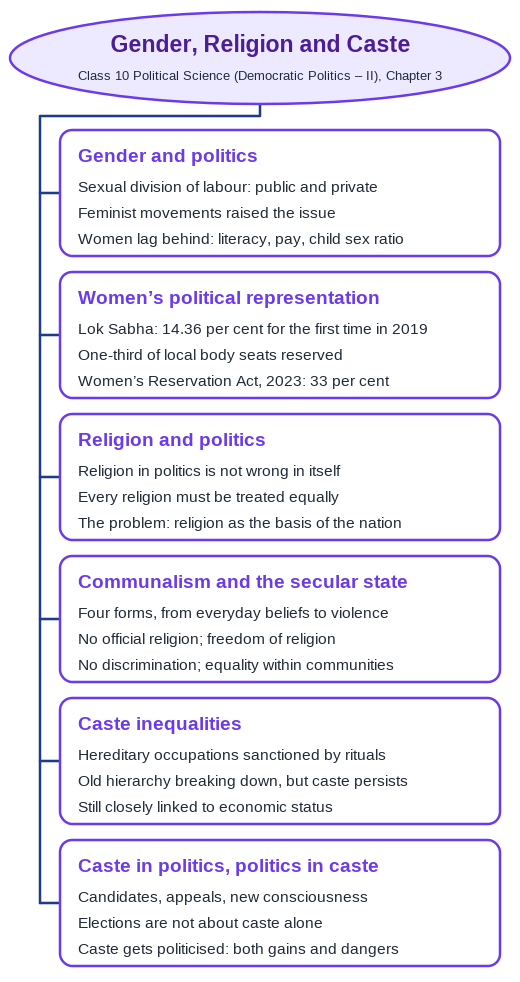
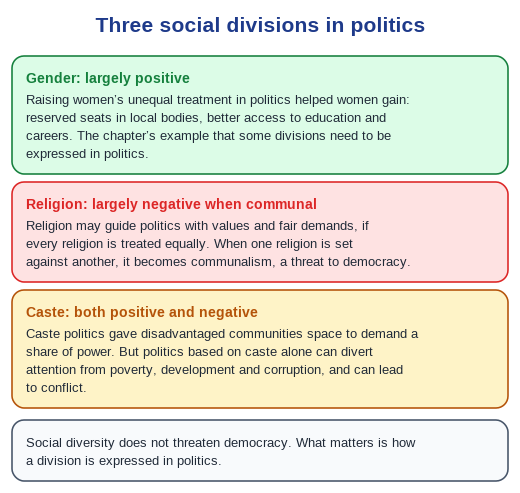
The chapter looks at three social differences, gender, religion and caste, and asks how each is expressed in Indian politics. Raising gender inequality in politics has helped women, for example through reserved seats in local bodies. Religion in politics turns harmful when it becomes communalism, which is why India chose to be a secular state. Caste in politics has both sides: it has given disadvantaged groups a voice, but politics based on caste alone is unhealthy for democracy.
What is this chapter about?
Every society has differences among its people. Some differences are simply variety; others turn into divisions and inequalities. This chapter of Democratic Politics – II opens with a simple idea: social diversity does not threaten democracy, and expressing social differences in politics is possible and sometimes even desirable. It then tests the idea on three differences found in India, those of gender, religion and caste. For each one it asks two questions: what form the division takes here, and whether its expression in politics is healthy for democracy or not.
What is the gender division?
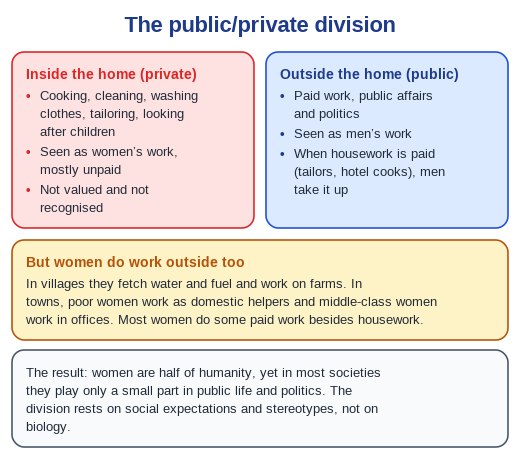
The chapter calls gender a hierarchical social division found everywhere, though rarely studied in politics. It is often thought natural and unchangeable, but it rests on social expectations and stereotypes, not on biology. Boys and girls are raised to believe that housework and bringing up children are mainly women’s jobs. This creates a sexual division of labour: women do the work inside the home, and men the work outside. Men can do housework; they just think it is women’s job, and when such work is paid, as for tailors or hotel cooks, men take it up. Women, in turn, also work outside: in fields, as domestic helpers, in offices. But their work is seldom valued. Read Gender and politics
How did gender become a political issue?
Because women do most of their work in the private sphere, their role in public life and politics has been minimal in most societies. At first only men could vote and stand for office. Women organised and agitated for the vote, for better legal and political status, and for education and careers. The more radical movements, called feminist movements, aimed at equality in personal and family life too. As a result women now work as scientists, doctors, engineers, lawyers, managers and teachers. In the Scandinavian countries, Sweden, Norway and Finland, women take a very large part in public life.
How are women disadvantaged in India?
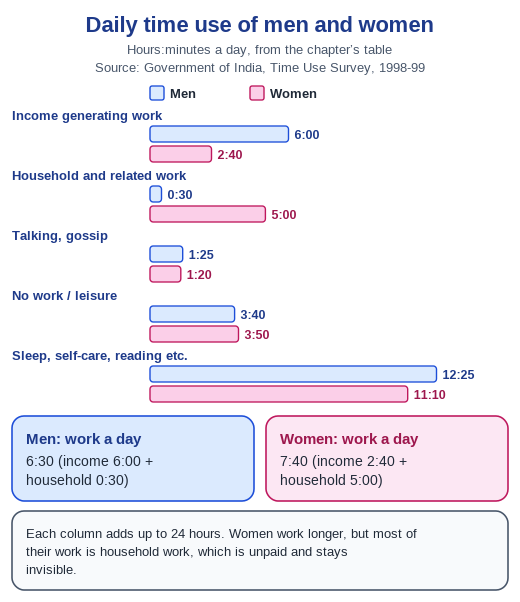
The chapter describes ours as still a male-dominated, patriarchal society. Literacy among women is 54 per cent, against 76 per cent among men, and fewer girls go on to higher studies. Few women hold highly paid jobs, and an average woman works about one hour a day more than a man, mostly unpaid. Women are paid less for the same work, although the Equal Remuneration Act, 1976 requires equal wages for equal work. A preference for sons has pushed the child sex ratio down to 919 girls per thousand boys, and lower in some States. A time use survey in six States shows the gap clearly.
How well are women represented in politics?
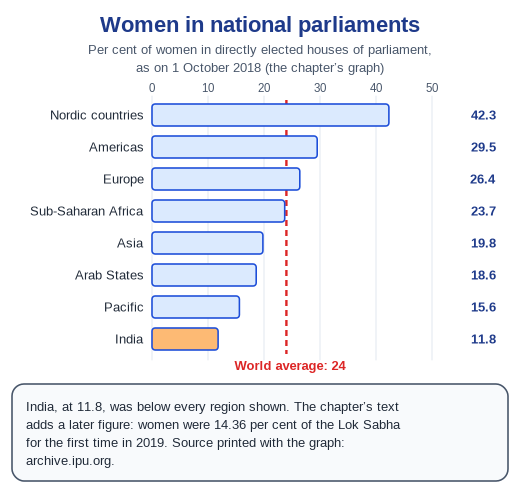
Not well. Women were 14.36 per cent of the Lok Sabha for the first time in 2019, and are under 5 per cent of members of State assemblies. The chapter’s graph places India among the lowest in the world. One remedy is to make a fair share of seats legally binding. Panchayati raj has done this: one-third of seats in panchayats and municipalities are reserved for women, and more than 10 lakh women are elected representatives in local bodies. In 2023, the Women’s Reservation Act (Nari Shakti Vandan Adhiniyam) was passed; it will give 33 per cent reservation in the Lok Sabha, State Legislative Assemblies and the Delhi Assembly.
When is religion in politics a problem?
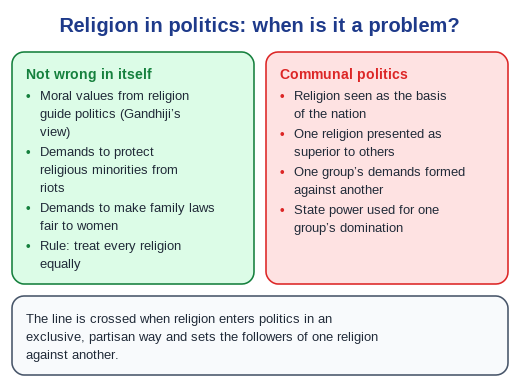
Religious diversity is found in many countries, India among them, and religious differences are often expressed in politics. That is not wrong in itself. The chapter gives three examples: the view, held by Gandhiji, that politics must be guided by moral values drawn from religion; demands to protect religious minorities from communal riots; and demands to make family laws fair to women. People may express their needs as members of a religious community, and governments may sometimes regulate religious practice to stop discrimination, as long as every religion is treated equally. Trouble starts when religion is treated as the basis of the nation and one religion is set against another. This is communal politics. Read Religion, communalism and caste in politics
What forms does communalism take?
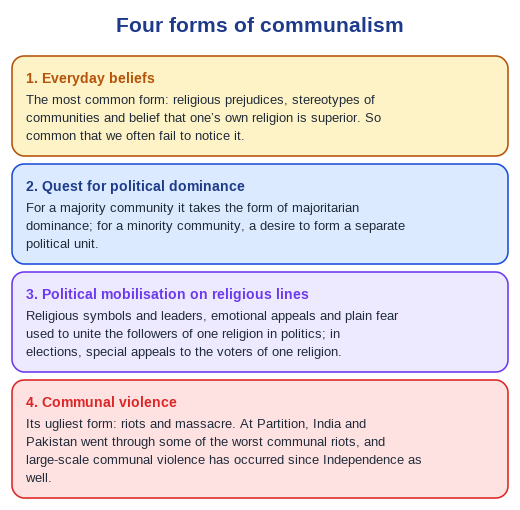
Communal thinking holds that followers of one religion form one community with the same interests, and that followers of different religions cannot live as equal citizens in one nation. The chapter calls this fundamentally flawed: everyone has many roles and identities, and every community has many voices. Communalism shows itself in four ways: in everyday beliefs (prejudices, stereotypes and a sense of superiority); in a quest for political dominance; in political mobilisation on religious lines; and, at its ugliest, in communal violence, riots and massacre.
How is India a secular state?
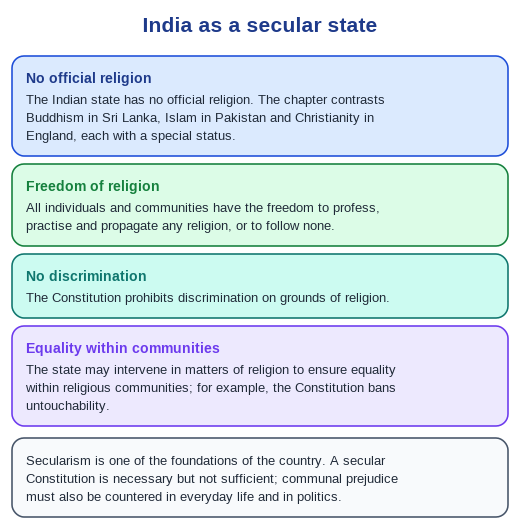
The makers of the Constitution knew communalism was a major challenge, so they chose a secular state. There is no official religion. Everyone has freedom in matters of faith: to profess, practise and propagate any religion, or to follow none. Discrimination on grounds of religion is prohibited. And the state may intervene in religious matters to ensure equality within communities; it bans untouchability, for instance. The chapter adds that secularism is one of the foundations of the country, and that a secular Constitution is necessary but not sufficient: prejudice must also be countered in everyday life and in politics.
What are caste inequalities?
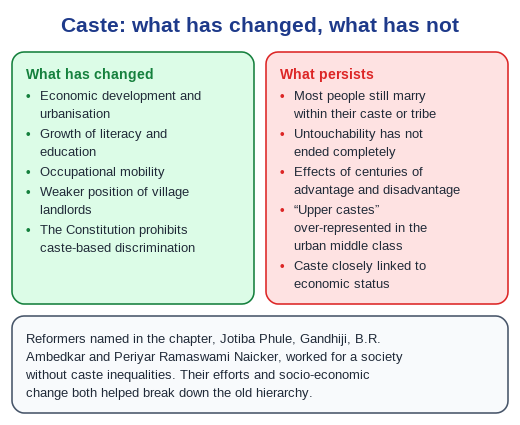
Unlike gender and religion, the caste division is special to India. In the caste system, hereditary occupations were sanctioned by rituals; members of a caste married within it and did not eat with other castes, and the ‘outcaste’ groups suffered exclusion and untouchability. Reformers named in the chapter, Jotiba Phule, Gandhiji, B.R. Ambedkar and Periyar Ramaswami Naicker, worked for a society without caste inequalities. With their efforts, and with economic development, urbanisation, education and occupational mobility, the old caste hierarchy is breaking down. Yet caste has not disappeared: most people still marry within their caste or tribe, untouchability has not ended completely, and caste remains closely linked to economic status. Read Caste inequalities in India
How does caste work in politics?
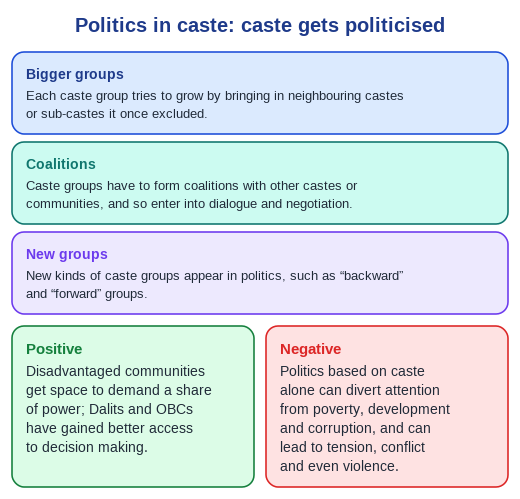
Casteism, like communalism, rests on the belief that caste is the only basis of community. Caste shows up in politics when parties choose candidates with the caste make-up of voters in mind, appeal to caste sentiment, and give different castes a place in government; adult franchise also brought new consciousness to castes once treated as low. But elections are not about caste alone: no constituency has a clear majority of one caste, no party wins all the votes of a caste, and ruling parties and sitting MPs and MLAs often lose. Politics also acts on caste. Caste groups grow larger, form coalitions and negotiate, and new ‘backward’ and ‘forward’ groups appear. This has helped Dalits and OBCs gain better access to decision making, but politics based on caste alone can divert attention from poverty, development and corruption.
Before we move on
This chapter makes up Unit II of the book. It builds on the idea of power sharing in Chapter 1, Power-sharing and Chapter 2, Federalism, which showed how a democracy can make room for diversity. The next chapter of the book, Political Parties, looks at how parties carry these and other demands into government. Answers to every exercise and to the questions inside this chapter are in the NCERT solutions for Chapter 3.
Key terms
| Term | Meaning |
|---|---|
| Sexual division of labour | A system in which all work inside the home is either done by the women of the family or organised by them through domestic helpers. |
| Feminist | A woman or a man who believes in equal rights and opportunities for women and men. |
| Feminist movements | Women’s movements that aimed at equality in personal and family life, besides political and legal rights and education and careers. |
| Patriarchy | Literally, rule by the father; a system that values men more and gives them power over women. |
| Child sex ratio | The number of girl children per thousand boys. |
| Communalism | Politics based on the idea that religion is the principal basis of social community, setting the followers of one religion against another. |
| Secular state | A state with no official religion, which treats all religions equally, gives freedom of religion and prohibits discrimination on grounds of religion. |
| Family laws | Laws that deal with family matters such as marriage, divorce, adoption and inheritance; in India different family laws apply to followers of different religions. |
| Caste hierarchy | A ladder-like arrangement in which caste groups are placed from the ‘highest’ to the ‘lowest’. |
| Urbanisation | The shift of population from rural areas to urban areas. |
| Occupational mobility | A shift from one occupation to another, usually when a new generation takes up work different from that of its ancestors. |
| Casteism | The belief that caste is the sole basis of social community, and that people of one caste share interests with no one from another caste. |
| Vote bank | A popular phrase for a caste or community said to vote for one party; usually it means only that a large share of its voters do so. |
Topics in this chapter
Practice
-
According to the chapter, the gender division is based on:
Show answer
Answer: (b) social expectations and stereotypes
-
What was the child sex ratio in the country, as given in the chapter?
Show answer
Answer: (c) 919
-
In which year did women first make up 14.36 per cent of the Lok Sabha?
Show answer
Answer: (d) 2019
-
Which of these is NOT a feature of India as a secular state?
Show answer
Answer: (c) A special status for one religion
-
Which social division does the chapter call special to India?
Show answer
Answer: (c) Caste
-
According to the Census of 2011 as given in the chapter, what share of the population were Scheduled Castes?
Show answer
Answer: (b) 16.6 per cent
Questions students ask
What are the main topics of Class 10 Political Science Chapter 3?
Gender and politics (the public/private division, women’s disadvantages, women’s political representation); religion, communalism and politics (the forms of communalism and the secular state); and caste and politics (caste inequalities, caste in politics and politics in caste).
Is Gender, Religion and Caste in the 2026-27 NCERT book?
Yes. It is Chapter 3 of Democratic Politics – II, the Class 10 Political Science textbook marked Reprint 2026-27, on pages 29 to 45. These notes follow the copy of the book now on NCERT’s website.
Why does the chapter say feminism is good but communalism and casteism are not?
Because of what each does in politics. Raising women’s unequal treatment asks for equal rights for everyone, and it helped a disadvantaged group. Communalism sets the followers of one religion against another, and politics based on caste alone can divert attention from other issues and lead to conflict. The chapter judges a division by how it is expressed, not by its existence.
Does talking about caste in a textbook promote casteism?
The chapter raises this question itself and answers that caste will not disappear if we stay silent about it. Wherever there is domination, it has to be discussed, so that its injustices can be understood and reversed.
Stuck on a question?
Take a photo and Lagnever AI explains it step by step. Try it for 7 days for ₹2.
Get it on Google Play Open in browser
For parents: after the trial, the plan renews monthly by UPI or card autopay. You can cancel anytime in the app.