
Religion, Communalism and Caste in Politics
Answer in short
Religion in politics is acceptable while every religion is treated equally; it becomes communalism when religion is made the basis of the nation and one religion is set against another. India answered with a secular state. Caste in politics has two sides: it gave disadvantaged groups a voice, but caste alone diverts attention from poverty, development and corruption.
Stuck on a question? Take a photo and Lagnever AI explains it step by step. Try it for 7 days for ₹2. Get it on Google Play
How are religion and politics connected?
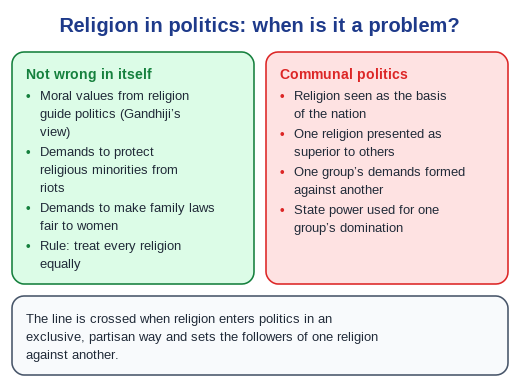
Many countries, India among them, have followers of different religions, and unlike gender differences, religious differences are often expressed in politics. The chapter shows that this is not always wrong, with three examples. Gandhiji held that ethics drawn from religion must guide politics, by which he meant the moral values that inform all religions, not any one religion. Human rights groups have asked the government to act to stop communal riots and to protect religious minorities. And the women’s movement has asked for the family laws of all religions to be made fair to women.
People may express their needs as members of a religious community, and governments may sometimes regulate religious practice to prevent discrimination. Such political acts are acceptable as long as they treat every religion equally.
What is communalism?
Trouble starts when religion is treated as the basis of the nation and used in politics in an exclusive, partisan way: when one religion is presented as superior, when one group’s demands are formed against another’s, and when state power is used for one group’s domination. This is communal politics.
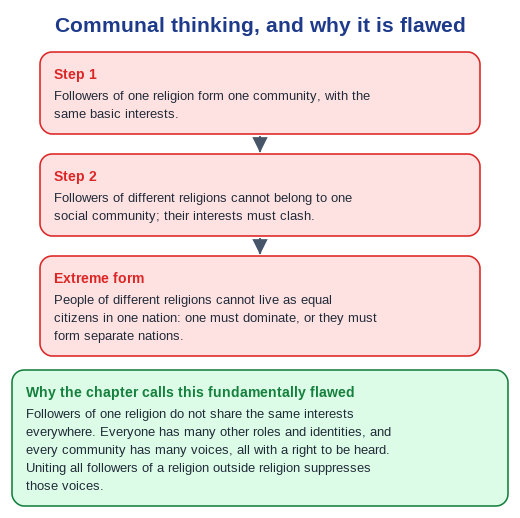
Communal thinking holds that the followers of one religion form one community with the same basic interests, and that followers of different religions cannot belong to one community. In its extreme form, it holds that they cannot live as equal citizens in one nation. The chapter calls this belief fundamentally flawed. People of one religion do not share the same interests everywhere; everyone has many roles and identities, and every community has many voices, all with a right to be heard.
What forms can communalism take?
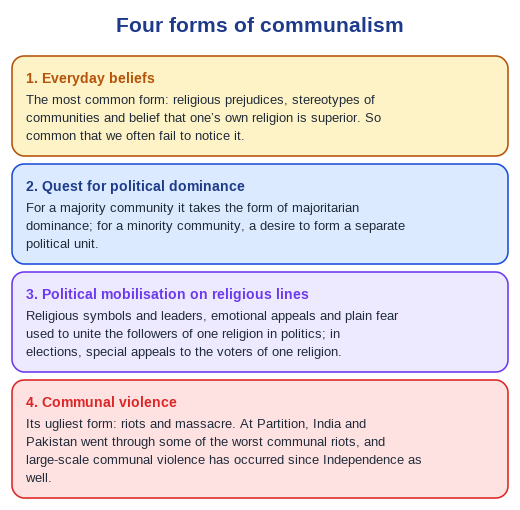
- Everyday beliefs: religious prejudices, stereotypes of communities and a belief that one’s own religion is superior. This is the most common form, so widespread that it often goes unnoticed.
- A quest for political dominance: for a majority community, majoritarian dominance; for a minority community, a desire to form a separate political unit.
- Political mobilisation on religious lines: religious symbols and leaders, emotional appeals and plain fear used to unite the followers of one religion, including special appeals to them in elections.
- Communal violence: riots and massacre, its ugliest form. At Partition, India and Pakistan went through some of the worst communal riots, and large-scale communal violence has occurred since Independence as well.
How does a secular state answer communalism?
The makers of the Constitution saw communalism as a major challenge to democracy, so they chose the model of a secular state. There is no official religion: unlike the status of Buddhism in Sri Lanka, Islam in Pakistan and Christianity in England, in the chapter’s examples, no religion has a special status. Everyone has the freedom to profess, practise and propagate any religion, or to follow none. Discrimination on grounds of religion is prohibited. And the state may intervene in religious matters to ensure equality within religious communities; the ban on untouchability is an example.
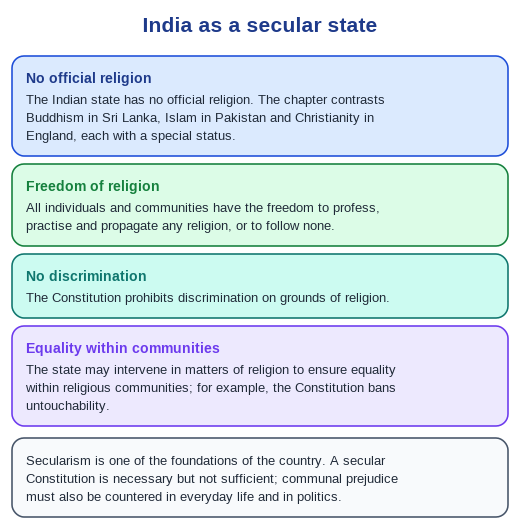
Secularism, the chapter says, is one of the foundations of the country, and communalism threatens the very idea of India. A secular Constitution is necessary but not sufficient: communal prejudice must also be countered in everyday life, and religion-based mobilisation in politics.
How does caste work in politics?
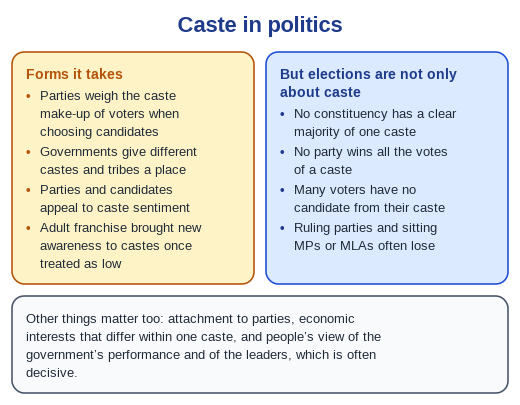
Casteism, like communalism, rests on the belief that caste alone makes a social community. Caste shows in politics in three ways. Parties choose candidates with the caste make-up of voters in mind, and governments give different castes and tribes a place. Parties and candidates appeal to caste sentiment. And universal adult franchise, with one person, one vote, made leaders seek people’s support and brought new consciousness to castes once treated as low.
But elections are not about caste alone. No constituency has a clear majority of one caste. No party wins all the votes of a caste; calling a caste a ‘vote bank’ usually means only that a large share of its voters back one party. Many voters have no candidate of their own caste. And ruling parties and sitting MPs and MLAs often lose. Attachment to parties, different economic interests within one caste, and people’s view of the government’s performance often decide the result.
What is politics in caste?
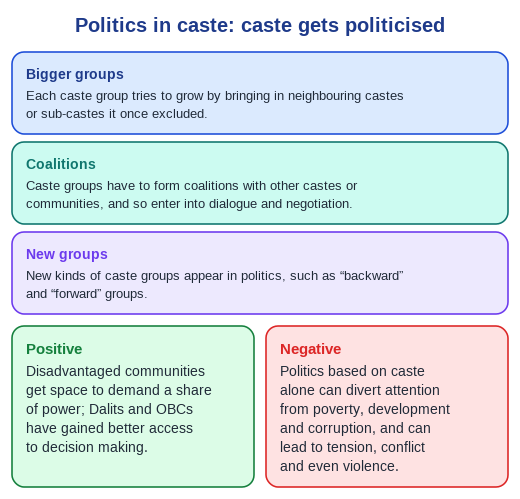
Politics also changes caste; in the chapter’s words, it is caste that gets politicised. Caste groups grow by taking in neighbouring castes or sub-castes, form coalitions and negotiate with others, and new groups such as ‘backward’ and ‘forward’ appear. This has given disadvantaged communities space to demand a share of power, and helped Dalits and OBCs gain better access to decision making. But politics based on caste identity alone can divert attention from poverty, development and corruption, and can lead to tension, conflict and even violence.
Read Caste inequalities in India for the caste system and the Census figures, go back to Gender and politics, or to the chapter notes and the NCERT solutions.
Practice
-
Which is the most common expression of communalism, according to the chapter?
Show answer
Answer: (b) Everyday beliefs, prejudices and stereotypes
-
The Constitution bans untouchability. This is an example of the state acting to:
Show answer
Answer: (b) ensure equality within religious communities
-
Which of these shows that caste alone does not decide elections?
Show answer
Answer: (b) No constituency has a clear majority of one caste
-
Why does the chapter call communal thinking fundamentally flawed?
Show answer
Answer: Because followers of one religion do not share the same interests and hopes in every situation. Each person also has other roles and identities, and every community holds many voices, each entitled to be heard. Bringing all followers of one religion together outside religion suppresses these voices.
-
What does the chapter mean by “politics in caste”?
Show answer
Answer: That politics also changes caste. Caste groups try to grow by bringing in neighbouring castes or sub-castes, they enter coalitions and negotiate with other castes and communities, and new kinds of groups such as ‘backward’ and ‘forward’ appear. It is caste that gets politicised, not politics that gets caste-ridden.
Questions students ask
What is communal politics?
Using religion in politics in exclusive and partisan terms: presenting one religion as superior to others, forming the demands of one religious group in opposition to another, or using state power to establish the domination of one religious group over the rest.
Is a secular Constitution enough to stop communalism?
No. The chapter calls it necessary but not sufficient. Communal prejudice and propaganda must also be fought in daily life, and mobilisation on religious lines must be resisted in politics.
What is meant by a caste being a ‘vote bank’?
The phrase is used when a large proportion of the voters of one caste vote for one party. The chapter stresses that no party gets every vote of a caste or community.
Stuck on a question?
Take a photo and Lagnever AI explains it step by step. Try it for 7 days for ₹2.
Get it on Google Play Open in browser
For parents: after the trial, the plan renews monthly by UPI or card autopay. You can cancel anytime in the app.