
Caste Inequalities in India
Answer in short
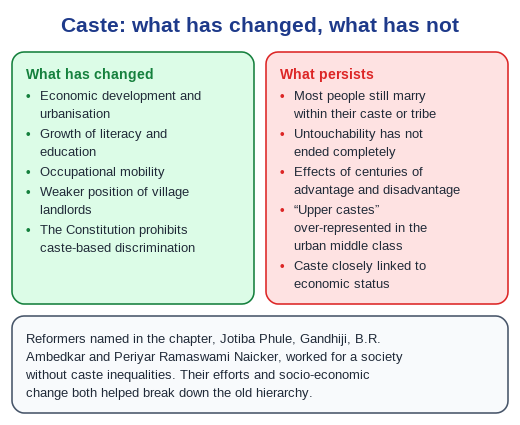
Caste is a division special to India, in which hereditary occupations were sanctioned by rituals and ‘outcaste’ groups faced untouchability. Reformers, the Constitution, education, urbanisation and occupational mobility have weakened the old hierarchy. Yet caste persists: most people marry within their caste, and caste is still closely linked to economic status and poverty.
Stuck on a question? Take a photo and Lagnever AI explains it step by step. Try it for 7 days for ₹2. Get it on Google Play
What makes caste different?
All societies have some social inequality and some division of labour, and in most, occupations pass from one generation to the next. The chapter calls the caste system an extreme form of this, and the caste division special to India. What sets it apart is that the hereditary division of occupations was sanctioned by rituals. Members of a caste were expected to follow the same or similar occupations, marry within the group, and not eat with members of other caste groups.
The system rested on shutting out the ‘outcaste’ groups and treating them unequally; they suffered the inhuman practice of untouchability. That is why political leaders and social reformers such as Jotiba Phule, Gandhiji, B.R. Ambedkar and Periyar Ramaswami Naicker worked for a society without caste inequalities.
What has changed, and what has not?
Partly because of their efforts and partly because of wider change, caste in modern India has changed a great deal. The old caste hierarchy is breaking down as the economy develops, cities grow (urbanisation), more people become literate and educated, people change occupations (occupational mobility) and village landlords lose their hold. In cities it hardly matters who walks beside us on the street or eats at the next table. The Constitution banned discrimination based on caste and set the base for policies to undo the caste system’s wrongs.
Yet caste has not disappeared. Most people still marry inside their own caste or tribe, and untouchability survives in places although the Constitution bans it. And the effects of centuries of advantage and disadvantage are still felt. Groups that could study under the old order did well in modern education too; those kept from it fell behind. So the ‘upper castes’ are disproportionately present in the urban middle class, and caste remains closely linked to economic status.
How big are the main social groups?
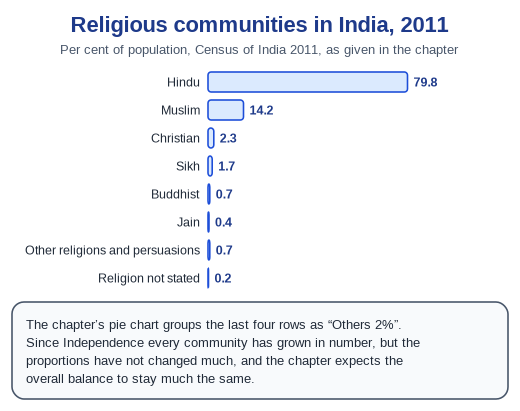
A box in the chapter, Social and Religious Diversity of India, explains that the Census records the religion of every person every ten years, exactly as each person describes it. Since Independence the share of each religious community has not changed much, and the chapter expects the overall balance to stay much the same.
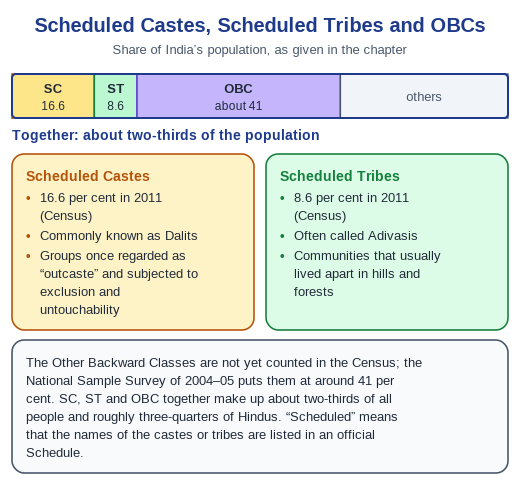
The Census also counts two social groups. The Scheduled Castes, commonly known as Dalits, include groups once regarded as ‘outcaste’ and subjected to exclusion and untouchability. The Scheduled Tribes, often called Adivasis, include communities that usually led a secluded life in hills and forests. In 2011 they were 16.6 and 8.6 per cent of the population. The Other Backward Classes are not yet counted in the Census; the National Sample Survey of 2004–05 estimates them at around 41 per cent. Together, these three groups make up about two-thirds of the population.
How is caste linked to poverty today?
A second box, Caste inequality today, explains that caste regulates access to resources. In earlier times the so-called ‘untouchable’ castes could not own land, and education was open only to the so-called ‘twice born’ castes. Such open inequality is now outlawed, but its effects continue, and new kinds of inequality have developed.
Today every caste has very rich and very poor members, which was very rare twenty or thirty years ago. Still, evidence from the National Sample Survey shows three patterns. The average economic status of caste groups follows the old hierarchy: the ‘upper’ castes are the most well off, Dalits and Adivasis the least, and the backward classes in between. Extreme poverty is far more common among the lowest castes than among the upper castes. And among the rich, the upper castes far exceed their share of the population.
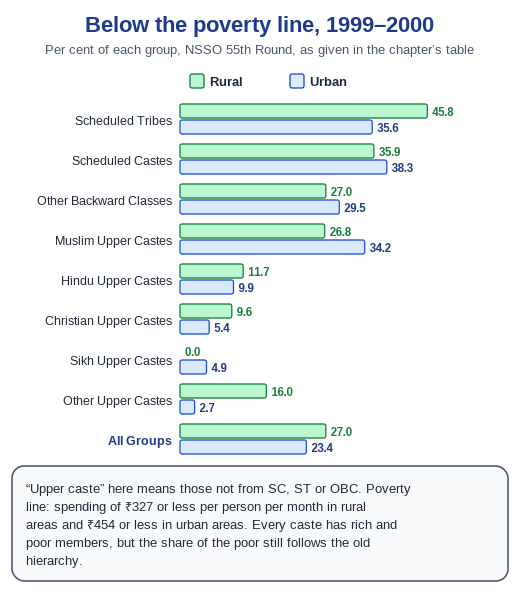
The chapter’s table shows this for 1999–2000: 45.8 per cent of Scheduled Tribes and 35.9 per cent of Scheduled Castes in rural areas lived below the poverty line, against 27.0 per cent of all groups. These inequalities explain why caste still matters in politics. Read Religion, communalism and caste in politics, go back to Gender and politics, or to the chapter notes and the NCERT solutions.
Practice
-
In the caste system, hereditary occupational division was sanctioned by:
Show answer
Answer: (b) rituals
-
The Scheduled Tribes are often referred to as:
Show answer
Answer: (b) Adivasis
-
According to the chapter’s table, what share of rural Scheduled Tribes lived below the poverty line in 1999–2000?
Show answer
Answer: (d) 45.8 per cent
-
Name three changes that have weakened the old caste hierarchy.
Show answer
Answer: Any three of: a developing economy, the growth of cities (urbanisation), wider literacy and education, people moving into new occupations (occupational mobility), and village landlords losing their hold. The Constitution’s ban on caste discrimination also opened the way for policies against its wrongs.
-
Why are the ‘upper castes’ disproportionately present in the urban middle class?
Show answer
Answer: Groups that could get education under the old order did well in modern education too, while those kept from it fell behind. The effects of centuries of advantage and disadvantage continue to be felt.
Questions students ask
Why are they called Scheduled Castes and Scheduled Tribes?
Each group covers hundreds of castes or tribes named in an official list, the Schedule, which gives them the name ‘Scheduled’. The Scheduled Castes are commonly known as Dalits, and the Scheduled Tribes are often called Adivasis.
Is caste still linked to poverty?
Yes, says the chapter’s evidence from the National Sample Survey. Every caste has rich and poor members, but the average economic status of caste groups follows the old hierarchy, and far more of the lowest castes than of the upper castes live below the poverty line.
Will the population balance of religious communities change greatly?
The chapter says no. Proportions have not changed much since Independence, and expert estimates for the Sachar Committee expect only a small change, of about 3 to 4 per cent, in one community’s share over the next 50 years.
Stuck on a question?
Take a photo and Lagnever AI explains it step by step. Try it for 7 days for ₹2.
Get it on Google Play Open in browser
For parents: after the trial, the plan renews monthly by UPI or card autopay. You can cancel anytime in the app.