
Gender and Politics
Answer in short
Gender division rests on social expectations, not biology: housework is treated as women’s unpaid work, which keeps women out of public life. Women’s movements made it political. Indian women still lag in literacy, pay and representation, but one-third of local body seats are reserved for them, and the Women’s Reservation Act, 2023 will give 33 per cent in legislatures.
Stuck on a question? Take a photo and Lagnever AI explains it step by step. Try it for 7 days for ₹2. Get it on Google Play
What is the gender division?
The chapter begins its study of social divisions with gender. It describes gender as a hierarchical division: one that ranks people, not just sorts them. It is found everywhere, yet it is rarely recognised in the study of politics. People often take it to be natural and fixed. The chapter says otherwise: the gender division rests not on biology but on social expectations and stereotypes, the ideas a society holds about what men and women should do.
What is the public/private division?
From childhood, boys and girls are taught that a woman’s main job is housework and bringing up children. The result, in most families, is a sexual division of labour: women do the work inside the home (cooking, cleaning, washing clothes, tailoring, looking after children) and men do the work outside it.
This is not about ability. Men can do housework; they think it is for women to do, yet when such jobs are paid, as for tailors or hotel cooks, men take them up. Nor do women stay at home: they fetch water and work in fields in villages, and work as domestic helpers or in offices in towns. But their work is not valued and gets little recognition.
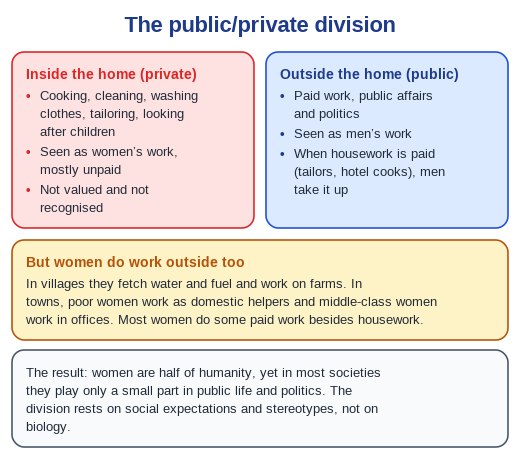
The outcome is that women, though half of humanity, have only a small role in public life, and especially in politics, in most societies.
How did women make gender a political issue?
At first, only men could take part in public affairs, vote and stand for office. Women in many countries organised and agitated for equal rights, beginning with the vote, and for better legal status, education and careers. The more radical feminist movements went further and sought equality in personal and family life as well. A feminist is a woman or a man who believes in equal rights and opportunities for women and men.
This helped. Women now work as scientists, doctors, engineers, lawyers, managers and university teachers, jobs once thought unsuitable for them. In Sweden, Norway and Finland, women take a very large part in public life.
How do women still lag behind in India?
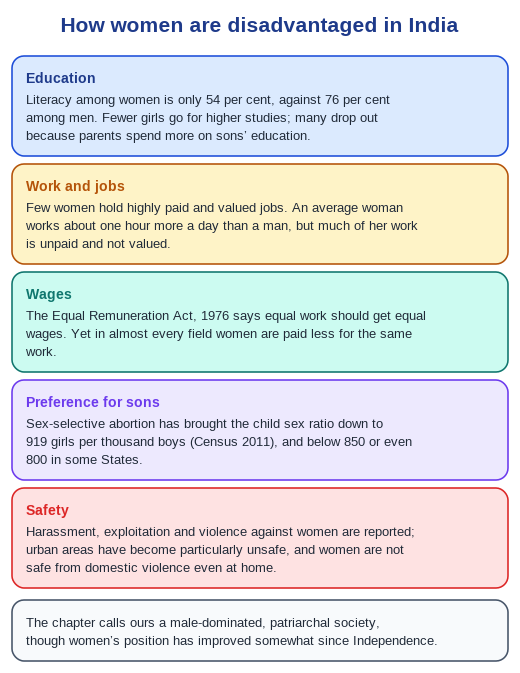
Women’s position has improved since Independence, but the chapter still calls Indian society male-dominated and patriarchal.
- Education. Only 54 per cent of women can read and write, against 76 per cent of men. Girls do as well as boys in school results, and in some places better, yet fewer go on to higher studies; many drop out because parents spend more on their sons’ education.
- Jobs and unpaid work. Few women hold highly paid and valued jobs. An average Indian woman works about one hour more every day than an average man, but much of her work is unpaid and so not valued.
- Wages. The Equal Remuneration Act, 1976 provides that equal work should get equal wages. In practice, whether in sport, films, factories or farms, women earn less than men even for identical work.
- Preference for sons. In many parts of India parents prefer sons, and sex-selective abortion of girls has reduced the child sex ratio (girls per thousand boys) to just 919. In some States it has fallen below 850, or even 800.
- Safety. Harassment, exploitation and violence against women are widely reported. Cities in particular have become unsafe for them, and many women face beating and other domestic violence even at home.
What did the time use survey show?
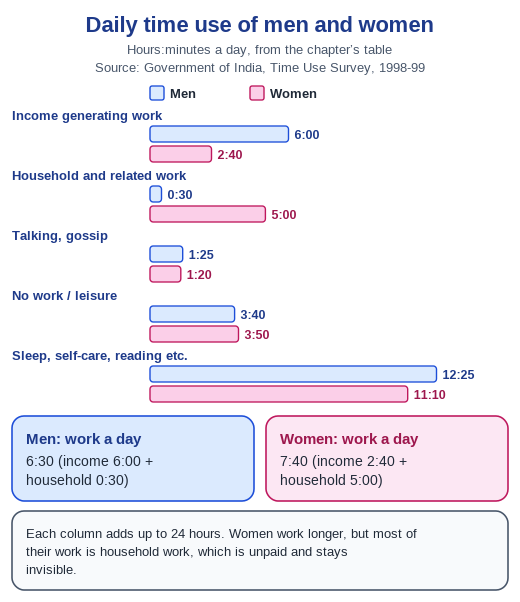
An activity box reports a time use survey in six States: an average woman works a little over seven and a half hours a day, an average man six and a half. Men’s work is more visible because most of it earns an income; most of women’s work is household work, unpaid and invisible.
How well are women represented in India’s legislatures?
Many feminists concluded that women’s problems will stay neglected until women themselves share in power, and that electing more women is one way to get there.
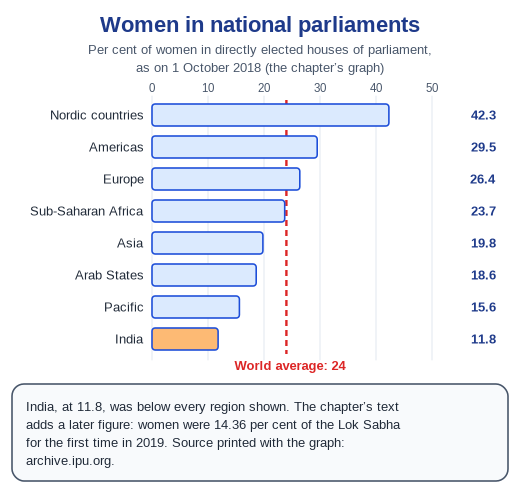
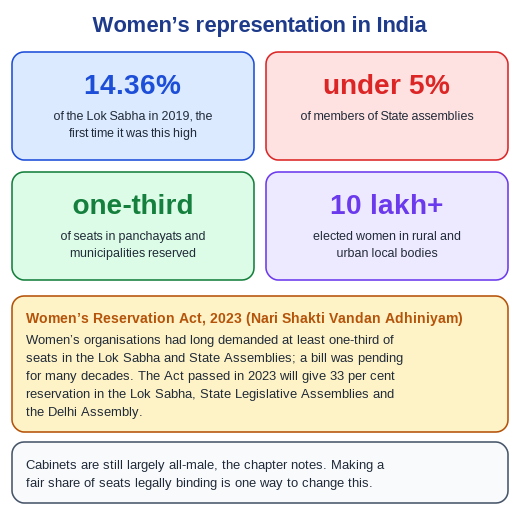
India’s record here is poor. Women made up 14.36 per cent of the Lok Sabha for the first time in 2019. In State assemblies, their share is less than 5 per cent. The chapter’s graph, with figures as on 1 October 2018, shows India at 11.8 per cent, below every region of the world and well under the world average of 24 per cent. Cabinets, too, are largely all-male.
How is the gap being closed?
One remedy is to make it legally binding for elected bodies to have a fair proportion of women. Panchayati raj in India has done this: a third of all seats in panchayats and municipalities is reserved for women, and over 10 lakh women now sit as elected members of village and town bodies.
A bill for a similar reservation in the Lok Sabha and State Assemblies was pending for many decades. In 2023, the Nari Shakti Vandan Adhiniyam (Women’s Reservation Act, 2023) was passed. The chapter says it will give 33 per cent reservation of seats for women in the Lok Sabha, the State Legislative Assemblies and the Delhi Assembly.
What does gender teach us about social divisions?
The chapter’s lesson: some social divisions need to be expressed in politics, and disadvantaged groups gain when their unequal treatment becomes a political issue. Read Religion, communalism and caste in politics, or go back to the chapter notes and the NCERT solutions.
Practice
-
A person who believes in equal rights and opportunities for women and men is called a:
Show answer
Answer: (b) feminist
-
According to the chapter, in which countries is women’s participation in public life very high?
Show answer
Answer: (a) Sweden, Norway and Finland
-
What share of seats in panchayats and municipalities is reserved for women?
Show answer
Answer: (b) One-third
-
What does the Equal Remuneration Act, 1976 provide?
Show answer
Answer: Equal pay for equal work. The chapter notes that women still earn less than men for identical work in nearly every field, from sport and films to factories and farms.
-
Why did women’s movements demand more women in elected bodies?
Show answer
Answer: Women’s well-being was not getting enough attention. Many feminists concluded that women’s problems will stay neglected until women themselves share in power, and that electing more women is one way to achieve this.
Questions students ask
What is the sexual division of labour?
It is a system in which all work inside the home is either done by the women of the family or organised by them through domestic helpers. Men do the work outside the home. When household jobs are paid, as for tailors or hotel cooks, men take them up.
Why is household work discussed in a Political Science textbook?
The chapter answers with a question of its own: if politics is about power, then male dominance in the household should also be considered political. Who does unpaid work at home affects who gets time, money and a voice in public life.
What is patriarchy?
Literally, rule by the father. The chapter uses it for a system that values men more and gives them power over women, and calls Indian society still male-dominated and patriarchal.
Stuck on a question?
Take a photo and Lagnever AI explains it step by step. Try it for 7 days for ₹2.
Get it on Google Play Open in browser
For parents: after the trial, the plan renews monthly by UPI or card autopay. You can cancel anytime in the app.