
Class 10 Political Science Chapter 2: Federalism Notes
This chapter in five lines
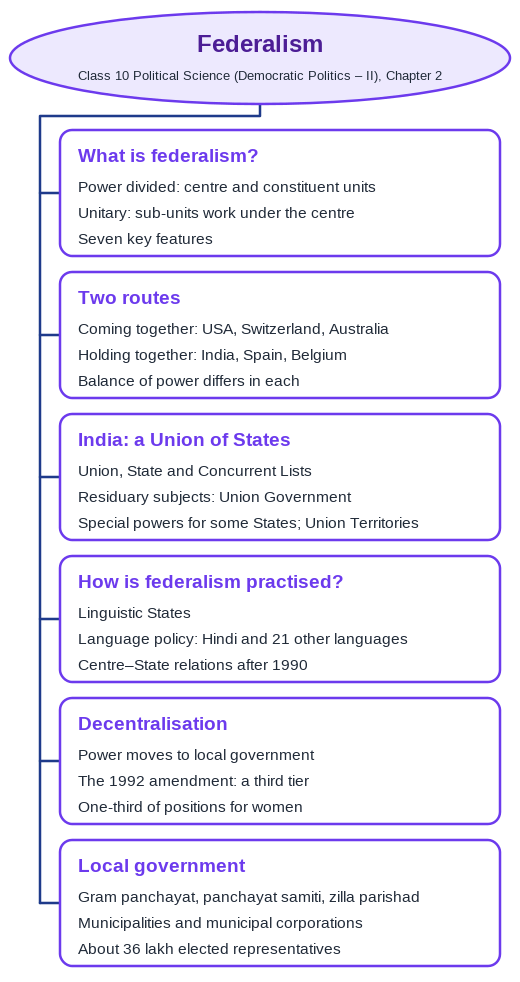
Federalism divides power between a central authority and the constituent units of a country, each with powers of its own under the constitution. India is a holding-together federation: the Union and the States share power through three lists. Linguistic States, a flexible language policy and changed Centre–State relations made it work, and the 1992 amendment added local government as a third tier.
What is this chapter about?
Think of how your school runs. The principal decides matters for the whole school, such as the timetable and the examination dates. Your class teacher decides matters for your class, such as the seating plan. Neither does the other’s job, and both follow the same school rules. A country can share power in a similar way, between a government for the whole country and governments for its parts. Chapter 1 called this the vertical division of power. Chapter 2 of Democratic Politics – II gives it its usual name, federalism, and asks four questions: what federalism is, what makes India a federal country, how federalism is practised here, and how power reaches the village and the town.
What is federalism?
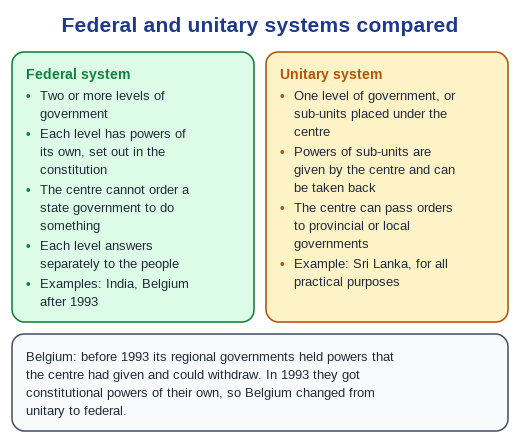
Federalism is a system of government in which power is divided between a central authority and the constituent units of the country. A federation usually has two levels of government: one for the whole country, which looks after a few subjects of common national interest, and governments of provinces or states, which do much of the day-to-day administration. Both levels hold their powers independently of each other.
The opposite is a unitary system, with only one level of government, or with sub-units that work under the centre. A unitary centre can pass orders to its provinces. A federal centre cannot order a state government to do something, because the state has powers of its own, and both governments answer separately to the people. Belgium became federal in 1993, when its regional governments got constitutional powers; Sri Lanka remains unitary for all practical purposes.
What are the key features of federalism?
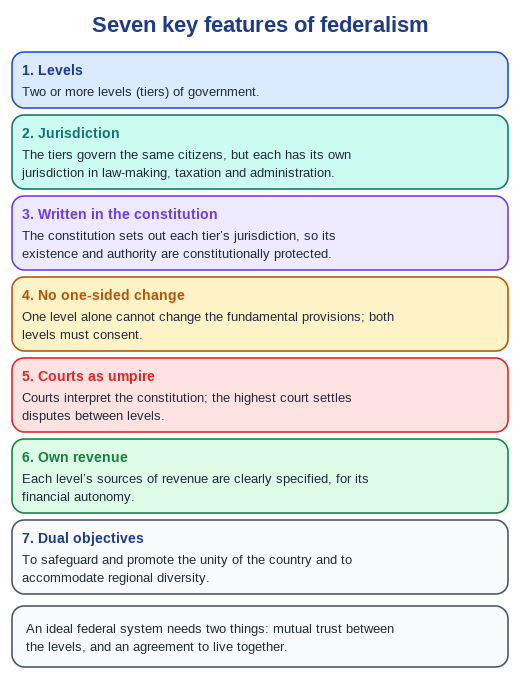
The chapter lists seven. There are two or more tiers of government. The tiers govern the same citizens, but each has its own jurisdiction in making laws, taxing and administering. The constitution sets out these jurisdictions, so each tier’s existence and authority are protected by it. One level cannot change the fundamental provisions alone. Courts interpret the constitution, and the highest court acts as an umpire. Each level has its own sources of revenue. And the system has two aims at once: to keep the country united and to make room for regional diversity.
How are federations formed?
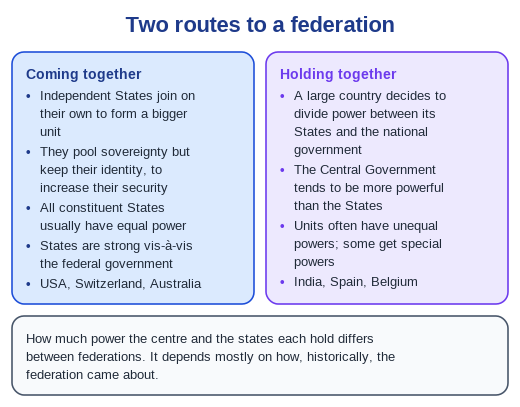
By two routes. In a coming-together federation, independent States join by choice to make a larger unit, as in the USA, Switzerland and Australia; the States are usually equal in power and strong compared with the federal government. In a holding-together federation, a large country divides its power between its States and the national government, as in India, Spain and Belgium; the centre tends to be stronger, and units often have unequal powers. Read What makes India a federal country?
What makes India a federal country?
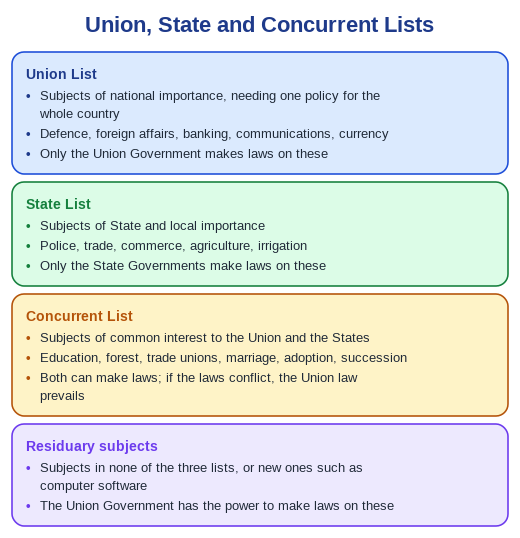
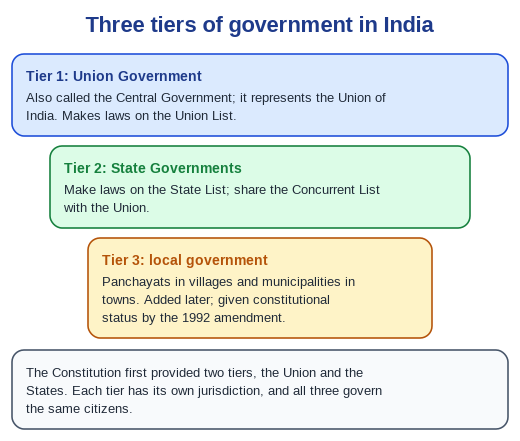
The Constitution declared India a Union of States. It does not use the word federation, yet all seven features apply to it. It first provided two tiers, the Union (or Central) Government and the State governments; a third tier, panchayats and municipalities, was added later. Law-making powers are divided into three lists. The Union List holds subjects of national importance, such as defence, foreign affairs, banking, communications and currency. The State List holds matters of State and local importance: police, trade, commerce, agriculture and irrigation, for example. The Concurrent List holds subjects of common interest, such as education, forest, trade unions, marriage, adoption and succession; if a Union law and a State law on these conflict, the Union law prevails. Subjects in no list, the residuary subjects, go to the Union.
Not every unit has the same powers. Some States, such as Assam, Nagaland, Arunachal Pradesh and Mizoram, have special powers under Article 371. Union Territories, like Chandigarh, Lakshadweep or the capital city of Delhi, have very little power. The whole arrangement is hard to change: a change needs a two-thirds majority in both Houses of Parliament and then ratification by the legislatures of at least half the States.
How is federalism practised?
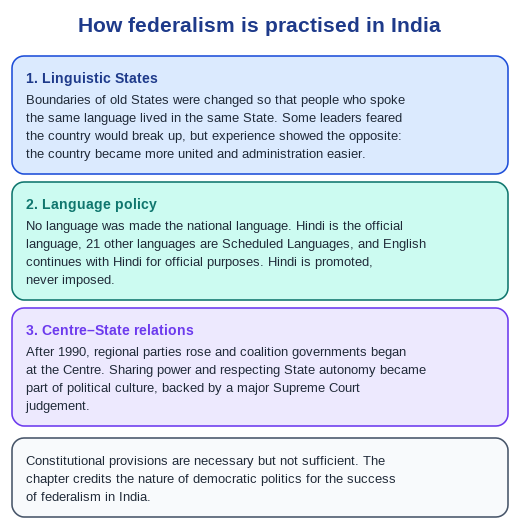
The chapter says constitutional provisions are necessary but not enough: federalism succeeded in India because of the nature of its democratic politics. Three things show this. Linguistic States were created so that people who spoke the same language lived in the same State; some leaders feared this would break up the country, but it made the country more united. The language policy gave no language the status of national language: Hindi is the official language, 21 other languages are Scheduled Languages, and English continues alongside Hindi. And Centre–State relations changed after 1990, when regional parties rose and coalition governments began at the Centre. Read How is federalism practised in India?
How diverse are India’s languages?
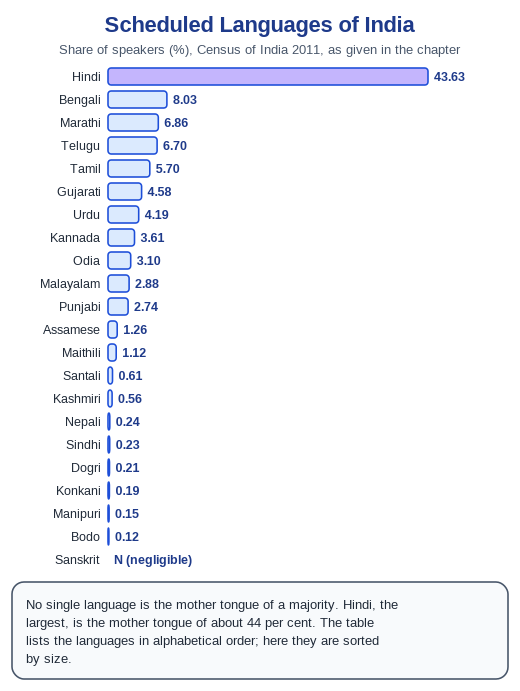
The chapter’s box on linguistic diversity uses the Census of India 2011. People named more than 1300 distinct languages as their mother tongues. Grouped together, these made 121 major languages, of which 22 are Scheduled Languages. No language is the mother tongue of a majority: Hindi, the largest, is the mother tongue of about 44 per cent. (The main text of the chapter says “about 40 per cent”; the Census box gives the later figure.)
What is decentralisation?
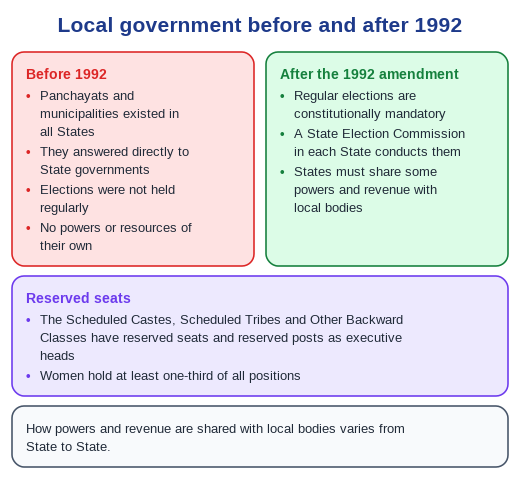
Two tiers are not enough for a vast country. Many Indian States match whole European countries in size, and many are very varied inside. Shifting power from the Central and State governments to local government is called decentralisation. Local people know local problems, and at this level they can take part in decisions directly. Before 1992, local bodies were under State control, elections were irregular and they had no powers or resources of their own. The 1992 amendment made regular elections mandatory, reserved seats (including at least one-third of all positions for women), created State Election Commissions and required States to share some powers and revenue. Read Decentralisation in India
How is local government organised?
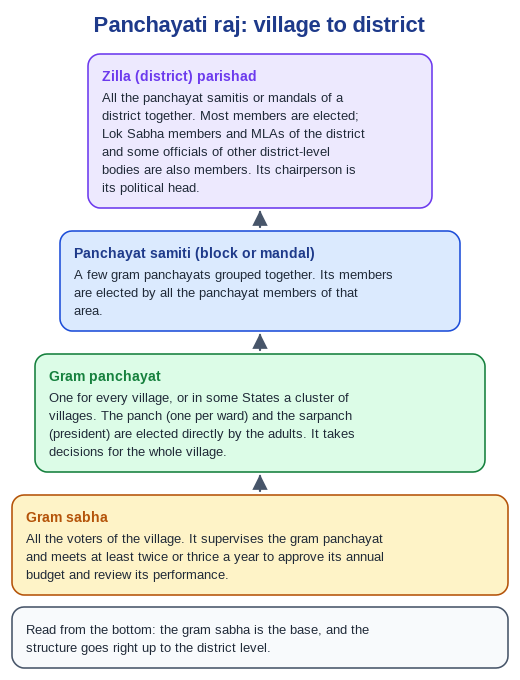
In villages it is called panchayati raj. A gram panchayat, with its panch and sarpanch, works under the gram sabha of all the voters. Gram panchayats are grouped into a panchayat samiti, and the samitis of a district form the zilla parishad. Towns have municipalities, headed by a municipal chairperson, and big cities have municipal corporations, headed by a mayor. The chapter counts about 36 lakh elected representatives in these bodies, yet notes that most States have not handed them significant powers or adequate resources.
Before we move on
This chapter completes Unit I, on power sharing. For the idea it grows from, go back to Chapter 1, Power-sharing and its forms of power sharing. The next chapter of the book, Gender, Religion and Caste, looks at how democracy handles social differences. Answers to every exercise and to the activities inside this chapter are in the NCERT solutions for Chapter 2.
Key terms
| Term | Meaning |
|---|---|
| Federalism | A system of government in which power is divided between a central authority and the various constituent units of the country. |
| Unitary system | A system with a single level of government, or one whose sub-units work under the central government. |
| Jurisdiction | The field in which a person or body holds legal authority; it may be marked out by geography or by kinds of subjects. |
| Coming-together federation | A federation formed when independent States join on their own to make a bigger unit, as in the USA, Switzerland and Australia. |
| Holding-together federation | A federation formed when a large country divides its power between its States and the national government, as in India, Spain and Belgium. |
| Union List | Subjects of national importance, such as defence, foreign affairs, banking, communications and currency; only the Union Government makes laws on them. |
| State List | Matters of State and local importance (police, trade, commerce, agriculture, irrigation); only the State Governments make laws on them. |
| Concurrent List | Subjects of common interest, such as education, forest, trade unions, marriage, adoption and succession; both levels make laws, and the Union law prevails in a conflict. |
| Residuary subjects | Subjects that fall in none of the three lists, such as computer software; the Union Government has the power to make laws on them. |
| Union Territories | Areas too small to become an independent State that could not be merged with an existing State; the Central Government has a special role in running them. |
| Scheduled Languages | The 22 languages, Hindi and 21 others, included in the Eighth Schedule of the Constitution. |
| Coalition government | A government formed when at least two political parties come together, usually as an alliance with a common programme. |
| Decentralisation | Taking power away from the Central and State governments and giving it to local government. |
| Gram sabha | The body of all the voters of a village; it supervises the gram panchayat, approves its annual budget and reviews its performance. |
| Panchayati raj | The popular name for rural local government: the gram panchayat, the panchayat samiti (block or mandal) and the zilla parishad. |
Topics in this chapter
Practice
-
Which of these is a coming-together federation?
Show answer
Answer: (d) Switzerland
-
Who can make laws on a subject in the Concurrent List?
Show answer
Answer: (c) Both the Union and the State Governments
-
Laws on residuary subjects, such as computer software, are made by:
Show answer
Answer: (a) the Union Government
-
Besides Hindi, how many languages does the Constitution recognise as Scheduled Languages?
Show answer
Answer: (c) 21
-
In which year was the Constitution amended to make the third tier more powerful and effective?
Show answer
Answer: (d) 1992
-
The political head of a municipal corporation is called the:
Show answer
Answer: (b) mayor
Questions students ask
What are the main topics of Class 10 Political Science Chapter 2?
What federalism is and its seven features; the two routes by which federations form; what makes India a federal country (the three lists, residuary subjects, special provisions and Union Territories); how federalism is practised (linguistic States, language policy, Centre–State relations); and decentralisation, with panchayati raj and urban local bodies.
Is Federalism in the 2026-27 NCERT book?
Yes. It is Chapter 2 of Democratic Politics – II, the Class 10 Political Science textbook marked Reprint 2026-27, on pages 13 to 28. These notes follow the copy of the book now on NCERT’s website.
Is India a federation if the Constitution never uses the word?
Yes, in the chapter’s view. The Constitution declared India a Union of States and did not use the word federation, but the chapter says the Union works on federal principles: all seven features of federalism apply to its provisions.
Is Hindi the national language of India?
No. The chapter says the Constitution made no language the national language. Hindi became the official language, and 21 other languages are also recognised as Scheduled Languages.
Stuck on a question?
Take a photo and Lagnever AI explains it step by step. Try it for 7 days for ₹2.
Get it on Google Play Open in browser
For parents: after the trial, the plan renews monthly by UPI or card autopay. You can cancel anytime in the app.