
NCERT Solutions Class 10 Political Science Chapter 2: Federalism
Answers to all twelve exercises of Chapter 2, Federalism, of Democratic Politics – II, the Class 10 Political Science textbook, and to every activity, cartoon question and thought bubble inside the chapter. Page numbers follow the 2026-27 reprint (pages 13–28). The exercises are quoted from the book; the questions inside the chapter are restated in short, in our own words. Map questions are answered in words, without maps, and the cartoons are described in general terms, not reproduced. Facts that are not in the chapter are marked “Extra”. Short notes: Chapter 2 notes.
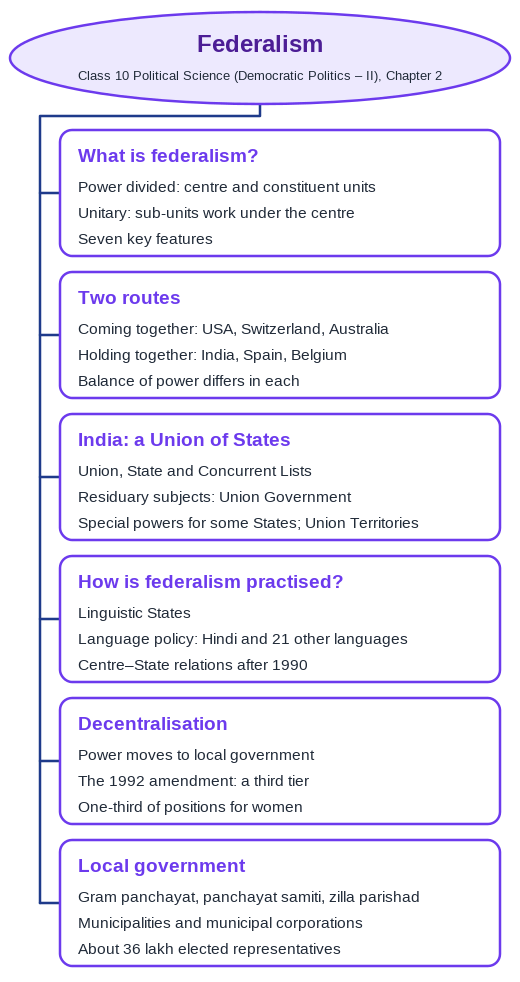
Activities and questions inside the chapter (pages 14–26)
Thought bubble, page 14: a student is confused about what to call the Indian government: Union, Federal or Central? All three point to the same government, the one for the whole country. The Constitution’s own term is the Union Government, because India is a Union of States. In everyday use it is called the Central Government, as the chapter itself says on page 16. “Federal government” is the general word for the national government of any federation; the chapter uses it for countries like the USA.
Map question, page 14: most large countries are federations. Which exception shows on the chapter’s world map? China. It is one of the largest countries on the map but is not shaded as a federal political system. (Extra: China has a unitary system of government.) The shaded large countries include Russia, Canada, the USA, Brazil, Australia, India and Argentina.
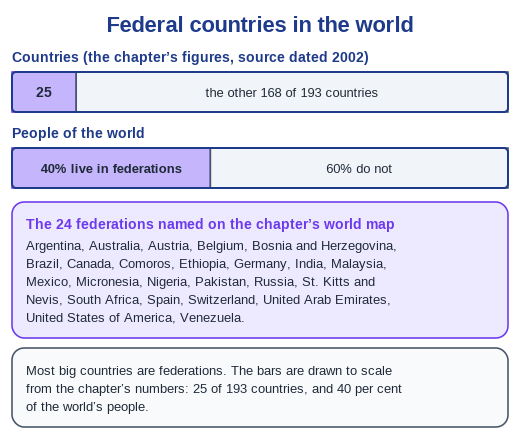
Thought bubble, page 15: a student asks why small Belgium chose federalism, if it suits only big countries. Because federalism is not only about size. Its purpose is to keep a country united while making room for regional diversity. Belgium is small but has distinct language communities and regions, as Chapter 1 showed, so it gave its regional governments constitutional powers in 1993. Big countries are often federations because they tend to be diverse; a small, diverse country can need federalism just as much.
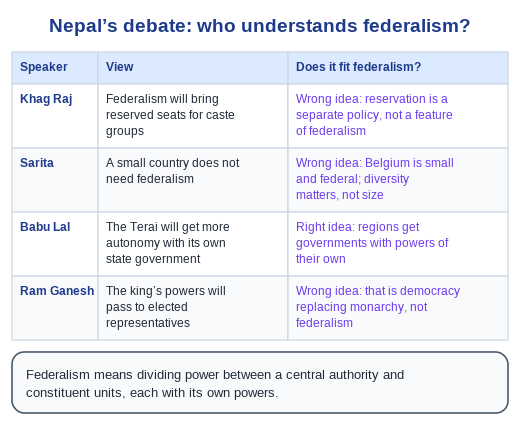
Let us revise, page 16: four Nepalese citizens give their views on adopting federalism. How would you reply to each, and which views show a wrong understanding of federalism?
- Khag Raj (federalism would bring reserved seats for caste groups, as in India): wrong understanding. Reservation of seats is a separate policy. Federalism is about dividing power between levels of government; a federal country may or may not have reservations.
- Sarita (the country is not very big, so it does not need federalism): wrong understanding. Size is not the test. Belgium is small and federal. What matters is whether regions and communities need governments with powers of their own.
- Babu Lal (the Terai areas will get more autonomy with their own state government): right understanding. A state government with constitutional powers of its own is exactly what federalism offers a region.
- Ram Ganesh (powers once held by the king will pass to elected representatives): wrong understanding. That describes a move from monarchy to democracy. A democracy can be unitary; federalism is about how power is divided between levels.
Thought bubble, page 16: the Constitution does not use the word “federation”. Were its makers unaware of the idea, or were they keeping away from the word? They knew it well: the Constitution they wrote has every feature of a federation, from the three lists to the role of the courts. The chapter gives the background. India became independent after a painful and bloody partition, and soon afterwards the princely states joined the country. Against that background the Constitution described India as a “Union of States”, a phrase that stresses unity, while building the Union on federal principles.
Thought bubble, page 17: the Union cabinet has ministers for agriculture and for commerce, though both are State subjects. Why? The chapter leaves this as a question to think about. A reasonable answer: a subject in the State List does not stop the Union from doing related work that falls in its own lists. (Extra: trade with other countries and trade between States are Union subjects, so a Union commerce ministry handles them; the Union agriculture ministry deals with matters such as national policy, research and funds that support the States’ work.) The States still make the laws on agriculture and on trade within the State.
Let us listen to radio, page 17: every day for a week, hear a national and a regional bulletin of All India Radio, and sort the news about government policies or decisions into three groups. This is an activity. A table to fill: date; news item; group. The three groups: (1) only the Central Government, such as news on defence, foreign affairs, banking or currency; (2) only your State or another State Government, such as news on police, agriculture or irrigation; (3) dealings between the Centre and the States, such as funds shared with States, a meeting of the Prime Minister with Chief Ministers, or a dispute about who decides a matter. What to notice: which list each item’s subject belongs to, and how often the two levels have to work together.
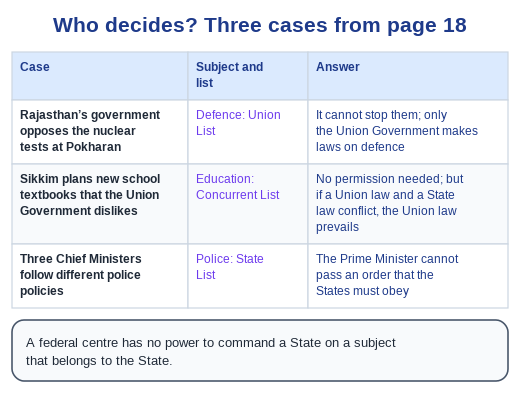
Let us revise, page 18: three imagined cases.
- Could the Government of Rajasthan, if it opposed the Central Government’s nuclear policy, stop the nuclear tests at Pokharan? No. Defence is in the Union List, and only the Union Government makes laws and policy on it. Where the test site lies does not matter.
- Sikkim plans new school textbooks, and the Union Government dislikes their style and content. Does Sikkim need the Union’s permission? No. Education is in the Concurrent List, so the State may act on it without asking permission. Only if a Union law and a State law on the matter conflicted would the Union law prevail.
- Andhra Pradesh, Chhattisgarh and Orissa each have their own policy for how the State police deals with the naxalites. May the Prime Minister step in with one order binding on all three Chief Ministers? No. Police is in the State List. A federal centre has no power to command a State on a State subject; it can advise and coordinate. (Extra: Orissa is now called Odisha.)
Questions with the maps, page 19: has your village, town or city stayed in the same State since Independence? Which three States of 1947 have had their names changed? Which three States were carved out of bigger States? The first part depends on where you live: ask older family members or your teacher which State or province your area belonged to in 1947. Names changed: the book’s 1947 map shows names such as Madras, Mysore, the United Provinces and Orissa. (Extra: the United Provinces became Uttar Pradesh in 1950, Madras State became Tamil Nadu in 1969, Mysore became Karnataka in 1973, and Orissa became Odisha in 2011.) Carved out of bigger States: the chapter names Uttarakhand and Jharkhand as newer States. (Extra: Uttarakhand was carved out of Uttar Pradesh, Jharkhand out of Bihar and Chhattisgarh out of Madhya Pradesh, all in 2000; Telangana was carved out of Andhra Pradesh in 2014.)
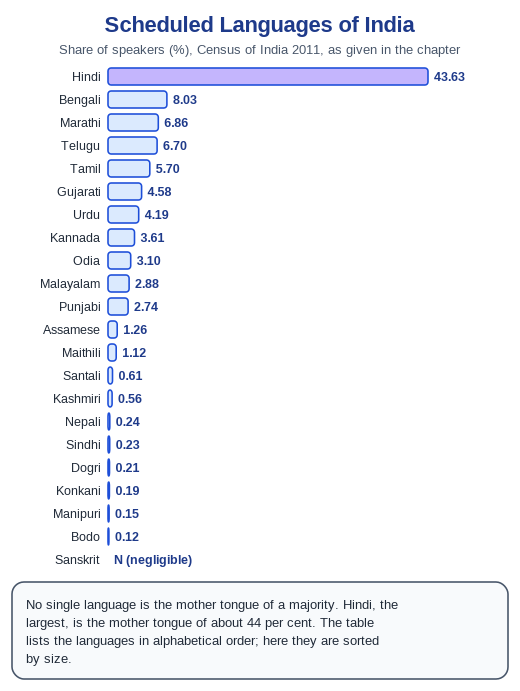
Thought bubble, page 20: a student wonders why Hindi was picked and not, say, Bangla or Telugu. Hindi was chosen as the official language because it had more speakers than any other language, though only about 40 per cent of Indians have it as their mother tongue, the chapter says. But it was not made the national language, and no language was. Bangla, Telugu and other languages are Scheduled Languages, are official languages in their own States, and can be used in Central Government examinations. So the choice of Hindi did not push the others out.
Cartoons, page 21: must a State beg the Centre for its share? And how does the head of a coalition keep every partner content? The first cartoon shows State leaders standing in a queue with bowls, asking for a share from a pot marked as the powers of the States. In a true federation this should not be needed: States get their powers and their sources of revenue from the Constitution, not as a favour from the Centre, and they are not its subordinates. The second cartoon shows the head of a coalition government sitting uneasily, held up by partners any of whom could cause trouble. A coalition leader keeps partners together by agreeing on a common programme, consulting them before big decisions, giving each a share in government, and respecting the autonomy of the States that regional partners come from.
Thought bubble, page 21: is regionalism really good for democracy? The chapter does not praise regionalism for its own sake. It makes a narrower point: when regional parties grew and coalition governments began after 1990, the Centre had to share power and respect the autonomy of State Governments, and that strengthened federalism. Regional voices help democracy when they bring a region’s needs into national decisions. They would harm it if they set regions against one another or against the unity of the country, which federalism is also meant to protect.
Box on linguistic diversity, page 22: make a bar or pie chart from the table; prepare a map of linguistic diversity; find three languages spoken in India that are not in the table. Chart: a bar chart of the table is drawn below, with the languages sorted by share. For a pie chart, give Hindi 43.63 per cent and group the small languages, since many slices would be too thin to see. The 21 figures in the table add up to 96.71 per cent; the rest is Sanskrit (negligible) and the non-Scheduled languages. Map: this needs an outline map from your teacher. Shade each language where it is mainly spoken, for example Bengali in the east, Marathi and Gujarati in the west, Tamil, Telugu, Kannada and Malayalam in the south and Hindi across much of the north and centre (Extra). Three languages not in the table: the chapter itself names Bhojpuri, Magadhi, Bundelkhandi, Chhattisgarhi and Rajasthani, which the Census grouped under Hindi. (Extra: non-Scheduled languages include Bhili, Gondi and Tulu.)
Let us revise, page 23: read the excerpts from a historian’s newspaper article of 1 November 2006 on linguistic States, then write a short note for or against his argument, using your own State or another State affected by linguistic reorganisation. The argument, in short: when the States Reorganisation Commission’s report was implemented on 1 November 1956, some leaders feared that States based on language would lead to more divisions, as faith had led to partition. The author, Ramachandra Guha, argues that the opposite happened: people found that they could belong to their language group and to India at once, and although such States sometimes quarrel, ignoring language could have been far worse. A sample note in favour: take Karnataka. (Extra: it was formed in 1956 by bringing Kannada-speaking areas of several older States together, and was called Mysore until 1973.) People there can deal with their government, courts and schools in Kannada, which makes administration easier, as the chapter says of linguistic States in general. Their pride in Kannada has not weakened their sense of being Indian. If you write against: you could point to disputes between neighbouring States, for example over borders or river water, and to the difficulties of people who speak a minority language within a State. Whichever side you take, give one example and one reason.
Thought bubble, page 24: a student compares the system to a train’s three-tier coach. It is a joke that helps you remember the count. Indian federalism has three tiers: the Union Government, the State Governments and local government. Unlike berths in a coach, the tiers are not ranked by comfort. Each has its own work, and the “lower berth”, local government, is the one nearest to the people.
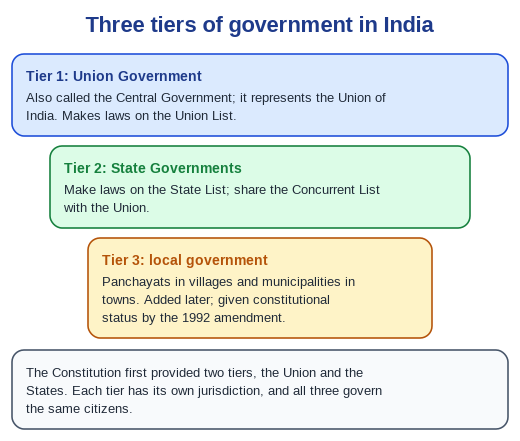
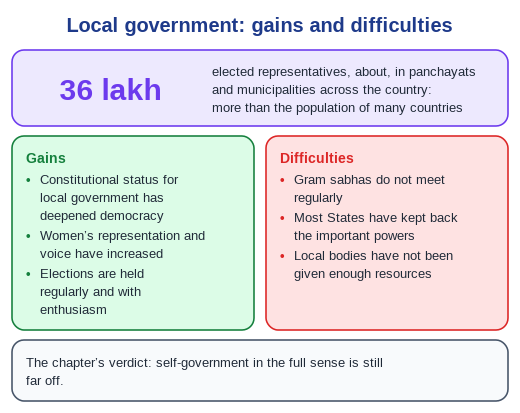
Thought bubble, page 25: the Prime Minister runs the country and the Chief Minister the State, so why does the D.M. or Collector, and not the zilla parishad chairperson, administer the district? The chapter leaves this open, but it gives the clue: most States have handed local governments neither real powers nor enough resources. The chairperson is the political head of the zilla parishad, an elected body with limited powers. (Extra: the District Magistrate or Collector is an officer appointed by the State government to run the district’s administration, such as law and order and land records.) The bubble’s point is that decentralisation is incomplete: if it went further, elected district bodies would decide more.
Newspaper clippings, page 25: what do they say about efforts at decentralisation in India? They show a mixed picture. Some headlines report gains: a very large number of women have been elected to panchayats, women heads of panchayats are bringing change, and a Bill proposes low-cost justice at the village level. Others report problems: panchayat posts being auctioned to the highest bidder in some places, and States opposing the direct funding of panchayats. This matches the chapter’s own verdict: local democracy has deepened, but it still faces many difficulties.
Let’s find out, page 26: find out about the local government where you live. This is a survey; the answers differ for every student. If you live in a village, note: the panch or member for your ward; the sarpanch; the panchayat samiti (block or mandal) you come under; who chairs the zilla parishad; the date of the last gram sabha meeting and how many people came. If you live in a town or city, note: your municipal councillor; the municipal chairperson or mayor; the budget of your municipality or municipal corporation and the main items the money was spent on. Where to ask: the panchayat office or ward office, your councillor or panch, older neighbours, and notices put up by the local body.
Exercises (pages 27–28)
1. “Locate the following States on a blank outline political map of India: Manipur, Sikkim, Chhattisgarh and Goa.”
Answer: Mark them on the outline map your teacher gives you. Here is where each one lies, in words (Extra, as the chapter does not describe their locations):
- Manipur: in the north-east, on the border with Myanmar, with Nagaland to its north, Assam to its west and Mizoram to its south.
- Sikkim: a small State in the eastern Himalayas, between Nepal on the west and Bhutan on the east, north of West Bengal.
- Chhattisgarh: in central India, with no coastline, east of Madhya Pradesh and west of Odisha.
- Goa: a small State on the west coast, on the Arabian Sea, between Maharashtra to the north and Karnataka to the east and south.
2. “Identify and shade three federal countries (other than India) on a blank outline political map of the world.”
Answer: Choose any three from the chapter’s map on page 14, for example:
- United States of America: in North America, between Canada and Mexico.
- Brazil: the largest country of South America, on its eastern side.
- Australia: the island continent south-east of Asia, between the Indian and Pacific Oceans.
Others on the chapter’s map include Canada, Russia, Germany, Switzerland, Belgium, Spain, Nigeria, South Africa, Argentina, Mexico and Malaysia. (The positions described here are Extra.)
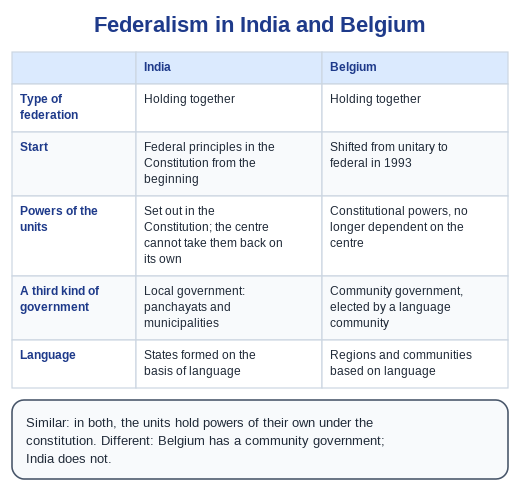
3. “Point out one feature in the practice of federalism in India that is similar to and one feature that is different from that of Belgium.”
Answer: Similar: both are holding-together federations. Different: Belgium has a community government, while India’s third tier is local government.
Similar
- Holding-together federations: in both, a country divided its power between the centre and the regions.
- Constitutional powers: the constitution gives the regional (State) governments powers of their own. The central government cannot take them back by itself.
- Language: both organised their units largely around language.
Different
- Community government: Belgium has a third kind of government, the community government. People of one language community elect it, wherever they live.
- Local government: India has no such government. Its third tier is local government: panchayats and municipalities.
- Another difference: Belgium became federal only in 1993; before that it was unitary. India’s Constitution was based on federal principles from the start.
4. “What is the main difference between a federal form of government and a unitary one? Explain with an example.”
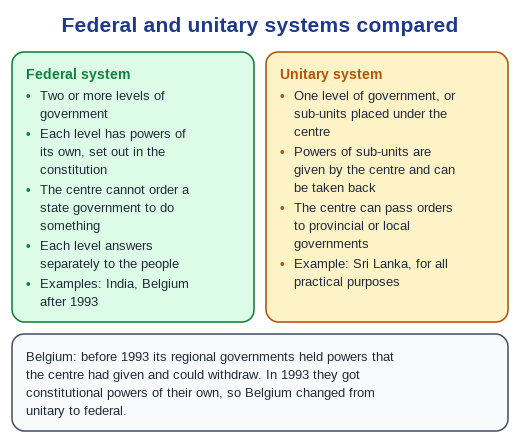
Answer: In a federal system, power is divided between levels of government by the constitution. In a unitary system, there is one level, or the lower levels work under the central government.
- Federal: power is shared between a central authority and the constituent units (States). Each level has its own powers written in the constitution.
- No orders from the centre: in a federation, the central government cannot order a State government to do something.
- Unitary: there is only one level of government, or the sub-units are under the central government.
- Orders from the centre: in a unitary system, the central government can give orders to the lower levels and take back their powers.
Examples
- India (federal): a State Government makes laws on State List subjects such as police. It is not answerable to the Central Government for them.
- Sri Lanka (unitary): for all practical purposes, the national government has all the powers.
- Belgium: it was unitary until 1993. Then its regional governments got powers of their own in the constitution, and it became federal.
5. “State any two differences between the local government before and after the Constitutional amendment in 1992.”
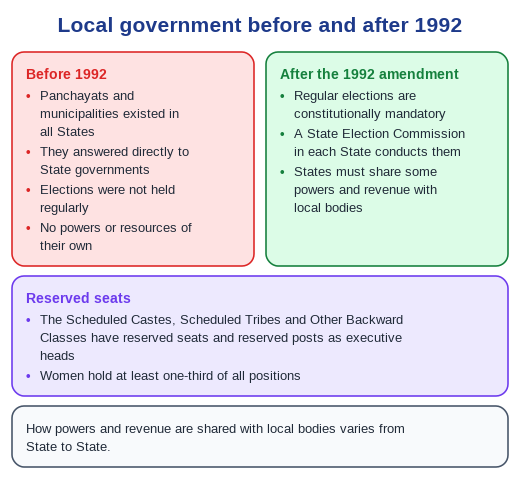
Answer: After 1992, elections to local bodies became regular and compulsory, and local bodies got a share of powers and money. Before 1992, they had neither.
| Before 1992 | After the 1992 amendment | |
|---|---|---|
| Elections | Not held regularly | Regular elections are constitutionally mandatory, conducted by a State Election Commission |
| Powers and resources | No powers or resources of their own; directly under State governments | State governments must share some powers and revenue with local bodies |
| Representation | No such constitutional rule (the chapter mentions none) | Seats reserved for SCs, STs and OBCs, and at least one-third of all positions for women |
Any two rows make a full answer.
6. “Fill in the blanks: Since the United States is a ___________________ type of federation, all the constituent States have equal powers and States are ______________ vis-à-vis the federal government. But India is a _____________________ type of federation and some States have more power than others. In India, the ____________ government has more powers.”
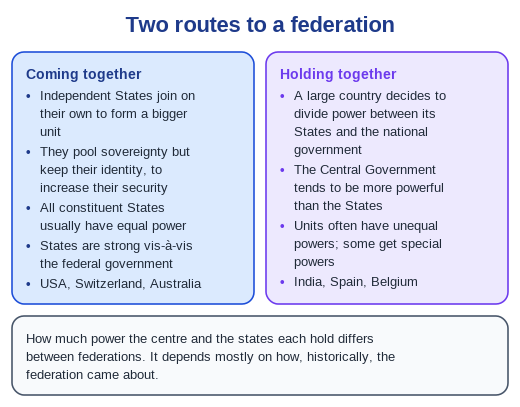
Since the United States is a coming together type of federation, all the constituent States have equal powers and States are strong vis-à-vis the federal government. But India is a holding together type of federation and some States have more power than others. In India, the Central (Union) government has more powers.
- Coming together: independent States join on their own to form a bigger country (USA, Switzerland, Australia).
- Holding together: a large country divides its power between the centre and the States (India, Spain, Belgium).
7. “Here are three reactions to the language policy followed in India. Give an argument and an example to support any of these positions.”
Sangeeta: The policy of accommodation has strengthened national unity.
Arman: Language-based States have divided us by making everyone conscious of their language.
Harish: This policy has only helped to consolidate the dominance of English over all other languages.
Answer: I support Sangeeta. India made room for all its languages instead of forcing one, and this kept the country united.
Argument
- No national language: the Constitution did not make any one language the national language.
- Many languages protected: besides Hindi, 21 other languages are Scheduled Languages, 22 in all.
- State languages: each State does much of its work in its own official language.
- No group shut out: so no language group has felt pushed out of the country.
Example
- 1965: English was due to stop being used for official work in 1965.
- Objection: many non-Hindi-speaking States demanded that English continue.
- Flexibility: the Central Government agreed to keep English along with Hindi.
- Contrast: the chapter says this flexibility helped India avoid the kind of situation Sri Lanka faced, where one language was pushed on everyone.
If you choose Arman: argue that language-based States make people think of themselves first as speakers of a language. Give disputes between neighbouring States as an example.
If you choose Harish: argue that keeping English for official work helps people educated in English. The chapter itself says many critics think the 1965 solution favoured the English-speaking elite (the small, powerful group who speak English).
The chapter’s own conclusion is closest to Sangeeta’s.
8. “The distinguishing feature of a federal government is: (a) National government gives some powers to the provincial governments. (b) Power is distributed among the legislature, executive and judiciary. (c) Elected officials exercise supreme power in the government. (d) Governmental power is divided between different levels of government.”
(d) Governmental power is divided between different levels of government.
- (a) is wrong: powers that the national government “gives” can be taken back. That is a unitary system, like Belgium before 1993.
- (b) is wrong: it describes the horizontal division of power between organs of government, not federalism.
- (c) is wrong: it is true of any democracy.
9. “A few subjects in various Lists of the Indian Constitution are given here. Group them under the Union, State and Concurrent Lists as provided in the table below. A. Defence; B. Police; C. Agriculture; D. Education; E. Banking; F. Forests; G. Communications; H. Trade; I. Marriages”
| List | Subjects |
|---|---|
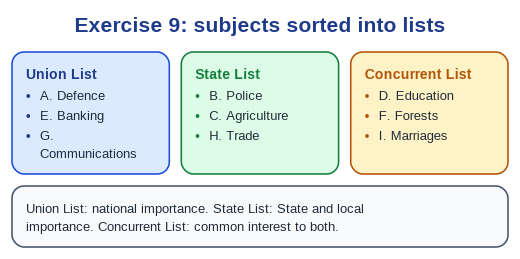
| Union List | A. Defence; E. Banking; G. Communications |
| State List | B. Police; C. Agriculture; H. Trade |
| Concurrent List | D. Education; F. Forests; I. Marriages |
- Union List: subjects of national importance that need one policy for the whole country. Only the Union Government makes laws on them.
- State List: subjects of State and local importance. Only the State Governments make laws on them.
- Concurrent List: subjects of common interest. Both can make laws; if the laws clash, the Union law prevails.
10. “Examine the following pairs that give the level of government in India and the powers of the government at that level to make laws on the subjects mentioned against each. Which of the following pairs is not correctly matched?”
| Level of government | Powers | |
|---|---|---|
| (a) | State government | State List |
| (b) | Central government | Union List |
| (c) | Central and State governments | Concurrent List |
| (d) | Local governments | Residuary powers |
(d) Local governments – Residuary powers is not correctly matched.
- Residuary subjects are subjects in none of the three lists, such as computer software.
- The power to make laws on them belongs to the Union Government, not to local governments.
- The other three pairs are correct.
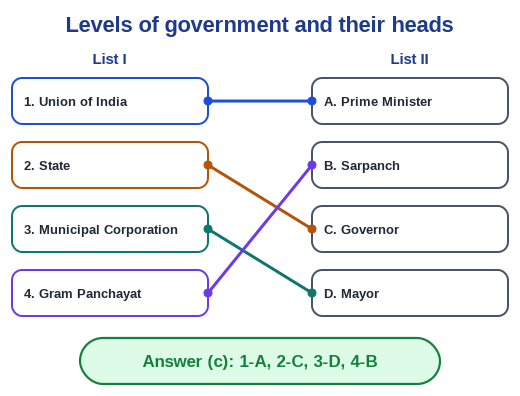
11. “Match List I with List II and select the correct answer using the codes given below the lists:”
| List I | List II |
|---|---|
| 1. Union of India | A. Prime Minister |
| 2. State | B. Sarpanch |
| 3. Municipal Corporation | C. Governor |
| 4. Gram Panchayat | D. Mayor |
Codes (1, 2, 3, 4): (a) D A B C; (b) B C D A; (c) A C D B; (d) C D A B.
(c) A C D B.
- 1-A: the Prime Minister heads the government of the Union of India.
- 2-C: the Governor goes with the State. (Extra: the chapter does not mention the Governor, who is the constitutional head of a State; the option also follows by elimination.)
- 3-D: the mayor is the head of a municipal corporation.
- 4-B: the sarpanch is the president of a gram panchayat.
12. “Consider the following two statements. A. In a federation, the powers of the federal and provincial governments are clearly demarcated. B. India is a federation because the powers of the Union and State Governments are specified in the Constitution and they have exclusive jurisdiction on their respective subjects. C. Sri Lanka is a federation because the country is divided into provinces. D. India is no longer a federation because some powers of the States have been devolved to the local government bodies. Which of the statements given above are correct? (a) A, B and C (b) A, C and D (c) A and B only (d) B and C only”
(c) A and B only.
- A is right: a federation’s constitution clearly sets out the powers of each level.
- B is right: India’s Constitution sets out the powers of the Union and the States in separate lists.
- C is wrong: having provinces does not make a country federal. Sri Lanka is, for all practical purposes, unitary: its national government has all the powers.
- D is wrong: giving powers to local bodies added a third tier. It made federal power sharing deeper, not weaker.
(The question says “two statements” but prints four, A to D.)
Practice
-
In which year did Belgium’s regional governments get constitutional powers that no longer depended on the central government?
Show answer
Answer: (d) 1993
-
Which of these is an example of a Union Territory given in the chapter?
Show answer
Answer: (b) Lakshadweep
-
How often must a gram sabha meet, according to the chapter?
Show answer
Answer: (b) At least twice or thrice a year
-
Why are defence and currency in the Union List?
Show answer
Answer: They are subjects of national importance, and the country needs a uniform policy on them everywhere. So only the Union Government can make laws on the subjects in the Union List.
-
What two things does an ideal federal system need?
Show answer
Answer: Mutual trust between the governments at different levels, and their agreement to live together by following agreed rules of power sharing.
Stuck on a question?
Take a photo and Lagnever AI explains it step by step. Try it for 7 days for ₹2.
Get it on Google Play Open in browser
For parents: after the trial, the plan renews monthly by UPI or card autopay. You can cancel anytime in the app.