
What makes India a federal country?
Answer in short
India is a federal country because its Constitution divides power between the Union Government and the State Governments. Law-making powers are split into the Union, State and Concurrent Lists. This arrangement cannot be changed by Parliament alone, courts settle disputes about it, and each level can raise its own taxes. A third tier, local government, was added later.
Stuck on a question? Take a photo and Lagnever AI explains it step by step. Try it for 7 days for ₹2. Get it on Google Play
What is federalism, in one line?
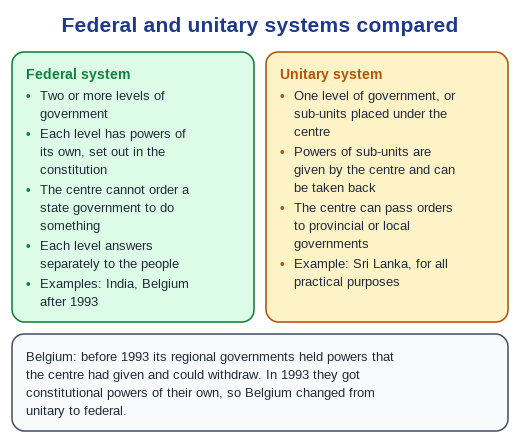
Federalism is a system of government in which power is divided between a central authority and the constituent units of a country. Each level has powers of its own and answers separately to the people. This is different from a unitary system, where there is one level of government, or the sub-units work under the centre and take its orders.
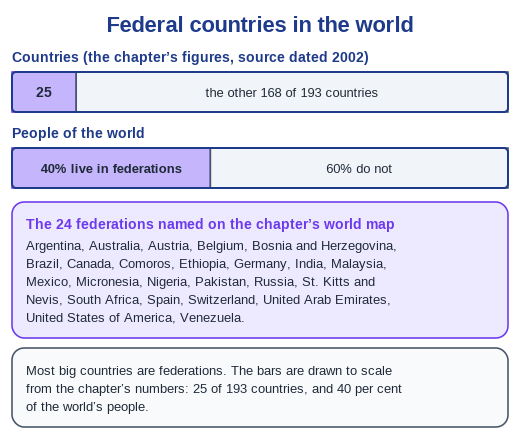
The chapter notes that federations are few, 25 out of 193 countries, yet 40 per cent of the world’s people live in them, because most large countries are federations. (These figures come with the chapter’s world map, whose source is dated 2002.)
Which kind of federation is India?
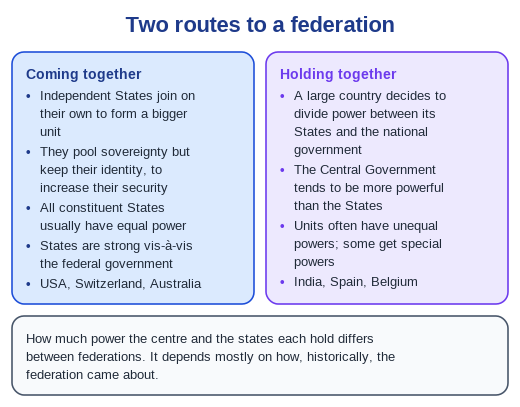
Federations form by two routes. Independent States may come together to form a bigger unit, pooling sovereignty while keeping their identity, as the USA, Switzerland and Australia did. Or a large country may decide to divide power between its States and the national government to hold together, as India, Spain and Belgium did. In the second kind, the centre usually ends up stronger than the States, and the units often differ in their powers.
Independence came with a painful partition, and several princely states joined the country soon after. The Constitution called India a Union of States. The word federation does not appear in it, but the Union it set up works on federal principles, and all seven key features of federalism apply to it.
How are law-making powers divided?
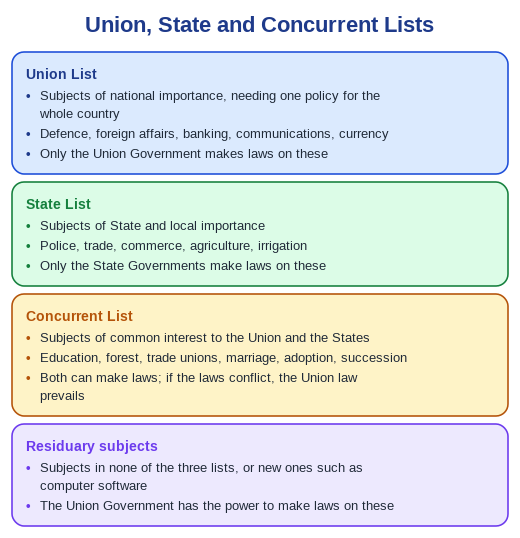
The Constitution sorts law-making powers between the Union and the States into three lists.
- Union List: matters that concern the whole nation: defence, foreign affairs, banking, communications and currency, for example. The country needs one policy on these, so only the Union Government can make laws on them.
- State List: matters of State and local importance: police, trade, commerce, agriculture and irrigation, for example. Only the State Governments can make laws on them.
- Concurrent List: matters in which the Union and the States both have an interest: education, forest, trade unions, marriage, adoption and succession, for example. Either may make laws on them. If the two laws clash, the Union’s law prevails.
Some subjects fall in none of the lists, and some, like computer software, came up after the Constitution was made. Such leftover, or residuary, subjects are for the Union Government to legislate on.
Do all States have equal powers?
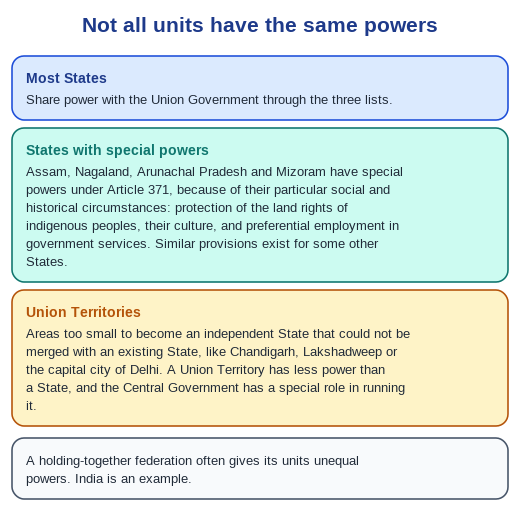
No. A holding-together federation often gives unequal powers to its units. Under Article 371 of the Constitution, Assam, Nagaland, Arunachal Pradesh and Mizoram, among others, hold special powers that reflect their particular social and historical circumstances. The powers mainly protect indigenous peoples’ rights over land and their culture, and give them preference in government jobs. Some other States have comparable provisions.
At the other end are Union Territories, like Chandigarh, Lakshadweep or the capital city of Delhi. They were too small to be made States, yet could not be joined to a neighbouring State. A Union Territory has less power than a State, and the Central Government has a special role in running it.
Can the arrangement be changed easily?
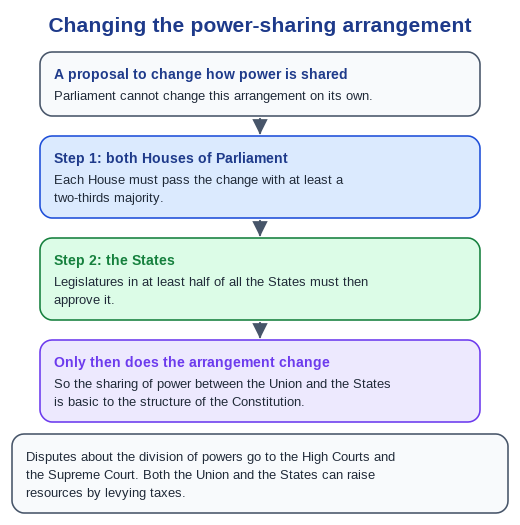
No, and that is what makes it federal. This division of power is part of the Constitution’s basic structure. Parliament cannot change it on its own. A change must first be passed by both Houses of Parliament with at least a two-thirds majority, and must then win the approval of the legislatures in at least half of all the States.
Who settles disputes, and who pays?
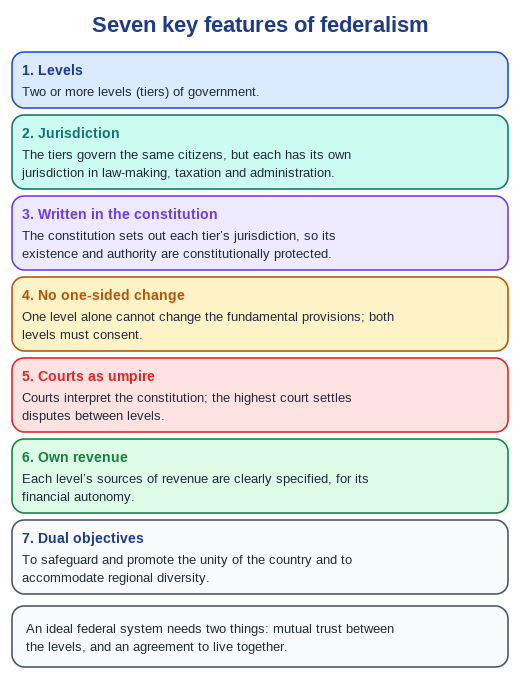
The judiciary oversees how the constitutional provisions are carried out. When the Union and a State disagree over who holds a power, the High Courts and the Supreme Court decide. Each level may also levy taxes of its own, to pay for the work it is responsible for. Put together, India has every feature on the chapter’s list: separate tiers, separate jurisdictions written into the Constitution, a hard-to-change arrangement, courts as umpire, and separate sources of revenue.
Go on to how federalism is practised in India and decentralisation in India, or back to the chapter notes and the NCERT solutions.
Practice
-
Which subject is in the State List?
Show answer
Answer: (c) Police
-
If a Union law and a State law on a Concurrent List subject conflict, which prevails?
Show answer
Answer: (b) The Union law
-
India is an example of which kind of federation?
Show answer
Answer: (b) Holding together
-
How can the sharing of power between the Union and the States be changed?
Show answer
Answer: Parliament cannot do it alone. The change must first be passed by both Houses of Parliament with at least a two-thirds majority, and then win the approval of the legislatures in at least half of all the States.
-
What are Union Territories?
Show answer
Answer: Areas too small to become an independent State that could not be merged with any existing State, like Chandigarh, Lakshadweep or the capital city of Delhi. A Union Territory has less power than a State, and the Central Government has a special role in running it.
Questions students ask
What are the three lists in the Indian Constitution?
The Union List (subjects of national importance, on which only the Union Government makes laws), the State List (subjects of State and local importance, on which only the State Governments make laws) and the Concurrent List (subjects of common interest, on which both can make laws).
What is the difference between coming-together and holding-together federations?
In a coming-together federation, independent States join to form a bigger unit, and the States are usually equal and strong, as in the USA. In a holding-together federation, a large country divides its power between the States and the centre, and the centre tends to be stronger, as in India.
Do all States of India have the same powers?
No. The chapter says Assam, Nagaland, Arunachal Pradesh and Mizoram, among others, have special powers under Article 371 because of their particular social and historical circumstances, and Union Territories have very little power.
Stuck on a question?
Take a photo and Lagnever AI explains it step by step. Try it for 7 days for ₹2.
Get it on Google Play Open in browser
For parents: after the trial, the plan renews monthly by UPI or card autopay. You can cancel anytime in the app.