
How is federalism practised in India?
Answer in short
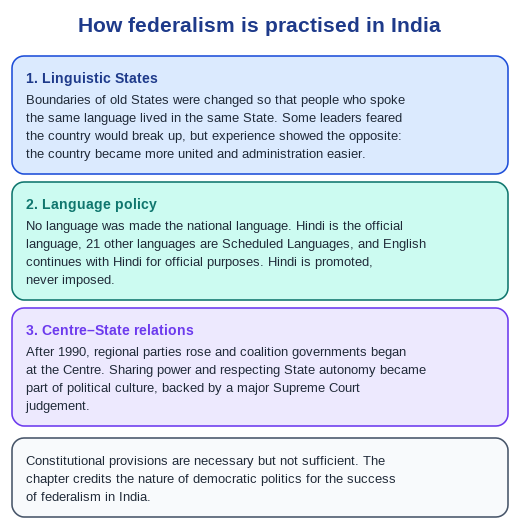
Federalism works in India because of democratic politics, not the Constitution alone. Three developments strengthened it. Linguistic States were formed and made the country more united. The language policy made Hindi the official language without imposing it, and protected other languages. After 1990, coalition governments at the Centre brought more respect for the autonomy of State Governments.
Stuck on a question? Take a photo and Lagnever AI explains it step by step. Try it for 7 days for ₹2. Get it on Google Play
Is a federal Constitution enough?
No. A constitution can set out who holds which power, but it cannot make governments and parties respect that division. The chapter argues that federalism has worked in India mainly because of the way democratic politics developed here: over time, respecting diversity and wanting to live together became ideals that people across the country share. It picks out three developments that show this.
Test 1: why were linguistic States formed?
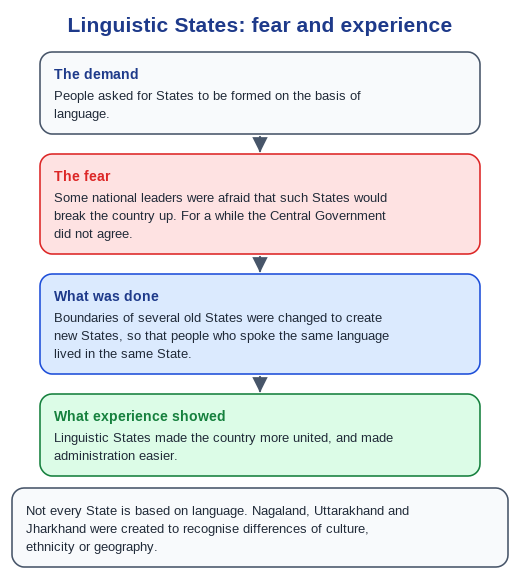
The first big test was the demand for States based on language. Put a political map of India from 1947 beside one from 2019, as the chapter does, and they hardly look like the same country: old States are gone, new ones have appeared, and borders and names have changed. Boundaries were redrawn so that speakers of one language would live together in one State. (The chapter’s text puts this change in 1947; the article it quotes on page 23 dates the States Reorganisation Commission’s report to 1 November 1956.)
Language was not the only basis. Nagaland, Uttarakhand and Jharkhand are the chapter’s examples of States formed to recognise differences of culture, ethnicity or geography.
The demand worried some national leaders, who thought that States built around languages might pull the country apart, and for a while the Central Government held out against it. The result was the opposite of what they feared: the country grew more united, and States became easier to administer.
Test 2: what is India’s language policy?
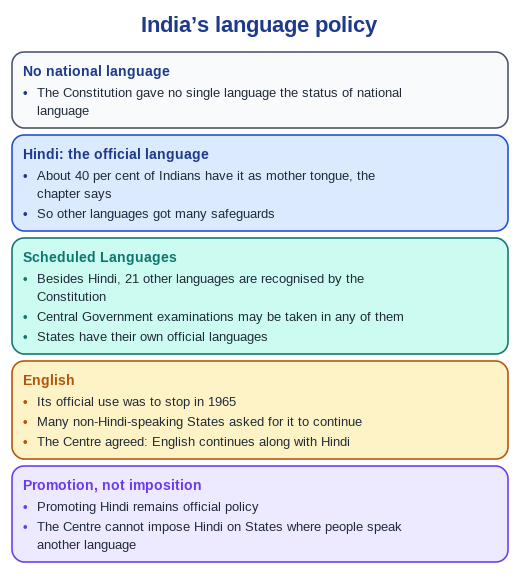
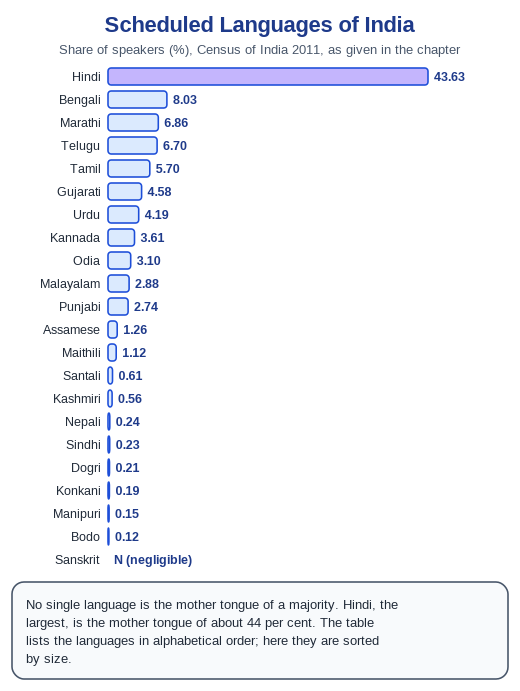
The second test was language itself. The Constitution names no national language. It made Hindi the official language, but since only about 40 per cent of Indians have Hindi as their mother tongue, as the chapter puts it, other languages were given safeguards. The Constitution recognises 21 more languages, besides Hindi, as Scheduled Languages, and someone sitting an examination for a Central Government post may write it in any of them. Each State also has an official language of its own, in which most of its government work is done.
What happened to English?
India’s leaders spread the use of Hindi with great caution. Under the Constitution, English was to stop being used for official purposes in 1965. Many States where Hindi is not spoken wanted English to stay, and the chapter notes that in Tamil Nadu the movement turned violent. The Central Government agreed to keep English in official use together with Hindi. The chapter adds that many critics see this as a solution that suited the English-speaking elite.
The Government of India still has a policy of promoting Hindi. Promoting is not imposing: the Centre cannot force Hindi on a State whose people speak another language. In the chapter’s view, this flexibility spared India the kind of conflict that Sri Lanka went through, which you read about in Chapter 1.
How many languages does India have?
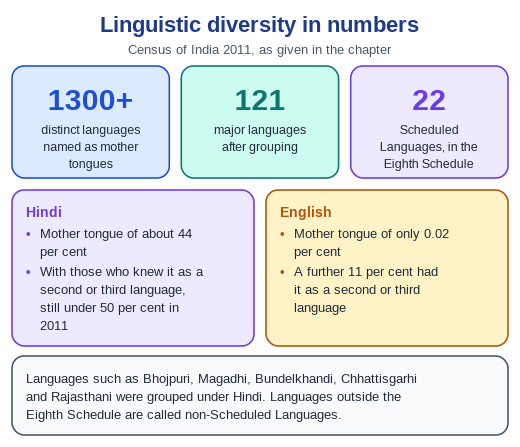
The chapter’s box uses the Census of India 2011. People named more than 1300 distinct languages as mother tongues. Grouped under major languages, they came to 121, of which 22 are Scheduled Languages. Hindi is the mother tongue of about 44 per cent in this Census; even with those who knew it as a second or third language, the total was under 50 per cent in 2011. English is the mother tongue of only 0.02 per cent, and a further 11 per cent had it as their second or third language.
Test 3: how did Centre–State relations change?
The third development concerns how the Centre treats the States. Rules on paper work only as well as the parties and leaders in power let them. For many years one party governed at the Centre and in most States, so the States seldom acted as units with rights of their own. Where a State was run by a different party, the chapter says, the party in power at the Centre tried to weaken it, and the Central Government often misused the Constitution to dismiss State Governments run by its rivals. That went against the spirit of federalism.
After 1990 the picture changed a great deal. Regional parties grew strong in many States. No single party could win a clear majority in the Lok Sabha, so the large national parties needed allies, many of them regional parties, to govern at the Centre: the era of coalition governments had begun. Sharing power and respecting the autonomy of the States became part of political culture. A major Supreme Court judgement helped, by making it hard for the Centre to dismiss a State Government arbitrarily.
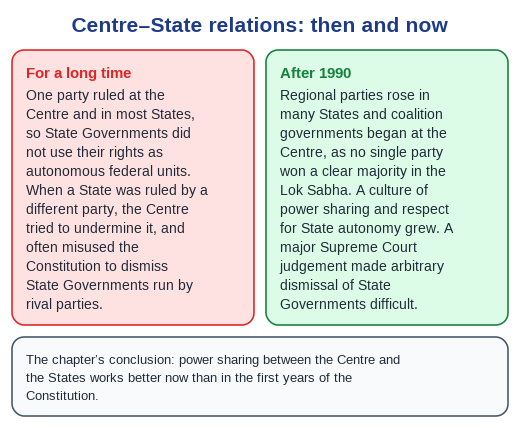
The chapter’s conclusion is that power sharing between the Centre and the States works better now than it did in the first years of the Constitution.
Go back to what makes India a federal country, on to decentralisation in India, or to the chapter notes and the NCERT solutions.
Practice
-
Under the Constitution, in which year was English due to go out of official use?
Show answer
Answer: (c) 1965
-
Which State was created to recognise differences of culture, ethnicity or geography, not language?
Show answer
Answer: (a) Nagaland
-
What began at the Centre after 1990?
Show answer
Answer: (a) The era of coalition governments
-
Why did some national leaders oppose linguistic States at first?
Show answer
Answer: They were afraid that States built around languages would break the country up. For a while the Central Government did not agree to them, but in the end linguistic States made the country more united.
-
What does “promotion of Hindi” mean, and what does it not mean?
Show answer
Answer: It means that the Government of India, as its official policy, encourages the use of Hindi. It does not allow the Centre to force Hindi on a State whose people speak another language.
Questions students ask
What are the three ways in which federalism has been strengthened in India?
The creation of linguistic States, a flexible language policy, and the restructuring of Centre–State relations after 1990. The chapter says these made the spirit of federalism, respect for diversity and the desire for living together shared ideals in the country.
How many Scheduled Languages does India have?
22. Besides Hindi, 21 other languages are recognised as Scheduled Languages by the Constitution, and they are listed in its Eighth Schedule. A candidate in an examination for Central Government positions may choose to take it in any of these languages.
How did coalition governments help federalism?
Once no party could win the Lok Sabha outright, the big national parties needed partners, regional parties among them, to govern. The chapter says the Centre then learnt to share power and to respect the autonomy of the States.
Stuck on a question?
Take a photo and Lagnever AI explains it step by step. Try it for 7 days for ₹2.
Get it on Google Play Open in browser
For parents: after the trial, the plan renews monthly by UPI or card autopay. You can cancel anytime in the app.