
Decentralisation in India
Answer in short
Decentralisation means taking power from the Central and State governments and giving it to local government. In 1992 the Constitution was amended to make this third tier stronger: regular elections became mandatory, seats were reserved, including at least one-third of all positions for women, State Election Commissions were created, and States had to hand over some powers and revenue.
Stuck on a question? Take a photo and Lagnever AI explains it step by step. Try it for 7 days for ₹2. Get it on Google Play
Why are two tiers not enough?
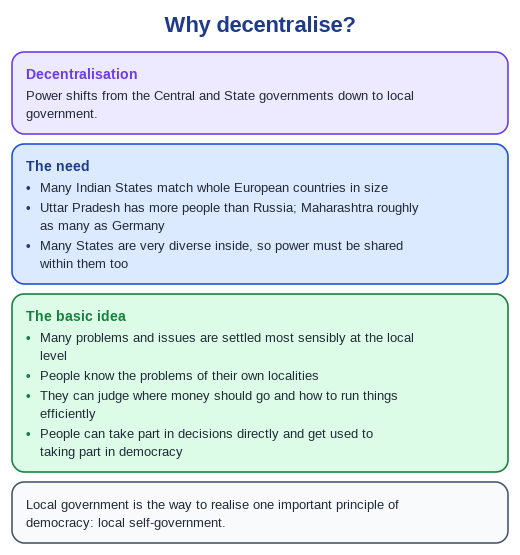
So far the chapter has dealt with two tiers, the Union and the States. But India is vast. The chapter compares its States to whole European countries: Uttar Pradesh has more people than Russia, and Maharashtra roughly as many as Germany. Many States are also very varied inside. So power needs to be shared within the States too, through a tier below the State governments. That third tier is local government.
What is decentralisation?
Decentralisation means shifting power from the Central and State governments down to local government. The thinking behind it is simple. A blocked drain, a broken hand pump or the site of a new school is a local matter, and many such issues are settled most sensibly close to where they arise. People know the problems of their own locality. They also have a good sense of where money should be spent and how things can be managed efficiently. And at the local level, people can take part in decisions directly, and so get used to taking part in democracy. Local government is how the democratic principle of local self-government is put into practice.
What was wrong before 1992?
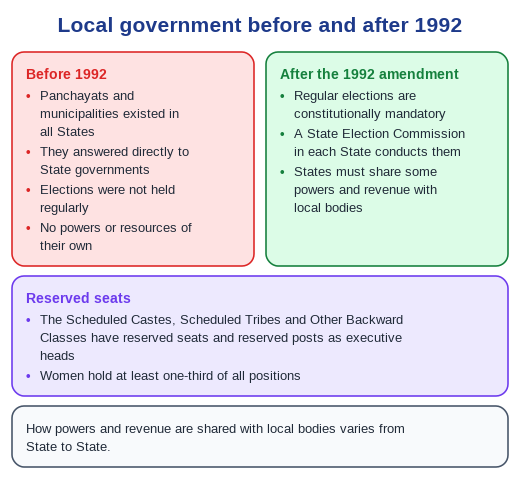
The makers of the Constitution saw the need for decentralisation, and governments tried more than once to carry power down to villages and towns. Every State set up panchayats for its villages and municipalities for its towns. These bodies, however, answered directly to the State government. Elections to them came irregularly, and they had neither powers nor funds of their own. On the ground, very little had been decentralised.
What did the 1992 amendment change?
A constitutional amendment in 1992 gave the third tier real strength. It brought five changes.
- Local government bodies must hold elections regularly; the Constitution now requires it.
- The Scheduled Castes, the Scheduled Tribes and the Other Backward Classes have reserved seats in these bodies, and reserved posts as their executive heads.
- Women hold at least one-third of all positions by reservation.
- Each State now has a State Election Commission, an independent body that runs panchayat and municipal elections.
- State governments have to hand over some powers and a share of revenue to local bodies. How much differs from State to State.
How does panchayati raj work?
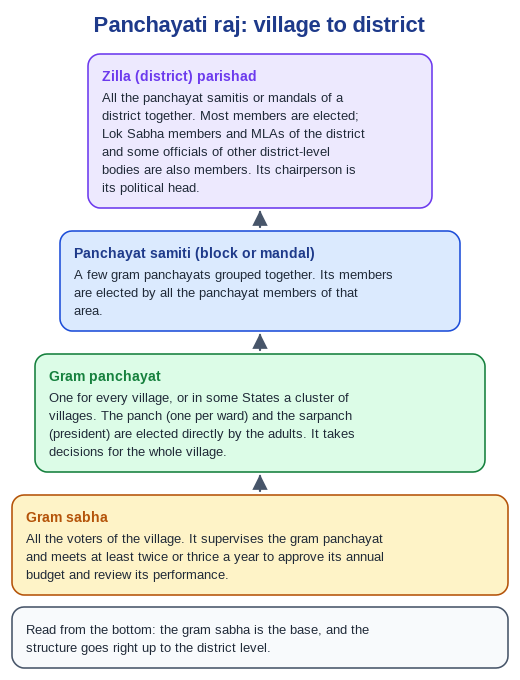
Rural local government is popularly known as panchayati raj. It has three levels.
- Gram panchayat. There is one for every village, or in some States for a cluster of villages. Its members are the panch, one for each ward, and its president is the sarpanch; the adults of the ward or village elect them directly. It takes decisions for the whole village. The gram sabha, to which every voter of the village belongs, keeps watch over it. The gram sabha must meet two or three times a year at the least, to pass the panchayat’s annual budget and to review its work.
- Panchayat samiti. A few gram panchayats are grouped together into what is usually called a panchayat samiti, block or mandal. Its members are elected by all the panchayat members of that area.
- Zilla parishad. All the panchayat samitis or mandals of a district together make up the zilla (district) parishad. Most members are elected; the district’s Lok Sabha members and MLAs sit on it too, along with some officials from other district-level bodies. Its chairperson is its political head.
What about towns and cities?
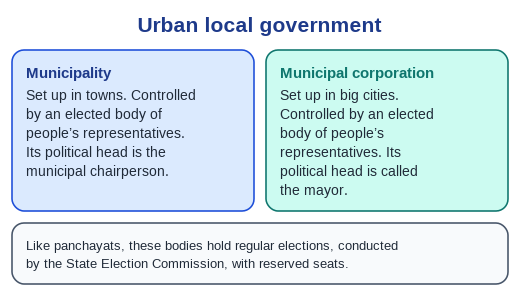
Urban areas have local government bodies too. Towns have municipalities, and big cities have municipal corporations. Each is run by a body of representatives whom the people elect. The political head of a municipality is the municipal chairperson; in a municipal corporation that officer is called the mayor.
Has it worked?
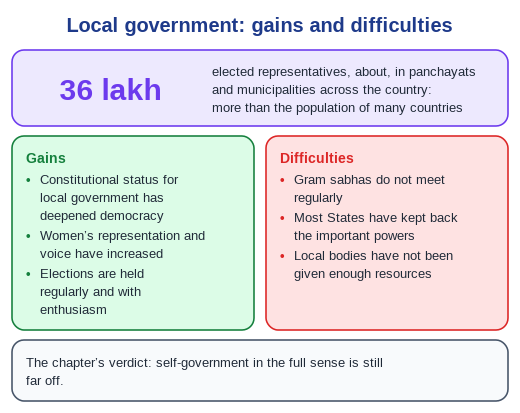
The chapter describes the new system as the biggest democratic experiment the world has seen. Panchayats, municipalities and similar bodies across India now have about 36 lakh elected representatives, a number larger than the population of many countries. Giving local government a place in the Constitution has deepened democracy, and women are now better represented and better heard.
There are difficulties as well. People vote in local elections regularly and eagerly, but gram sabhas do not meet regularly. Most States have kept back the important powers, and the money that local governments need. The chapter’s judgement is that self-government in the full sense is still far off.
What happened in Porto Alegre?
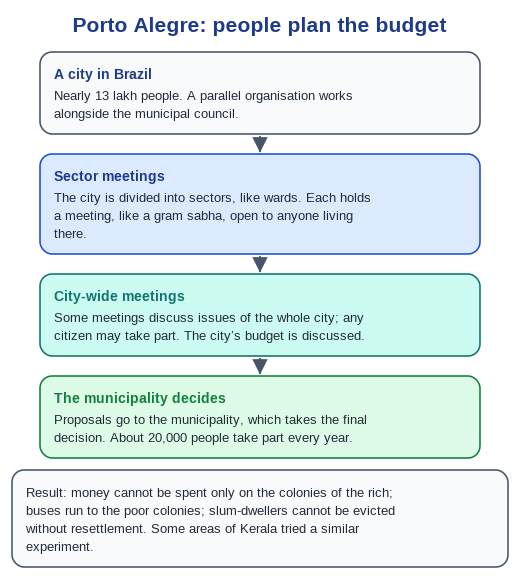
A box in the chapter describes Porto Alegre, a city in Brazil with nearly 13 lakh people. The city set up a parallel organisation alongside the municipal council so that residents could take real decisions about the city’s budget. Each sector of the city, like a ward, holds a meeting open to everyone who lives there, much like a gram sabha, and some meetings deal with the whole city. The proposals go to the municipality, which takes the final decision. About 20,000 people take part every year. As a result, spending can no longer be kept to the richer neighbourhoods: poor colonies now have bus services, and slum-dwellers cannot be evicted by builders unless they are resettled. The chapter adds that a similar experiment took place in some areas of Kerala, where ordinary people helped make the development plan for their locality.
Go back to what makes India a federal country or how federalism is practised in India, or to the chapter notes and the NCERT solutions.
Practice
-
Who are the members of a gram sabha?
Show answer
Answer: (b) All the voters in the village
-
Which body conducts panchayat and municipal elections in a State?
Show answer
Answer: (a) The State Election Commission
-
All the panchayat samitis or mandals of a district together form the:
Show answer
Answer: (c) zilla parishad
-
State two differences between local government before and after 1992.
Show answer
Answer: Before 1992 elections to local bodies were not held regularly; now regular elections are constitutionally mandatory. Before, local bodies had no powers or resources of their own; now State governments have to hand some powers and revenue to them.
-
What difficulties does local government still face?
Show answer
Answer: Gram sabhas do not meet regularly, and most States have given local governments neither important powers nor enough resources. The chapter says self-government in the full sense is still far off.
Questions students ask
What is decentralisation?
Decentralisation means shifting power from the Central and State governments down to local government. The idea is that many problems are settled most sensibly at the local level, where people know their own localities and can take part in decisions directly.
What is the three-tier structure of panchayati raj?
The gram panchayat for a village or group of villages; the panchayat samiti, also called block or mandal, for a group of gram panchayats; and the zilla parishad for the district. The gram panchayat works under the supervision of the gram sabha.
What is the difference between a municipality and a municipal corporation?
Municipalities are set up in towns and are headed by a municipal chairperson. Big cities are constituted into municipal corporations, whose political head is called the mayor. Both are controlled by elected bodies of people’s representatives.
Stuck on a question?
Take a photo and Lagnever AI explains it step by step. Try it for 7 days for ₹2.
Get it on Google Play Open in browser
For parents: after the trial, the plan renews monthly by UPI or card autopay. You can cancel anytime in the app.