
NCERT Solutions Class 10 Political Science Chapter 5: Outcomes of Democracy
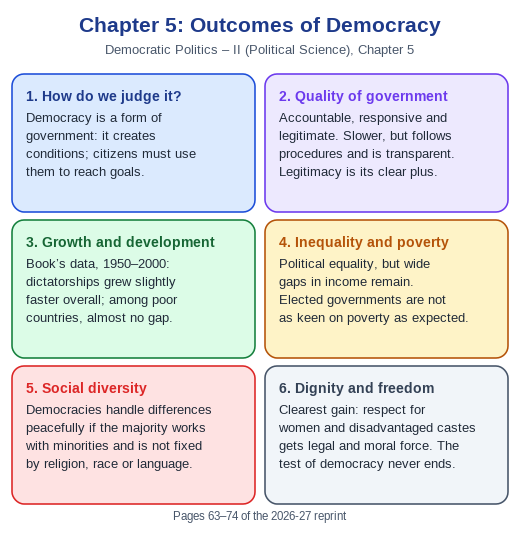
Answers to all eight exercises of Chapter 5, Outcomes of Democracy, of Democratic Politics – II, the Class 10 Political Science textbook, and to every thought bubble, cartoon question and activity inside the chapter. Page numbers follow the 2026-27 reprint (pages 63–74). The exercises are quoted from the book, except Exercises 6 and 8, which are restated (see the note at the end). The questions inside the chapter are restated in short, in our own words, and the chapter’s cartoons are described in general terms, not reproduced. Survey and table figures are given as the book prints them, with its sources and years. Short notes: Chapter 5 notes.
Questions inside the chapter (pages 64–72)
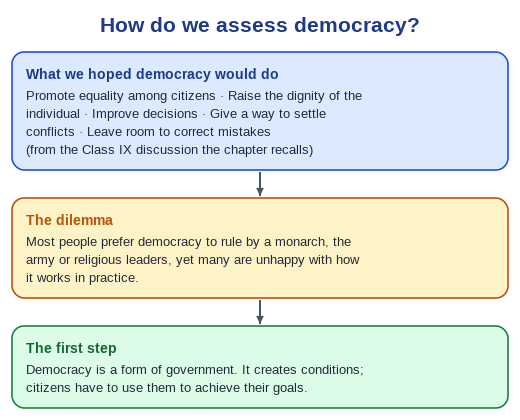
Thought bubble, page 64: a student asks whether the Class IX class reached its conclusions about democracy, and says she liked that class because no conclusions were dictated. Yes, but they were reached through discussion, not handed down. The students compared democracy with other forms of government and agreed that it promotes equality, respects individual dignity, improves decisions, offers a peaceful way to settle conflicts and allows mistakes to be corrected. Reaching a view by open argument is itself a democratic habit. This chapter tests those conclusions against what democracies have actually done.
Cartoon, page 64: a man labelled “democracy” is hit by stones marked with many different demands, such as a separate State, student demands, more allowance and protests against police excesses. The caption asks whether democracy is mainly a matter of handling many pressures at once and making room for different demands. Largely, yes, and that is a strength rather than a weakness. In a democracy every group can voice its demands openly, so the government faces many pressures at once. Its job is to hear them, negotiate and find solutions through procedures. A non-democratic government can simply suppress such demands. But democracy is more than coping with pressure: it also has to produce accountable and legitimate government, respect dignity and freedom, and give every citizen a chance to be heard.
Cartoon, page 65, “Governmental Secrecy”: a giant telescope lets the government see everything about a citizen, while the citizen, looking from the other end, sees almost nothing about the government. It shows the gap in information: governments know a great deal about people, but people know little about how governments work. This is why the chapter lists citizens’ right to information as one of the tests of accountable government.
Box, page 65: what does the government know about you and your family, and how? What are your sources of information about the government? What it knows: names, ages, address and family members (from the census and the ration card), who is an adult voter (voter identity card), birth and school records, income and property in some cases (tax records), and bank and mobile details linked to identity documents. How: through forms we fill in, registration offices, surveys and the documents we apply for. Our sources about the government: newspapers, television, radio and websites; official notices and announcements; elected representatives and local officials; debates in the legislature; and, where needed, an application under the Right to Information Act. Notice that the flow of information is usually heavier in one direction, from citizens to the government.
Thought bubble, page 66: a student jokes that all this hard thinking has only shown that democracy’s main result is being a democracy. It sounds circular, but there is a real point. The chapter shows that democracies have a mixed record on speed, responsiveness, corruption, growth and inequality, but they are certainly better on one count: a democratic government is legitimate, the people’s own. People value being ruled by those they elect, and surveys show wide support for this. So being a democracy is itself a valuable outcome, though citizens still have to work for the other outcomes.
Cartoons on pages 67–70 about the gap between rich and poor: should everyone share the gains of growth equally? How can poor people make themselves heard and win a fairer share within their country? What can poor nations do to get more of the world’s wealth? (The cartoons, described in general terms: a rich man growing ever stronger; a poor child unable to reach housing, health care, schooling and food; the voice of the poor; and the world’s wealth held by a few.)
- Evenly shared gains: gains need not be exactly equal, but they should reach everyone. If growth only enriches the top, as Table 2 shows can happen, most people gain little and inequality grows. Spending on health, education, jobs and food security helps spread the gains.
- A voice for the poor: by voting together on their issues, forming associations, unions and movements, using the right to information, and supporting parties and representatives who take up their demands. The poor are a large share of voters, so organised action can make governments listen.
- Poor countries: by working together in international bodies to press for fairer trade rules, by investing in education, health and their own industries, and by cooperating with one another.
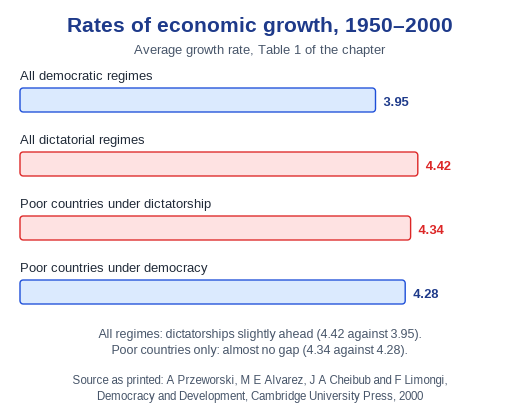
Question, page 68: what would your verdict on democracy be if you judged it only on economic performance, that is growth and equal distribution? On growth alone, democracies come out slightly behind dictatorships on average (3.95 against 4.42 in Table 1), though among poor countries there is almost no difference (4.28 against 4.34). On distribution, Table 2 shows very high inequality in some democracies, such as South Africa and Brazil. So on purely economic grounds the verdict would be mixed, and not clearly in democracy’s favour. But the chapter argues that this is not a fair basis on its own: growth depends on many factors, and democracy has other outcomes, legitimacy, dignity and freedom, and peaceful handling of differences, that dictatorships cannot match.
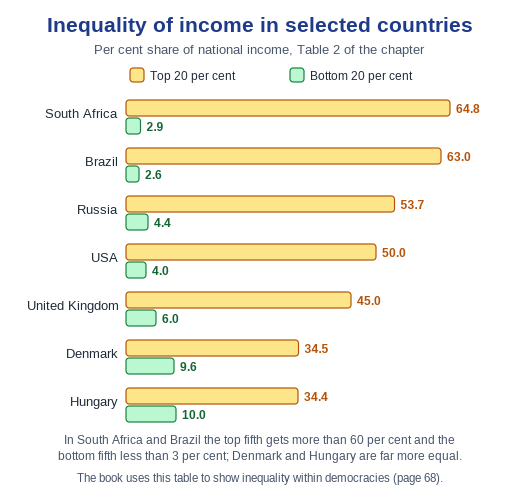
Thought bubble, page 69: democracy is rule by the majority, and the poor are the majority, so democracy must be rule by the poor. How can it not be? Being a majority in numbers does not automatically mean holding power. The poor are often divided by caste, religion, region and language, and they vote on many issues, not only poverty. They usually have less money, organisation, information and time for politics than the rich, while the rich can fund campaigns and influence parties and media. So, as the chapter notes, elected governments are not as keen on poverty as one might expect. The poor can turn their numbers into influence only when they organise around their common interests.
Thought bubble, page 70: a student says the chapter only shows that democracy keeps people from violently attacking one another, and asks whether that is real harmony and whether we should be happy with it. Preventing violence is not full harmony, but it is a real and important achievement, because many societies without democracy see differences turn into open conflict or are kept quiet by force. The chapter admits no society can end group conflicts permanently. What democracy offers is a peaceful way to express and negotiate differences, and the chance to build respect over time. We should value this, and still work for deeper harmony, which depends on the majority working with minorities and nobody being shut out by birth.
Let us revise, page 71: two images, “Enemies” (a single body with a zip down the middle and two fists holding clubs, ready to fight itself) and “Greeting” (two very different figures shaking hands). Pick an example for each picture and write a paragraph on what democratic politics led to in that case.
- Enemies: this is what happens when a democracy lets the majority community rule alone. The book’s example is Sri Lanka, from Chapter 1: after independence, laws and policies favoured the majority community, the minority felt shut out, and distrust between the two communities grew into a long civil conflict. Democratic politics, used to serve one community only, divided one society into two hostile camps and weakened the country.
- Greeting: this is what happens when democracy makes room for differences. The book’s example is Belgium, from Chapter 1: the Dutch-speaking and French-speaking communities agreed to share power in the central government, in the States and in the city of Brussels, with separate community governments. The two communities live together and the country has stayed united. Democratic politics here turned a possible conflict into cooperation.
Thought bubble, page 72: a student nervous about her board exams jokes that democracy faces endless exams, with crores of people marking it. It is a good way to put the chapter’s point that democracy’s examination never ends. In a democracy every citizen is an examiner: people judge governments at every election, through the media, in public debate and in their daily dealings with officials. When democracy passes one test, people set a harder one. These constant exams keep governments answerable, and the complaints they produce show that people have become citizens, not subjects.
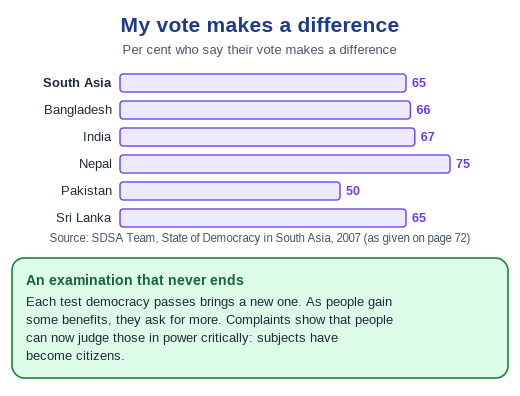
Let us revise, page 72: a cartoon about a famous act of courage on a bus during the civil rights struggle in the USA, in which present-day leaders are shown as small beside her, and a graph of people who say their vote makes a difference. Which sentences of the section “Dignity and freedom of the citizens” connect to them? Ideas from the section that connect (in our own words; underline the matching sentences in your book):
- Cartoon: that each person wants to be respected by others, and quarrels start when people feel disrespected; that the passion for respect and freedom is the basis of democracy; and that once equal dignity is recognised as a principle, it becomes easier to struggle against discrimination, which is now wrong in law and morals.
- Graph: that most people today believe their vote affects the way they are governed and their own interests (65 per cent across South Asia, and 50 to 75 per cent in each country surveyed), and that democracy turns people from subjects into citizens.
Poster, page 74: how to cast your vote using the electronic voting machine and the paper trail slip, from the Election Commission of India. It has no question. It shows the steps in a polling booth: entering, pressing the button against the candidate of your choice, seeing the light, and checking the printed slip.
Exercises (pages 73–74)
1. “How does democracy produce an accountable, responsive and legitimate government?”
Answer: Democracy makes the government answer to the people through elections, open debate and the right to information; and because the people choose it, they accept it as their own.
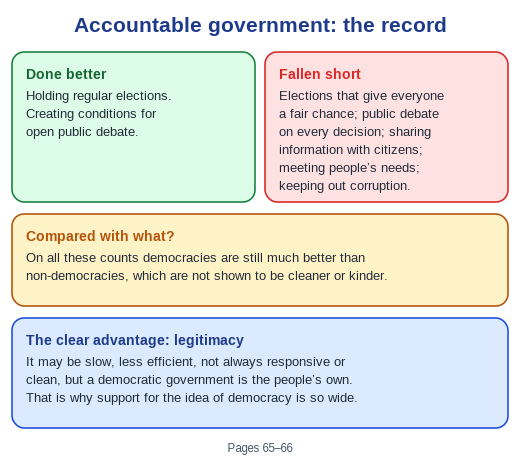
- Accountable (answerable to the people): people elect their rulers in regular elections and can remove them.
- Transparency (openness): decisions are taken by rules and procedures. A citizen has the right and the means to check whether a decision followed the correct procedure.
- Right to information and open debate: citizens can ask about the government and its working, and major policies and laws are debated in public.
- Responsive (attentive to people’s needs): rulers must face voters again, so they have a reason to listen to people’s needs and demands. An independent press, opposition parties and public debate bring problems to the government’s notice.
- Legitimate (accepted as rightful): a democratic government is the people’s own government. It may be slow or less efficient, but people accept it and its decisions.
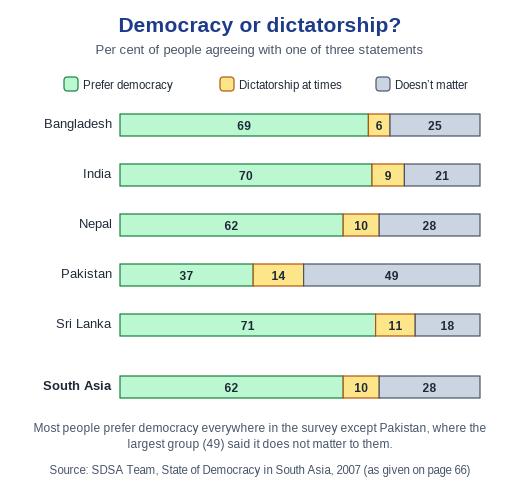
- Wide support: in the chapter’s South Asia survey, 94 per cent agreed with rule by leaders elected by the people.
- The honest record: democracies do better at regular elections and open debate than at sharing information, meeting people’s needs and controlling corruption. Still, they do much better than non-democracies on elections and debate, and nothing shows that non-democracies are less corrupt.
2. “What are the conditions under which democracies accommodate social diversities?”
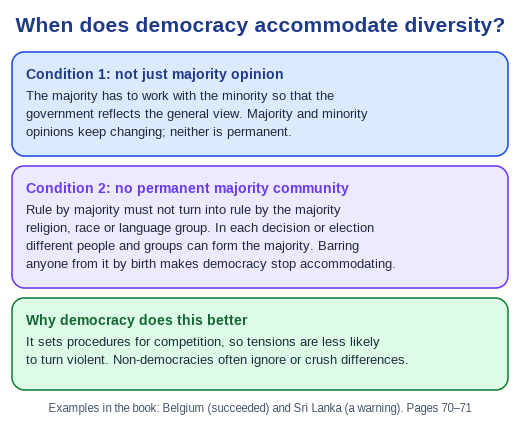
Answer: Democracy makes room for social diversity when majority rule does not become the rule of one fixed community, and every citizen can be part of the majority at some time.
- Not just majority opinion: democracy is not simply rule by majority opinion. The majority must work with the minority, so that the government represents the general view.
- Majority is not fixed: majority and minority opinions change; they are not permanent groups.
- Not the rule of one community: majority rule must not become rule by the majority community of a religion, race or language group.
- A chance for everyone: in each decision or election, different persons and groups can form a majority. If someone is barred from the majority because of birth, democracy stops making room for that person or group.
- Peaceful competition: democracies develop procedures for groups to compete, so tensions do not turn violent.
- Examples (Chapter 1): Belgium met these conditions and stayed united. Sri Lanka did not, and distrust grew into conflict.
3. “Give arguments to support or oppose the following assertions:”
(a) “Industrialised countries can afford democracy but the poor need dictatorship to become rich.”
Answer (oppose): The evidence shows that dictatorship does not make poor countries grow faster.
- Table 1 (1950–2000): poor countries under dictatorship grew at 4.34, and poor countries under democracy at 4.28. The difference is negligible (very small).
- Other factors: growth depends on the country’s population size, the global situation, cooperation from other countries and its economic priorities.
- What democracy adds: a legitimate government, dignity, freedom and a voice to demand a fair share. A dictatorship cannot give these.
- Conclusion: poor countries do not need to give up democracy to become rich.
(b) “Democracy can’t reduce inequality of incomes between different citizens.”
Answer: Partly true, because democracies have not done well at it so far; but it is not impossible.
Support:
- The chapter says democracies do not appear very successful in reducing economic inequality.
- In South Africa and Brazil (Table 2), the top 20 per cent take more than 60 per cent of the national income. The bottom 20 per cent get less than 3 per cent.
- A small number of ultra-rich people hold a large and growing share of wealth.
Oppose:
- Denmark and Hungary, also in Table 2, are far more equal: their bottom 20 per cent get 9.6 and 10.0 per cent of income.
- Political equality gives every poor person a vote. If the poor organise, they can push governments for policies that reduce the gap.
(c) “Government in poor countries should spend less on poverty reduction, health, education and spend more on industries and infrastructure.”
Answer (oppose, with a balance): Poor countries need both kinds of spending; cutting the spending on people’s basic needs would be wrong in a democracy.
- Industry needs people: industries and infrastructure (roads, power and the like) help growth, but they need healthy and educated workers.
- Growth may not reach the poor: the inequality data in the chapter show that growth alone does not reach everyone.
- Basic needs: the chapter notes that the poor sometimes cannot meet basic needs such as food, clothing, house, education and health.
- Democracy must listen to the majority: the poor are a large share of voters, so their needs cannot be ignored.
- Conclusion: a sensible government balances spending on people with spending on industry.
(d) “In democracy all citizens have one vote, which means that there is absence of any domination and conflict.”
Answer (oppose): One vote gives political equality, but it does not end domination or conflict.
- Political equality: every citizen’s vote has equal weight in choosing representatives.
- Economic domination: at the same time economic inequality grows; a few ultra-rich people hold a large and growing share of wealth.
- Social differences: differences of caste, religion and language continue. Conflicts arise when some people feel they are not treated with respect.
- Women and caste: women and disadvantaged castes still face unequal treatment, and caste-based atrocities still happen.
- What democracy does: it gives a peaceful way to handle conflicts, and it takes away the legal and moral basis for domination.
4. “Identify the challenges to democracy in the following descriptions. Also suggest policy/institutional mechanism to deepen democracy in the given situations:”
(a) “Following a High Court directive, a temple in Orissa that had separate entry doors for dalits and non-dalits allowed entry for all from the same door.”
Challenge: caste discrimination, and the denial of equal dignity to some citizens. The change came only after a court order, which shows how deep the practice was.
Mechanisms:
- Strict use of the constitutional ban on untouchability and of the laws against caste discrimination.
- An independent judiciary that citizens can approach.
- Awareness campaigns against caste practices.
- Representation of disadvantaged groups in local bodies, so that their voice is heard.
(b) “A large number of farmers are committing suicide in different states of India.”
Challenge: deep economic distress and inequality, and a government not responsive enough to a large section of citizens.
Mechanisms:
- Easier and cheaper loans from banks and cooperatives, so farmers are not trapped by high-interest loans.
- Crop insurance and fair prices for their produce.
- Help when crops fail, better irrigation and good farming advice.
- Farmers’ associations and local bodies that carry farmers’ problems to the government.
- Mental-health support and helplines in rural areas.
(c) “Following an allegation of killing of three civilians in Gandwara in a fake encounter by Jammu and Kashmir police, an enquiry has been ordered.”
Challenge: protecting citizens’ right to life and liberty from misuse of power by security forces, and making the state accountable to its people.
Mechanisms:
- Quick, impartial (fair, not taking sides) enquiries, and punishment for those found guilty.
- Independent human rights commissions.
- Courts that citizens can approach.
- Clear rules for police conduct, and training in human rights.
- An open flow of information through the media, so that such allegations come to light.
5. “In the context of democracies, which of the following ideas is correct– democracies have successfully eliminated: A. conflicts among people B. economic inequalities among people C. differences of opinion about how marginalised sections are to be treated D. the idea of political inequality”
D. the idea of political inequality.
- In a democracy every citizen has one vote of equal weight, so political inequality is no longer accepted as an idea.
- Conflicts (A), economic inequalities (B) and differences of opinion (C) still exist in democracies; the chapter discusses each of them.
6. (Restated) In the context of assessing democracy, which among the following is the odd one out? Democracies need to ensure: A. elections that are regular, open and fair B. dignity of the individual C. majority rule D. equal treatment before law
C. majority rule.
- A, B and D are things a democracy must secure for every citizen.
- Majority rule is only a way of taking decisions.
- The chapter warns that democracy is not simply rule by majority opinion: the majority must work with the minority and must not become a fixed community.
7. “Studies on political and social inequalities in democracy show that: A. democracy and development go together. B. inequalities exist in democracies. C. inequalities do not exist under dictatorship. D. dictatorship is better than democracy.”
B. inequalities exist in democracies.
- Table 2 shows high income inequality in democracies such as South Africa and Brazil.
- The chapter also discusses continuing caste and gender inequality in democracies.
- The other options do not follow: the chapter says democracy does not make development certain (A), it never says dictatorships have no inequality (C), and it prefers democracy (D).
8. (Restated: the passage names a person.) The exercise gives a passage about a daily wage earner living in a slum colony in East Delhi. After losing his ration card, he asked for a new copy in January 2004. For three months he kept visiting the local Food and Civil Supplies office, but the clerks and officials ignored him and would not even tell him the status of his application. He then filed an application under the Right to Information Act, asking for the daily progress on his application, the names of the officials responsible, and what action would be taken against them for not acting. Within a week, an inspector from the Food Department visited him to say the card was ready. When he went to collect it, the Food and Supply Officer, the head of the Circle, welcomed him warmly, offered him tea and asked him to withdraw his application since his work was done. The questions: what does his example show? What impact did his action have on officials? Ask your parents about their experiences when they approach government officials to deal with their problems.
Answer: It shows that the Right to Information makes officials accountable: an ordinary citizen got his work done just by asking questions under the law.
What it shows:
- The Right to Information is a strong tool of accountability (making officials answer for their work).
- An ordinary citizen, with no money or influence, made officials do their duty.
- He only asked, under the law, about the progress of his application, the names of the officials responsible and the action against them.
- This is the transparency the chapter speaks of: citizens have the right and the means to check how decisions are made.
- Democracy creates such rights, but citizens have to use them.
Impact on officials:
- Officials who had ignored him for three months acted within a week.
- They knew they could now be named and made to answer for not acting.
- The warm welcome, the tea and the request to withdraw the application show that they feared being exposed and facing action.
Ask your parents: this is a personal activity. Ask what office they went to, how they were treated, how long the work took, and whether anything (a complaint, a helpline, an online service or a right to information application) helped. Compare their experiences with this example.
Note
- Exercise 6 is restated rather than quoted because the wording of option A contains a word the site does not print; the option means elections in which people can vote as they choose and every candidate gets a fair chance.
- Exercise 8 is restated rather than quoted because its passage names a private person; the questions are given in our own words.
Practice
-
In the chapter’s South Asia survey, what share of people in the region said democracy is preferable?
Show answer
Answer: (b) 62 per cent
-
In the chapter’s survey, in which country did the largest share of people say their vote makes a difference?
Show answer
Answer: (c) Nepal
-
Which of these have democracies successfully eliminated, according to Exercise 5?
Show answer
Answer: (d) The idea of political inequality
-
Why is majority rule the odd one out in Exercise 6?
Show answer
Answer: The other three, fair elections, dignity of the individual and equal treatment before law, are things every democracy must secure for all citizens. Majority rule alone is not enough; the chapter says democracy is not simply rule by majority opinion and the majority must work with the minority.
-
What does the right to information example in Exercise 8 show about accountability?
Show answer
Answer: That a citizen can make officials answerable. A legal right to ask for information on the progress of an application, and on which officials were responsible, made the officials act within a week.
Stuck on a question?
Take a photo and Lagnever AI explains it step by step. Try it for 7 days for ₹2.
Get it on Google Play Open in browser
For parents: after the trial, the plan renews monthly by UPI or card autopay. You can cancel anytime in the app.