
Class 10 Political Science Chapter 5: Outcomes of Democracy Notes
This chapter in five lines
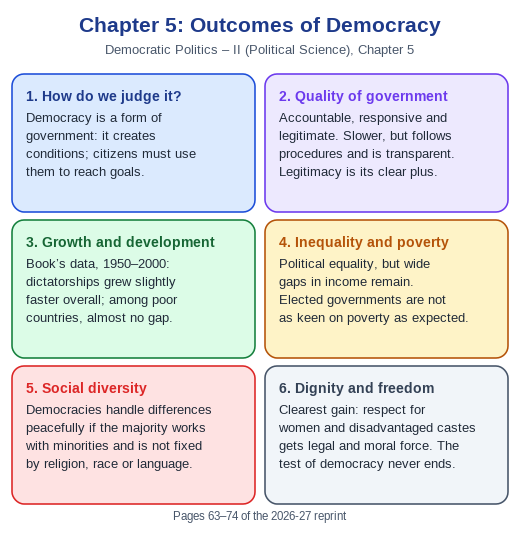
Democracy is only a form of government: it sets up conditions, and citizens must use them. Judged by its outcomes, it produces an accountable, responsive and above all legitimate government. On economic growth, the book’s data show dictatorships only slightly ahead, and no real gap among poor countries. Democracies have not done well at reducing inequality and poverty. They handle social differences peacefully when the majority works with minorities, and they stand far ahead of other forms of government in promoting the dignity and freedom of citizens.
What is this chapter about?
Earlier chapters of Democratic Politics – II looked at particular parts of democracy: sharing power, federalism, social divisions and political parties. This last chapter, which forms Unit IV of the book, steps back and asks a broader question. What can we fairly expect democracy to deliver, and does it deliver it in real life? It first settles how to judge outcomes, then takes up five areas in turn: how good the government is, how people fare economically, gaps between rich and poor, the handling of social differences, and citizens’ dignity and freedom.
How should we judge what democracy delivers?
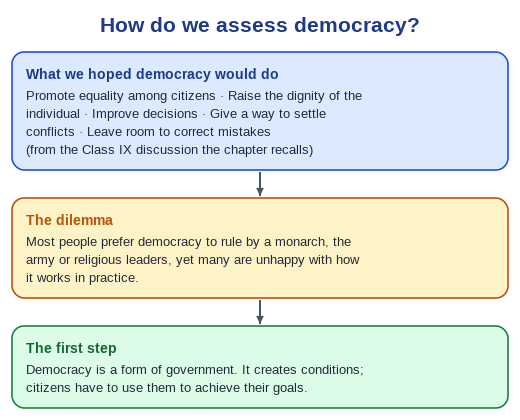
The chapter recalls the Class IX discussion in which students concluded that democracy is better than its alternatives because it promotes equality, raises individual dignity, improves decisions, offers a way to settle conflicts and leaves room to correct mistakes. Yet many people who prefer democracy to rule by a king, the army or religious leaders are still unhappy with how it works. To get out of this puzzle, the chapter makes one point first: democracy is only a form of government. It can set up favourable conditions, but citizens themselves must use them to reach their goals. So the fair question is what any democracy can be expected to do just by being a democracy. Read Accountable and legitimate government
Does democracy give accountable, responsive and legitimate government?
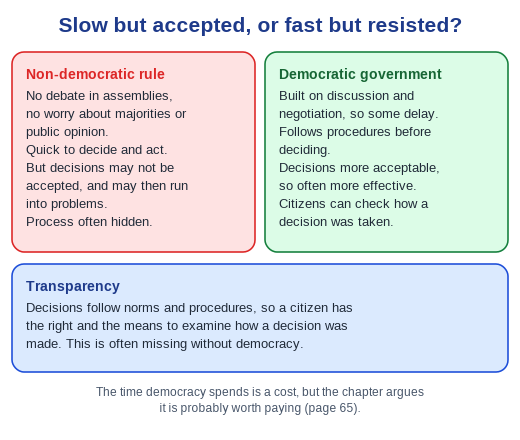
The most basic outcome should be a government that answers to citizens and attends to their needs. Some say democracy is slow. It is, because it works through discussion and negotiation, but decisions that follow procedures are more widely accepted and so may work better; the time spent is a cost worth paying. Democracy also offers transparency: a citizen can check whether a decision followed the rules. The record is mixed. Democracies hold regular elections and allow open debate, but fall short on fair chances for all, public debate on every decision, sharing information, meeting needs and controlling corruption. Even so, they do better than non-democracies, and one advantage is certain: a democratic government is legitimate, the people’s own.
How strong is support for democracy?
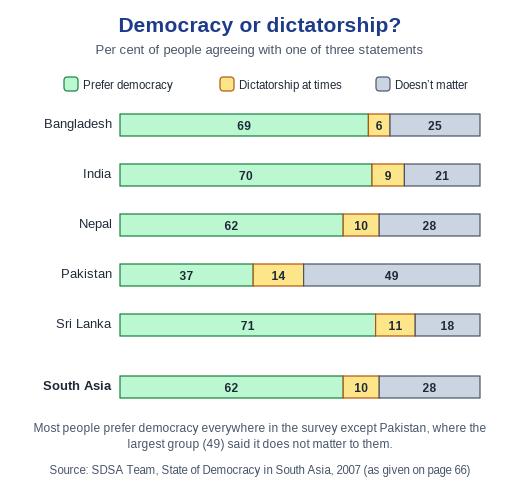
The chapter backs the point on legitimacy with surveys from South Asia (the book cites the SDSA Team’s 2007 report on democracy in South Asia). Across the region, 62 per cent preferred democracy, 10 per cent said dictatorship is sometimes better and 28 per cent said it does not matter. In the region as a whole, 88 per cent called democracy suitable for their country, and 94 per cent agreed with rule by leaders the people elect. The support appears in countries with and without democratic rule. Democracy’s ability to create its own support is, the chapter says, an outcome in itself.
Does democracy bring economic growth?
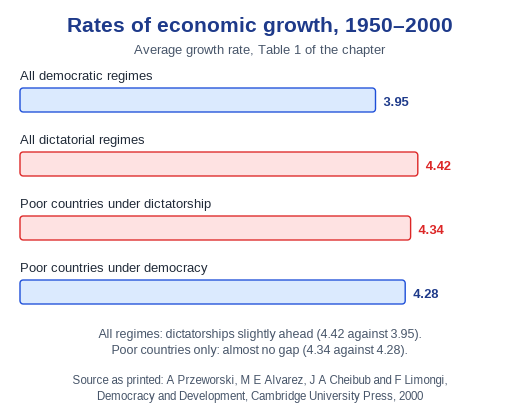
If democracy gives good government, should it not also bring development? The chapter’s evidence says not always. Taking all democracies and all dictatorships from 1950 to 2000, dictatorships grew slightly faster (4.42 against 3.95 in Table 1). But among poor countries the difference almost disappears (4.34 against 4.28). Growth depends on many things, such as population, the global situation, help from other countries and a country’s economic priorities. So democracy cannot promise development, but it need not lag behind dictatorship, and its other outcomes make it the better choice. Read Democracy, development and dignity
Has democracy reduced inequality and poverty?
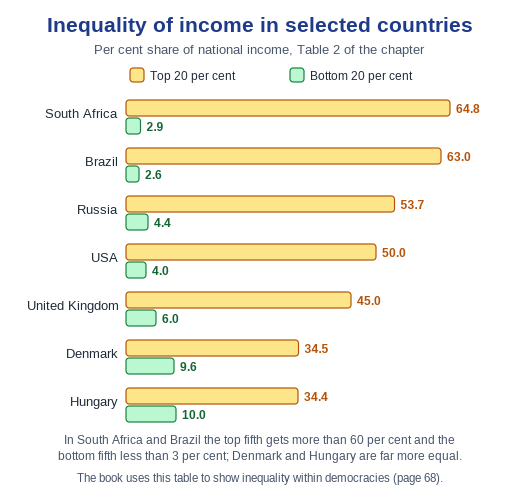
Democracy rests on political equality: every vote counts the same. Alongside it, the chapter notes, economic gaps have grown. A small group of the very rich holds a large and rising share of income, while those at the bottom struggle to meet basic needs. Table 2 shows that inequality can be very high within democracies: in South Africa and Brazil the richest fifth takes over 60 per cent of national income and the poorest fifth under 3 per cent, while Denmark and Hungary are far more equal. The poor are a large share of voters, yet elected governments have not been as keen to tackle poverty as one would expect.
Can democracy accommodate social diversity?
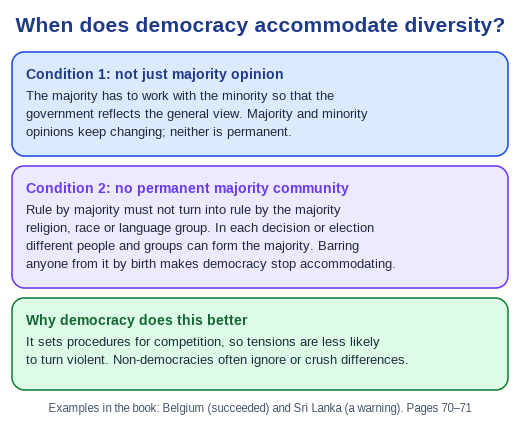
No society can end conflict between groups for good, but people can learn to respect differences and build ways to negotiate them. Democracies set rules for competition, which makes tensions less likely to turn violent, while non-democracies often ignore or suppress differences. The chapter recalls Belgium’s success and treats Sri Lanka as a warning, and draws two conditions. Democracy is not just rule by majority opinion: the majority must work with the minority, and neither is permanent. And majority rule must not turn into the rule of one religious, racial or language community: every citizen should be able to end up in the majority at some point.
How does democracy promote dignity and freedom?
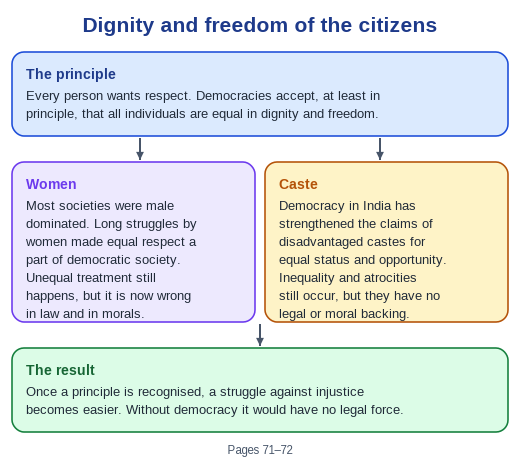
Here democracy is far ahead of every other form of government. Every person wants respect, and conflicts often begin when people feel they are not treated with it. Democracies accept, at least in principle, that all individuals are equal. Women’s long struggles have made respect for women part of what a democratic society means; unequal treatment still happens, but it is now wrong in law and in morals, which makes it easier to fight. In India, democracy has strengthened the claims of disadvantaged castes for equal status and opportunity in the same way. Finally, democracy’s examination never ends: people ask for more, and their complaints show they have become citizens, not subjects.
Before we move on
This is the last chapter of the Political Science book. It draws on the earlier chapters: power sharing in Belgium and Sri Lanka in Chapter 1, Chapter 2, Federalism, social divisions in Chapter 3, and Chapter 4, Political Parties. Answers to every exercise and to the questions inside this chapter are in the NCERT solutions for Chapter 5.
Key terms
| Term | Meaning |
|---|---|
| Outcome | What a form of government actually delivers in practice, as against what it promises in principle. |
| Accountable government | A government that answers to the citizens, who can question it and remove it through elections. |
| Responsive government | A government that listens to what people need and expect, and acts on it. |
| Legitimate government | A government that people accept as rightfully theirs, because they chose it themselves. |
| Transparency | A citizen’s right and means to find out whether a decision was taken by the correct procedure. |
| Deliberation | Careful discussion of a matter, as in an assembly, before a decision is taken. |
| Dictatorship | Rule by a person or group that does not depend on the people’s choice and is not answerable to them. |
| Economic inequality | Large gaps in income and wealth between groups of people, for example between the richest fifth and the poorest fifth. |
| Political equality | Every adult citizen’s vote has the same weight in choosing representatives. |
| Accommodation of social diversity | Making room for different social groups, so that their differences are negotiated peacefully instead of being ignored or crushed. |
| Dignity | The respect every person deserves as a human being and an equal citizen. |
Topics in this chapter
Practice
-
According to Table 1 of the chapter, which group had the highest average rate of economic growth between 1950 and 2000?
Show answer
Answer: (b) All dictatorial regimes
-
The right and the means of a citizen to examine how a decision was made is called:
Show answer
Answer: (b) transparency
-
On which count does the chapter say democracy clearly beats other forms of government?
Show answer
Answer: (c) It is legitimate
-
In which two countries of Table 2 does the bottom 20 per cent get less than 3 per cent of national income?
Show answer
Answer: (b) South Africa and Brazil
-
Rule by majority stops being accommodative when:
Show answer
Answer: (b) someone is barred from being in the majority because of birth
-
Why does the chapter say people’s complaints about democracy show its success?
Show answer
Answer: (b) They show people can judge those in power critically
Questions students ask
What are the main topics of Class 10 Political Science Chapter 5?
How to judge what democracy delivers, and five outcomes in turn: accountable, responsive and legitimate government; economic growth and development; reduction of inequality and poverty; accommodation of social diversity; and the dignity and freedom of citizens.
Is Outcomes of Democracy in the 2026-27 NCERT book?
Yes. It is Chapter 5, the last chapter, of Democratic Politics – II, the Class 10 Political Science textbook marked Reprint 2026-27, on pages 63 to 74. These notes follow the copy of the book now on NCERT’s website.
Does the chapter say dictatorships are better for the economy?
No. Its data show dictatorships slightly ahead on average growth, but almost no difference among poor countries. It says growth depends on many factors besides the form of government, and that democracy should be preferred because of its other positive outcomes.
Why do these notes not discuss any present-day government?
The chapter gives general arguments and survey tables with their sources and years. This site stays strictly neutral, so the notes present the book’s data as the book gives them and do not judge any real government.
Stuck on a question?
Take a photo and Lagnever AI explains it step by step. Try it for 7 days for ₹2.
Get it on Google Play Open in browser
For parents: after the trial, the plan renews monthly by UPI or card autopay. You can cancel anytime in the app.