
Accountable, Responsive and Legitimate Government
Answer in short
Democracy is a form of government that sets up conditions citizens can use. Its most basic outcome is a government accountable and responsive to citizens. It may be slower, but its decisions follow procedures, are more acceptable and can be checked. Its record on fairness, information and corruption is mixed, but a democratic government is legitimate: the people’s own.
Stuck on a question? Take a photo and Lagnever AI explains it step by step. Try it for 7 days for ₹2. Get it on Google Play
Why do we need to think about outcomes?
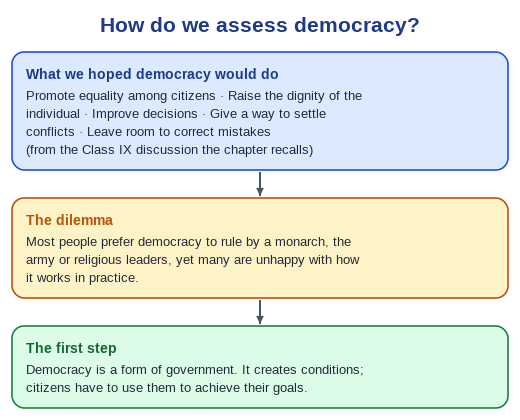
In Class IX, students in a classroom discussion decided that democracy beats dictatorship and other systems because it promotes equality, raises the dignity of each person, improves decisions, gives a method for resolving conflicts and leaves room to correct mistakes. But are these hopes met in practice? Most people around us would choose democracy over rule by a monarch, the military or religious leaders, yet many of them are not satisfied with democracy as it works. The chapter calls this a dilemma: democracy looks good in principle and less good in practice.
Over a hundred countries today have some form of democratic politics, with constitutions, elections, parties and citizens’ rights. Still, they differ a lot in their society, economy and culture, so their achievements differ too. The chapter therefore asks whether there is anything we can expect from every democracy, simply because it is one.
Democracy is only a form of government
Because we admire democracy, we may expect it to fix every problem in society, the economy and politics. When some hopes are not met, we blame the idea of democracy, or doubt that we live in one. The chapter’s first step is to see democracy as a form of government and nothing more. It sets up conditions in which things can be achieved; citizens themselves must use those conditions to reach the goals.
What is the most basic outcome?
In a democracy, people pick their rulers and keep a check on them, and, wherever possible and needed, citizens take part in decisions that affect them all. So the most basic outcome should be a government that is:
- accountable: it answers to citizens, and
- responsive: it attends to what people need and expect.
Is democratic government efficient?
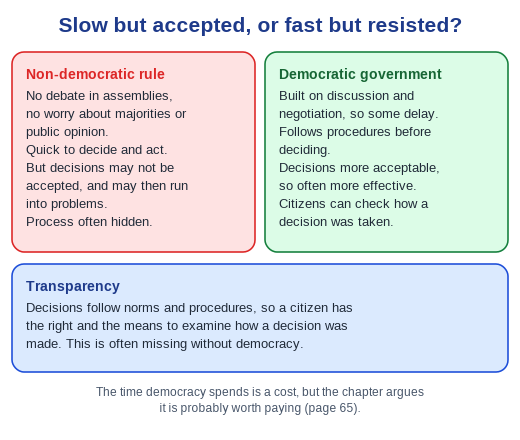
A common objection is that democratic governments get less done. It is true that non-democratic rulers need not worry about debate in assemblies, majorities or public opinion, so they can decide and act quickly. Democracy works through deliberation and negotiation, which always takes some time.
The chapter asks us to think in terms of costs. A government that decides very fast may take decisions people do not accept, and then face problems. A democratic government spends more time on procedures, but for that very reason its decisions may be more acceptable and more effective. The cost in time is probably worth paying.
There is another side too. Because democratic decisions follow norms and procedures, any citizen can find out whether a decision went through the proper steps. She is entitled to look into the process, and has ways of doing so. This is transparency, and it is often missing in non-democratic government. So it is fair to expect a democracy to follow procedures, to be accountable, and to build ways for citizens to hold it to account and to take part in decisions.
How do democracies actually score?
To measure democracies by this outcome, the chapter suggests looking for three things: elections held regularly that are open and fair; open discussion of major policies and laws; and a right for citizens to know what the government is doing and how.
The real record is mixed:
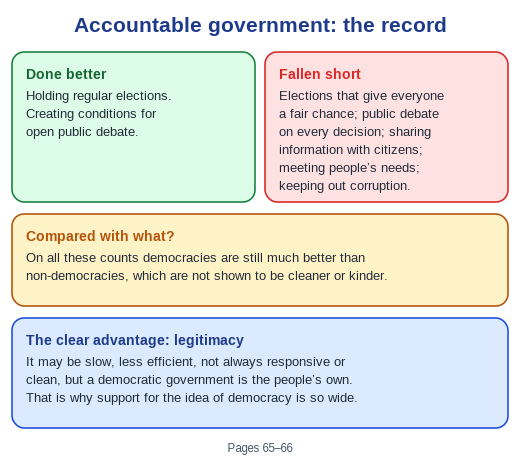
- Democracies have done better at holding regular elections and creating conditions for open public debate.
- Most fall short of elections that give everyone a fair chance, and of putting every decision to public debate.
- Their record on sharing information with citizens is not good.
- On being attentive to people’s needs and largely clean of corruption, the record is not impressive either: democracies often ignore what most of their people want, and stories of corruption are common.
But the comparison matters. On all these counts democracies are much better than non-democratic regimes, and there is no evidence that non-democracies are cleaner or more caring towards people.
Why is legitimacy democracy’s clear advantage?
On one count democracy clearly wins: its government is legitimate. It can be slow, not very efficient, and not always responsive or honest, yet the people regard it as their own. People prefer to be governed by representatives they choose, and they believe democracy suits their country.
The chapter shows this with surveys from South Asia, which the book takes from the SDSA Team’s 2007 report on the state of democracy in South Asia:
- Across the region, 62 per cent said democracy is preferable, 10 per cent said dictatorship is sometimes better, and 28 per cent said it does not matter to them. Most people preferred democracy in every country surveyed except Pakistan, where 37 per cent preferred it and 49 per cent said it does not matter.
- 88 per cent in the region said democracy is suitable or very suitable for their country.
- 94 per cent agreed or strongly agreed with rule by leaders elected by the people.
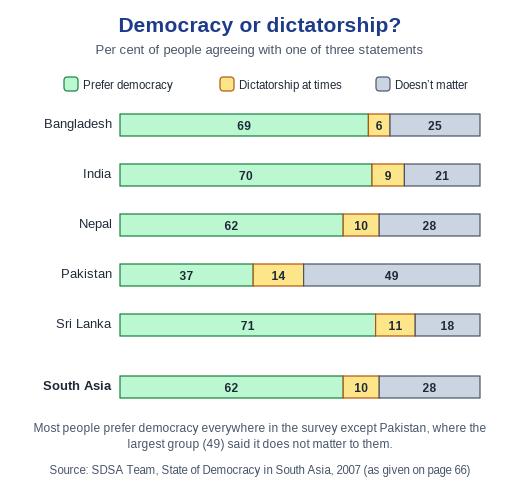
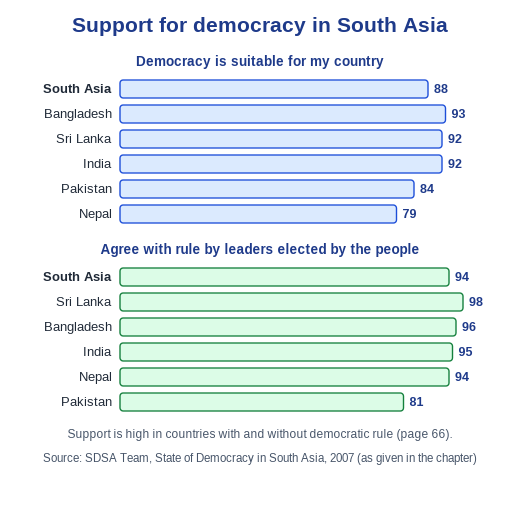
The support is found both where democracy is in place and where it is not. For the chapter, the fact that democracy wins people’s backing on its own is an important outcome in itself.
Next, read Democracy, development and dignity, or go back to the chapter notes and the NCERT solutions.
Practice
-
Why can non-democratic rulers often decide faster?
Show answer
Answer: (b) They need not bother about debate in assemblies, majorities or public opinion
-
Which of these is NOT one of the practices the chapter says you would look for to measure accountable government?
Show answer
Answer: (d) A single ruling party
-
In the chapter’s South Asia survey, which country had the lowest share of people saying democracy is preferable?
Show answer
Answer: (d) Pakistan
-
Explain why the chapter thinks the time democracy takes is worth it.
Show answer
Answer: A government that decides very fast may take decisions people do not accept, and then run into problems. A democratic government takes longer because it follows procedures, but for that reason its decisions are more acceptable to people and may be more effective.
-
What does it mean to say democracy can generate its own support?
Show answer
Answer: People in many countries, including some without democratic rule, want representatives they elect to govern them and think democracy suits their country. This wide support is itself an outcome of democracy, because a democratic government is seen as the people’s own.
Questions students ask
What is the difference between accountable and responsive government?
An accountable government answers to citizens: they can question it, examine its decisions and remove it at elections. A responsive government pays attention to people’s needs and expectations. The chapter expects both, and says democracies do better on the first than on the second.
What is transparency in democracy?
It means a citizen is entitled, and able, to check whether a decision went through the proper steps. Because democratic decisions follow norms and procedures, they can be examined. The chapter says this is often missing in a non-democratic government.
Is democracy legitimate even if it is slow?
Yes. The chapter grants that a democratic government can be slow, not very efficient and not always responsive or honest, but people still see it as their own, and that is why it is legitimate.
Stuck on a question?
Take a photo and Lagnever AI explains it step by step. Try it for 7 days for ₹2.
Get it on Google Play Open in browser
For parents: after the trial, the plan renews monthly by UPI or card autopay. You can cancel anytime in the app.