
Democracy, Development and Dignity
Answer in short
The chapter’s data show dictatorships growing slightly faster than democracies from 1950 to 2000, but almost no gap among poor countries. Democracies give political equality yet have done little to cut economic inequality and poverty. They handle social differences peacefully when the majority works with minorities, and lead every other system in protecting dignity and freedom.
Stuck on a question? Take a photo and Lagnever AI explains it step by step. Try it for 7 days for ₹2. Get it on Google Play
Should democracy bring development?
If democracies give good government, it seems fair to expect them to bring development as well. The evidence the chapter presents shows that many democracies have not met this hope.
Table 1 in the chapter compares growth rates for 1950 to 2000:
| Type of regime | Growth rate |
|---|---|
| All democratic regimes | 3.95 |
| All dictatorial regimes | 4.42 |
| Poor countries under dictatorship | 4.34 |
| Poor countries under democracy | 4.28 |
Source as printed in the book: A Przeworski, M E Alvarez, J A Cheibub and F Limongi, Democracy and Development, Cambridge University Press, 2000.
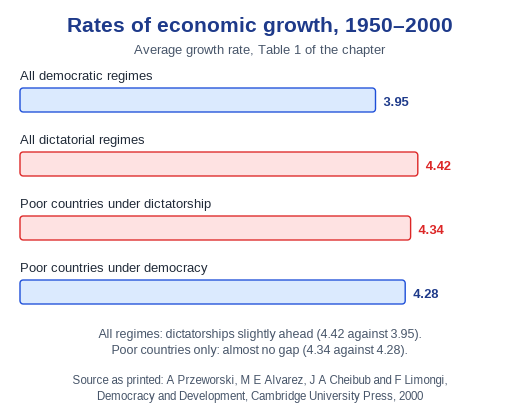
Read the table in two steps. Across all countries, dictatorships grew a little faster. Among poor countries only, the gap is almost nothing. The chapter adds that development depends on several factors, such as population size, the global situation, cooperation from other countries and the economic priorities a country chooses. So democracy cannot promise development, but it should not lag behind dictatorship, and because it has many other positive outcomes it is still the better choice.
Do democracies reduce inequality?
Perhaps more than growth, we might expect democracy to narrow economic gaps.
Democracy rests on political equality: every person’s vote has equal weight. Yet, side by side with this, economic inequality has grown. A tiny group of the very rich holds a highly unequal share of wealth and income, and that share has been rising, while people at the bottom have little to depend on and sometimes cannot meet basic needs such as food, clothing, housing, education and health.
Table 2 in the chapter shows how unequal incomes can be within democracies:
| Country | Top 20 per cent | Bottom 20 per cent |
|---|---|---|
| South Africa | 64.8 | 2.9 |
| Brazil | 63.0 | 2.6 |
| Russia | 53.7 | 4.4 |
| USA | 50.0 | 4.0 |
| United Kingdom | 45.0 | 6.0 |
| Denmark | 34.5 | 9.6 |
| Hungary | 34.4 | 10.0 |
Per cent share of national income, as given in the book; no separate source is printed for this table.
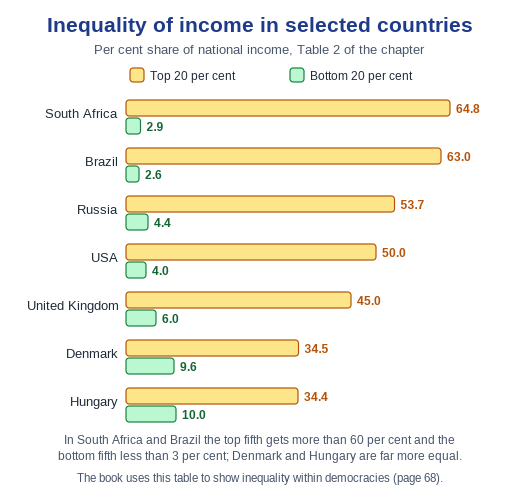
In South Africa and Brazil the richest fifth gets over 60 per cent of national income and the poorest fifth under 3 per cent. Denmark and Hungary are much more equal.
Why has poverty not been tackled more?
In practice, democracies have not been very successful at reducing inequality. In India the poor are a large share of voters, and no party wants to lose their votes, yet elected governments seem less eager to tackle poverty than one would expect. The chapter notes that things are worse elsewhere: in Bangladesh over half the population lives in poverty, and several poor countries now depend on rich ones even for food.
Can democracy accommodate social diversity?
A peaceful, harmonious social life is a fair thing to expect from democracy. Earlier chapters showed how democracies make room for social divisions, for example Belgium’s success in negotiating differences between ethnic communities. Democracies usually develop rules for competition between groups, which makes tensions less likely to become explosive or violent.
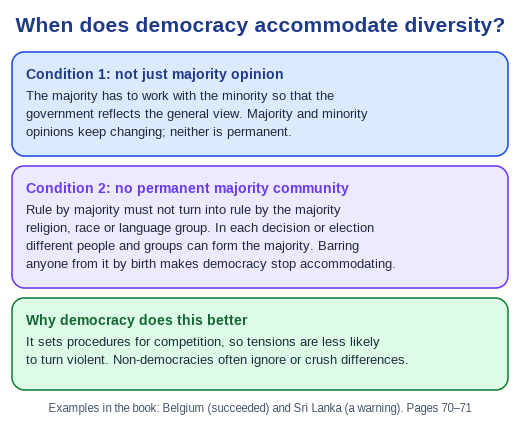
No society can settle conflicts between groups fully and for ever. But people can learn to respect differences and build ways to negotiate them, and democracy suits this task well. Non-democratic regimes often look away from social differences or suppress them. So the ability to handle differences is a definite strength of democracy. Sri Lanka, though, is a reminder that two conditions must be met:
- Democracy is not simply rule by majority opinion. The majority has to work with the minority so that the government reflects the general view. Majority and minority opinions change; neither is permanent.
- Majority rule must not become rule by a majority community. It must not mean rule by one religion, race or language group. In each decision or election, different people and groups can form the majority. Democracy stays democratic only while every citizen has a chance to be in the majority at some point; anyone barred from it by birth is no longer accommodated.
How does democracy protect dignity and freedom?
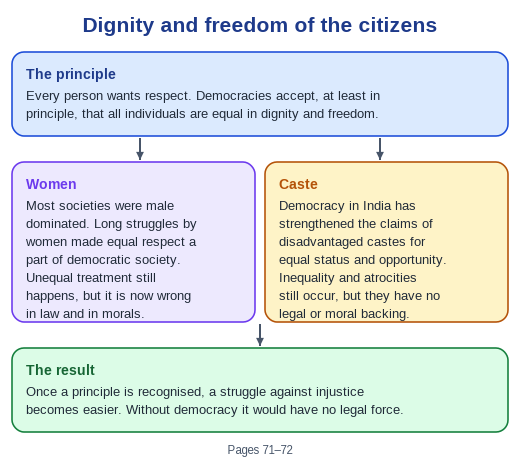
On this outcome democracy is far ahead of any other form of government. Everyone wants respect from others, and conflicts often start when people feel they are not treated with it. The desire for respect and freedom lies at the root of democracy, and democracies across the world accept this, at least in principle, to different degrees.
- Women. Most societies were historically dominated by men. Long struggles by women have made respect and equal treatment of women part of what a democratic society needs. That does not mean women are always respected, but once the principle is accepted, it is easier to fight what is now wrong in law and in morals. Without democracy, such a fight would have no legal basis.
- Caste. In India, democracy has given more weight to the demands of castes that faced disadvantage and discrimination for equal standing and equal chances. Caste inequality and atrocities still occur, but they have no moral or legal foundation.
Why does democracy’s examination never end?
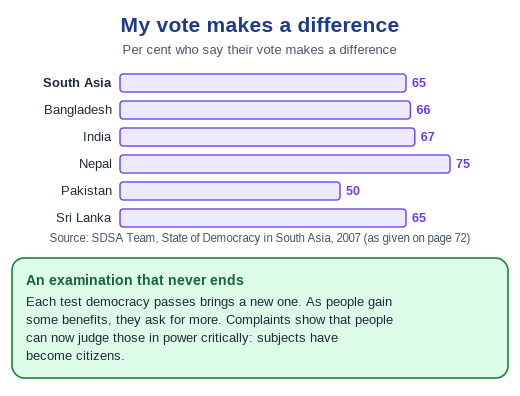
The expectations we have of democracy also become the yardsticks for judging any democracy. What makes democracy unusual is that its test is never over: when it passes one, people set another. As they get some benefits, they want more and want to improve democracy further. So whenever people are asked, they voice fresh hopes and plenty of complaints.
The chapter reads these complaints as a sign of success. They show that people have become aware, can expect things and can look critically at those in power. Public dissatisfaction turns people from subjects into citizens. Most people today believe their vote affects how the government runs and their own interests: in the chapter’s survey, 65 per cent across South Asia said their vote makes a difference.
Next, try the NCERT solutions, or go back to Accountable and legitimate government and the chapter notes.
Practice
-
According to Table 1, the growth rate of poor countries under democracy between 1950 and 2000 was:
Show answer
Answer: (b) 4.28
-
In which country of Table 2 does the bottom 20 per cent get the largest share of national income?
Show answer
Answer: (c) Hungary
-
Which country does the chapter give as an example of successfully negotiating differences among ethnic groups?
Show answer
Answer: (b) Belgium
-
Why can poor democracies not be blamed alone for slow growth?
Show answer
Answer: Because economic development depends on many factors besides the form of government: the size of the population, the global situation, cooperation from other countries and the economic priorities the country chooses.
-
Give one example from the chapter of democracy promoting dignity.
Show answer
Answer: Women: long struggles have made respect and equal treatment of women part of a democratic society. Unequal treatment still happens, but it is now unacceptable in law and morals, so women can fight it more easily. Disadvantaged castes in India gained in the same way.
Questions students ask
Does democracy reduce poverty?
Not as much as expected, the chapter says. The poor are a large share of voters, yet elected governments do not appear keen enough to deal with poverty, and the situation is worse in some other countries. The chapter mentions that more than half of Bangladesh’s population lives in poverty.
What does it mean that democracy’s examination never gets over?
Each time democracy meets one expectation, people raise another. As they gain some benefits, they ask for more. This is why surveys always find complaints, and the chapter treats those complaints as a sign of success.
Why are Sri Lanka and Belgium mentioned in this chapter?
They come from Chapter 1 of the book. Belgium shows a democracy negotiating differences successfully; Sri Lanka is a reminder that democracy accommodates diversity only when the majority does not become a fixed community that shuts others out.
Stuck on a question?
Take a photo and Lagnever AI explains it step by step. Try it for 7 days for ₹2.
Get it on Google Play Open in browser
For parents: after the trial, the plan renews monthly by UPI or card autopay. You can cancel anytime in the app.