
Class 10 Political Science Chapter 4: Political Parties Notes
This chapter in five lines
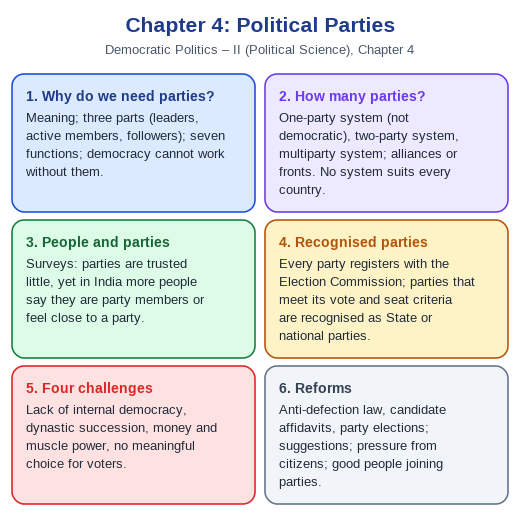
A political party is a group of people who join together to fight elections and win power in government. Parties contest elections, offer policies, make laws, run governments, act as opposition, shape opinion and connect people to the government, so modern democracy cannot work without them. India has a multiparty system. Parties face four challenges, weak internal democracy, dynastic succession, money and muscle power, and little real choice, and the chapter discusses how they can be reformed.
What is this chapter about?
Political parties have come up again and again in this book: as partners in sharing power between levels of government, and as the channels through which social divisions reach politics. This chapter of Democratic Politics – II finally looks at parties themselves. It asks two everyday questions, why we need parties at all and how many parties suit a democracy, then explains how parties are classed as national or State parties, what goes wrong with them, and how that might be fixed. The chapter makes Unit III of the book.
What is a political party?
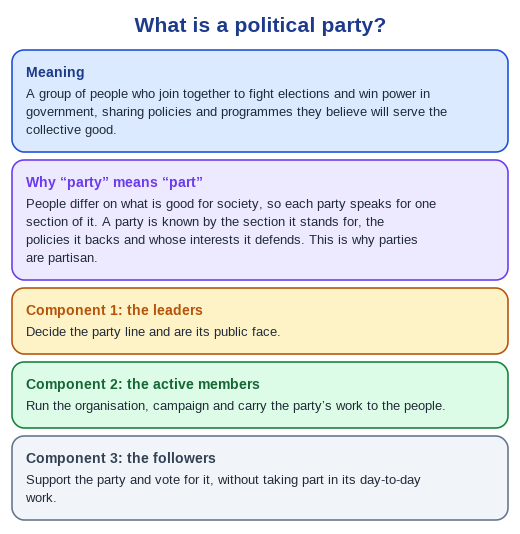
Most people meet democracy through parties: even a voter who knows little about the Constitution usually knows the parties. Yet being visible is not the same as being liked, and parties are often blamed for whatever goes wrong in public life. So the chapter starts by defining them. A political party is a group of people who join together to fight elections and win power in the government, sharing a set of policies and programmes they think will serve the collective good. Since people disagree about what is good, each party speaks for one part of society and tries to convince voters that its policies are the right ones. That is why parties are partisan. Every party has three components: leaders, active members and followers. Read Functions of political parties
What do political parties do?
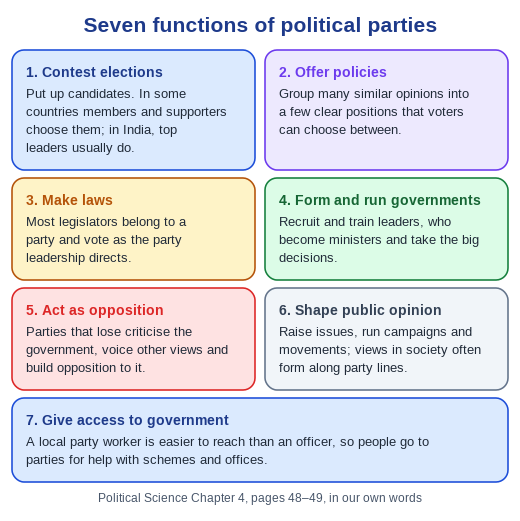
At bottom, parties fill political offices and use political power. The chapter lists seven functions. Parties contest elections, choosing candidates (by members and supporters in some countries, by top leaders in India). They put forward policies and programmes, boiling down a huge range of opinions into a few positions voters can choose from. They play the main part in making laws, since most legislators follow the party line. They form and run governments, training leaders who become ministers. Parties that lose act as the opposition. Parties shape public opinion by raising issues and running movements. And they help ordinary people reach government offices and welfare schemes, since a local party worker is easier to reach than an officer.
Why can democracy not do without parties?
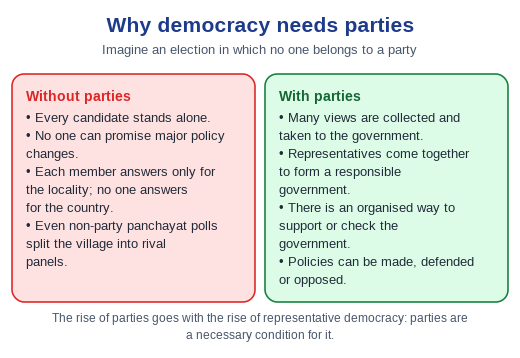
Picture an election with no parties. Every candidate would stand alone, so no one could promise a big change in policy. A government might still be formed, but no one would be answerable for running the country as a whole. Even panchayat elections held without parties tend to split a village into rival groups, each with its own panel of candidates, which is exactly what a party is. As societies grew larger they needed representative democracy, and representative democracy needs a way to gather views, bring representatives together and support or restrain the government. Parties do this, which is why the chapter calls them a necessary condition for democracy.
How many parties should a democracy have?
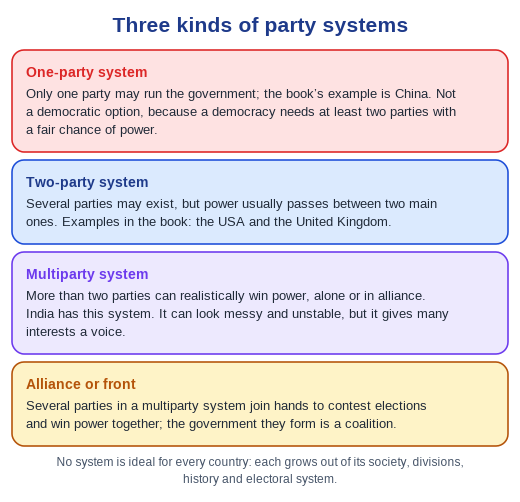
Any group of citizens may form a party, and more than 750 parties are registered with the Election Commission of India, but only a few are serious contenders. Where only one party may control the government, as in the book’s example of China, there is a one-party system, which is not a democratic option. In a two-party system, power usually passes between two main parties (the USA and the United Kingdom in the book). In a multiparty system, like India’s, more than two parties have a real chance of power, alone or as part of an alliance or front. Such systems can look messy and unstable, but they give many interests a voice. The chapter’s view: no system suits every country, because each grows out of its own society and history. Read Party systems, national and State parties
Do people trust political parties?
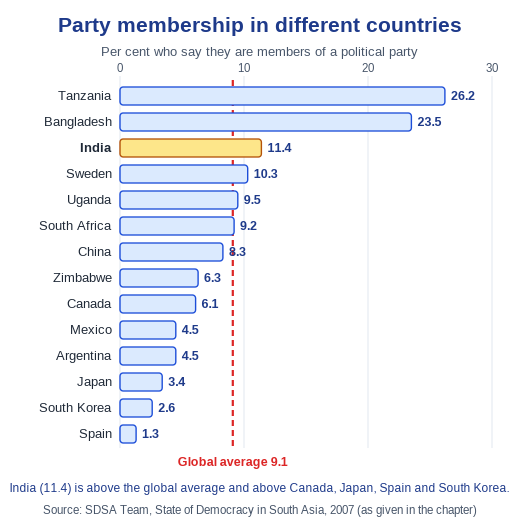
A box in the chapter, based on large surveys over several decades, gives a mixed answer. Parties are trusted little in South Asia and in most other democracies; worldwide they are among the least trusted institutions. But participation in India is high: more Indians say they are party members than people in Canada, Japan, Spain or South Korea, and both membership and the share of people who feel close to a party have risen.
What are national and State parties?
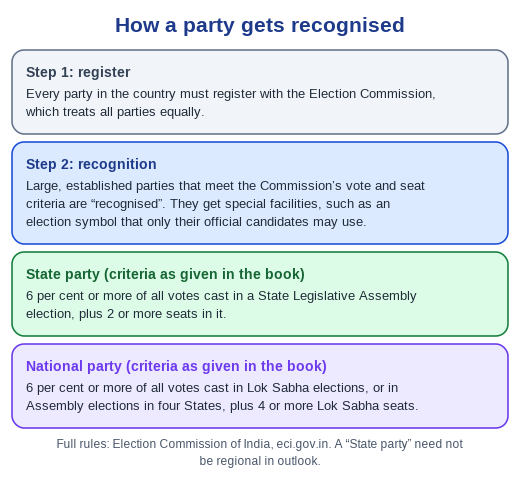
Federal democracies usually have two kinds of parties: those present in only one unit of the federation, and those present across many units. Every party in India must register with the Election Commission. The Commission treats all parties equally, but parties that meet its criteria of votes and seats are recognised and get special facilities, including an election symbol that only their official candidates may use. Depending on how widely they win support, recognised parties are classed as State parties or national parties. The book gives short profiles of the national parties of the time and a map of State parties; these notes do not repeat them, so read them in the book and check the current list with the Election Commission.
What challenges do parties face?
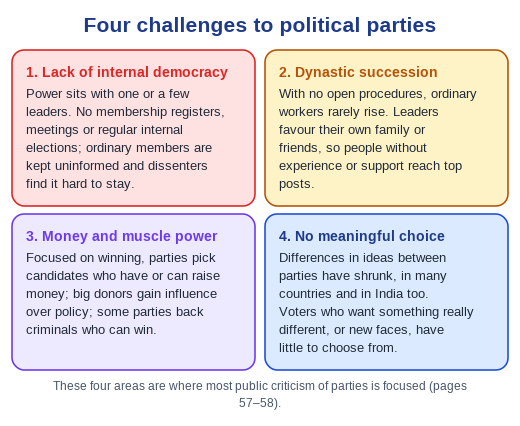
Because parties are the part of democracy people see most, they take the blame when democracy works badly. The chapter groups the criticism into four challenges. Lack of internal democracy: power is held by one or a few leaders, with no regular membership lists, meetings or internal elections. Dynastic succession: ordinary workers rarely rise, while leaders’ relatives take top posts. Money and muscle power: parties prefer candidates with money, donors gain influence, and some parties back criminals who can win. No meaningful choice: parties differ less and less in their ideas, and the same leaders keep moving between parties. Read Challenges and reforms of political parties
How can parties be reformed?
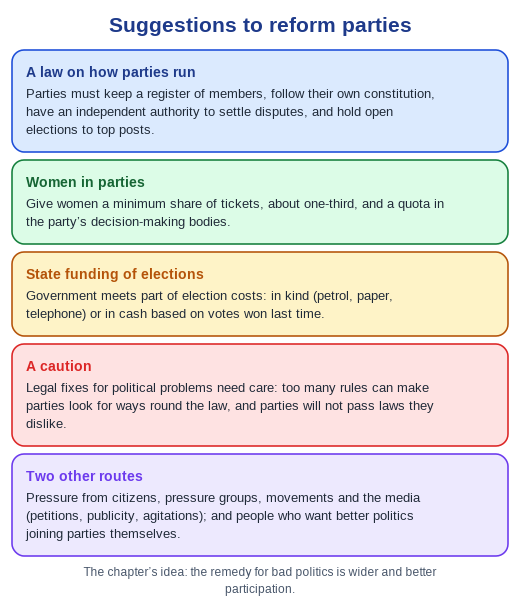
The difficulty is that the people who would have to pass reforms are themselves party leaders. Still, some steps have been taken: a constitutional amendment against defection, a Supreme Court order making candidates file an affidavit on their property and criminal cases, and an Election Commission order on party elections and tax returns. Each helped a little and has limits. Further suggestions include a law on how parties run their internal affairs, about one-third of tickets for women, and state funding of elections. The chapter warns against too many legal fixes, and points to two more routes: pressure from citizens and the media, and people who want reform joining parties.
Before we move on
This chapter builds on Chapter 3, Gender, Religion and Caste, which showed parties carrying social divisions into politics, and on the power sharing of Chapter 1 and Chapter 2. The next chapter of the book, Outcomes of Democracy, takes up the chapter’s closing idea that politics improves when more citizens take part. Answers to every exercise and to the questions inside this chapter are in the NCERT solutions for Chapter 4.
Key terms
| Term | Meaning |
|---|---|
| Political party | A group of people who join together to fight elections and win power in the government, agreeing on policies and programmes for the good of society. |
| Partisan | A person strongly committed to one party, group or faction; partisanship is the habit of taking a side and not seeing an issue in a balanced way. |
| Ruling party | The political party that runs the government. |
| Opposition | The parties that lost the election; they question and criticise the government and offer different views. |
| One-party system | A system in which only one party may run the government. |
| Two-party system | A system in which power usually changes hands between two main parties, though other parties may exist. |
| Multiparty system | A system in which more than two parties can realistically win power, alone or in alliance. |
| Alliance or front | Several parties in a multiparty system joining hands to contest elections and win power; the government they form is a coalition. |
| Recognised party | A registered party that meets the Election Commission’s criteria of votes and seats and so gets special facilities, such as its own election symbol. |
| Defection | Leaving the party on whose ticket a person was elected to a legislature and joining another party. |
| Affidavit | A signed, sworn statement about oneself, submitted to an officer. |
| Dynastic succession | Top posts in a party passing to the leaders’ family members instead of being open to all members. |
Topics in this chapter
Practice
-
How many components does a political party have, according to the chapter?
Show answer
Answer: (b) Three
-
Which party system does India have?
Show answer
Answer: (c) Multiparty system
-
Which body must every political party in India register with?
Show answer
Answer: (b) The Election Commission
-
The law that makes an MLA or MP lose the seat on changing party was brought in to stop:
Show answer
Answer: (b) defection
-
Which of these is NOT one of the four challenges to parties named in the chapter?
Show answer
Answer: (c) Too many independent candidates
-
According to the chapter, roughly how many parties are registered with the Election Commission of India?
Show answer
Answer: (c) More than 750
Questions students ask
What are the main topics of Class 10 Political Science Chapter 4?
Why we need political parties (their meaning, components, functions and necessity), how many parties a democracy should have (one-party, two-party and multiparty systems), national and State parties, the challenges parties face, and how they can be reformed.
Is Political Parties in the 2026-27 NCERT book?
Yes. It is Chapter 4 of Democratic Politics – II, the Class 10 Political Science textbook marked Reprint 2026-27, on pages 46 to 62. These notes follow the copy of the book now on NCERT’s website.
Why do these notes not describe individual parties?
The book gives short profiles of the parties recognised at the time, with a map of State parties. Those details change after every election, and this site stays strictly neutral, so the notes explain the categories and the recognition process in general terms. Read the profiles in the book itself, and check the current list with the Election Commission of India.
Are political parties good or bad for democracy?
The chapter’s answer is that democracy cannot work without them, even though people often distrust them. Parties have real weaknesses, which the chapter lists, but its remedy is to reform them, through rules, public pressure and more people taking part, not to do without them.
Stuck on a question?
Take a photo and Lagnever AI explains it step by step. Try it for 7 days for ₹2.
Get it on Google Play Open in browser
For parents: after the trial, the plan renews monthly by UPI or card autopay. You can cancel anytime in the app.