
Functions of Political Parties
Answer in short
A political party is a group of people who fight elections to win power, agreeing on policies for the collective good. Parties contest elections, offer policies, make laws, form and run governments, act as opposition, shape public opinion and connect people to government. Without them no one could promise policies or answer for running the country.
Stuck on a question? Take a photo and Lagnever AI explains it step by step. Try it for 7 days for ₹2. Get it on Google Play
What is a political party?
Parties are probably the most visible part of any democracy. For many ordinary citizens, democracy simply means parties, and even people who know little about the Constitution can usually name a few. But visibility is not popularity: people often hold parties responsible for everything wrong in public life. Parties were rare in the world a hundred years ago; now almost every country has them. To see why, the chapter first defines a party.
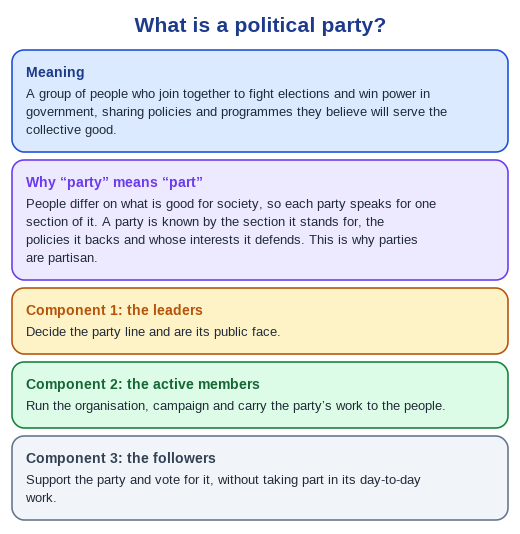
A political party is a group of people who join together to fight elections and win power in the government. Its members agree on some policies and programmes that, in their view, will serve the collective good. Because people disagree about what is good for society, each party tries to convince voters that its policies are better than others’, and seeks to carry them out by winning elections.
Why are parties called partisan?
A party reflects the basic political divisions in society. It speaks for one part of society, which is why it involves partisanship: the habit of taking one side. You can tell a party by the section of society it stands for, the policies it backs and whose interests it defends.
Every party has three components:
- its leaders,
- its active members, and
- its followers.
What are the functions of political parties?
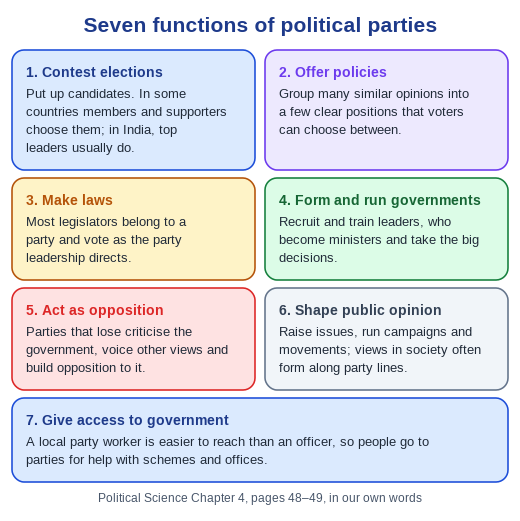
In short, parties fill posts in government and use political power. They do it through seven functions.
- Contesting elections. In most democracies the contest is mainly between candidates that parties put up. How candidates are chosen varies: in some countries, for example the USA, a party’s members and supporters pick them, and more countries are moving to this method; in India, top party leaders usually decide.
- Putting forward policies and programmes. Citizens hold countless opinions, and no government can act on all of them. A party groups similar opinions into a few broad positions, and voters choose between these. A government is expected to follow the line of the ruling party.
- Making laws. Laws are formally discussed and voted on in the legislature, but most legislators belong to parties and vote as the party leadership directs, whatever their personal opinion.
- Forming and running governments. The big decisions are taken by the political executive, which comes from the parties. Parties recruit and train leaders, then make them ministers.
- Playing the opposition. Parties that lose elections voice different views, criticise the government for failures or wrong policies, and mobilise opposition to it.
- Shaping public opinion. Parties raise issues and highlight them. With lakhs of members and activists across the country, and with many pressure groups linked to them, they sometimes launch movements on people’s problems. Opinion in society often forms along the lines parties take.
- Giving access to government. Parties link people with government offices and welfare schemes. Reaching a local party worker is easier for an ordinary citizen than reaching an official, so people stay attached to parties even while doubting them. Parties, in turn, must respond to people’s needs, or risk losing the next election.
Why does democracy need parties?
The list of functions is one answer: we need parties because they do all this. But the chapter also asks why a modern democracy cannot exist without them, and suggests imagining one.
If there were no parties, every candidate would be independent. No candidate could promise the people any major change in policy. A government might still be formed, but nobody could tell what it would achieve. Each representative would answer to the constituency for local work, but no one would be responsible for running the country.
The chapter points to a real case. In many States, panchayat elections are held without parties. Even so, a village usually divides into factions, and each faction puts up a “panel” of candidates. That is exactly what a party does. This is why parties are found in nearly every country, whatever its size, age or level of development.
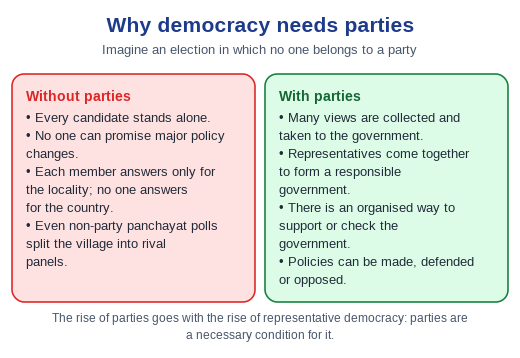
The rise of parties is tied to the rise of representative democracy. Large, complex societies needed some agency to collect different views and take them to the government, some way to bring representatives together into a responsible government, and some mechanism to support or restrain that government and to make, justify or oppose policies. Parties meet these needs, so the chapter calls them a necessary condition for democracy.
Do people trust parties?
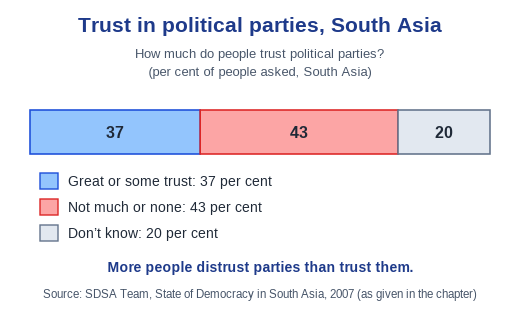
A box in the chapter tests the common belief that parties are unpopular and that citizens do not care about them. Large sample surveys over several decades show that this holds only in part for India:
- In South Asia, more people say they trust parties “not much” or “not at all” than say they trust them “some” or a “great” deal. The same holds in most democracies; parties are among the least trusted institutions worldwide.
- Yet participation is fairly high. A larger share of people in India say they are members of a party than in Canada, Japan, Spain or South Korea.
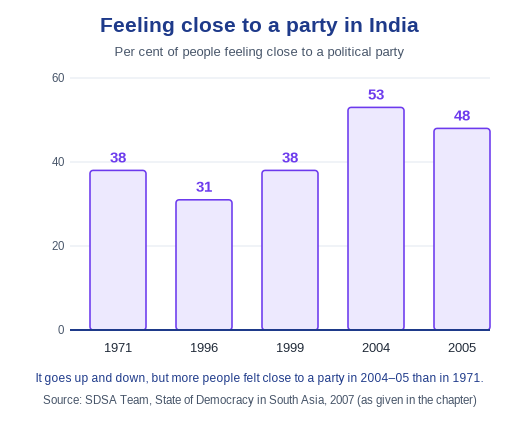
- In the past thirty years, both party membership and the share of people who report feeling close to a party have risen in India.
Next, read Party systems, national and State parties, or go back to the chapter notes and the NCERT solutions.
Practice
-
Which of these is NOT one of the three components of a political party named in the chapter?
Show answer
Answer: (d) Judges
-
Parties that lose an election usually:
Show answer
Answer: (b) play the role of opposition
-
In India, who usually chooses a party’s candidates for elections?
Show answer
Answer: (c) Top party leaders
-
Why do people stay attached to parties even when they doubt them?
Show answer
Answer: Because parties give them access to the government. A local party worker is easier to reach than an official, and parties help people reach welfare schemes. Parties also have to respond to people’s needs, or they risk being rejected at the next election.
-
How do non-party panchayat elections show that parties are needed?
Show answer
Answer: Even where parties do not formally contest, the village usually splits into rival factions, each putting up a panel of candidates. A panel is exactly what a party does, so groups like parties form even when they are not allowed.
Questions students ask
What is meant by partisanship?
Partisanship is the tendency to take one side and to be unable to see an issue in a balanced way. A partisan is someone deeply attached to one party, group or faction. Parties involve partisanship because each speaks for one part of society.
How do parties help in making laws?
Laws are formally discussed and voted on in the legislature, but most legislators belong to parties and follow the directions of the party leadership, whatever their personal views. So parties play a decisive role in which laws are made.
How many functions of political parties should I write in the exam?
Write as many as the marks need, each with one line of explanation. The chapter gives seven; for a long answer, cover all seven briefly.
Stuck on a question?
Take a photo and Lagnever AI explains it step by step. Try it for 7 days for ₹2.
Get it on Google Play Open in browser
For parents: after the trial, the plan renews monthly by UPI or card autopay. You can cancel anytime in the app.