
Party Systems, National and State Parties
Answer in short
A one-party system lets only one party rule, so it is not democratic. In a two-party system power usually alternates between two main parties; in a multiparty system, like India’s, several parties can win, alone or in alliances. Every party registers with the Election Commission, which recognises parties as State or national parties by their votes and seats.
Stuck on a question? Take a photo and Lagnever AI explains it step by step. Try it for 7 days for ₹2. Get it on Google Play
How many parties are there?
Citizens in a democracy are entitled to set up a political party of their own. In that formal sense every democracy has many parties: more than 750 are registered with the Election Commission of India. But most of them never come close to winning. Usually only a handful are real contenders in the race for power. So the useful question is how many major parties are good for a democracy. Countries answer it in three broad ways.
What is a one-party system?
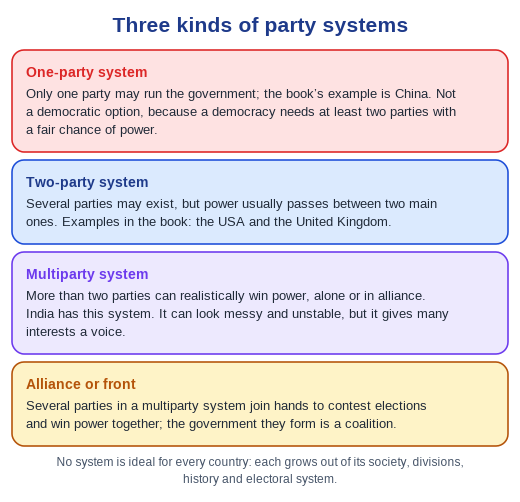
In some countries a single party alone is permitted to run the government. This is a one-party system. The book’s example is China, which you met in Class IX. On paper people may form other parties, but the electoral system does not allow open competition for power, so it does not happen.
The chapter rejects this as an option for a democracy. A democratic system must let at least two parties compete in elections, and each must have a fair chance of coming to power.
What is a two-party system?
In a two-party system, power usually passes back and forth between two main parties. Other parties can also fight elections and pick up some seats, but only the two main ones have a serious chance of winning a majority and forming the government. The book’s examples are the USA and the UK.
What is a multiparty system?
When several parties are in the race and more than two can realistically win power, on their own or with partners, it is a multiparty system. India has one. Governments here are often formed by several parties together, in a coalition.
When parties in a multiparty system join hands to fight elections and win power, the group is known as an alliance or front. The book mentions that three major alliances took part in the 2004 Lok Sabha elections.
A multiparty system can seem untidy and can lead to unstable governments. Its strength is that it lets many interests and opinions find a place in politics.
Which party system is better?
The chapter’s answer is that the question itself is not very useful. A country does not choose its party system. It takes shape over many years, moulded by the kind of society a country has, the social and regional splits within it, its political past and its method of voting, and none of these shifts quickly. India has a multiparty system because a country this large and this diverse, socially and geographically, cannot easily fit into two or three parties. No one system suits every country and every situation.
What are national and State parties?
Federal democracies usually have two kinds of parties: some that exist in only one unit of the federation, and some that work in several or all units. India is the same. Country-wide parties, called national parties, have units in many States, and these units broadly follow policies and strategy decided at the national level.
How does a party get this status? The process has two steps.
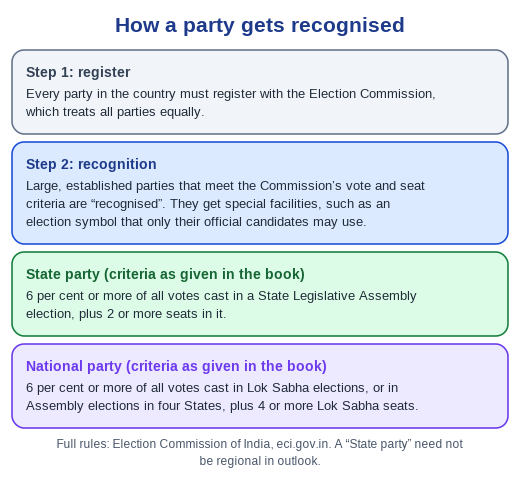
- Registration. Every party in the country must register with the Election Commission, which treats all parties equally.
- Recognition. The Commission gives some special facilities to large, established parties. The main one is a unique election symbol that only the party’s official candidates can use. Parties given these facilities are called recognised political parties. The Commission has set out detailed rules on the share of votes and number of seats a party must win to be recognised.
The book states the criteria like this:
- State party: 6 per cent or more of all votes cast in a State Legislative Assembly election, plus 2 or more seats in it.
- National party: 6 per cent or more of all votes cast in Lok Sabha elections, or in Assembly elections in four States, plus 4 or more Lok Sabha seats.
The Commission’s full rules are on its website, eci.gov.in, which the book itself points to. The book says that, under these rules, six national parties were recognised in the Commission’s 2023 notification.
Are State parties the same as regional parties?
Most of the country’s major parties outside the national list are classed as State parties, and people often call them regional parties. The chapter warns that the label can mislead. Some State parties are all-India parties in their ideas and organisation that have so far succeeded only in some States. Others are deliberately focused on the identity of one State.
Over the last three decades, State parties have grown in number and strength, and Parliament has become more varied. National parties have often needed State parties as partners, and since 1996 nearly every State party has had a turn in some national coalition government. The chapter sees this as having strengthened federalism and democracy.
The book also gives a short profile of each national party of its time and a map of State parties. These notes deliberately do not describe individual parties: read the profiles in the book, and check the current list with the Election Commission.
Next, read Challenges and reforms of political parties, or go back to Functions of political parties and the chapter notes.
Practice
-
Which party system does the chapter say is NOT a democratic option?
Show answer
Answer: (a) One-party system
-
Several parties joining hands to contest elections and win power is called:
Show answer
Answer: (b) an alliance or front
-
According to the book, a party that gets 6 per cent or more of the votes in a State Assembly election and wins two or more seats becomes a recognised:
Show answer
Answer: (b) State party
-
Why has India evolved a multiparty system, according to the chapter?
Show answer
Answer: Because the social and geographical diversity of such a large country cannot easily be held by two or even three parties. Many groups and regions want their own voice, and a multiparty system lets them be represented.
-
What does recognition by the Election Commission give a party?
Show answer
Answer: Special facilities. The main one is a unique election symbol that only the party’s official candidates may use. Recognition depends on the share of votes and number of seats the party wins.
Questions students ask
Which is better, a two-party or a multiparty system?
The chapter says this is not a very useful question. A party system is not chosen; it grows over a long time out of a country’s society, divisions, history and electoral system. A two-party system is simpler and more stable; a multiparty system looks messier but represents more interests. No system suits every country.
What is the difference between a registered party and a recognised party?
Every party must register with the Election Commission. Only registered parties that meet the Commission’s criteria of votes and seats become recognised parties, which get special facilities such as a reserved election symbol.
Which parties are national parties now?
The list changes as parties gain or lose votes. The book says six national parties were recognised under the Election Commission’s 2023 notification and profiles the parties of that time. This site does not describe individual parties; for the current list, see the Election Commission of India website.
Stuck on a question?
Take a photo and Lagnever AI explains it step by step. Try it for 7 days for ₹2.
Get it on Google Play Open in browser
For parents: after the trial, the plan renews monthly by UPI or card autopay. You can cancel anytime in the app.