
Challenges and Reforms of Political Parties
Answer in short
Parties face four challenges: lack of internal democracy, dynastic succession, the rising influence of money and muscle power, and too little meaningful choice for voters. India has an anti-defection law, compulsory candidate affidavits and rules on party elections. Further suggestions include a law on party affairs, tickets for women and state funding, along with public pressure and wider participation.
Stuck on a question? Take a photo and Lagnever AI explains it step by step. Try it for 7 days for ₹2. Get it on Google Play
Why are parties criticised?
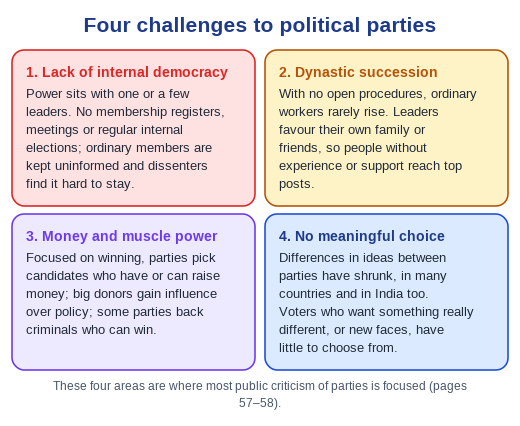
Parties are what people see first when they look at democracy, so people tend to blame them whenever democracy does not work well. Around the world, and in India too, citizens are deeply unhappy with how parties perform their functions. The chapter sorts the criticism into four problem areas. Parties have to overcome them to remain useful tools of democracy.
Challenge 1: Is there democracy inside parties?
Often not. Parties everywhere tend to concentrate power in one leader or a few at the top. Many keep no proper list of members, rarely call organisational meetings and seldom hold internal elections on time. Ordinary members are not told enough about what goes on inside the party, and they lack the means or contacts to influence decisions. So the leaders take more and more decisions in the party’s name. Anyone who disagrees with the leadership finds it hard to stay, and personal loyalty to the leader comes to matter more than loyalty to the party’s principles and policies.
Challenge 2: Why is dynastic succession a problem?
This follows from the first challenge. Since most parties do not work through open and transparent procedures, an ordinary worker has very few ways to rise to the top. Those already at the top can favour people close to them, even their own relatives, and in many parties the top posts stay in one family. This is unfair to the other members. It is also bad for democracy, because people without enough experience or public support end up in positions of power. The chapter adds that this happens to some degree all over the world, including in older democracies.
Challenge 3: How do money and muscle power enter politics?
Parties focused only on winning look for short-cuts. They tend to choose candidates who have, or can raise, a lot of money. Rich people and companies that fund parties then gain influence over the party’s policies and decisions. In some cases parties even back criminals who can win elections. People who care about democracy around the world are worried about the growing role of the rich and of big companies in politics.
Challenge 4: Do voters have a real choice?
For a choice to mean something, parties must differ significantly. In recent years the differences in ideas between parties have shrunk in most parts of the world. The book’s example is a democracy where the two main parties agree on fundamentals and differ only on details of how policies are made and carried out. In India too, the differences among the major parties on economic policy have narrowed. Voters looking for genuinely different policies find no party offering them, and sometimes cannot even pick new leaders, because the same leaders keep moving from one party to another.
What reforms have already been tried?
Can parties be made to reform? The difficulty is that, in a democracy, the final decisions are made by leaders who belong to parties. Voters can remove them, yet whoever takes their place is also a party leader. Still, the chapter lists three recent steps in India.
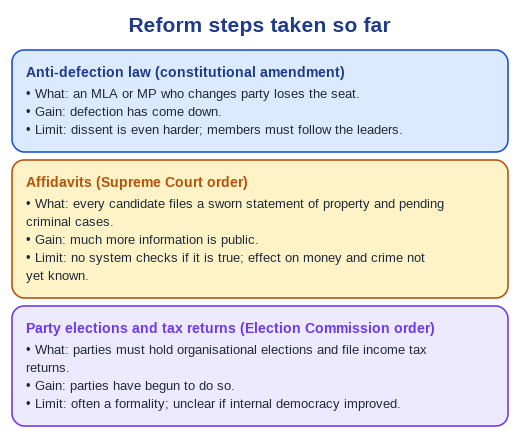
- Anti-defection law. Many elected members were switching parties to get ministerial posts or money. The Constitution was amended so that an MLA or MP who changes party loses the seat. Defection has come down, but dissent has become even harder: members must now go along with every decision of the party leaders.
- Affidavits. To cut down the hold of money and crime, the Supreme Court made it compulsory for every candidate to submit a sworn affidavit listing their property and any criminal cases pending against them. Much more information is now public, but nobody verifies whether it is true, and it is not yet clear whether the influence of the rich and of criminals has fallen.
- Party elections and tax returns. The Election Commission ordered parties to hold organisational elections and file income tax returns. Parties now do this, though at times only on paper.
What else has been suggested?
Several further ideas are often put forward:
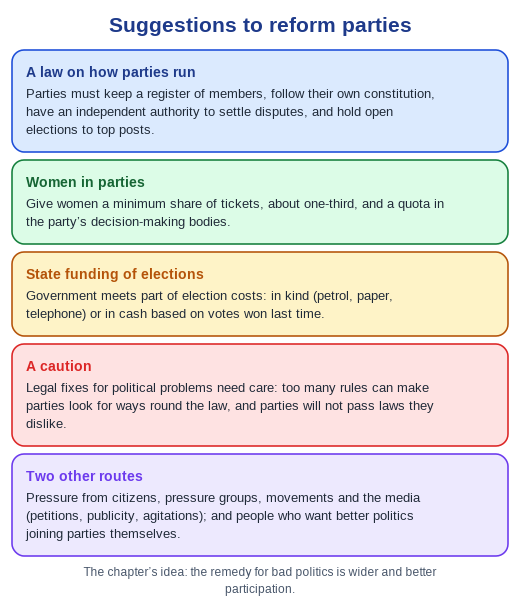
- A law to regulate parties’ internal affairs: parties would have to keep a register of members, follow their own constitution, have an independent authority to settle disputes, and hold open elections to the top posts.
- A minimum share of tickets, about one-third, for women candidates, and a quota for women in the party’s decision-making bodies.
- State funding of elections: the government would help with parties’ election costs, either in kind (petrol, paper, telephone and so on) or in cash, based on the votes the party won in the last election.
Parties have not accepted these yet. The chapter also urges caution about legal fixes for political problems: too much regulation can push parties to find ways round the law, and parties will not pass laws they dislike.
What can citizens do?
The chapter ends with two routes that do not depend on new laws. First, people can put pressure on parties by petitioning, publicising issues and agitating; citizens, pressure groups, movements and the media all play a part. Parties take reform more seriously when they fear losing support. Second, people who want better politics can join parties. The quality of a democracy depends on how much the public takes part, and politics is hard to reform if citizens only criticise it from outside. The chapter’s conclusion is that the remedy for bad politics is not less politics but wider and better participation in it.
Go back to Party systems, national and State parties, the chapter notes or the NCERT solutions.
Practice
-
The order making every candidate file an affidavit about property and pending criminal cases was passed by:
Show answer
Answer: (b) the Supreme Court
-
Top posts in a party being held by members of one family is called:
Show answer
Answer: (b) dynastic succession
-
Which reform is still only a suggestion, according to the chapter?
Show answer
Answer: (c) State funding of elections
-
Why does the chapter warn against too many legal solutions to party problems?
Show answer
Answer: Over-regulation can backfire: it would push every party to look for ways to cheat the law. Also, parties themselves make the laws, and they will not pass a law they do not like.
-
Name the two ways, apart from laws, in which parties can be reformed.
Show answer
Answer: First, people can press parties to change by petitioning, publicising issues and agitating, with help from pressure groups, movements and the media. Second, people who want better politics can join parties and change them from inside.
Questions students ask
Why is dynastic succession bad for democracy?
It is unfair to other members of the party, who have little chance of reaching the top. It also places people without enough experience or public support in positions of power. The chapter notes the tendency is found in some form all over the world, including older democracies.
What is defection and how was it checked?
Defection means leaving the party on whose ticket one was elected and joining another. Many legislators did it to get ministerial posts or money, so the Constitution was amended: an MLA or MP who changes party now loses the seat.
Why are parties slow to reform?
In a democracy, the final decisions rest with leaders who are themselves party members. Voters can remove them, but whoever takes their place is also a party leader. If none of them wants reform, it is hard to force it.
Stuck on a question?
Take a photo and Lagnever AI explains it step by step. Try it for 7 days for ₹2.
Get it on Google Play Open in browser
For parents: after the trial, the plan renews monthly by UPI or card autopay. You can cancel anytime in the app.