
NCERT Solutions Class 10 Political Science Chapter 4: Political Parties
Answers to all eleven exercises of Chapter 4, Political Parties, of Democratic Politics – II, the Class 10 Political Science textbook, and to every activity, thought bubble and cartoon question inside the chapter. Page numbers follow the 2026-27 reprint (pages 46–62). The exercises are quoted from the book, except Exercises 7, 8, 9 and 11, whose wording names real parties or people: those four are restated in general terms and marked “restated”. The questions inside the chapter are restated in short, in our own words, and the chapter’s photographs, cartoons and map are described in general terms, not reproduced. This site does not name, describe or compare any real political party or politician; where a question depends on a party profile, we explain the idea and point to the page of the book. Short notes: Chapter 4 notes.
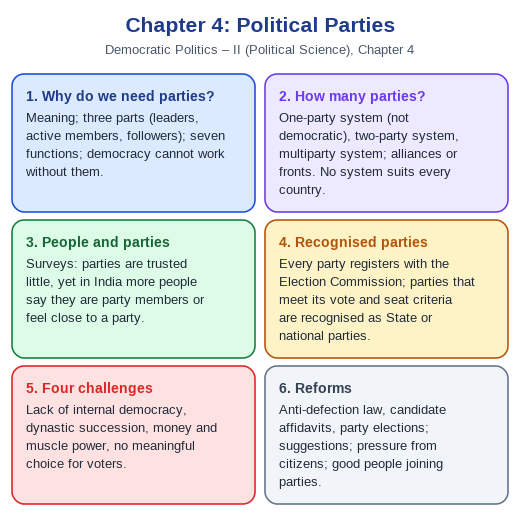
Activities and questions inside the chapter (pages 47–60)
Thought bubble, page 47: a student says parties are partial and partisan, cause partitions, and do nothing except divide people. Is that their real function? No. It is true that a party stands for one part of society and so is partisan, but that is not the same as dividing people. Disagreements about policy already exist in every society; parties gather similar opinions into a few clear positions so that voters can choose between them. Parties also contest elections, make laws, run governments, act as opposition, shape opinion and connect people to the government. Without them no one could promise policies or answer for running the country. Parties can deepen divisions when they misuse them, which is one reason the chapter discusses how to reform them, but dividing people is not their function.
Thought bubble, page 49: if we cannot live without parties, what makes people back a particular party? People support a party for many reasons, and usually for a mix of them: its policies and programmes (on prices, jobs, farming and so on); the section of society it stands for and whose interests it upholds; its leaders and how much people trust them; its record in government or in opposition; the access it gives to government help, since a local party worker is easier to reach than an officer; and family tradition or local loyalty. In a healthy democracy, the chapter suggests, support should rest on policies and performance, which is why it worries when parties stop offering a meaningful choice.
Let us revise, page 50: sort the three photographs by the functions of parties they show, and find a photograph or news report from your area for every function. The photographs, described in general terms: (1) women activists of a party’s women’s wing protesting against a rise in the prices of onions and cooking gas; (2) a minister handing a cheque of financial help to families of people who died after drinking illicit liquor; (3) activists of several parties marching against a State government’s decision to let a foreign steel company export iron ore.
| Photograph | Functions it shows |
|---|---|
| 1. Protest against price rise | Shaping public opinion by raising an issue; acting as opposition to the government |
| 2. Minister giving help to families | Forming and running governments; giving people access to welfare schemes |
| 3. Rally against an export decision | Acting as opposition; launching a movement on a public issue |
For your own area: for every one of the seven functions (contest elections, put forward policies, make laws, run governments, act as opposition, shape public opinion, give access to government), look for one local news report or photo, such as a candidate’s campaign, a manifesto, a debate on a bill, a scheme launched by a minister, an opposition protest, a public meeting, or a party office helping people with forms. Collect them in a chart with a one-line caption each.
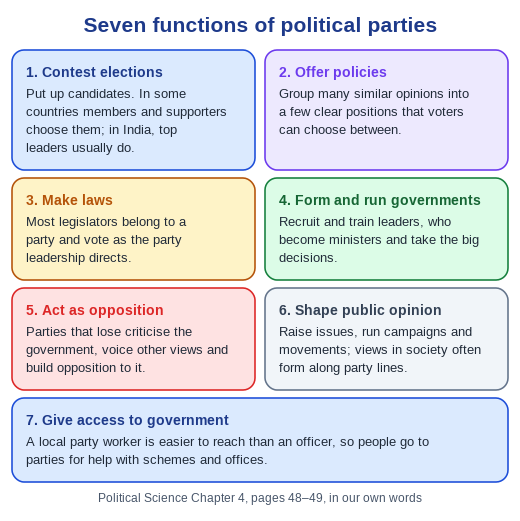
Thought bubble, page 51: a student wonders how politicians manage coalitions, when the student cannot even keep track of all the party names. Coalitions are managed by negotiation and compromise. Before the election, partners agree on how to share seats and often on a common programme. After it, they share ministerial posts and agree on policies, usually with some forum for settling disputes. Each party gives up part of its own agenda in return for a share of power. This is why multiparty systems can look messy and unstable, as the chapter says, but it is also how many different interests get a voice in government. Remembering every party name is not needed; what matters is understanding how alliances work.
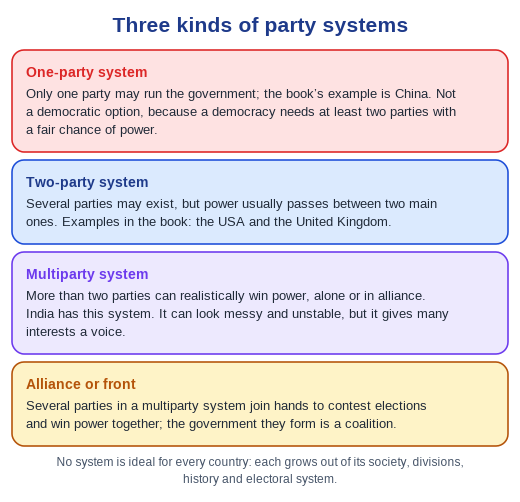
Let us revise, page 51: name at least two States for each type of party system at the State level: a two-party system, a multiparty system with two alliances, and a multiparty system. This depends on the latest Assembly elections, and the answer changes from one election to the next, so we do not give a fixed list. How to work it out: take the most recent Assembly election result of your State from the Election Commission of India (eci.gov.in). If two parties win almost all the seats and power usually alternates between them, it is a two-party system. If many parties win seats but they fight as two rival alliances, it is a multiparty system with two alliances. If several parties compete separately and more than two have a real chance of forming the government, it is a multiparty system. Then compare with neighbouring States, and check your answer with your teacher.
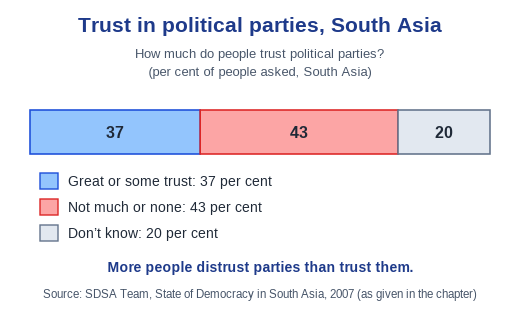
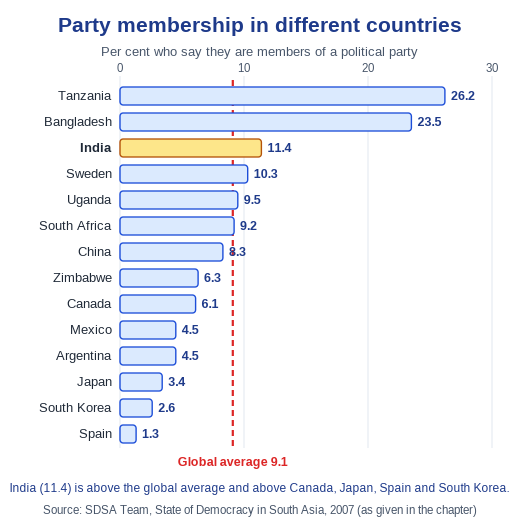
Cartoon with the survey box, page 53: does the cartoon reflect the data graphics on the previous page? The cartoon, from another democracy, shows that only small shares of people want either of the two main parties in power, while nearly everyone agrees that all politicians should be sent over a waterfall. It reflects one half of the data: political parties are among the least trusted institutions, and in South Asia more people distrust parties (43 per cent) than trust them (37 per cent). It does not reflect the other half: in India, party membership (11.4 per cent, above the global average of 9.1) and the share of people who feel close to a party (48 to 53 per cent in 2004–05) have gone up. Indians criticise parties but still take part in them.
Map, page 56: the book’s map of State parties. It has no question. These notes do not reproduce the map or describe individual parties; see Party systems, national and State parties for the categories.
Thought bubble, page 57: why do parties field so few women candidates? Is weak internal democracy part of the reason? Largely, yes. In India top party leaders choose the candidates, and with power concentrated in a few hands and no open internal elections, ordinary members, including women, have little say. Leaders also tend to pick candidates who have money or are considered sure winners, and fewer women have such resources. The chapter’s suggestion follows from this: make it compulsory for parties to give about one-third of tickets to women and to have a quota for women in party decision-making bodies.
Let us revise, page 59: which challenges are shown in the cartoons on pages 57 to 59, and how can money and muscle power be kept in check? The cartoons, described in general terms:
| Cartoon | What it shows | Challenge |
|---|---|---|
| Page 57: a head of government who is also a leading business owner, pulling the strings of puppets on a TV screen | Business wealth and media power used to control politics and a party | Money power; lack of internal democracy (one leader controls everything) |
| Page 58: a cartoon from the USA in which big business holds all the main institutions of the country | Rich companies controlling parties and government | Money power; no meaningful choice (in effect, one-party rule by business) |
| Page 59: an officer asking a candidate who declares huge wealth why they want to contest elections at all | Rich candidates and the suspicion that politics is a way to make money | Money power in elections |
Ways to curb money and muscle power: the existing affidavits on property and criminal cases, with a system to verify them; state funding of elections, so that parties depend less on rich donors; parties’ income tax returns and accounts made public; not giving tickets to candidates with serious criminal cases; open internal elections in parties; and alert voters, media and civil society who refuse to support such candidates.
Thought bubbles, page 59: does the cartoon suggest that people in democracies stand for election just to get rich? Yet are there not politicians who work for people’s welfare? The cartoon exaggerates to make a point; it is a warning, not a description of every politician. The chapter does say that parties prefer candidates who have or can raise money, and that rich donors gain influence, so the worry is real. But many people enter politics to serve: to work for their area, take up public causes or run governments well. The chapter’s answer to the problem is not to give up on politics but to reform parties and for committed citizens to join them.
Cartoon, page 60: an Election Commission official with a whip marked “election code” shouts “Attention!” at a crowd of unruly politicians who say electoral discipline is not for them. Do you agree that this way of reforming parties will be acceptable to them? Probably not, at least not willingly. The cartoon shows reform forced from outside, by orders and rules, and the politicians resisting it. The chapter makes the same point: the Election Commission’s order on party elections is sometimes followed only as a formality, parties will not pass laws they do not like, and over-regulation can push them to find ways round the law. Rules help, but lasting reform also needs pressure from citizens and the media, and good people joining parties, so that parties see reform as in their own interest.
Exercises (pages 61–62)
1. “State the various functions political parties perform in a democracy.”
Answer: Political parties fill political offices and use political power. They do this through seven main functions.
- Contest elections: Elections are fought mainly between candidates put up by parties. In India, top party leaders usually choose the candidates.
- Put forward policies and programmes: Parties group many different opinions into a few clear positions. Voters then choose between them.
- Make laws: Most members of the legislature belong to a party. They usually vote as the party leaders decide.
- Form and run governments: Parties recruit and train leaders, who become ministers and take the big policy decisions.
- Play the role of opposition: Parties that lose the election give different views and criticise the government’s failures. They also organise opposition to it.
- Shape public opinion: Parties raise issues, run campaigns and sometimes start movements. People’s opinions often form along party lines.
- Connect people with the government: It is easier to reach a local party leader than a government officer. So parties help people reach government offices and welfare schemes.
2. “What are the various challenges faced by political parties?”
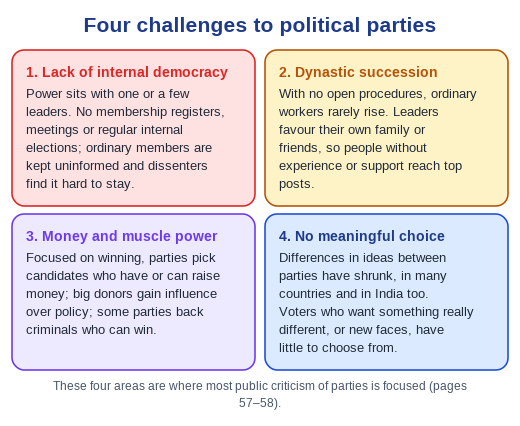
Answer: The chapter names four challenges: lack of internal democracy, dynastic succession, money and muscle power, and no meaningful choice for voters.
- Lack of internal democracy: Power is held by one or a few top leaders. Parties do not keep membership registers, hold meetings or conduct regular internal elections. Members who disagree find it hard to stay.
- Dynastic succession (power passing within a family): Ordinary workers rarely rise to the top. Leaders favour people close to them or their family members, so people without experience or public support get power.
- Money and muscle power: Parties pick candidates who have or can raise a lot of money. Rich donors and companies influence party decisions. Some parties support criminals who can win elections.
- No meaningful choice: The differences in ideas between parties have become small, in India too on economic policy. The same leaders keep moving from one party to another, so voters have little real choice.
3. “Suggest some reforms to strengthen parties so that they perform their functions well?”
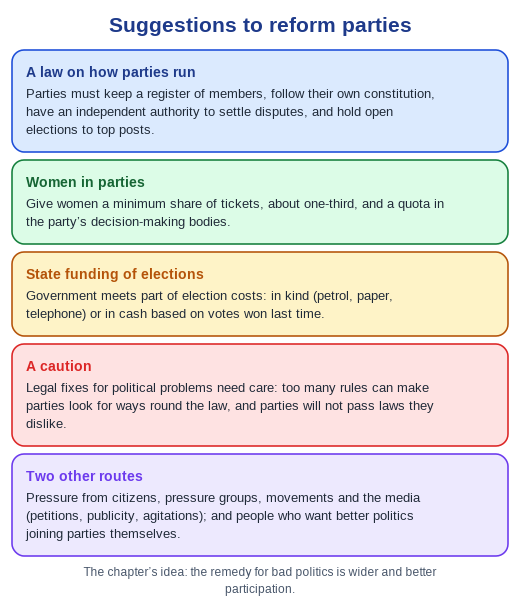
Answer: Parties can be reformed through laws and rules, through pressure from citizens, and by good people joining them.
- A law on parties’ internal affairs: Every party should keep a register of members, follow its own constitution, have an independent authority to settle disputes, and hold open elections to the highest posts.
- Tickets for women: About one-third of tickets should go to women candidates. There should also be a quota for women in the party’s decision-making bodies.
- State funding of elections: The government could give parties support for election costs, either in kind (petrol, paper, telephone) or in cash based on votes won in the last election. This would reduce the role of money.
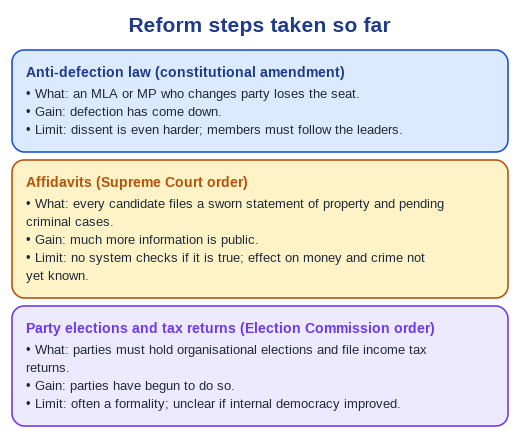
- Make existing steps work better: These are the anti-defection law, the affidavits (sworn statements) on candidates’ property and criminal cases, which need a way to check them, and the Election Commission’s order on party elections and income tax returns, which should be followed in spirit, not as a formality.
- Pressure from citizens: People can press parties through petitions, publicity and agitations, helped by pressure groups, movements and the media.
- Good people joining parties: Politics cannot be improved only by criticising it from outside. People who want reform should take part.
(The chapter also warns that too many legal controls can backfire: parties may look for ways to cheat the law.)
4. “What is a political party?”
Answer: A political party is a group of people who come together to fight elections and win power in the government.
- Its members agree on some policies and programmes for society, aimed at the collective good (the good of all).
- They try to win people’s support for these policies through elections.
5. “What are the characteristics of a political party?”
Answer: A party is an organised group with shared policies that seeks power through elections, stands for a part of society, and has leaders, active members and followers.
- A group with one aim: It is a group of people who want to fight elections and win power in the government.
- Shared policies: Its members agree on policies and programmes they believe are good for society. They try to convince voters that these are better than others’.
- Power through elections: It wants to carry out its policies by winning people’s support in elections.
- Stands for a part of society: So it is partisan (it takes one side). It is known by the section it stands for, the policies it supports and whose interests it protects.
- Three components: the leaders, the active members and the followers.
- Functions: It contests elections, makes laws, forms the government or acts as opposition, and shapes public opinion.
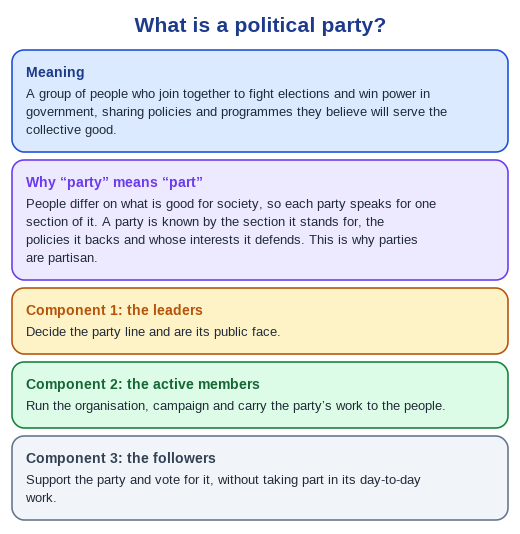
6. “A group of people who come together to contest elections and hold power in the government is called a _____________________.”
Political party.
7. (Restated: the lists name real parties.) Match List I, which names four parties, with List II, which gives three alliances of the 2004 Lok Sabha elections and the category “State party”, and choose the correct code from (a) C A B D, (b) C D A B, (c) C A D B, (d) D C A B.
Short answer: Work out the code from the party profiles on pages 54–55 of the book. This site does not describe individual parties.
The question tests two ideas from the chapter:
- Alliance or front: In a multiparty system, several parties join hands to fight elections and win power. The book names three major alliances of the 2004 Lok Sabha elections (page 51).
- State party: A recognised party that meets the Election Commission’s conditions in a State, but not the conditions for a national party (page 53).
Tip: each code uses every letter once, and only one party in List I can be the State party.
8. (Restated: the question and options name real people and a party.) Who among four leaders and social reformers listed in the options is the founder of one of the national parties profiled in the book?
Short answer: The founder’s name is given at the start of that party’s profile on page 54 of the book. Take the answer from there; this site does not describe individual parties or politicians.
The idea behind the question: every party has leaders who shape it, and a party is often known by the section of society it says it stands for.
9. (Restated: the question names a real party.) What is the guiding philosophy of one of the national parties profiled in the book, choosing from four options?
Short answer: The book’s profile of that party on page 54 names the idea it draws on. Take the answer from there; this site does not describe or compare the ideas of individual parties.
The idea behind the question: a party’s guiding philosophy is its ideology, the core ideas that it says shape its policies and programmes. The chapter says a party is known by the policies it supports.
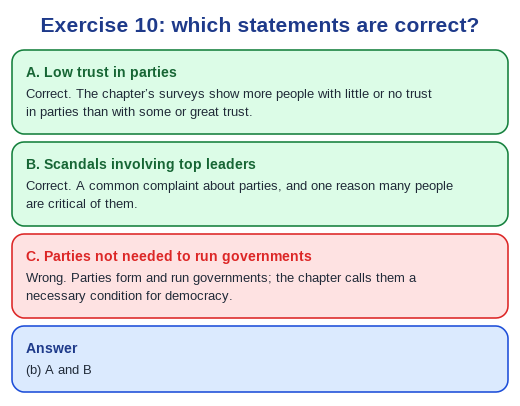
10. “Consider the following statements on parties. A. Political parties do not enjoy much trust among the people. B. Parties are often rocked by scandals involving top party leaders. C. Parties are not necessary to run governments. Which of the statements given above are correct? (a) A, B, and C (b) A and B (c) B and C (d) A and C”
Answer: (b) A and B.
- A is correct: The chapter’s surveys show that in South Asia more people have little or no trust in parties than have some or great trust. Parties are among the least trusted institutions all over the world.
- B is correct: It is a common complaint that makes people critical of parties. (The chapter does not discuss scandals directly, but it describes the criticism parties face.)
- C is wrong: Parties form and run governments. The chapter calls them a necessary condition for democracy.
11. (Restated: the passage names real people and parties.) The exercise gives a news passage from 2007 about a well-known public figure in a neighbouring South Asian country, honoured internationally for work for the poor, who announced a new political party. He wanted good leadership and clean governance, and a party democratic from the grassroots, different from the traditional ones. Some citizens welcomed it, hoping for a government that would fight corruption; leaders of the established parties were wary, saying politics is very different and often controversial; one observer asked whether he was being planted by backers from abroad. The questions: was it a right decision to float a new party? Then, quoted from the book: “Do you agree with the statements and fears expressed by various people? How do you want this new party organised to make it different from other parties? If you were the one to begin this political party, how would you defend it?”
Answer: Yes, forming a new party is a citizen’s democratic right, and it can give voters a real choice. It should be run on the reforms the chapter suggests.
Was it a right decision? We answer about the idea, not the person.
- In a democracy, citizens have the right to form new parties.
- A new party can widen voters’ choice. The chapter says this choice is often missing when old parties differ very little.
- Starting a party for clean, democratic politics is a fair and democratic step. Whether it succeeds is for voters to decide.
The statements and fears:
- The hope of choosing between good and bad: Fair. A meaningful choice is what the chapter says parties should offer. But a new party must also prove itself.
- The warning that politics is different: Partly true. Winning elections needs organisation, members and resources. A good record outside politics does not ensure success in it.
- The question about backers from abroad: A serious charge that needs proof. Without proof, it should not be used to block a citizen’s right to form a party. Open accounts of the party’s funds are the clearest answer.
How to organise the new party differently (from the chapter’s reforms):
- Members’ register and open elections: Keep a public register of members and hold regular, open internal elections to all posts, including the top one.
- Own constitution: Follow it, with an independent authority to settle disputes.
- Women: Give about one-third of tickets to women, and include women in decision-making bodies.
- Clean money: Keep transparent accounts, file income tax returns and publish donations.
- Clean candidates: Give no tickets to people with serious criminal cases, and let members take part in choosing candidates.
- No dynasty: Let ordinary workers rise on merit.
How to defend it:
- Forming a party is every citizen’s democratic right.
- It offers voters a real alternative.
- It is democratic and transparent inside, and practises the reforms people demand of others.
- Like every other party, it will be judged by voters at elections.
Practice
-
In the chapter’s survey graphic, what is the global average share of people who say they are members of a political party?
Show answer
Answer: (b) 9.1 per cent
-
What share of people in South Asia said they had great or some trust in political parties, according to the chapter’s survey?
Show answer
Answer: (b) 37 per cent
-
Which reform step has made dissent inside a party even more difficult, according to the chapter?
Show answer
Answer: (b) The anti-defection law
-
Give one gain and one limit of the affidavit system for candidates.
Show answer
Answer: Gain: a lot of information about candidates’ property and pending criminal cases is now public. Limit: there is no system to check whether the information is true, and it is not yet known whether it has reduced the influence of the rich and of criminals.
-
Why does the chapter say a one-party system is not a good option?
Show answer
Answer: Because it is not democratic. A democracy needs at least two parties competing in elections, each with a fair chance of coming to power; a one-party system does not allow open competition for power.
Stuck on a question?
Take a photo and Lagnever AI explains it step by step. Try it for 7 days for ₹2.
Get it on Google Play Open in browser
For parents: after the trial, the plan renews monthly by UPI or card autopay. You can cancel anytime in the app.