
NCERT Solutions Class 12 Biology Chapter 10: Biotechnology and its Applications
Answers to all 13 end-of-chapter exercises of Chapter 10, Biotechnology and its Applications, of Biology, the Class 12 NCERT textbook. Page numbers follow the 2026-27 reprint (pages 177–187). The exercises are quoted from the book as printed, including its spelling, except Exercise 1, which is restated (see the note at the end); the answers are our own, built from the chapter, and every fact from outside the chapter is marked Extra. The questions the chapter text asks along the way are answered in short at the end. The book prints no answer key for this chapter. Short notes: Chapter 10 notes.
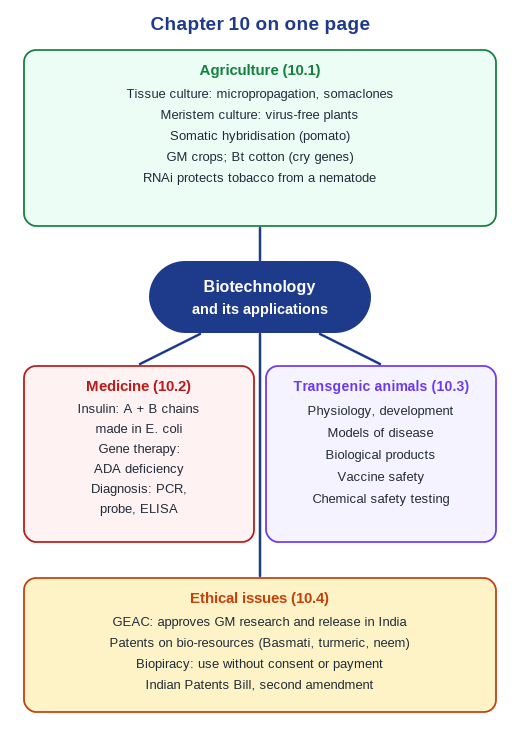
Exercises 1 to 4: tissue culture and Bt toxin
1. (Restated) Which part of the plant is most suitable for making virus-free plants, and why?
The meristem, apical (shoot tip) or axillary.
- Even when a plant is infected with a virus, its meristem is not infected. So a meristem cut out and grown in vitro gives healthy, virus-free plants.
- This has been done for banana, sugarcane and potato.
- Extra: the usual explanation is that meristem cells divide very fast and have no connection to the vascular tissue (phloem) through which viruses spread, so the virus does not reach them in time.
2. “What is the major advantage of producing plants by micropropagation?”
Main advantage: thousands of plants can be produced in a very short time, and all of them are genetically identical to the parent plant.
- Such identical plants are called somaclones.
- So a plant with a desirable trait can be multiplied quickly, and the trait is not lost.
- Tomato, banana and apple have been produced on a commercial scale this way.
- Extra: it needs little space, works all through the year, and with meristem culture gives healthy, virus-free stock.
3. “Find out what the various components of the medium used for propagation of an explant in vitro are?”
| Component | Example | Role |
|---|---|---|
| Carbon source | Sucrose | Energy, since the explant cannot photosynthesise enough |
| Inorganic salts | Mineral nutrients | Macro- and micro-nutrients for growth |
| Vitamins | B vitamins (Extra example) | Growth factors |
| Amino acids | Glycine (Extra example) | Nitrogen and building blocks |
| Growth regulators | Auxins, cytokinins | Control division, root and shoot formation |
Extra: the medium is made in water, often solidified with agar, and kept sterile; the balance of auxin to cytokinin decides whether roots or shoots form.
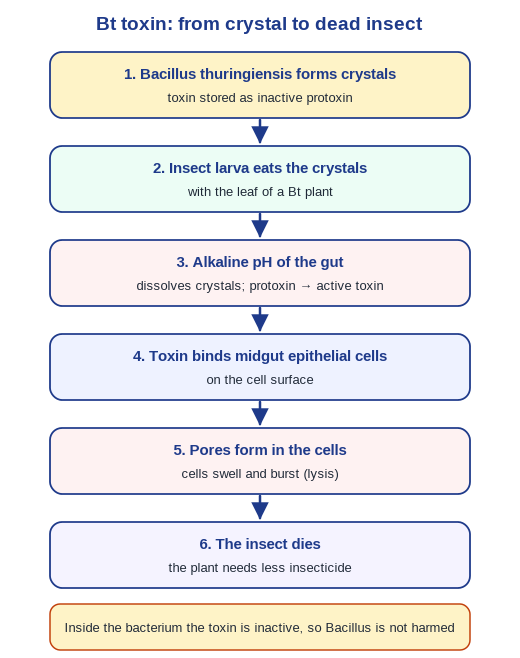
4. “Crystals of Bt toxin produced by some bacteria do not kill the bacteria themselves because – (a) bacteria are resistant to the toxin (b) toxin is immature; (c) toxin is inactive; (d) bacteria encloses toxin in a special sac.”
Answer: (c) toxin is inactive. Inside Bacillus thuringiensis the toxin exists as an inactive protoxin. It becomes active only in the alkaline gut of an insect that eats the crystals; it then makes pores in the midgut cells and kills the insect.
Exercises 5 to 8: transgenic bacteria, GM crops, Cry proteins, gene therapy
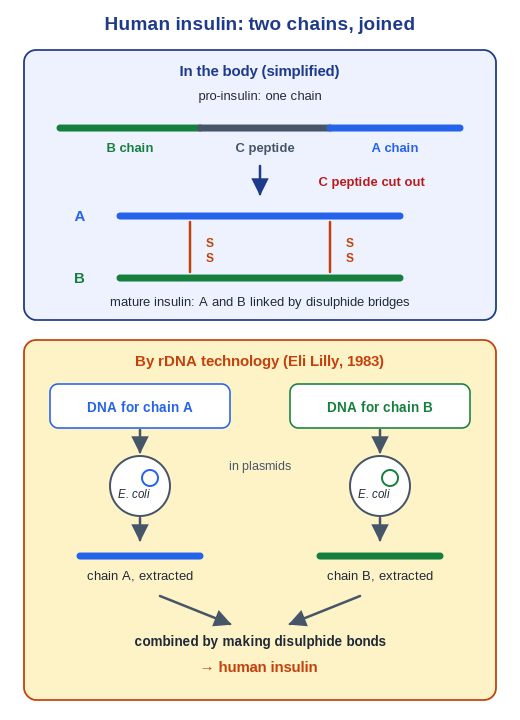
5. “What are transgenic bacteria? Illustrate using any one example.”
Transgenic bacteria carry and express a foreign gene put into them by recombinant DNA technology.
Example: E. coli making human insulin.
- Two DNA sequences, for chain A and chain B of human insulin, were prepared (Eli Lilly, 1983).
- Each was inserted into a plasmid of E. coli.
- The transgenic bacteria made the A and B chains separately.
- The chains were extracted and joined by disulphide bonds to form human insulin.
This insulin has the same structure as the human molecule, so it avoids the allergic reactions some patients had to insulin from cattle and pigs.
6. “Compare and contrast the advantages and disadvantages of production of genetically modified crops.”
| Advantages (from the chapter) | Disadvantages and concerns |
|---|---|
| More tolerant of abiotic stress: cold, drought, salt, heat | GM organisms released into the ecosystem may have unpredictable effects (chapter) |
| Less use of chemical pesticides (Bt cotton, RNAi tobacco) | Ethical questions about manipulating living organisms (chapter) |
| Lower post-harvest losses | Patents and biopiracy: bio-resources of farmers and indigenous people may be patented by others (chapter) |
| More efficient mineral use, so soil fertility lasts | Extra: pests may in time become resistant to a toxin such as Bt |
| Higher nutritional value, e.g. golden rice | Extra: genes may pass to wild relatives; possible effects on non-target organisms |
| Starches, fuels and pharmaceuticals for industry | Extra: seed may cost more; food safety, such as allergy risk, must be tested |
Contrast: the advantages are mostly about higher, cheaper and more nutritious production, while the concerns are mostly about safety, ecology and ownership. That is why, in India, GEAC examines GM research and decides whether GM organisms are safe to release.
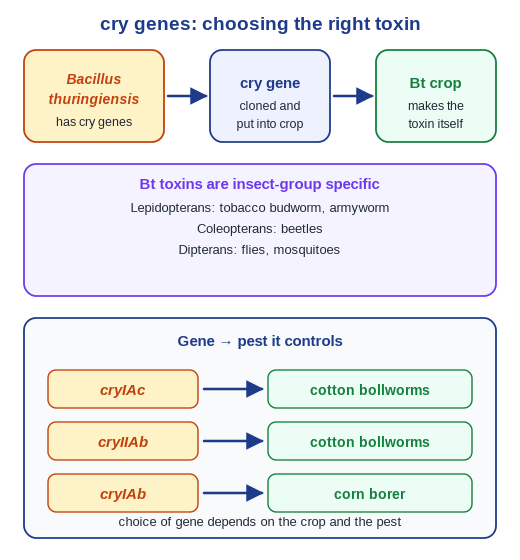
7. “What are Cry proteins? Name an organism that produce it. How has man exploited this protein to his benefit?”
- Cry proteins are insecticidal (Bt) toxin proteins coded by the cry genes. They are formed as crystals of inactive protoxin, which become toxic in the alkaline gut of certain insects.
- Organism: the bacterium Bacillus thuringiensis.
- Use by humans: specific cry genes were isolated and introduced into crops, so the crops make the toxin themselves and resist insects without insecticide sprays. The protein of cryIAc and cryIIAb controls cotton bollworms (Bt cotton); that of cryIAb controls corn borer (Bt corn). Bt rice, tomato, potato and soyabean have also been made.
8. “What is gene therapy? Illustrate using the example of adenosine deaminase (ADA) deficiency.”
Gene therapy is a collection of methods to correct a gene defect diagnosed in a child or embryo by delivering a normal gene into the person’s cells or tissues, so that it takes over the function of the faulty gene.
ADA deficiency:
- The enzyme ADA is crucial for the immune system. The disorder is caused by deletion of the ADA gene.
- Bone marrow transplantation or enzyme replacement therapy (ADA by injection) help, but are not completely curative.
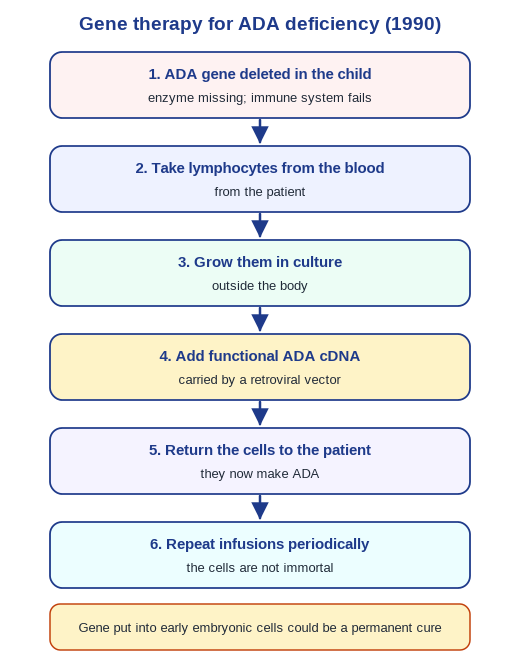
- In 1990, the first clinical gene therapy was given to a 4-year-old girl: her lymphocytes were grown in culture, a functional ADA cDNA was introduced with a retroviral vector, and the cells were returned to her.
- The cells are not immortal, so periodic infusions are needed.
- Introducing the gene into early embryonic cells could give a permanent cure.
Exercises 9 to 13: cloning, oil, golden rice and protein drugs
9. “Digrammatically represent the experimental steps in cloning and expressing an human gene (say the gene for growth hormone) into a bacterium like E. coli?”
The steps use the tools of Chapter 9:
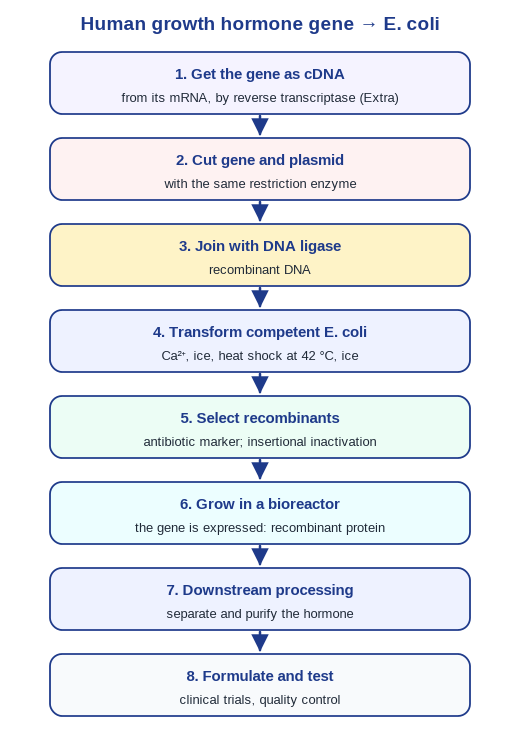
- Obtain the gene. Extra: human genes contain introns, which bacteria cannot remove, so the gene is used as cDNA, copied from the growth-hormone mRNA by the enzyme reverse transcriptase. It can then be amplified by PCR.
- Cut the gene and a plasmid vector (with ori and an antibiotic-resistance marker) with the same restriction enzyme, giving matching sticky ends.
- Join them with DNA ligase to make recombinant DNA.
- Transform competent E. coli (calcium treatment, ice, heat shock at 42 °C, ice).
- Select transformants on an antibiotic plate, and recombinants by insertional inactivation (for example, colourless colonies on a chromogenic substrate).
- Express: grow the recombinant bacteria on a large scale in a bioreactor; the gene is expressed as a recombinant protein. Extra: a bacterial promoter is placed before the gene so that E. coli transcribes it.
- Downstream processing: separate and purify the hormone, formulate it, then clinical trials and quality control.
10. “Can you suggest a method to remove oil (hydrocarbon) from seeds based on your understanding of rDNA technology and chemistry of oil?”
This is an open question, so the answer is a suggestion (Extra).
- Chemistry of oil: seed oil is mainly triglycerides, each made of one glycerol joined to three fatty acids. Making it needs enzymes for fatty acid synthesis and for joining fatty acids to glycerol.
- rDNA idea: identify the gene for a key enzyme of this pathway and switch it off only in the seed, for example by RNA interference (as in the nematode example, using a construct that makes sense and antisense RNA, giving dsRNA that silences that mRNA), delivered with an Agrobacterium vector.
- Without the enzyme the seed makes little or no oil, and stores its food as starch or protein instead. The oil is then never made, instead of being removed after harvest.
11. “Find out from internet what is golden rice.”
The chapter names golden rice only as rice enriched with vitamin A, an example of GM crops with better nutritional value. Extra (to check with your teacher):
- Golden rice is a genetically modified rice whose grain (endosperm) makes β-carotene, the pigment the body converts into vitamin A. The β-carotene gives the grain a golden-yellow colour, hence the name.
- Ordinary rice grain does not make β-carotene. Genes for the missing steps of the pathway were added: the first version used genes from daffodil and a soil bacterium, later versions a gene from maize.
- Aim: to reduce vitamin A deficiency, which causes night blindness and weak immunity, among people who eat mainly rice.
12. “Does our blood have proteases and nucleases?”
Yes (Extra, as the chapter does not discuss blood enzymes).
- Proteases: blood clotting depends on a cascade of protease enzymes, such as thrombin, which cuts fibrinogen into fibrin; plasmin breaks down clots. White blood cells also carry proteases.
- Nucleases: serum contains DNases and RNases that break down nucleic acids released by dead cells or brought in by viruses.
- This is one reason why protein and DNA medicines injected into the body are broken down after some time, and why they need careful design.
13. “Consult internet and find out how to make orally active protein pharmaceutical. What is the major problem to be encountered?”
Major problem: a protein swallowed by mouth is digested. The stomach’s acid and proteases (pepsin, then trypsin and others in the intestine) break it into amino acids before it can act. Even an intact protein is a large molecule and is poorly absorbed through the gut wall. This is why insulin is injected, not swallowed (the chapter raises this question on page 181).
Ways being tried (Extra):
- enclosing the protein in protective capsules or coatings that survive the stomach and release it in the intestine;
- packing it in tiny carrier particles (nanoparticles, liposomes);
- adding protease inhibitors or substances that improve absorption;
- making the protein in edible transgenic plants, as an oral vaccine.
None of these fully solves the problem for every protein, which is why most protein medicines are still injected.
Questions asked in the chapter text
These are not quoted; each is restated briefly with its page.
Page 178: what is tissue culture? Growing a whole plant from an explant, any part of a plant, in a test tube under sterile conditions on a nutrient medium. It works because plant cells are totipotent.
Page 179: why does Bt toxin not kill the Bacillus? The bacterium keeps it as an inactive protoxin; only the alkaline gut of an insect activates it.
Page 181: is insulin from animals as good as human insulin, and does it trigger an immune response? It works, but it is a foreign protein, so some patients develop allergy or other reactions. Human insulin made in bacteria has the same structure as the natural human molecule and avoids this.
Page 181: can insulin be given by mouth? No. It is a protein, so the digestive enzymes of the stomach and intestine would break it down before it reached the blood. It is given by injection.
Page 182: can a hereditary disease be corrected? Gene therapy attempts this by delivering a normal gene into the person’s cells, as in ADA deficiency.
Page 183: how can PCR detect very low amounts of DNA? Each PCR cycle roughly doubles the target stretch of DNA, so after many cycles a few molecules become millions or more, enough to detect (see the PCR cycle in Chapter 9).
Page 183: why are transgenic animals made, and how do humans benefit? To study normal physiology and development, to model human diseases, to produce biological products, to test vaccine safety and to test chemical safety.
Note
- Exercise 1 is restated rather than quoted because its wording contains a word the site does not print.
Practice
-
Virus-free plants are obtained by culturing the:
Show answer
Answer: (b) apical or axillary meristem
-
In ADA gene therapy, the functional ADA cDNA is put into the patient's:
Show answer
Answer: (b) lymphocytes
-
Insulin cannot be given by mouth mainly because:
Show answer
Answer: (b) it is digested by gut proteases
-
Name two growth regulators added to a plant tissue culture medium.
Show answer
Answer: Auxins and cytokinins.
-
Give one difference between a transgenic plant and a somatic hybrid.
Show answer
Answer: A transgenic plant gets one or a few selected foreign genes by recombinant DNA technology. A somatic hybrid is made by fusing whole protoplasts of two plant varieties, so it carries both complete genomes.
Stuck on a question?
Take a photo and Lagnever AI explains it step by step. Try it for 7 days for ₹2.
Get it on Google Play Open in browser
For parents: after the trial, the plan renews monthly by UPI or card autopay. You can cancel anytime in the app.