
Class 12 Biology Chapter 10: Biotechnology and its Applications Notes
This chapter in five lines
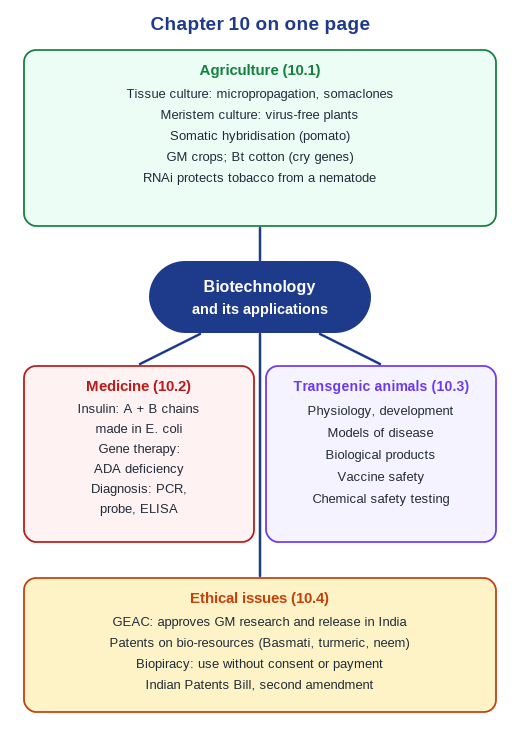
Biotechnology is applied in agriculture through tissue culture and genetically modified crops such as Bt cotton and RNAi-protected tobacco; in medicine through recombinant insulin, gene therapy for ADA deficiency and early diagnosis by PCR, probes and ELISA; and through transgenic animals for research and products. Its use raises ethical questions handled by bodies such as GEAC, and by patent laws against biopiracy.
What is this chapter about?
Chapter 9, Biotechnology: Principles and Processes, explained the tools: restriction enzymes, vectors, PCR and bioreactors. This chapter shows what those tools are used for, mainly in food production and health.
Biotechnology here means making biopharmaceuticals and biologicals on an industrial scale with genetically modified microbes, fungi, plants and animals. It is used for energy production, waste treatment, bioremediation and processed food as well as for diagnostics, therapeutics and GM crops. The book names three critical research areas:
- the catalyst: an improved organism (usually a microbe) or a pure enzyme;
- optimal conditions, created by engineering, for that catalyst to act;
- downstream processing to purify the protein or organic compound.
Two topic pages go deeper: Bt crops and pest-resistant plants and biotechnology in medicine. All 13 exercises are answered in the NCERT solutions.
How is biotechnology used in agriculture?
Food production can be raised in three ways: by agro-chemicals, by organic farming, or by growing genetically engineered crops. The Green Revolution tripled the food supply, mostly through better management and agrochemicals (fertilisers and pesticides), but this was still not enough for a growing population. Agrochemicals are often too costly for farmers in developing countries, and conventional breeding could not push yields of existing varieties much higher.
Tissue culture
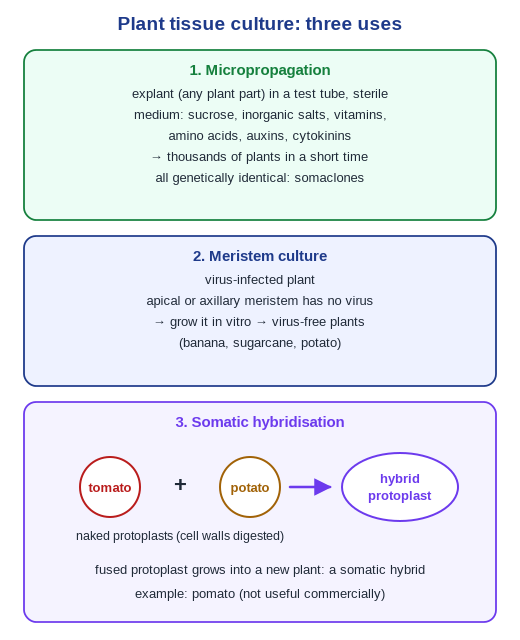
In the 1950s scientists learnt that a whole plant can be regenerated from an explant, any piece of a plant cultured in a test tube, kept sterile, on a special nutrient medium. The capacity of a cell or explant to give a whole plant is totipotency.
- The medium must supply a carbon source such as sucrose, plus vitamins, amino acids, inorganic salts and growth regulators such as auxins and cytokinins.
- Micropropagation: producing thousands of plants this way in a short time. All are genetically identical to the source plant, so they are somaclones. Tomato, banana and apple have been produced commercially by this method.
- Healthy plants from diseased ones: even in a virus-infected plant, the meristem (apical and axillary) carries no virus. Culturing the meristem in vitro gives virus-free plants; this has been done for banana, sugarcane and potato.
- Somatic hybridisation: cell walls of single plant cells are digested to give naked protoplasts. Protoplasts of two varieties, each with a useful trait, are fused, and the hybrid protoplast is grown into a somatic hybrid. Tomato and potato protoplasts gave the pomato, but it did not combine all the desired traits and was not used commercially.
Genetically modified crops
Any organism, whether plant, animal, fungus or bacterium, whose genes have been changed by deliberate manipulation is a Genetically Modified Organism (GMO). Genetic modification of crops has:
- made crops more tolerant of abiotic stresses (cold, drought, salt, heat);
- cut the need for chemical pesticides (pest-resistant crops);
- helped reduce post-harvest losses;
- made plants use minerals more efficiently, so soil fertility is not used up early;
- raised nutritional value, for example golden rice, rice enriched with vitamin A.
GM plants have also been tailored to supply industries with starches, fuels and pharmaceuticals.
Bt cotton
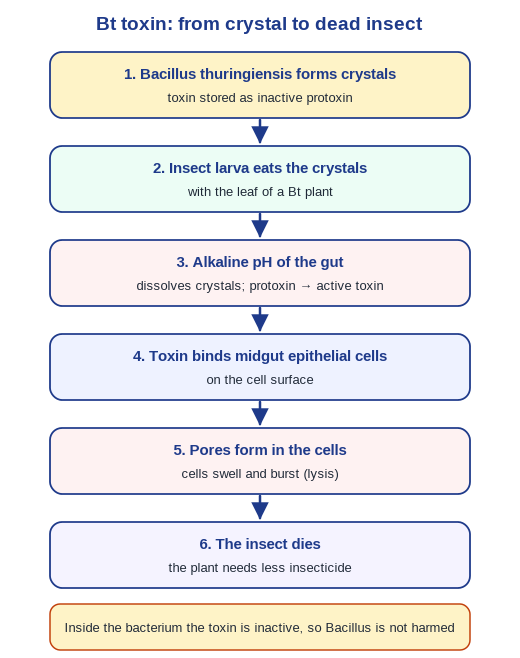
Bacillus thuringiensis (Bt) makes proteins that kill certain insects: dipterans (flies, mosquitoes), coleopterans (beetles) and lepidopterans (armyworm, tobacco budworm). The bacterium stores the toxin in protein crystals as an inactive protoxin, which is why it does not harm the bacterium itself. When an insect eats the crystals, the alkaline pH of its gut dissolves them and activates the toxin. The active toxin attaches to midgut epithelial cells on their surface and makes pores, so the cells swell and burst (lysis) and the insect dies.
The toxin is coded by cry genes. Specific cry genes were isolated and put into crops such as cotton, giving a built-in bio-pesticide. Most Bt toxins are specific to an insect group, so the gene is chosen to suit the crop and the pest: the proteins of cryIAc and cryIIAb control cotton bollworms, and that of cryIAb controls corn borer. Other Bt crops named in the book are Bt corn, rice, tomato, potato and soyabean.
Pest-resistant plants: RNA interference
The nematode Meloidogyne incognita (printed in the book as Meloidegyne incognitia) infects tobacco roots and greatly reduces yield. The protection used RNA interference (RNAi), a defence found in all eukaryotes: a complementary double-stranded RNA (dsRNA) binds a specific mRNA and stops its translation (silencing). In nature such RNA can come from RNA viruses or from transposons that copy themselves through an RNA intermediate.
Genes specific to the nematode were transferred into tobacco with Agrobacterium vectors so that the plant cells made both sense and antisense RNA. These paired into dsRNA, which started RNAi and silenced a specific mRNA of the nematode. The parasite could not survive in the transgenic host, so the roots were protected. Details are on Bt crops and pest-resistant plants.
How is biotechnology used in medicine?
Recombinant DNA technology allows mass production of safe and more effective drugs. Recombinant therapeutics do not cause the unwanted immune responses that similar products from non-human sources often cause. The book notes about 30 recombinant therapeutics approved for human use worldwide, 12 of them marketed in India.
Genetically engineered insulin
Insulin taken at regular intervals manages adult-onset diabetes. Earlier it was extracted from the pancreas of slaughtered cattle and pigs, and some patients developed allergies or other reactions to this foreign protein.
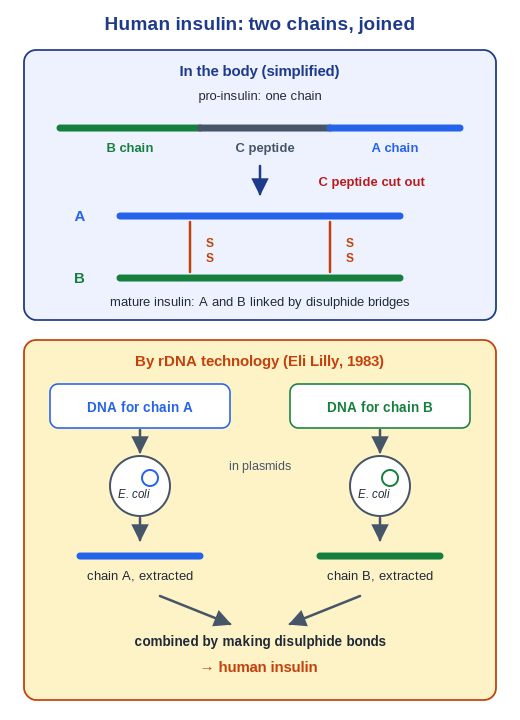
- Insulin has two short polypeptide chains, A and B, linked by disulphide bridges.
- In mammals it is first made as a pro-hormone (pro-insulin) with an extra stretch, the C peptide, which is removed during maturation. Getting the chains assembled into the mature form was the main difficulty for rDNA production.
- In 1983, the American company Eli Lilly prepared two DNA sequences for chains A and B of human insulin and put them into plasmids of E. coli. The chains were made separately, extracted, and joined by creating disulphide bonds to give human insulin.
Gene therapy
Gene therapy is a set of methods for correcting a gene defect diagnosed in a child or embryo: a normal gene is delivered into the person’s cells or tissues to take over the function of the non-functional gene.
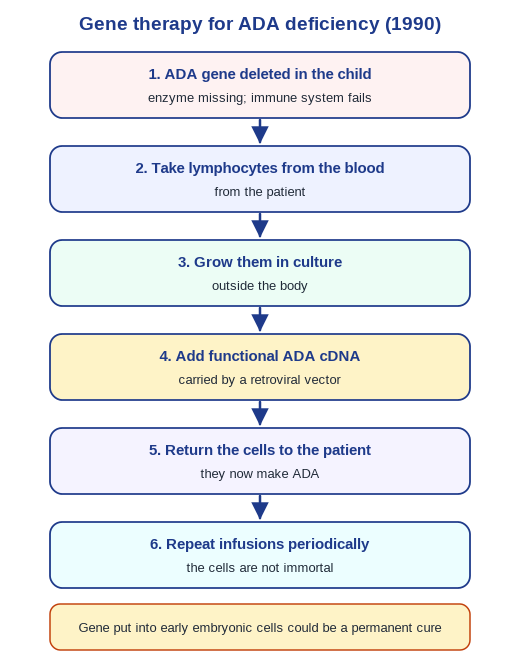
In 1990, a 4-year-old girl suffering from adenosine deaminase (ADA) deficiency received the first clinical gene therapy. ADA is crucial for the immune system; the disorder is caused by deletion of the ADA gene. Bone marrow transplantation or enzyme replacement therapy (functional ADA by injection) helps some children, but neither is completely curative. In gene therapy, lymphocytes from the patient’s blood are grown in culture, a functional ADA cDNA is introduced into them with a retroviral vector, and the cells are returned to the patient. These cells are not immortal, so periodic infusions are needed. Introducing the ADA gene (isolated from marrow cells) into cells at early embryonic stages could be a permanent cure.
Molecular diagnosis
Conventional tests (serum and urine analysis) cannot detect disease early. A pathogen is usually suspected only after symptoms appear, when it is already present in large numbers.
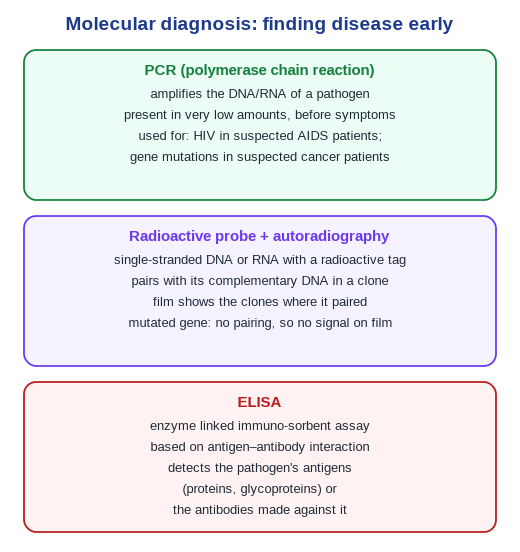
- PCR amplifies the nucleic acid of a bacterium or virus present in very low amounts, before symptoms. It is used routinely to detect HIV in suspected AIDS patients, to find gene mutations in suspected cancer patients, and for many other genetic disorders.
- Probes: a radioactively labelled single-stranded DNA or RNA, the probe, pairs with the matching DNA in a cell clone and is seen by autoradiography. A clone with a mutated gene does not show on the film, because the probe cannot pair with it.
- ELISA (Enzyme Linked Immuno-sorbent Assay) uses antigen–antibody interaction. It detects infection by finding the pathogen’s antigens (proteins, glycoproteins and so on) or the antibodies made against it.
What are transgenic animals?
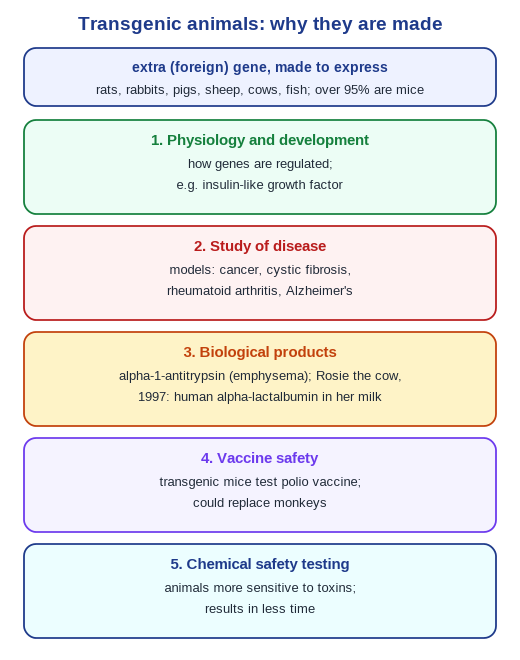
Transgenic animals have had their DNA manipulated to carry and express an extra (foreign) gene. Transgenic fish, cows, sheep, pigs, rabbits and rats have been made, but over 95 per cent are mice. They are made for five main reasons:
- Normal physiology and development: to study gene regulation and the effect of genes on body functions, for example the role of insulin-like growth factor.
- Study of disease: as models of human diseases such as Alzheimer’s, cancer, cystic fibrosis and rheumatoid arthritis, so new treatments can be investigated.
- Biological products: animals carrying a gene for a useful product, such as human α-1-antitrypsin for treating emphysema; similar attempts are being made for phenylketonuria (PKU) and cystic fibrosis as well. Rosie, the first transgenic cow (1997), gave milk enriched with human protein (2.4 grams per litre), containing human alpha-lactalbumin, nutritionally more balanced for human babies than ordinary cow milk.
- Vaccine safety: transgenic mice are used to check whether batches of polio vaccine are safe; if reliable, they could replace monkeys for this testing.
- Chemical safety testing (toxicity testing): animals made more sensitive to toxic substances give results in less time.
What ethical issues does biotechnology raise?
The book’s position is that manipulating living organisms needs regulation and ethical standards. Apart from morality, there is a biological concern: GM organisms released into an ecosystem may have unpredictable effects.
- GEAC (Genetic Engineering Approval Committee), set up by the Government of India, judges whether GM research is valid and whether GM organisms are safe to release for public use.
- Patents: the book records concern about patents granted to companies for products and technologies built on genetic material and plants long known to, and used by, farmers and indigenous communities of a region.
- Basmati example: India has an estimated 200,000 varieties of rice, and 27 documented varieties of Basmati. In 1997 an American company received a US patent on Basmati rice; the ‘new’ variety had been derived by crossing Indian Basmati with semi-dwarf varieties. There have also been attempts to patent uses of Indian traditional herbal medicines such as turmeric and neem.
- Biopiracy means exploiting a country’s bio-resources, as multinational companies or other organisations may do, without the proper permission of that country and its people and without paying them. Industrialised nations are often rich in money but poor in biodiversity and traditional knowledge, while developing nations are rich in both.
- Some nations are making laws against such unauthorised use. The Indian Parliament passed the Indian Patents Bill’s second amendment, which takes these issues into account.
These are questions of law and policy discussed in society; for the exam, know the terms, the role of GEAC and the examples the book gives.
Before we move on
This chapter applies the tools of Chapter 9 and closes Unit IX, Biotechnology. Know the steps of Bt toxin action and the cry genes with their pests, the RNAi strategy against the nematode, the A and B chains of insulin and the role of the C peptide, the steps of ADA gene therapy, the three diagnostic tools, the five uses of transgenic animals, and the meaning of GEAC and biopiracy. All 13 exercises are answered in the NCERT solutions for Chapter 10.
Key terms
| Term | Meaning |
|---|---|
| Totipotency | The ability of a single plant cell or explant to grow into a whole new plant. |
| Micropropagation | Producing thousands of plants in a short time by tissue culture. The plants are genetically identical to the parent and are called somaclones. |
| Somatic hybridisation | Fusing naked protoplasts from two plant varieties and growing the fused cell into a new plant, a somatic hybrid (for example, the pomato). |
| Genetically Modified Organism (GMO) | A plant, bacterium, fungus or animal whose genes have been altered by manipulation, usually by recombinant DNA technology. |
| Bt toxin | An insecticidal protein made by the bacterium Bacillus thuringiensis. It is stored as an inactive protoxin and becomes active only in the alkaline gut of an insect. |
| cry gene | A gene of Bacillus thuringiensis that codes for a Bt (Cry) toxin protein, for example cryIAc, cryIIAb and cryIAb. |
| RNA interference (RNAi) | A cellular defence in all eukaryotes in which a complementary double-stranded RNA silences a specific mRNA, so that mRNA is not translated. |
| Gene therapy | Methods that correct a diagnosed gene defect by putting a normal gene into a person's cells or tissues, so that it takes over from the non-functional gene. |
| ELISA | Enzyme Linked Immuno-sorbent Assay: a test based on antigen–antibody interaction that detects either the antigens of a pathogen or the antibodies made against it. |
| Transgenic animal | An animal whose DNA has been manipulated so that it carries and expresses an extra, foreign gene. |
| Biopiracy | When a multinational company or another organisation exploits a country's bio-resources without that country's and its people's proper permission, and without paying them. |
Topics in this chapter
Practice
-
Bt toxin becomes active in the insect gut because the gut has:
Show answer
Answer: (b) an alkaline pH
-
The proteins coded by cryIAc and cryIIAb control:
Show answer
Answer: (b) cotton bollworms
-
RNA interference silences a specific mRNA by means of:
Show answer
Answer: (b) a complementary double-stranded RNA
-
In the first clinical gene therapy (1990), the missing enzyme was:
Show answer
Answer: (b) adenosine deaminase
-
ELISA works on the principle of:
Show answer
Answer: (b) antigen–antibody interaction
-
Which Indian body judges GM research and decides whether GM organisms are safe to release?
Show answer
Answer: (b) GEAC
Questions students ask
What are the main topics of Class 12 Biology Chapter 10?
Applications of biotechnology in agriculture (tissue culture, GM crops, Bt cotton, RNA interference), in medicine (genetically engineered insulin, gene therapy, molecular diagnosis), transgenic animals, and ethical issues (GEAC, patents and biopiracy).
Is Biotechnology and its Applications in the 2026-27 NCERT Class 12 Biology book?
Yes. It is Chapter 10, the second chapter of Unit IX, Biotechnology, in the Class 12 Biology textbook marked Reprint 2026-27, on pages 177 to 187. It has 13 end-of-chapter exercises.
Why does Bt toxin not kill the bacterium that makes it?
Inside Bacillus thuringiensis the toxin exists as an inactive protoxin in crystals. It becomes active only when an insect eats it and the alkaline pH of the insect gut dissolves the crystals.
Which diagrams should I practise for this chapter?
The action of Bt toxin in the insect gut, RNAi protecting a plant from a nematode, pro-insulin maturing into insulin with A and B chains joined by disulphide bridges, the steps of gene therapy for ADA deficiency, and the steps of cloning a human gene in E. coli.
Stuck on a question?
Take a photo and Lagnever AI explains it step by step. Try it for 7 days for ₹2.
Get it on Google Play Open in browser
For parents: after the trial, the plan renews monthly by UPI or card autopay. You can cancel anytime in the app.