
How is biotechnology used in medicine?
Answer in short
Recombinant DNA technology mass-produces safe human proteins such as insulin, made as separate A and B chains in E. coli and joined by disulphide bonds. Gene therapy corrected ADA deficiency in 1990 using lymphocytes given a functional gene. PCR, probes and ELISA detect disease early, and transgenic animals serve as disease models and producers of proteins.
Stuck on a question? Take a photo and Lagnever AI explains it step by step. Try it for 7 days for ₹2. Get it on Google Play
What has rDNA technology done for health?
Recombinant DNA technology allows mass production of safe and more effective medicines. A recombinant human protein matches the human molecule, so it does not trigger the unwanted immune responses common with similar products from non-human sources. The book notes that about 30 recombinant therapeutics are approved worldwide for use in humans, and 12 are sold in India. This page covers sections 10.2 and 10.3; the Chapter 10 notes give the whole chapter.
How is human insulin made?
Insulin, taken at fixed intervals, manages adult-onset diabetes. It used to come from the pancreas of slaughtered cattle and pigs; being a foreign protein, it caused allergies or other reactions in some patients.
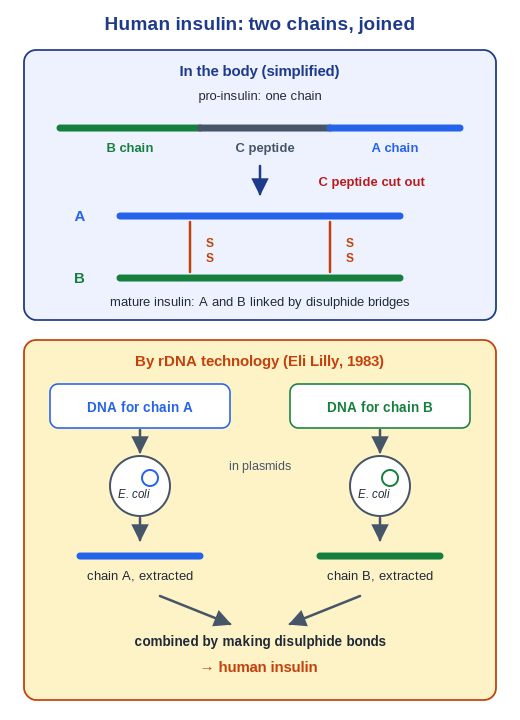
Structure. Insulin has two short polypeptide chains, A and B, held together by disulphide bridges.
Maturation in the body. Mammals first make insulin as a pro-hormone, pro-insulin, which carries an extra stretch called the C peptide. Like a pro-enzyme, the pro-hormone must be processed: the C peptide is cut out, and only then is the hormone mature and functional. Assembling insulin in its mature form was the main challenge for rDNA production.
The solution (1983). The American company Eli Lilly prepared two DNA sequences, one for chain A and one for chain B of human insulin, and introduced them into plasmids of E. coli. The bacteria made the two chains separately; they were extracted and combined by creating disulphide bonds, giving human insulin.
What is gene therapy?
Gene therapy tries to correct a hereditary defect diagnosed in a child or an embryo. A normal gene is delivered into the person’s cells or tissues to take over from, and make up for, the non-functional gene.
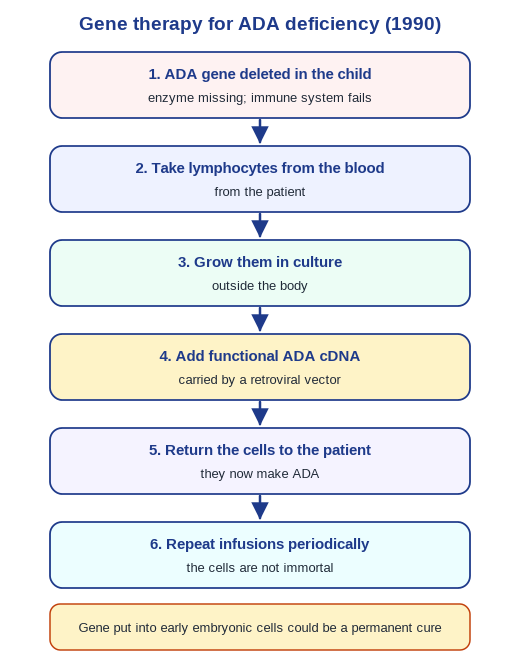
The first case (1990). A 4-year-old girl had adenosine deaminase (ADA) deficiency. ADA is crucial for the immune system, and the disorder comes from deletion of the ADA gene.
| Treatment | How it works | Limitation |
|---|---|---|
| Bone marrow transplantation | Replaces the marrow in some children | Not completely curative |
| Enzyme replacement therapy | Functional ADA injected | Not completely curative |
| Gene therapy | Patient’s cells given a working ADA gene | Cells not immortal; repeat infusions |
Steps of the gene therapy:
- Lymphocytes are taken from the patient’s blood and grown in culture outside the body.
- A functional ADA cDNA is introduced into them using a retroviral vector.
- The engineered lymphocytes are returned to the patient.
- Since these cells are not immortal, the patient needs periodic infusions.
If the ADA gene isolated from marrow cells were placed in the cells of an early embryo, the cure could be permanent.
How is disease diagnosed early?
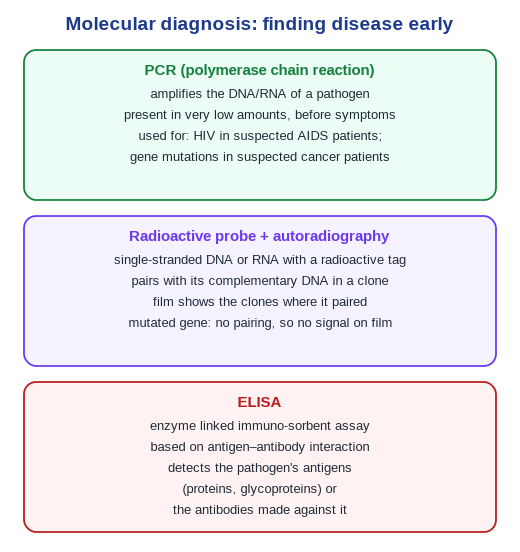
Serum and urine tests usually pick up a pathogen only after it has caused symptoms, when it is already present in large amounts. Three molecular methods detect it much earlier:
- PCR (polymerase chain reaction) amplifies the nucleic acid of a pathogen present in very low concentration. It is used routinely to detect HIV in suspected AIDS patients, to detect mutations in suspected cancer patients, and to identify many other genetic disorders.
- Radioactive probe: a single-stranded DNA or RNA carrying a radioactive tag pairs with the matching DNA in a cell clone, and autoradiography reveals it on photographic film. A clone with the mutated gene does not appear, because the probe cannot pair with it.
- ELISA (Enzyme Linked Immuno-sorbent Assay) relies on antigen–antibody interaction. It detects infection through the pathogen’s antigens (proteins, glycoproteins) or through the antibodies the body has made against it.
How do transgenic animals help medicine?
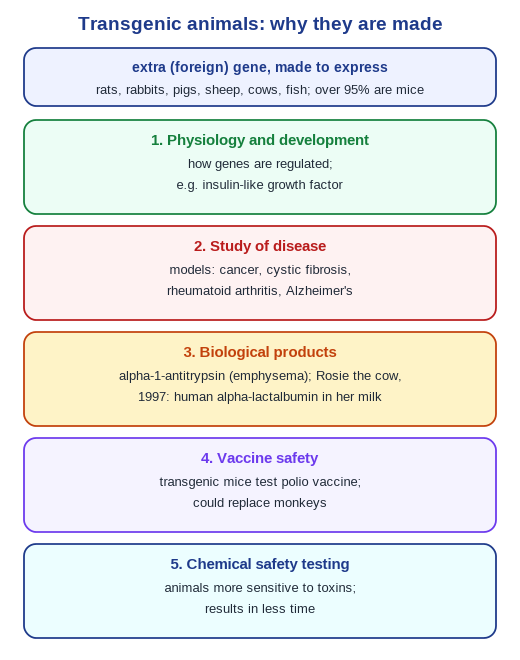
A transgenic animal has had its DNA manipulated to carry and express a foreign gene. Most (over 95 per cent) are mice. Medically useful roles include disease models (Alzheimer’s, cancer, cystic fibrosis, rheumatoid arthritis), biological products such as human α-1-antitrypsin for emphysema, the cow Rosie (1997) whose milk carried human alpha-lactalbumin, testing the safety of the polio vaccine in transgenic mice instead of monkeys, and faster toxicity testing. All five uses are listed on the Chapter 10 notes.
The agricultural side of the chapter is on Bt crops and pest-resistant plants. Medicines named here are given only on a doctor’s advice.
Practice
-
Gene therapy for ADA deficiency used a vector that was:
Show answer
Answer: (b) a retrovirus
-
ADA deficiency is caused by:
Show answer
Answer: (b) deletion of the ADA gene
-
PCR is routinely used to detect which virus in suspected AIDS patients?
Show answer
Answer: (b) HIV
-
Why were animal sources of insulin a problem?
Show answer
Answer: Insulin from the pancreas of slaughtered cattle and pigs is a foreign protein for humans. Some patients developed allergy or other reactions to it.
-
Name the five uses of transgenic animals given in the chapter.
Show answer
Answer: Study of normal physiology and development, study of disease (disease models), production of biological products, testing vaccine safety, and chemical safety (toxicity) testing.
Questions students ask
Why must the engineered lymphocytes be given again and again?
Lymphocytes are not immortal. When the engineered cells die, the ADA they made is lost, so the patient needs periodic infusions of new engineered lymphocytes.
How does PCR find a disease before symptoms?
At an early stage the pathogen is present in very small numbers. PCR copies a chosen stretch of its DNA (or of DNA made from its RNA) many times, so even a tiny amount becomes enough to detect.
Who was Rosie?
The first transgenic cow, produced in 1997. Her milk contained human alpha-lactalbumin (2.4 grams per litre of human protein) and was nutritionally more balanced for human babies than ordinary cow milk.
Stuck on a question?
Take a photo and Lagnever AI explains it step by step. Try it for 7 days for ₹2.
Get it on Google Play Open in browser
For parents: after the trial, the plan renews monthly by UPI or card autopay. You can cancel anytime in the app.