
What are Bt crops and pest-resistant plants?
Answer in short
Bt crops carry cry genes from the bacterium Bacillus thuringiensis and make their own insecticidal toxin. The toxin is an inactive protoxin until the alkaline insect gut activates it; it then makes pores in midgut cells and kills the pest. Tobacco protected from a nematode by RNA interference is another pest-resistant plant.
Stuck on a question? Take a photo and Lagnever AI explains it step by step. Try it for 7 days for ₹2. Get it on Google Play
Why genetically modified crops?
Farmers want more yield with fewer chemicals. Agrochemicals are costly and harm the environment, and conventional breeding has reached its limits for many varieties. Genetically modified (GM) crops are one answer. A Genetically Modified Organism (GMO) is any plant, bacterium, fungus or animal whose genes have been altered by manipulation. This page covers the pest-resistant crops of section 10.1; the Chapter 10 notes give the whole chapter in short, including tissue culture.
What genetic modification has done for crops:
| Benefit | What it means |
|---|---|
| Abiotic stress tolerance | Crops cope better with cold, drought, salt and heat |
| Pest resistance | Less reliance on chemical pesticides |
| Lower post-harvest losses | Less produce wasted after harvest |
| Efficient mineral use | Soil fertility is not exhausted early |
| Better nutrition | Golden rice, enriched with vitamin A |
Where does Bt toxin come from?
Bacillus thuringiensis (Bt) is a bacterium. Some of its strains make proteins that kill particular insects:
- dipterans: flies, mosquitoes;
- coleopterans: beetles;
- lepidopterans: armyworm, tobacco budworm.
During one phase of growth, the bacterium forms protein crystals that contain the toxic insecticidal protein.
Why does the toxin not kill the bacterium?
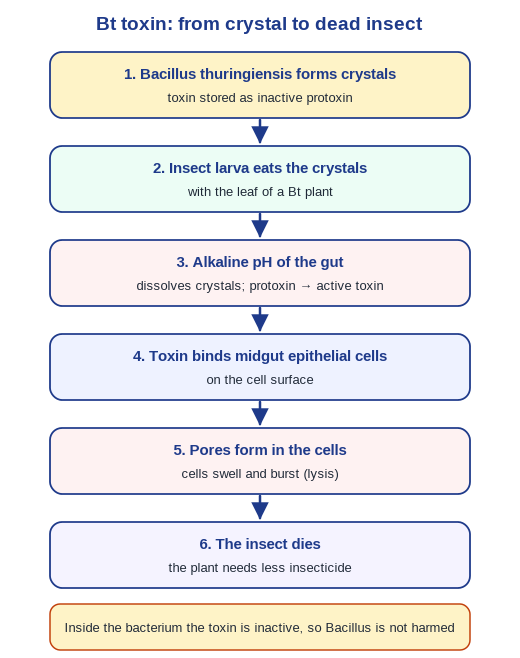
Inside the bacterium, the toxin is an inactive protoxin. It becomes active only after an insect swallows it:
- The insect eats the crystals (in a Bt plant, they are in the leaves it chews).
- The alkaline pH of the insect gut dissolves the crystals and converts the protoxin into the active toxin.
- The active toxin attaches to midgut epithelial cells on their surface.
- It creates pores in these cells, which swell and burst (lysis).
- The insect dies.
How is a Bt crop made?
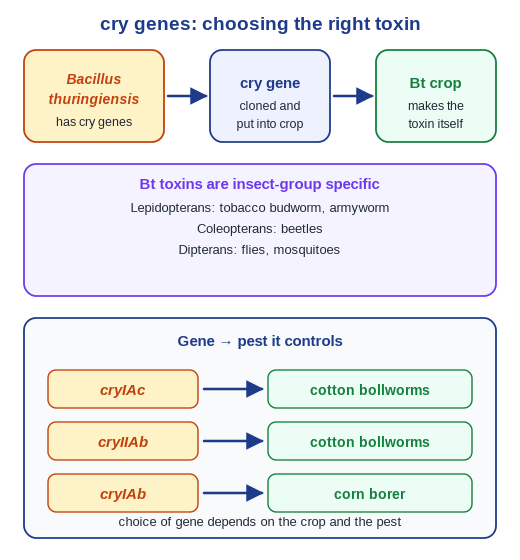
The toxin is coded by a gene named cry. Specific cry genes were isolated from B. thuringiensis and put into several crop plants, cotton among them. The plant then makes the toxin itself, which works as a bio-pesticide without spraying insecticides. Most Bt toxins are insect-group specific, so the gene is chosen according to the crop and its pest:
| Gene | Pest controlled by its protein |
|---|---|
| cryIAc | Cotton bollworms |
| cryIIAb | Cotton bollworms |
| cryIAb | Corn borer |
The book’s examples of Bt crops are cotton, corn, rice, tomato, potato and soyabean. A cotton boll eaten by bollworms is destroyed; a protected boll matures fully.
How does RNA interference protect a plant?
Many nematodes parasitise plants and animals. The nematode Meloidogyne incognita (printed in the book as Meloidegyne incognitia) infects the roots of tobacco and cuts the yield a lot. The new strategy against it uses RNA interference (RNAi).
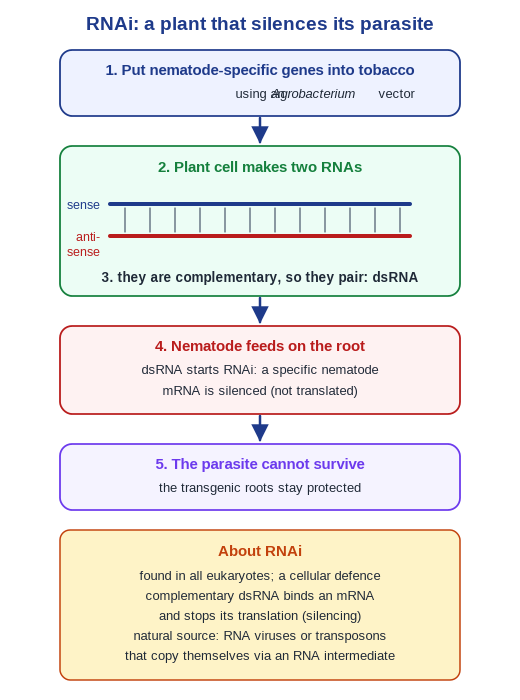
What RNAi is. All eukaryotic organisms use RNAi as a cellular defence. A double-stranded RNA (dsRNA) that is complementary to a particular mRNA binds to it and prevents its translation. This is called silencing. In nature, the complementary RNA may come from viruses with RNA genomes, or from transposons (mobile genetic elements) that replicate through an RNA intermediate.
How it was used:
- Nematode-specific genes were introduced into tobacco using Agrobacterium vectors.
- The DNA was introduced in a way that made the host cells produce both sense and antisense RNA.
- Being complementary, the two RNAs paired into dsRNA.
- The dsRNA started RNAi and silenced a specific mRNA of the nematode feeding on the plant.
- The parasite could not survive in the transgenic host, so the roots stayed protected.
In the book’s comparison, roots of an ordinary plant are heavily infected, while transgenic roots stay protected five days after being deliberately infected with the nematode.
Points to keep in mind
Bt crops and RNAi plants are examples of reducing pesticide use with genes rather than chemicals. Their release is regulated in India by GEAC, discussed with the other ethical issues on the Chapter 10 notes. The medical uses of the same tools are on biotechnology in medicine.
Practice
-
Bt toxin kills insects by:
Show answer
Answer: (b) making pores in midgut epithelial cells
-
The nematode controlled by RNAi in the chapter infects the roots of:
Show answer
Answer: (b) tobacco
-
Which vector was used to introduce nematode-specific genes into the host plant?
Show answer
Answer: (b) Agrobacterium
-
Why is a Bt crop described as having a built-in bio-pesticide?
Show answer
Answer: The crop carries a cry gene from Bacillus thuringiensis and makes the Bt toxin protein in its own tissues. An insect that feeds on it eats the toxin and dies, so the crop is protected without spraying insecticide.
-
How do sense and antisense RNA together protect a tobacco plant from the nematode?
Show answer
Answer: The two RNAs are complementary, so they pair to form double-stranded RNA. This dsRNA starts RNA interference, which silences a specific mRNA of the nematode. The parasite cannot survive in the transgenic plant.
Questions students ask
What does 'Bt' stand for?
Bt is short for Bacillus thuringiensis, the soil bacterium whose cry genes code for the insecticidal Bt toxin.
Why are different cry genes used for different crops?
Most Bt toxins act on only one group of insects. So the gene is chosen to match the pest of that crop, for example cryIAc and cryIIAb for cotton bollworms and cryIAb for corn borer.
Where does the dsRNA for RNAi come from in nature?
From infection by viruses whose genome is RNA, or from mobile genetic elements (transposons) that copy themselves through an RNA intermediate.
Stuck on a question?
Take a photo and Lagnever AI explains it step by step. Try it for 7 days for ₹2.
Get it on Google Play Open in browser
For parents: after the trial, the plan renews monthly by UPI or card autopay. You can cancel anytime in the app.