
Class 12 Biology Chapter 9: Biotechnology: Principles and Processes Notes
This chapter in five lines
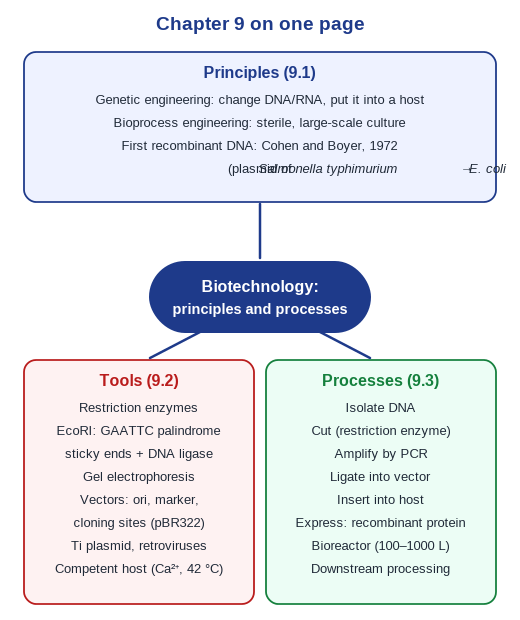
Modern biotechnology rests on genetic engineering and bioprocess engineering. Recombinant DNA is made by cutting source DNA and a vector with the same restriction enzyme, joining them with DNA ligase and putting the result into a competent host. The processes are isolating DNA, cutting it, amplifying the gene by PCR, ligation, insertion, expression in bioreactors and downstream processing.
What is this chapter about?
Chapter 8, Microbes in Human Welfare, showed microbes making curd, bread and medicines. This chapter opens Unit IX, Biotechnology, and explains the methods behind modern biotechnology: how scientists cut a gene out of one organism, join it to a carrier DNA and make another organism copy it and make its product.
Two topic pages go deeper: tools of recombinant DNA technology and processes of recombinant DNA technology. All 12 exercises are answered in the NCERT solutions.
What is biotechnology?
Biotechnology uses live organisms, or enzymes from organisms, to make products and processes useful to humans. In a broad sense, making curd, bread or wine with microbes is biotechnology. Today the word is used in a narrower sense: processes that use genetically modified organisms to do this on a large scale. Other techniques are counted too: in vitro fertilisation that gives a ‘test-tube’ baby, making a gene artificially and using it, preparing a DNA vaccine, and repairing a faulty gene.
The European Federation of Biotechnology (EFB) gives a definition that covers both the traditional and the modern view. In short, it describes biotechnology as bringing natural science together with organisms, cells, parts of cells and molecular analogues to give products and services.
What are the principles of biotechnology?
Two core techniques made modern biotechnology possible:
- Genetic engineering: techniques to change the chemistry of the genetic material (DNA and RNA), introduce it into a host organism, and so change the phenotype of the host.
- Bioprocess engineering: keeping a sterile ambience (no microbial contamination) in chemical engineering processes, so that only the desired microbe or eukaryotic cell grows in large quantities, to make products such as antibiotics, vaccines and enzymes.
Why genetic engineering? Sexual reproduction allows variation, while asexual reproduction preserves genetic information. Traditional hybridisation in plant and animal breeding often carries undesirable genes along with the desired ones. Genetic engineering (recombinant DNA, gene cloning and gene transfer) lets us introduce only one gene, or a chosen set of genes, into the target organism.
Why an origin of replication? A piece of DNA moved into an alien organism usually cannot multiply in the progeny cells. It multiplies only if it becomes part of a chromosome, because a chromosome carries a specific sequence, the origin of replication, where replication begins. So alien DNA is linked to an origin of replication; it can then replicate in the host. Making many identical copies of a template DNA in this way is called cloning.
The first recombinant DNA. In 1972, Stanley Cohen and Herbert Boyer cut out an antibiotic-resistance gene from a plasmid with restriction enzymes (‘molecular scissors’) and linked it, using DNA ligase, to a plasmid naturally present in Salmonella typhimurium (a plasmid is a small ring of DNA outside the chromosome that copies itself on its own). The plasmid acted as a vector, the way a mosquito is an insect vector for the malarial parasite. Put into Escherichia coli, the recombinant DNA was copied by the host’s DNA polymerase: the antibiotic-resistance gene was cloned in E. coli.
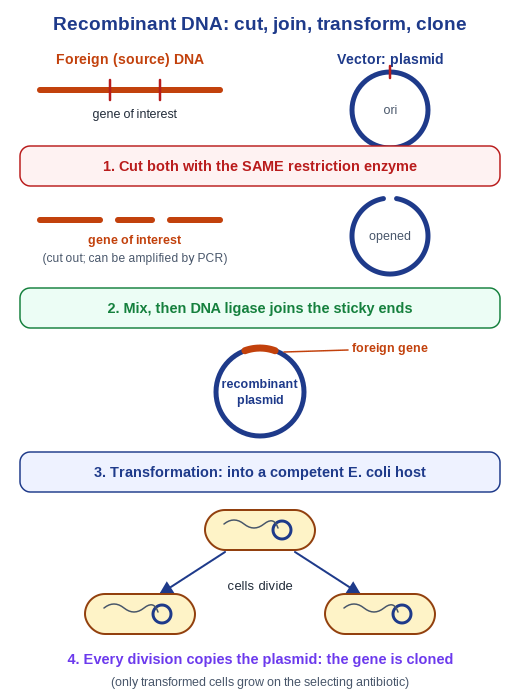
So genetically modifying an organism has three basic steps: (i) identify DNA with the desirable genes; (ii) introduce it into the host; (iii) maintain it in the host and transfer it to the host’s progeny.
What tools does recombinant DNA technology need?
Five kinds of tools are needed: restriction enzymes to cut, polymerases to copy, ligases to join, vectors to carry and a host organism to multiply the DNA.
Restriction enzymes
- In 1963, two enzymes that restrict the growth of bacteriophages in E. coli were isolated: one added methyl groups to DNA, the other cut DNA. The cutting one was called a restriction endonuclease.
- Five years later Hind II was isolated: it cut DNA at one fixed place each time, after spotting a particular six-base-pair sequence, its recognition sequence. Today more than 900 restriction enzymes are known, from over 230 strains of bacteria.
- Naming: the first letter comes from the genus and the next two from the species of the prokaryote; for EcoRI, Escherichia coli RY 13, the ‘R’ comes from the strain, and the Roman numeral gives the order in which enzymes were isolated from that strain.
- Restriction enzymes are nucleases. Exonucleases remove nucleotides from the ends of DNA; endonucleases cut at chosen places inside the DNA.
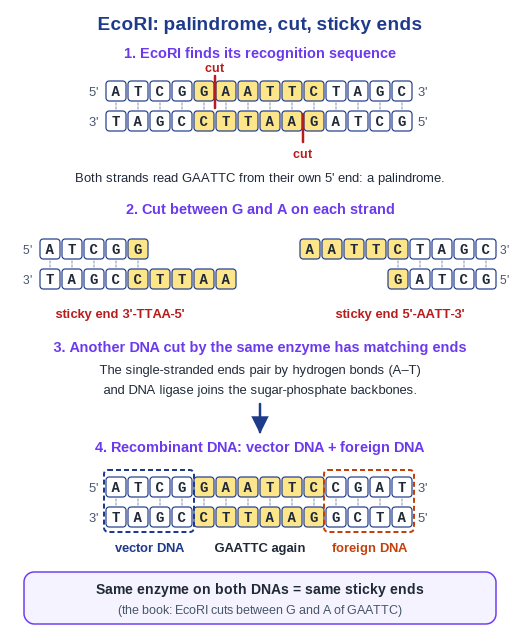
Each restriction endonuclease ‘inspects’ the DNA until it finds its palindromic recognition sequence, binds there and cuts both strands in the sugar-phosphate backbones. A DNA palindrome reads the same on both strands when read in the same orientation:
| Strand | Sequence |
|---|---|
| Top | 5’ — GAATTC — 3’ |
| Bottom | 3’ — CTTAAG — 5’ |
Read from its own 5’ end, each strand says GAATTC. EcoRI cuts between G and A on each strand. The two cuts are slightly off the middle of the palindrome, yet both fall between the same pair of bases (G and A) on their own strand. Each fragment is left with a single-stranded overhang, AATT, called a sticky end: it forms hydrogen bonds with a matching cut end, which makes the work of DNA ligase easier. DNA from different sources cut with the same enzyme has the same sticky ends, so the pieces can be joined end to end.
Separating DNA fragments: gel electrophoresis
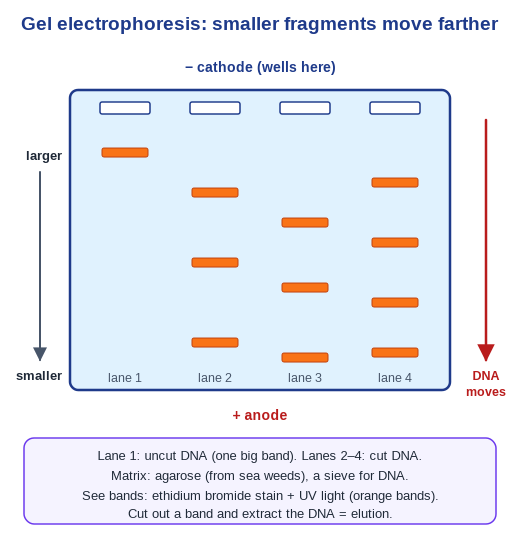
DNA fragments are negatively charged, so in an electric field they move through a matrix towards the anode. The usual matrix is agarose, a natural polymer from sea weeds; it acts as a sieve, so the smaller the fragment, the farther it moves. The bands become visible only after staining with ethidium bromide and exposing the gel to UV radiation (bright orange bands). A band is cut out and the DNA extracted from it: this is elution. (Extra: ethidium bromide and UV light are hazardous; gel work is done only in a laboratory with a teacher.)
Cloning vectors
Plasmids and bacteriophages replicate inside bacteria independently of the chromosome. Some plasmids have one or two copies per cell, others 15–100 or more; phages have very high copy numbers. DNA linked to them is multiplied to their copy number. A vector needs:
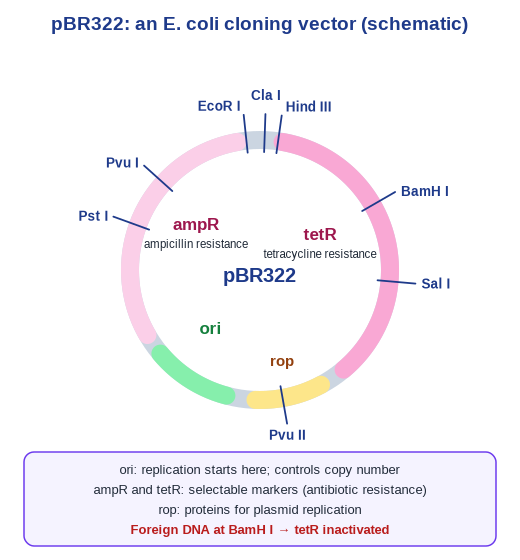
- Origin of replication (ori): where replication starts; it also controls the copy number of the linked DNA.
- Selectable marker: a gene, usually for resistance to an antibiotic such as ampicillin, chloramphenicol, tetracycline or kanamycin, that helps eliminate non-transformants and lets transformants grow. Normal E. coli is not resistant to any of these. (Transformation is the procedure by which a piece of DNA is introduced into a host bacterium.)
- Cloning sites: for each commonly used restriction enzyme, the vector should have as few sites as possible, ideally just one; more sites would cut the vector into several fragments.
- Vectors for plants and animals: the tumour-inducing Ti plasmid of Agrobacterium tumifaciens (spelled so in the book) has been made non-pathogenic and now delivers useful genes into many plants; disarmed retroviruses deliver genes into animal cells.
In the vector pBR322, foreign DNA ligated at the BamH I site of the tetracycline-resistance gene inactivates it. Recombinants grow on ampicillin but not on tetracycline; non-recombinants grow on both. Because this needs two plates, a simpler method uses a chromogenic substrate: the insert is placed inside the gene for β-galactosidase. Colonies with no insert turn blue; recombinant colonies stay colourless. Loss of a gene’s function by such an insert is insertional inactivation.
Competent host
DNA is hydrophilic, so it cannot pass through cell membranes. Bacteria are made competent with a measured dose of a divalent cation, for example calcium. The cells are then incubated with recombinant DNA on ice, given a brief heat shock at 42 °C, and put back on ice, so they take up the DNA. Other methods: micro-injection into the nucleus of an animal cell; biolistics or the gene gun, which bombards plant cells with DNA-coated micro-particles of gold or tungsten; and disarmed pathogen vectors. The details are on tools of recombinant DNA technology.
What are the processes of recombinant DNA technology?
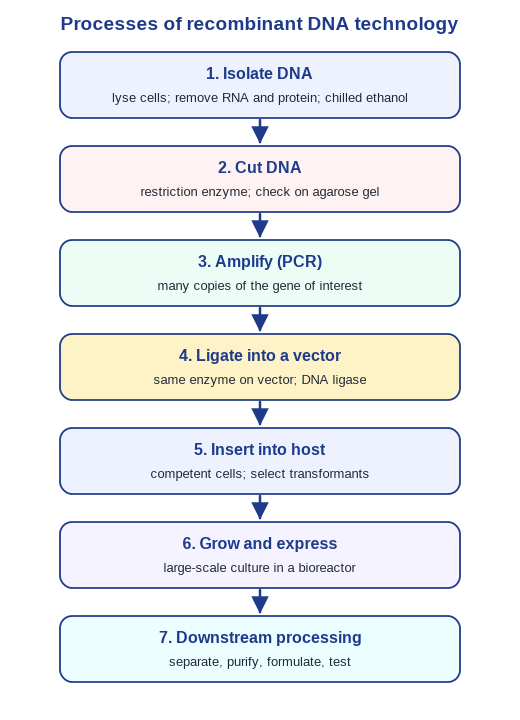
- Isolating DNA. Cells are broken open with lysozyme (bacteria), cellulase (plant cells) or chitinase (fungi). RNA is removed with ribonuclease, proteins such as histones with protease; adding chilled ethanol makes the purified DNA come out as fine threads, which can be spooled.
- Cutting DNA at specific locations. Purified DNA is kept with the restriction enzyme under the conditions that suit that enzyme; agarose gel electrophoresis checks how far the digestion has gone. The vector is cut the same way; the gene of interest and the cut vector are mixed with ligase to make recombinant DNA.
- Amplifying the gene by PCR. Two primers and a thermostable DNA polymerase from Thermus aquaticus copy the gene in vitro through repeated cycles of denaturation, primer annealing and extension; the segment can be amplified about a billion times.
- Inserting recombinant DNA into the host. Competent cells take up the DNA; with an ampicillin-resistance gene, only transformants grow on ampicillin plates, so the gene is a selectable marker.
- Obtaining the foreign gene product. The aim is usually a protein. A protein made from a gene expressed in a different (heterologous) host is a recombinant protein. Cells can be grown in a continuous culture, where used medium is drained out on one side and fresh medium added on the other, keeping the cells in their most active log/exponential phase.
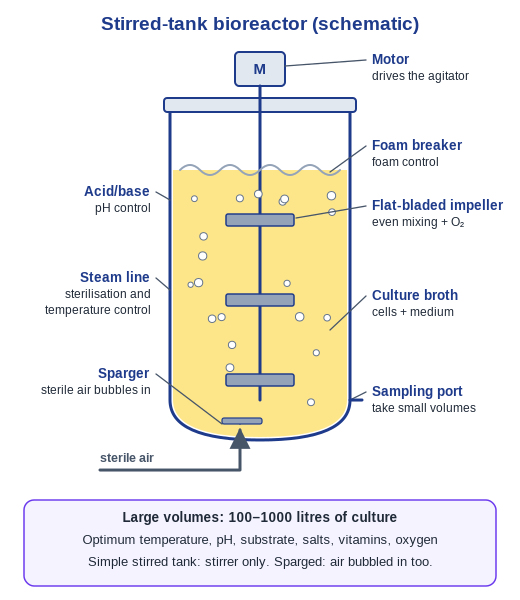
- Bioreactors. For large amounts, bioreactors process 100–1000 litres of culture under optimum temperature, pH, substrate, salts, vitamins and oxygen. The common stirred-tank type has an agitator, oxygen delivery, foam control, temperature and pH control, and sampling ports.
- Downstream processing. Separation and purification of the product, formulation with preservatives, clinical trials for drugs, and strict quality control.
PCR, insertion, bioreactors and downstream processing are explained step by step on processes of recombinant DNA technology. All of this is laboratory and industrial work, not something to try at home.
Before we move on
This chapter builds on Chapter 5, Molecular Basis of Inheritance (DNA structure, base pairing and replication), and leads into Chapter 10, Biotechnology and its Applications, which uses these tools in agriculture and medicine. Know the EcoRI palindrome and its cut, the features of a cloning vector with pBR322 as the example, the two ways of selecting recombinants, the three steps of PCR and the parts of a stirred-tank bioreactor. All 12 exercises are answered in the NCERT solutions for Chapter 9.
Key terms
| Term | Meaning |
|---|---|
| Biotechnology | Techniques that use live organisms, or enzymes from organisms, to make products and processes useful to humans. Today the word mostly means processes that use genetically modified organisms on a large scale. |
| Genetic engineering | Techniques that change the chemistry of the genetic material (DNA and RNA), introduce it into a host organism and so change the host's phenotype. |
| Bioprocess engineering | Keeping a sterile ambience, without microbial contamination, in chemical engineering processes so that only the desired microbe or eukaryotic cell grows in large quantities to make products such as antibiotics, vaccines and enzymes. |
| Recombinant DNA | A new combination of DNA made in vitro by joining DNA from different sources, for example a gene joined to a plasmid vector. |
| Restriction endonuclease | A 'molecular scissors' enzyme that recognises a specific palindromic sequence in DNA and cuts the sugar-phosphate backbone of both strands at fixed points. |
| Palindrome (in DNA) | A run of base pairs that gives the same sequence on both strands when each strand is read in the same direction, for example 5'-GAATTC-3' paired with 3'-CTTAAG-5'. |
| Sticky ends | Short single-stranded overhangs left because a restriction enzyme cuts each strand slightly off the middle of the palindrome. They form hydrogen bonds with matching cut ends, which helps DNA ligase join them. |
| Gel electrophoresis | Separating DNA fragments by size: negatively charged DNA is pushed through an agarose gel towards the anode, and smaller fragments move farther. |
| Cloning vector | A DNA molecule, such as a plasmid or bacteriophage, that can replicate in a host and carry a linked piece of foreign DNA into it. |
| Selectable marker | A gene in the vector, such as one for resistance to ampicillin or tetracycline, that lets transformants grow and non-transformants be eliminated. |
| Insertional inactivation | Loss of a gene's function because foreign DNA has been inserted inside it; used to tell recombinants from non-recombinants. |
| PCR (polymerase chain reaction) | Making many copies of a chosen DNA segment in vitro with two primers and a thermostable DNA polymerase, by repeated cycles of denaturation, annealing and extension. |
| Bioreactor | A vessel, often holding 100–1000 litres of culture, in which raw materials are converted biologically into products under optimum conditions. |
| Downstream processing | The separation and purification of the product after the biosynthetic stage, followed by formulation, clinical trials (for drugs) and quality control. |
Topics in this chapter
Practice
-
The recognition sequence of EcoRI is:
Show answer
Answer: (b) 5'-GAATTC-3'
-
In gel electrophoresis, DNA fragments move towards the:
Show answer
Answer: (b) anode, because DNA is negatively charged
-
Foreign DNA is inserted at the BamH I site of pBR322. The recombinant cells will grow on:
Show answer
Answer: (c) ampicillin but not tetracycline
-
The thermostable DNA polymerase used in PCR comes from:
Show answer
Answer: (b) Thermus aquaticus
-
Which enzyme is used to break open fungal cells to release DNA?
Show answer
Answer: (c) Chitinase
-
In the blue-white test, recombinant colonies are:
Show answer
Answer: (b) colourless
Questions students ask
What are the main topics of Class 12 Biology Chapter 9?
Principles of biotechnology (genetic engineering and bioprocess engineering, the first recombinant DNA), tools of recombinant DNA technology (restriction enzymes, gel electrophoresis, cloning vectors, competent host) and processes of recombinant DNA technology (isolating and cutting DNA, PCR, insertion into the host, obtaining the product, bioreactors and downstream processing).
Is Biotechnology: Principles and Processes in the 2026-27 NCERT Class 12 Biology book?
Yes. It is Chapter 9, the first chapter of Unit IX, Biotechnology, in the Class 12 Biology textbook marked Reprint 2026-27, on pages 163 to 176. It has 12 end-of-chapter exercises.
Why must the vector and the source DNA be cut with the same restriction enzyme?
The same enzyme leaves the same kind of sticky ends on both. Only matching sticky ends pair with each other, so DNA ligase can join the gene into the vector. The chapter says that normally the recombinant vector cannot be made unless both are cut with the same enzyme.
Which diagrams should I practise for this chapter?
The action of EcoRI with sticky ends, the steps of making recombinant DNA, an agarose gel with lanes and bands, the pBR322 map with ori, ampR, tetR and restriction sites, one PCR cycle, and a stirred-tank bioreactor.
Stuck on a question?
Take a photo and Lagnever AI explains it step by step. Try it for 7 days for ₹2.
Get it on Google Play Open in browser
For parents: after the trial, the plan renews monthly by UPI or card autopay. You can cancel anytime in the app.