
NCERT Solutions Class 12 Biology Chapter 9: Biotechnology: Principles and Processes
Answers to all 12 end-of-chapter exercises of Chapter 9, Biotechnology: Principles and Processes, of Biology, the Class 12 NCERT textbook. Page numbers follow the 2026-27 reprint (pages 163–176). The exercises are quoted from the book as printed; the answers are our own, built from the chapter, and every fact from outside the chapter is marked Extra. Every DNA sequence on this page was checked by script (complementary strand, reverse complement, cut position), and the PCR and concentration numbers were computed by script. The questions the chapter text asks along the way are answered in short at the end. The book prints no answer key for this chapter. Short notes: Chapter 9 notes.
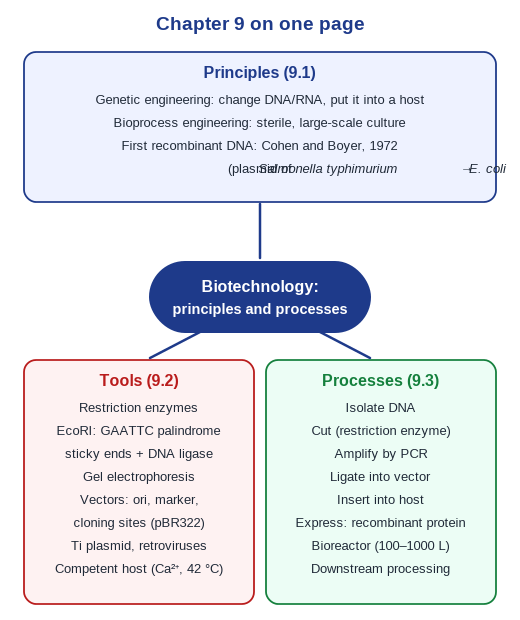
Exercises 1 to 4: proteins, enzymes and DNA
1. “Can you list 10 recombinant proteins which are used in medical practice? Find out where they are used as therapeutics (use the internet).”
The chapter explains how recombinant proteins are made but does not list them, so this whole answer is Extra. These are well-known examples; check the list with your teacher.
| Recombinant protein | Used for |
|---|---|
| Human insulin | Diabetes (Chapter 10 describes how it is made) |
| Human growth hormone | Growth hormone deficiency (short stature) |
| Interferon alpha | Some viral infections, such as hepatitis, and some cancers |
| Interferon beta | Multiple sclerosis |
| Erythropoietin | Anaemia, for example in chronic kidney disease |
| Tissue plasminogen activator (tPA) | Dissolving blood clots after a heart attack or stroke |
| Blood clotting factor VIII | Haemophilia A |
| Hepatitis B surface antigen | Vaccine against hepatitis B |
| Granulocyte colony stimulating factor (G-CSF) | Raising white blood cell counts after chemotherapy |
| Follicle stimulating hormone (FSH) | Infertility treatment |
All are made by expressing a human (or viral) gene in a host such as bacteria, yeast or mammalian cells, which is exactly what makes them recombinant proteins. They are prescription medicines given only by doctors.
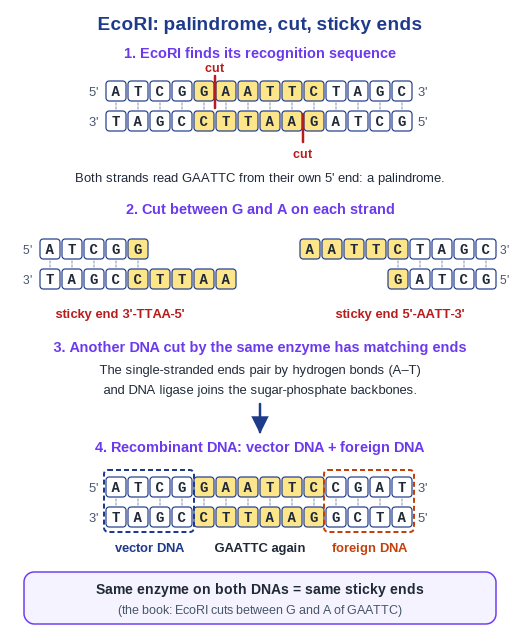
2. “Make a chart (with diagrammatic representation) showing a restriction enzyme, the substrate DNA on which it acts, the site at which it cuts DNA and the product it produces.”
| Part of the chart | EcoRI (the book’s example) |
|---|---|
| Restriction enzyme | EcoRI, from Escherichia coli RY 13 |
| Substrate DNA | Double-stranded DNA containing the palindrome 5’-GAATTC-3’ / 3’-CTTAAG-5’ |
| Site of cut | Between G and A on each strand, in the sugar-phosphate backbone |
| Product | Two DNA fragments, each with a single-stranded AATT overhang (sticky end) |
Example, checked base by base:
- Before the cut: top 5’-ATCGGAATTCTAGC-3’, bottom 3’-TAGCCTTAAGATCG-5’.
- Left fragment: top 5’-ATCGG-3’, bottom 3’-TAGCCTTAA-5’.
- Right fragment: top 5’-AATTCTAGC-3’, bottom 3’-GATCG-5’.
A DNA cut by the same enzyme has matching sticky ends, so the two can be joined by DNA ligase into recombinant DNA.
3. “From what you have learnt, can you tell whether enzymes are bigger or DNA is bigger in molecular size? How did you know?”
Answer: DNA is far bigger than an enzyme.
How we know, from this chapter:
- A restriction enzyme moves along (‘inspects’) a long DNA molecule and binds to only one short stretch of it, its recognition sequence of about six base pairs. So one enzyme covers only a tiny part of the DNA.
- One DNA molecule has many such sites, so it can be cut into many fragments. Even these fragments are big enough to be sorted by size on a gel.
- When chilled ethanol is added, purified DNA separates out as long, fine threads that we can see. This shows how long DNA molecules are.
- From Chapter 5: the haploid human genome is about 3.3 × 10⁹ bp. Extra: a typical enzyme is a chain of only a few hundred amino acids.
4. “What would be the molar concentration of human DNA in a human cell? Consult your teacher.”
This needs assumptions, so the answer is an Extra estimate to discuss with your teacher.
- A diploid human cell has 46 chromosomes, that is, 46 DNA molecules, with about 6.6 × 10⁹ bp in all (Chapter 5).
- Moles of DNA molecules = 46 ÷ (6.022 × 10²³) ≈ 7.6 × 10⁻²³ mol. (6.022 × 10²³ is Avogadro’s number, the number of particles in one mole.)
- Extra assumption: the nucleus is a sphere about 6 µm across, so its volume is (4/3)π(3 × 10⁻⁶ m)³ ≈ 1.13 × 10⁻¹⁶ m³ ≈ 1.1 × 10⁻¹³ L.
- Molar concentration of DNA molecules = moles ÷ volume ≈ 7.6 × 10⁻²³ ÷ 1.13 × 10⁻¹³ ≈ 6.8 × 10⁻¹⁰ M (about 0.7 nanomolar).
- Counted as base pairs instead: 6.6 × 10⁹ ÷ 6.022 × 10²³ ≈ 1.1 × 10⁻¹⁴ mol of bp, giving about 0.1 M of base pairs in the nucleus.
Answer (estimate): about 7 × 10⁻¹⁰ M of DNA molecules (about 0.1 M if base pairs are counted).
The point of the question: there are only 46 DNA molecules per cell, but each is enormous, so the concentration of molecules is tiny while the concentration of base pairs is high.
Exercises 5 to 7: enzymes, bioreactors and palindromes
5. “Do eukaryotic cells have restriction endonucleases? Justify your answer.”
No, restriction endonucleases are not found in eukaryotic cells.
- The chapter says these enzymes were found because they restrict the growth of bacteriophages in E. coli, and that all of them come from bacteria (over 230 strains); their names come from the genus and species of the prokaryotic cell. They work as a defence of bacteria against invading phage DNA.
- Extra: the bacterium protects its own DNA by methylating it (the chapter mentions the second, methylating enzyme). Eukaryotes do not have this restriction-modification system. Eukaryotic cells do have other nucleases, for example for DNA repair, but not restriction enzymes.
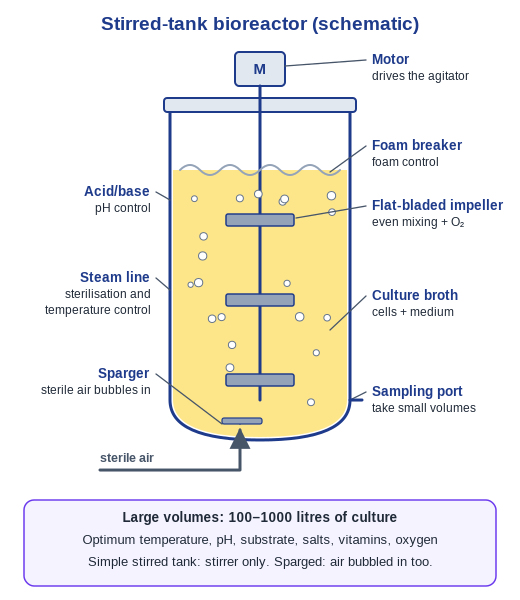
6. “Besides better aeration and mixing properties, what other advantages do stirred tank bioreactors have over shake flasks?”
| Feature | Shake flask | Stirred-tank bioreactor |
|---|---|---|
| Volume | Small; cannot yield appreciable quantities | Large, 100–1000 litres |
| Temperature | Not controlled inside the culture | Temperature control system |
| pH | Not controlled | pH control system (acid or base added) |
| Foam | No control | Foam control system |
| Oxygen | Only by shaking | Oxygen delivery system; sterile air can be sparged |
| Checking progress | Hard without disturbing the culture | Sampling ports to withdraw small volumes |
| Sterility | Extra: easily contaminated when opened | Can be sterilised (for example by steam) and run closed |
So a bioreactor holds the whole large volume at the right temperature and pH, with enough substrate, salts, vitamins and oxygen, giving a much larger yield of the desired product.
7. “Collect 5 examples of palindromic DNA sequences by consulting your teacher. Better try to create a palindromic sequence by following base-pair rules.”
A DNA palindrome reads the same on both strands when each is read from 5’ to 3’. The first one is the book’s example; the other four are the recognition sites of enzymes whose names appear on the pBR322 map in the book (the sequences themselves are Extra). Each was checked by script.
| Enzyme | Top strand 5’ → 3’ | Bottom strand 3’ → 5’ |
|---|---|---|
| EcoRI | GAATTC | CTTAAG |
| BamH I | GGATCC | CCTAGG |
| Hind III | AAGCTT | TTCGAA |
| Sal I | GTCGAC | CAGCTG |
| Pst I | CTGCAG | GACGTC |
Creating one. Write any short sequence, then add its reverse complement after it (complement each base, A↔T and G↔C, and write them in reverse order):
- Start with 5’-GCTA.
- Complement: CGAT; reverse it: TAGC.
- Join: 5’-GCTATAGC-3’. Its partner strand is 3’-CGATATCG-5’, which read from its own 5’ end is GCTATAGC again. It is a palindrome.
Exercises 8 to 10: meiosis, reporters and key terms
8. “Can you recall meiosis and indicate at what stage a recombinant DNA is made?”
In nature, recombinant DNA is made during crossing over, in the pachytene stage of prophase I of meiosis (from Class XI, Cell Cycle and Cell Division). Non-sister chromatids of homologous chromosomes exchange segments, with the help of the enzyme recombinase (Extra detail from Class XI), so each recombinant chromatid carries a new combination of DNA from the two parents.
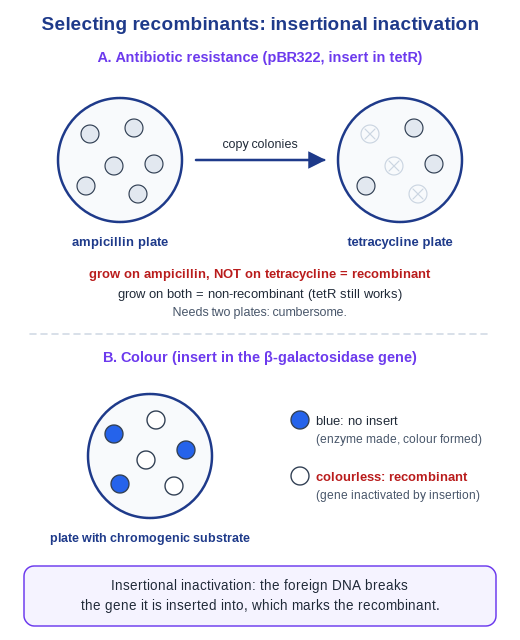
9. “Can you think and answer how a reporter enzyme can be used to monitor transformation of host cells by foreign DNA in addition to a selectable marker?”
- A reporter enzyme is one whose activity is easy to see. The chapter’s example is β-galactosidase with a chromogenic substrate.
- If the vector carries the β-galactosidase gene and the host is transformed, the enzyme acts on the substrate and the colony turns blue. So colour shows which cells have taken up the vector.
- If the foreign DNA has been inserted inside this gene, the gene is inactivated (insertional inactivation) and the colony stays colourless: this marks recombinants.
- Together: the antibiotic (selectable marker) lets only transformants grow, and the reporter colour tells recombinants (colourless) from non-recombinants (blue) on a single plate.
- Extra: other reporters used in laboratories include green fluorescent protein (GFP) and luciferase.
10. “Describe briefly the following: (a) Origin of replication (b) Bioreactors (c) Downstream processing”
(a) Origin of replication (ori). The DNA sequence where replication starts. Any piece of DNA linked to it can be made to replicate in the host cell, and it also controls the copy number of the linked DNA. To get many copies of a target DNA, clone it in a vector whose ori supports a high copy number.
(b) Bioreactors. Large vessels (100–1000 litres) in which raw materials are converted biologically into specific products, using microbial, plant, animal or human cells. They keep temperature, pH, nutrients (substrate, salts, vitamins) and oxygen at the levels that suit growth. The common stirred-tank type has an agitator, oxygen delivery and foam control systems, temperature and pH control, and sampling ports.
(c) Downstream processing. The processes after the biosynthetic stage that make the product ready for the market: separation and purification, formulation with suitable preservatives, clinical trials (for drugs) and strict quality control. They vary from product to product.
Exercises 11 and 12: explain and distinguish
11. “Explain briefly (a) PCR (b) Restriction enzymes and DNA (c) Chitinase”
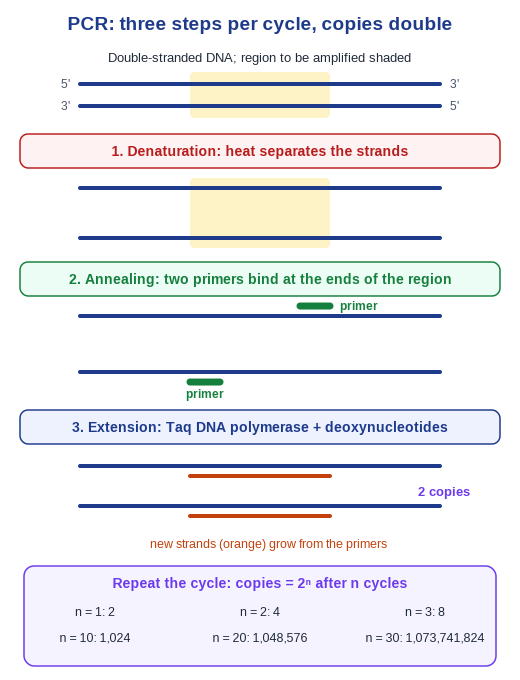
(a) PCR (polymerase chain reaction). Making many copies of a gene in vitro using two primers, nucleotides, the DNA template and a thermostable DNA polymerase from Thermus aquaticus. Each cycle has denaturation (heat separates the strands), primer annealing and extension. Copies double every cycle; 30 cycles give 2³⁰ = 1,073,741,824, about a billion copies.
(b) Restriction enzymes and DNA. Restriction endonucleases recognise a specific palindromic sequence in DNA, bind to it and cut both strands at specific points in the sugar-phosphate backbone. EcoRI, for example, cuts 5’-GAATTC-3’ between G and A, leaving sticky ends. DNA from two sources cut with the same enzyme can then be joined by DNA ligase into recombinant DNA.
(c) Chitinase. An enzyme that breaks down chitin, the material of fungal cell walls (Extra: chitin is a polysaccharide). In isolating DNA from fungi, chitinase breaks the cell open to release the DNA, just as lysozyme does for bacteria and cellulase for plant cells.
12. “Discuss with your teacher and find out how to distinguish between (a) Plasmid DNA and Chromosomal DNA (b) RNA and DNA (c) Exonuclease and Endonuclease”
(a) Plasmid DNA and chromosomal DNA
| Plasmid DNA | Chromosomal DNA |
|---|---|
| Small, circular, extra-chromosomal | Large; the main genetic material of the cell |
| Replicates autonomously, independent of the chromosome | Replicates once per cell cycle with the cell |
| May have 1–2 or 15–100 or more copies per cell | Extra: usually one copy in a bacterium |
| Carries a few extra genes, such as antibiotic resistance | Carries the genes the cell needs to live |
| Used as a cloning vector | Extra: not normally used as a vector |
(b) RNA and DNA (from Chapter 5)
| RNA | DNA |
|---|---|
| Sugar: ribose | Sugar: deoxyribose |
| Bases A, G, C and uracil | Bases A, G, C and thymine |
| Usually single-stranded | Double-stranded helix |
| Less stable; can act as a catalyst | More stable; the genetic material of most organisms |
| Removed with ribonuclease during DNA isolation | Precipitated with chilled ethanol |
(c) Exonuclease and endonuclease
| Exonuclease | Endonuclease |
|---|---|
| Removes nucleotides from the ends of DNA | Cuts at specific positions within the DNA |
| Shortens the molecule from its ends | Can cut it into fragments |
| Not used to make recombinant DNA | Restriction endonucleases such as EcoRI are the ‘molecular scissors’ of genetic engineering |
Questions asked in the chapter text
These are not quoted; each is restated briefly with its page.
Page 164: what usually happens to a piece of DNA moved into an alien organism? It usually cannot multiply in the progeny cells. It is copied and inherited only if it joins a chromosome, or is linked to an origin of replication, which starts replication.
Page 166: what are palindromes? Words that read the same forwards and backwards, such as MALAYALAM. In DNA, it is a run of base pairs that gives the same sequence on both strands when each is read in the same direction, such as 5’-GAATTC-3’ / 3’-CTTAAG-5’.
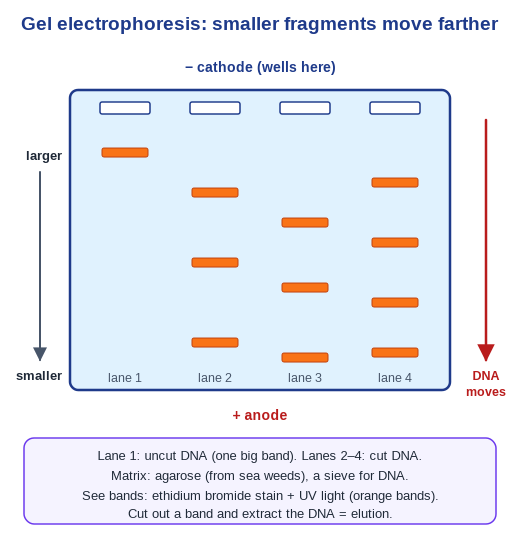
Page 168: at which end of the gel was the sample loaded? At the end with the wells, the cathode (negative) end. DNA is negatively charged and moves away from it towards the anode, and the largest fragments stay closest to the wells.
Page 170: why can’t DNA pass through cell membranes? DNA is hydrophilic (and negatively charged). Extra: the middle of a cell membrane is a hydrophobic lipid layer, which keeps such large water-loving molecules out. So cells must be made competent, or the DNA delivered by injection, a gene gun or a vector.
Page 173: why is large-scale production needed? Small cultures cannot give appreciable quantities of a product, but medicines and other proteins are needed in large amounts for many people. Bioreactors of 100–1000 litres give much higher yields.
Practice
-
Which of these is a palindromic DNA sequence (top strand, 5' to 3')?
Show answer
Answer: (b) GGATCC
-
After 5 cycles of PCR starting from one DNA molecule (perfect doubling), the number of copies is:
Show answer
Answer: (c) 32
-
Chitinase is used to break the cell walls of:
Show answer
Answer: (c) fungi
-
Write the complementary strand of 5'-GGATCC-3' and say whether the sequence is a palindrome.
Show answer
Answer: The complementary strand is 3'-CCTAGG-5'. Read from its own 5' end it is GGATCC, the same as the top strand, so the sequence is a palindrome.
-
Give one difference between an exonuclease and an endonuclease.
Show answer
Answer: An exonuclease removes nucleotides from the ends of a DNA molecule; an endonuclease cuts at chosen places inside the DNA.
Stuck on a question?
Take a photo and Lagnever AI explains it step by step. Try it for 7 days for ₹2.
Get it on Google Play Open in browser
For parents: after the trial, the plan renews monthly by UPI or card autopay. You can cancel anytime in the app.