
What are the tools of recombinant DNA technology?
Answer in short
The key tools are restriction enzymes, which cut DNA at specific palindromic sites and leave sticky ends; DNA ligase, which joins the pieces; polymerases; cloning vectors such as plasmids, with an origin of replication, selectable markers and cloning sites; and a competent host that takes up the recombinant DNA. Gel electrophoresis separates the cut fragments.
Stuck on a question? Take a photo and Lagnever AI explains it step by step. Try it for 7 days for ₹2. Get it on Google Play
Which tools are needed?
Genetic engineering is possible only with a set of key tools: restriction enzymes to cut DNA, polymerase enzymes to copy it, ligases to join it, vectors to carry it, and a host organism to multiply it. This page covers section 9.2 of the chapter; the Chapter 9 notes give the whole chapter in short.
How were restriction enzymes found and named?
- In 1963, two enzymes that restrict the growth of bacteriophages in Escherichia coli were isolated. One added methyl groups to DNA; the other cut DNA and was named a restriction endonuclease.
- About five years later, Hind II was isolated and characterised. Each time, it cut DNA at one fixed place after spotting a set run of six base pairs, its recognition sequence.
- Today we know of more than 900 of them, taken from over 230 bacterial strains, and each one looks for its own sequence.
Naming rule. The first letter is from the genus, the next two from the species, then the strain, then a Roman numeral for the order of isolation from that strain.
| Part of the name | EcoRI |
|---|---|
| Genus | E (Escherichia) |
| Species | co (coli) |
| Strain | R (RY 13) |
| Order of isolation | I |
Restriction enzymes belong to the nucleases. Exonucleases remove nucleotides from the ends of DNA; endonucleases cut at specific positions within it.
How does a restriction enzyme cut DNA?
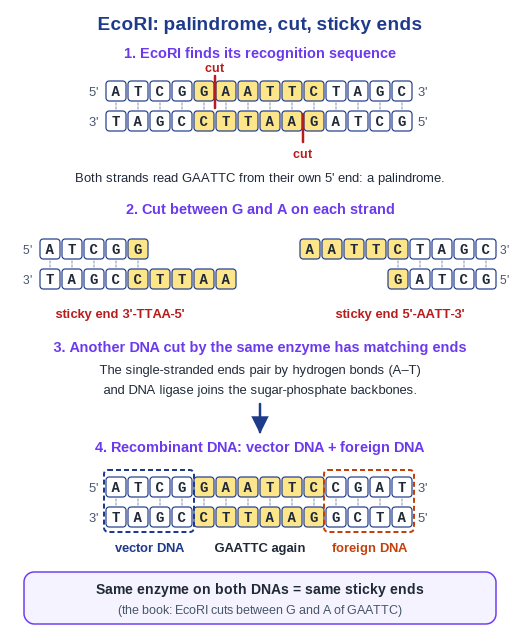
The enzyme moves along the DNA, ‘inspecting’ it, until it finds its recognition sequence. It binds there and breaks the sugar-phosphate backbone of both strands, each at a fixed point. The recognition sequence is a palindrome: like the word MALAYALAM, but in DNA it means the base pairs read the same on both strands when read in the same direction.
| Strand | Direction | Sequence |
|---|---|---|
| Top | 5’ → 3’ | GAATTC |
| Bottom | 3’ → 5’ | CTTAAG |
| Bottom read from its own 5’ end | 5’ → 3’ | GAATTC |
EcoRI cuts between G and A on each strand. The two cuts are a little away from the centre, so each piece keeps a four-base single strand, AATT, hanging out. These sticky ends form hydrogen bonds with matching ends, and DNA ligase then seals the backbone. Any two DNAs cut by the same enzyme get the same sticky ends; that is why the vector and the source DNA must be cut with the same enzyme.
How are the cut fragments separated?
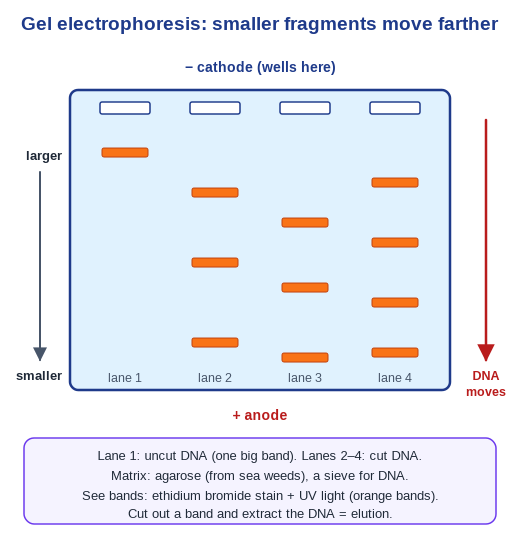
By gel electrophoresis. DNA is negatively charged, so in an electric field it moves through the gel towards the anode. The matrix is usually agarose, a natural polymer from sea weeds. It sieves the fragments: smaller fragments move farther. The DNA is stained with ethidium bromide and seen as orange bands under UV light. The wanted band is cut out and the DNA extracted (elution) for joining to a vector.
What makes a good cloning vector?
- Origin of replication (ori). Replication starts here, and it controls the copy number. For many copies of the target DNA, use a vector whose ori supports a high copy number.
- Selectable marker. Usually a gene for resistance to ampicillin, chloramphenicol, tetracycline or kanamycin. Normal E. coli has none of these resistances, so only transformants survive on the antibiotic.
- Cloning sites. For each commonly used restriction enzyme, as few sites as possible, ideally just one.
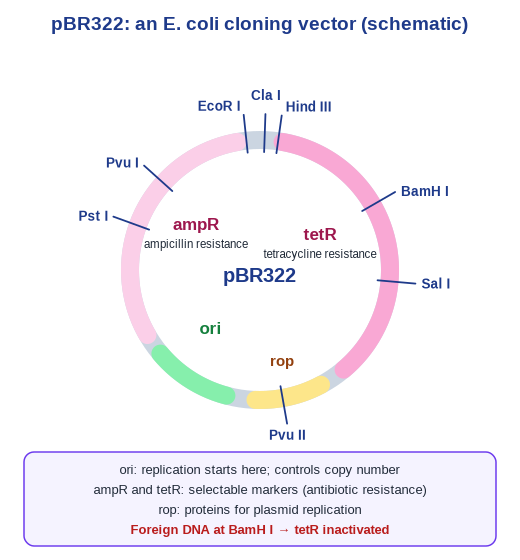
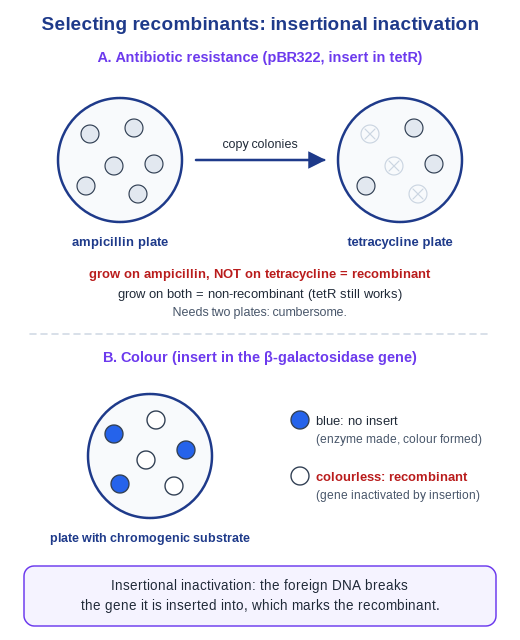
Selecting recombinants. In pBR322, foreign DNA ligated at the BamH I site inside tetR inactivates that gene. Transformants are first grown on ampicillin, then copied to tetracycline: recombinants grow on ampicillin but not on tetracycline; non-recombinants grow on both. A simpler method inserts the DNA inside the β-galactosidase gene. On a chromogenic substrate, plasmids without an insert give blue colonies; recombinants give colourless ones. This is insertional inactivation.
Vectors for plants and animals. Agrobacterium tumifaciens naturally delivers a piece of DNA, T-DNA, that turns plant cells into a tumour; its Ti plasmid has been disarmed into a vector that delivers useful genes into many plants. Retroviruses, which can make animal cells cancerous, have also been disarmed to deliver genes into animal cells.
How does DNA get into the host?
DNA is hydrophilic and cannot cross cell membranes on its own.
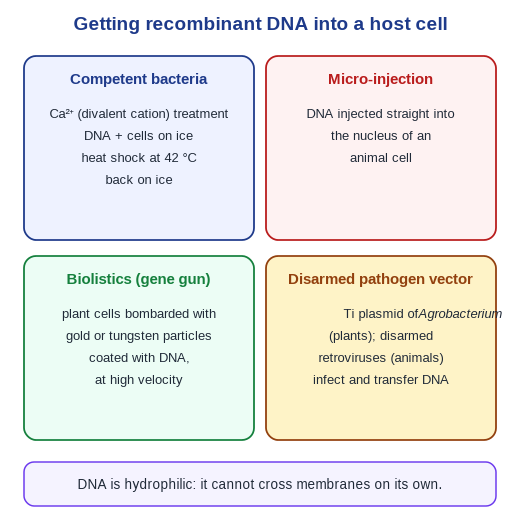
- Competent bacteria: a divalent cation, for example calcium, helps DNA enter through pores in the cell wall; then ice → heat shock at 42 °C → ice.
- Micro-injection: DNA is pushed straight into the nucleus of an animal cell with a fine needle.
- Biolistics (gene gun): plant cells bombarded with high-velocity gold or tungsten micro-particles coated with DNA.
- Disarmed pathogen vectors: they infect the cell and transfer the recombinant DNA.
How these tools are used one after another is on processes of recombinant DNA technology. These are laboratory techniques, done only under a teacher’s or scientist’s supervision.
Practice
-
In EcoRI, the letter 'R' comes from the:
Show answer
Answer: (c) strain
-
Which feature of a vector controls the copy number of the linked DNA?
Show answer
Answer: (b) Origin of replication
-
Agarose, the matrix used in gel electrophoresis, is obtained from:
Show answer
Answer: (b) sea weeds
-
Why should a vector have only one (or very few) sites for a given restriction enzyme?
Show answer
Answer: If the vector had several sites for the same enzyme, the enzyme would cut it into several fragments, which complicates gene cloning. A single site opens the vector at one place, where the foreign DNA can be ligated.
-
How are E. coli cells made competent to take up recombinant DNA?
Show answer
Answer: They are treated with a measured amount of a divalent cation, for example calcium, incubated with the recombinant DNA on ice, given a brief heat shock at 42 °C, and put back on ice.
Questions students ask
What are sticky ends?
Because a restriction enzyme such as EcoRI cuts each strand slightly off the middle of its palindrome, each fragment keeps a short single-stranded overhang. These overhangs form hydrogen bonds with complementary overhangs cut by the same enzyme, so they are called sticky ends. They help DNA ligase join the pieces.
Why is the β-galactosidase method preferred over two antibiotic plates?
Selecting recombinants by antibiotic inactivation needs plating on two plates with different antibiotics, which is cumbersome. With a chromogenic substrate, one plate shows blue colonies (no insert) and colourless colonies (recombinant) at once.
How are genes put into plant and animal cells?
Plants: the Ti plasmid of Agrobacterium tumifaciens, made non-pathogenic, carries genes into many plants; biolistics also works. Animals: disarmed retroviruses carry genes into cells, and DNA can be micro-injected into the nucleus.
Stuck on a question?
Take a photo and Lagnever AI explains it step by step. Try it for 7 days for ₹2.
Get it on Google Play Open in browser
For parents: after the trial, the plan renews monthly by UPI or card autopay. You can cancel anytime in the app.