
What are the processes of recombinant DNA technology?
Answer in short
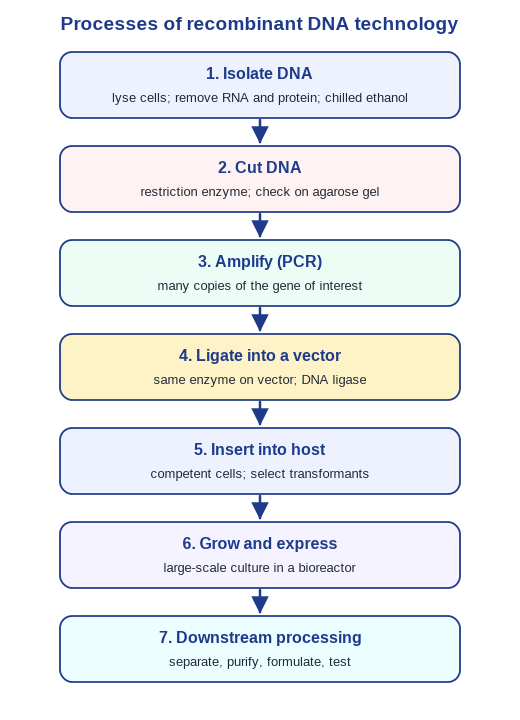
The steps follow a fixed order: isolate pure DNA, cut it with a restriction enzyme, isolate the desired fragment (amplifying it by PCR if needed), ligate it into a vector, transfer the recombinant DNA into a host, grow the host on a large scale in bioreactors so the gene is expressed, and then purify the product by downstream processing.
Stuck on a question? Take a photo and Lagnever AI explains it step by step. Try it for 7 days for ₹2. Get it on Google Play
What are the steps, in order?
Recombinant DNA technology runs in a fixed order. First the DNA is isolated and cut with restriction endonucleases; the wanted fragment is picked out and ligated into a vector; the recombinant DNA is put into a host; the host is grown in bulk; and finally the product is extracted. This page covers section 9.3; the tools themselves are on tools of recombinant DNA technology.
How is DNA isolated?
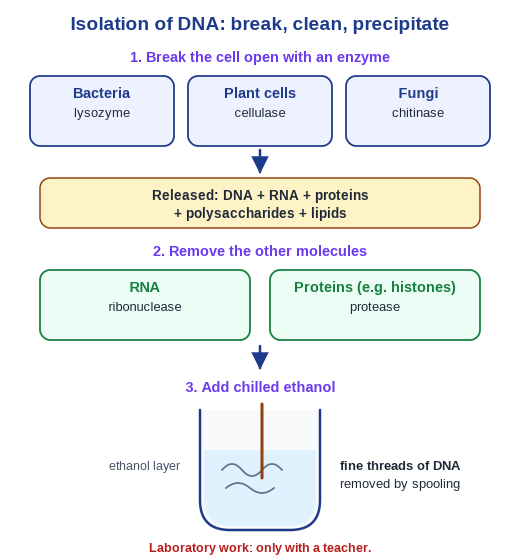
In most organisms the genetic material is DNA, and to cut it with restriction enzymes it must be pure, with no other macromolecules. Because DNA lies inside membranes, the cell is broken open, which releases DNA along with RNA, proteins, polysaccharides and lipids.
| What | Enzyme or treatment |
|---|---|
| Break bacterial cells | Lysozyme |
| Break plant cells | Cellulase |
| Break fungal cells | Chitinase |
| Remove RNA | Ribonuclease |
| Remove proteins (DNA is wound around histones) | Protease |
| Precipitate purified DNA | Chilled ethanol: fine threads, removed by spooling |
How is DNA cut and joined?
Purified DNA is kept with the restriction enzyme under the conditions that suit that particular enzyme. Agarose gel electrophoresis checks how far the digestion has gone: DNA, being negatively charged, moves towards the anode. The vector DNA is cut the same way. The cut-out gene of interest and the cut vector are mixed, and ligase is added; this gives recombinant DNA.
How does PCR amplify a gene?
PCR (polymerase chain reaction) makes many copies of a gene in vitro. It uses two primers, small chemically synthesised oligonucleotides complementary to the two ends of the DNA region, the nucleotides, the genomic DNA as template, and a DNA polymerase. Each cycle has three steps:
- Denaturation: heat separates the two strands.
- Primer annealing: the primers bind to their complementary sites.
- Extension: the polymerase extends the primers, copying the template.
Repeated amplification is possible because the polymerase is thermostable: it is isolated from the bacterium Thermus aquaticus (Taq) and stays active at the high temperature used for denaturation. The amplified fragment can then be ligated into a vector.
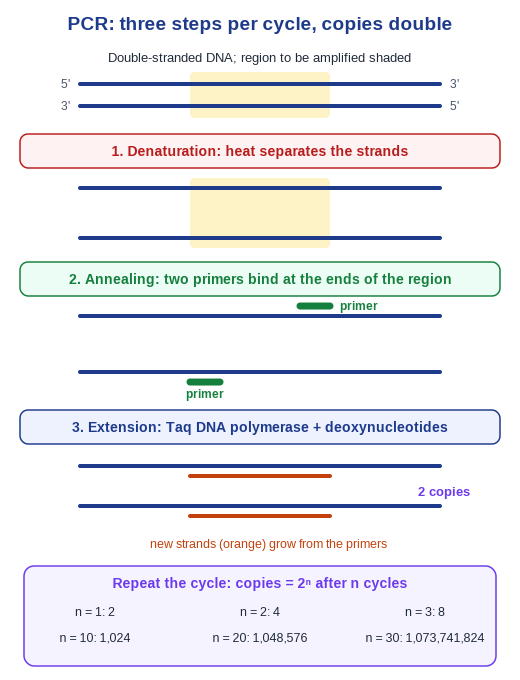
How fast do copies grow? Ideally each cycle doubles the DNA, so after n cycles one molecule gives 2ⁿ copies:
| Cycles | Copies (ideal) |
|---|---|
| 1 | 2 |
| 3 | 8 |
| 10 | 1,024 |
| 20 | 1,048,576 |
| 30 | 1,073,741,824 |
Thirty cycles give about 1 billion copies, matching the chapter’s ‘approximately billion times’. (Extra: in a real reaction the doubling is not perfect.)
How is the recombinant DNA put into the host?
The host cells are first made competent, and then they take up DNA from their surroundings. If the recombinant DNA carries a gene for ampicillin resistance, E. coli cells that take it up become ampicillin-resistant. Spread on agar plates with ampicillin, only these transformants grow; untransformed cells die. Here the ampicillin-resistance gene is the selectable marker.
How is the foreign gene product obtained?
In almost all recombinant technologies the aim is a protein, so the foreign gene must be expressed under suitable conditions. A protein-coding gene expressed in a heterologous host gives a recombinant protein.
- In the laboratory, a small culture of the cells can be grown, and the protein taken out and purified.
- In a continuous culture, spent medium flows out at one end and fresh medium flows in at the other, keeping the cells in their most active log/exponential phase. This gives more biomass and a higher yield.
- Small cultures cannot give useful quantities, so large-scale production needs bioreactors.
What is a bioreactor?
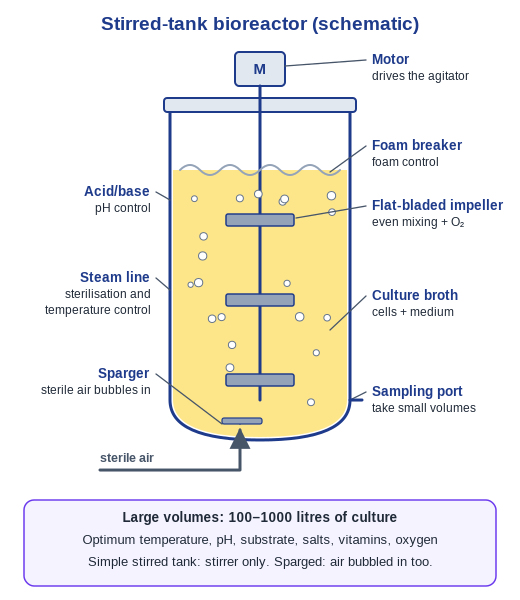
A bioreactor is a vessel in which raw materials are converted biologically into specific products or enzymes, using microbial, plant, animal or human cells. It handles 100–1000 litres of culture and keeps growth conditions optimum: the right temperature and pH, enough substrate, salts and vitamins, and oxygen.
The most common type is the stirred-tank bioreactor, cylindrical or with a curved base for good mixing. The stirrer mixes evenly and spreads oxygen; in a sparged stirred tank, sterile air is also bubbled through. It has:
- an agitator system and an oxygen delivery system;
- a system to control foam;
- systems to control temperature and pH;
- sampling ports to withdraw small volumes of culture from time to time.
What is downstream processing?
After the biosynthetic stage, the product goes through separation and purification, together called downstream processing. It is then formulated with suitable preservatives. Drugs must pass thorough clinical trials, and every product needs strict quality control testing. These steps vary from product to product.
All of these steps happen in laboratories and industries; they are not home experiments.
Practice
-
Which enzyme removes RNA during DNA isolation?
Show answer
Answer: (b) Ribonuclease
-
The correct order of steps in one PCR cycle is:
Show answer
Answer: (c) denaturation, annealing, extension
-
Bioreactors in the chapter handle culture volumes of about:
Show answer
Answer: (c) 100–1000 litres
-
Starting from one DNA molecule, how many copies are there after 10 PCR cycles, assuming perfect doubling?
Show answer
Answer: 2¹⁰ = 1,024 copies. Each cycle doubles the number, so after n cycles there are 2ⁿ copies.
-
Why are cells in a continuous culture kept in the log phase?
Show answer
Answer: In the log (exponential) phase the cells are physiologically most active. Draining used medium on one side and adding fresh medium on the other keeps them there, which gives more biomass and a higher yield of the desired protein.
Questions students ask
Why is Taq polymerase used in PCR?
Each PCR cycle starts by heating the DNA to separate its strands. Taq polymerase, isolated from the bacterium Thermus aquaticus, is thermostable: it stays active through these high temperatures, so the cycle can be repeated many times.
What is a recombinant protein?
If a gene that codes for a protein is expressed in a heterologous host, that is, an organism other than the one it came from, the protein made is called a recombinant protein.
Why are stirred-tank bioreactors used instead of small flasks?
Small cultures cannot give useful amounts of product. Stirred-tank bioreactors process 100–1000 litres and keep optimum conditions with an agitator, oxygen delivery, foam control, temperature and pH control, and sampling ports.
Stuck on a question?
Take a photo and Lagnever AI explains it step by step. Try it for 7 days for ₹2.
Get it on Google Play Open in browser
For parents: after the trial, the plan renews monthly by UPI or card autopay. You can cancel anytime in the app.