
NCERT Solutions Class 12 Biology Chapter 12: Ecosystem
Answers to all 11 end-of-chapter exercises of Chapter 12, Ecosystem, of Biology, the Class 12 NCERT textbook. Page numbers follow the 2026-27 reprint (pages 205–215). The exercises are quoted from the book as printed, except the options of Exercise 5, which are restated (see the note at the end); the answers are our own, built from the chapter, and every fact from outside the chapter is marked Extra. Every number on this page was computed by script. The questions the chapter text asks along the way are answered in short at the end. The book prints no answer key for this chapter. Short notes: Chapter 12 notes.
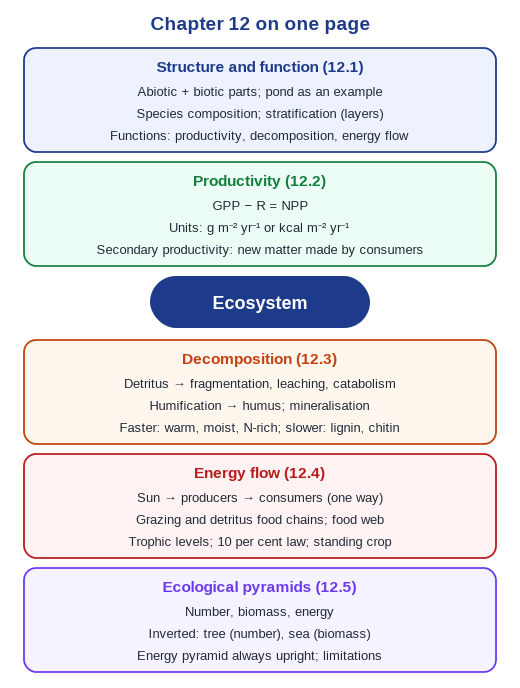
Exercises 1 to 5: blanks and choices
1. “Fill in the blanks.”
(a) “Plants are called as_________because they fix carbon dioxide.” Producers (autotrophs). They fix carbon dioxide into organic matter using sunlight.
(b) “In an ecosystem dominated by trees, the pyramid (of numbers) is_________type.” Inverted. One big tree supports a very large number of insects, so the base (producers) is narrower than the next level.
(c) “In aquatic ecosystems, the limiting factor for the productivity is_________.” Light. Sunlight weakens quickly with depth, so only the upper layer of water can photosynthesise well (Extra: the chapter only asks you to discuss low ocean productivity; nutrient shortage, especially of nitrogen, is a second factor often named).
(d) “Common detritivores in our ecosystem are_________.” Earthworms (the chapter’s example). Extra: millipedes, woodlice and some insect larvae also do this job.
(e) “The major reservoir of carbon on earth is_________.” Oceans. Extra: the rationalised chapter does not cover the carbon cycle; its summary says the reservoir of gaseous cycles such as carbon is the atmosphere or hydrosphere. Of these, the oceans (hydrosphere) hold far more dissolved carbon than the air.
2. “Which one of the following has the largest population in a food chain? (a) Producers (b) Primary consumers (c) Secondary consumers (d) Decomposers”
Answer: (a) Producers. The chapter says producers are more in number than herbivores, and herbivores more than carnivores; the base of the pyramid of number is the producers. Extra: decomposers are not shown in ecological pyramids at all; if microbes were counted one by one, bacteria would far outnumber everything, so some guides give (d). Follow your teacher on this point.
3. “The second trophic level in a lake is (a) Phytoplankton (b) Zooplankton (c) Benthos (d) Fishes”
Answer: (b) Zooplankton. Phytoplankton are the producers (first level); zooplankton eat them and are the primary consumers (second level). Benthos are bottom-dwelling organisms of mixed feeding habits, and most fishes are higher consumers (Extra).
4. “Secondary producers are (a) Herbivores (b) Producers (c) Carnivores (d) None of the above”
Answer: (d) None of the above. Only green plants and other autotrophs are producers. Herbivores and carnivores are consumers: they show secondary productivity (they make new organic matter from food), but they are not called producers. Extra: some guides give (a), reading “secondary producer” as an organism with secondary productivity; check with your teacher.
5. (Options restated) “What is the percentage of photosynthetically active radiation (PAR) in the incident solar radiation?” The options are: (a) the whole of it, (b) 50 %, (c) 1-5%, (d) 2-10%.
Answer: (b) 50 %. The chapter says PAR is less than 50 per cent of incident solar radiation, so (b) is the closest choice. Option (d), 2–10 per cent, is the share of PAR that plants actually capture, not the share of sunlight that is PAR.
Exercise 6: distinguish between
6. “Distinguish between (a) Grazing food chain and detritus food chain (b) Production and decomposition (c) Upright and inverted pyramid (d) Food chain and Food web (e) Litter and detritus (f) Primary and secondary productivity”
(a) Grazing food chain and detritus food chain
| Grazing food chain (GFC) | Detritus food chain (DFC) |
|---|---|
| Starts with living green plants (producers) | Starts with dead organic matter (detritus) |
| Next link: herbivores, then carnivores | Next link: decomposers (fungi, bacteria), which are saprotrophs |
| Energy source: sunlight fixed by plants | Energy source: dead organic matter |
| Main route of energy in aquatic ecosystems | Carries a much larger share of energy on land |
| Example: grass → goat → man | Example: dead leaves → earthworm (Extra: → bacteria and fungi) |
(b) Production and decomposition
| Production | Decomposition |
|---|---|
| Making organic matter from inorganic matter by photosynthesis | Breaking organic matter down to inorganic substances |
| Done by producers (green plants) | Done by decomposers and detritivores |
| Uses carbon dioxide and water with solar energy | Releases carbon dioxide, water and nutrients |
| Builds up biomass | Returns nutrients for reuse |
(c) Upright and inverted pyramid
| Upright pyramid | Inverted pyramid |
|---|---|
| The base (producers) is the largest; each higher level is smaller | A higher level is larger than the level below it |
| Most ecosystems: e.g. grassland numbers, 5,842,000 plants to 3 top carnivores | Number pyramid of one tree with its insects; biomass pyramid of the sea (phytoplankton 4, zooplankton 21) |
| All three pyramids can be upright; energy always is | Only number and biomass pyramids can be inverted |
(d) Food chain and food web
| Food chain | Food web |
|---|---|
| A single straight series of who eats whom | Many food chains linked together |
| Each organism eats only one kind of food in the chain | An organism can eat several foods and be eaten by several animals |
| Simple, rare in nature | Natural and more stable (Extra) |
| Example: grass → goat → man | Grazing and detritus chains joined, e.g. crows and cockroaches as omnivores |
(e) Litter and detritus
| Litter | Detritus |
|---|---|
| Dead plant parts lying on the ground, such as fallen leaves, twigs and bark (Extra: standard meaning) | All dead plant remains and dead animals with their faecal matter |
| Only plant material, not yet broken down much | Plant and animal material at any stage of breakdown |
| A part of detritus | The raw material for decomposition as a whole |
(f) Primary and secondary productivity
| Primary productivity | Secondary productivity |
|---|---|
| Rate of biomass production by producers in photosynthesis | Rate at which consumers build new organic matter |
| Split into GPP and NPP (GPP − R = NPP) | Built from food eaten, ultimately from NPP |
| Units: g m⁻² yr⁻¹ or kcal m⁻² yr⁻¹ | Same units |
Exercises 7 and 8: components and pyramids
7. “Describe the components of an ecosystem.”
An ecosystem has two kinds of components that interact all the time.
- Abiotic components: inorganic materials (air, water, soil) together with sunlight and climate. In a pond these are the water and the inorganic and organic substances dissolved in it, the nutrient-rich soil at the bottom, and the sunlight, temperature cycle and day-length that set the pace of the pond.
- Biotic components:
- Producers (autotrophs): in a pond, phytoplankton, some algae and floating, submerged and marginal plants.
- Consumers (heterotrophs): zooplankton and animals that swim or live on the bottom; herbivores are primary consumers, carnivores secondary and tertiary consumers.
- Decomposers: fungi, bacteria and flagellates, especially at the bottom of the pond.
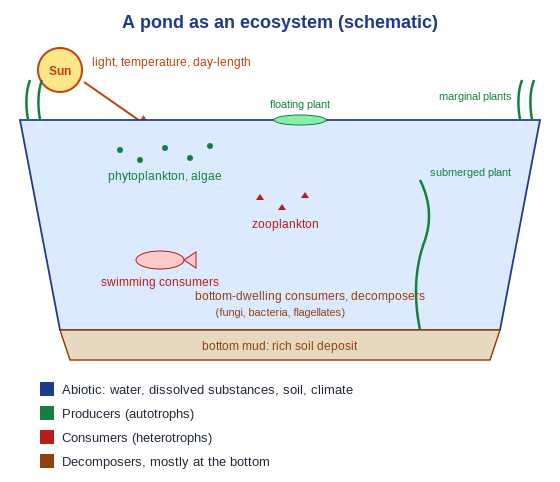
The interaction gives each ecosystem a structure, described by its species composition and stratification (in a forest: trees on top, shrubs next, herbs and grasses at the bottom). The components work as one unit through productivity, decomposition, energy flow and nutrient cycling.
8. “Define ecological pyramids and describe with examples, pyramids of number and biomass.”
An ecological pyramid is a diagram that shows the number, biomass or energy at successive trophic levels as stacked bars, with producers (first trophic level) at the base and the top consumer at the apex.
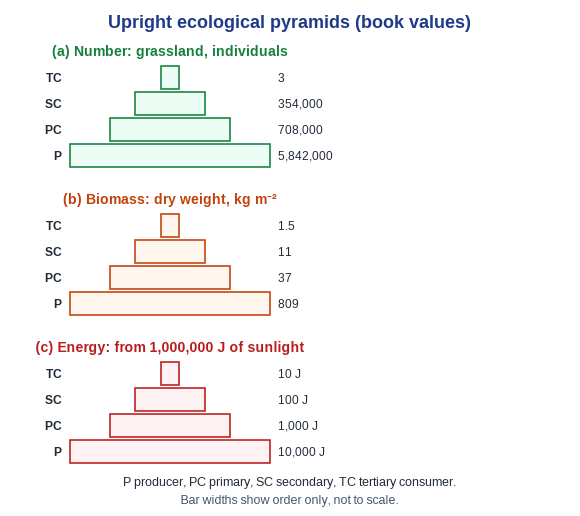
Pyramid of number: the number of individuals at each level per unit area.
- Upright example, grassland (book values): producers 5,842,000, primary consumers 708,000, secondary consumers 354,000, tertiary consumers 3. Nearly 6 million plants support only 3 top carnivores.
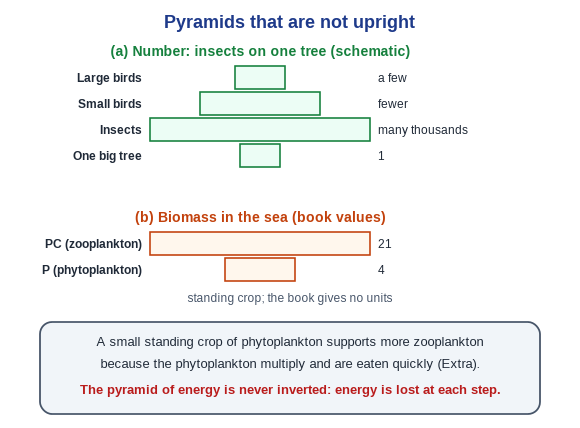
- Inverted example: one big tree supports thousands of insects, which feed a smaller number of small birds and still fewer large birds.
Pyramid of biomass: the standing crop (dry weight) at each level per unit area.
- Upright example (book values, kg m⁻²): producers 809, primary consumers 37, secondary consumers 11, tertiary consumers 1.5, a sharp fall at each level.
- Inverted example, the sea: a small standing crop of phytoplankton (4) supports a larger standing crop of zooplankton (21).
Exercises 9 to 11: productivity, decomposition and energy flow
9. “What is primary productivity? Give brief description of factors that affect primary productivity.”
Primary productivity is the rate at which producers make biomass (organic matter) per unit area by photosynthesis, expressed in g m⁻² yr⁻¹ or kcal m⁻² yr⁻¹. Its total is the GPP; after the plants’ own respiration, NPP = GPP − R.
Factors:
- Plant species: the kind of plants living in the area and their photosynthetic capacity.
- Environmental factors: Extra examples are light, temperature and water; for instance, light falls off quickly with depth in water.
- Availability of nutrients in the soil or water.
Because these differ, productivity varies between ecosystems: the biosphere’s annual NPP is about 170 billion tons (dry weight), of which the oceans, though about 70 per cent of the surface, give only about 55 billion tons.
10. “Define decomposition and describe the processes and products of decomposition.”
Decomposition is the breakdown of complex organic matter (detritus) by decomposers into inorganic substances. Detritus is dead plant parts (leaves, bark, flowers) and dead animals together with their faecal matter.
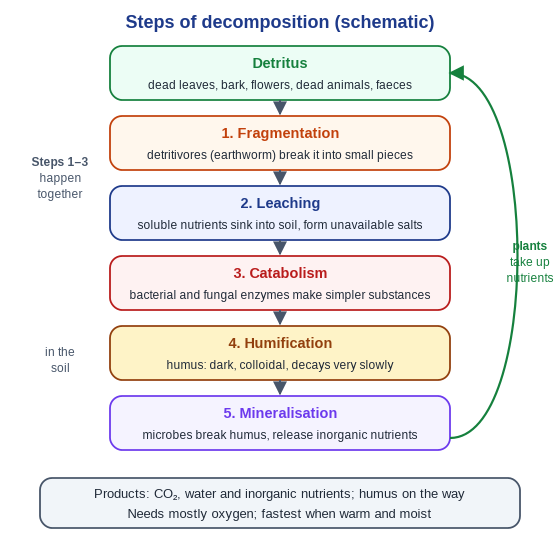
Processes:
- Fragmentation: detritivores such as earthworms break detritus into small particles.
- Leaching: water-soluble inorganic nutrients move down into the soil and are precipitated as unavailable salts.
- Catabolism: bacterial and fungal enzymes break detritus into simpler inorganic substances.
- Humification: forms humus, a dark, amorphous, colloidal substance that resists microbes, decays very slowly and stores nutrients.
- Mineralisation: microbes degrade humus further and release inorganic nutrients.
The first three act together; humification and mineralisation take place in the soil.
Products: carbon dioxide, water and inorganic nutrients (with humus formed on the way).
Rate: decomposition mostly needs oxygen. It is faster in warm, moist conditions and with detritus rich in nitrogen and sugars; it is slower with lignin and chitin, at low temperature and without oxygen, when organic matter builds up.
11. “Give an account of energy flow in an ecosystem.”
- Source: apart from the deep-sea hydrothermal ecosystem, every ecosystem gets its energy from the sun. Less than 50 per cent of incident sunlight is PAR, and plants trap just 2–10 per cent of the PAR.
- Producers: green plants fix this energy as food (GPP; what remains after respiration is NPP).
- Consumers: herbivores (primary consumers) eat plants; primary carnivores (secondary consumers) eat herbivores; secondary carnivores (tertiary consumers) eat them.
- Food chains: the grazing food chain (grass → goat → man) starts with living plants; the detritus food chain starts with dead matter and its decomposers. In water the GFC carries most energy; on land the DFC carries more. Linked chains form a food web.
- Direction: energy flows one way, from sun to producers to consumers, and never returns to the sun. Ecosystems need a constant input because of the second law of thermodynamics.
- Loss at each step: only about 10 per cent passes to the next level (the 10 per cent law). The rest goes in respiration and is lost as heat; dead matter goes to decomposers.
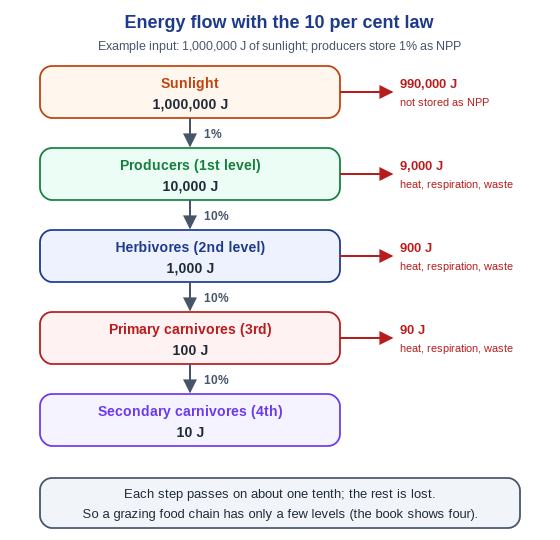
Worked example (book’s starting value, our computation): 1,000,000 J of sunlight; producers store 1 per cent = 10,000 J; herbivores 1,000 J; primary carnivores 100 J; secondary carnivores 10 J. This is why the energy pyramid is always upright and food chains have only a few levels.
Questions asked in the chapter text
These are not quoted; each is restated briefly with its page.
Page 207: why are oceans less productive than land? Oceans give about 55 of the 170 billion tons of NPP although they cover about 70 per cent of the surface. Extra: light reaches only the top layer of water, and open-ocean water is generally poor in nutrients such as nitrogen and phosphorus.
Page 209: does the one-way flow of energy agree with the first law of thermodynamics? Yes. The first law says energy is neither created nor destroyed, only changed from one form to another. Solar energy becomes chemical energy in food, and at each level part of it becomes heat; none is created or destroyed, but the heat cannot be used again by producers, so the flow is one way.
Page 210: how would you classify human beings? As omnivores: humans eat plant food (primary consumers) and animal food (secondary or higher consumers), so they belong to more than one trophic level.
Page 211: why is dry weight a more accurate measure of biomass? The water content of organisms varies widely between species, with age and with the weather; dry weight removes that variation and measures only the organic matter (Extra reasoning).
Page 211: is the detritus food chain limited in the same way as the grazing chain? Extra reasoning: energy is still lost as heat at every step of a detritus chain, so it cannot go on for ever. But the detritus chain is fed by dead matter from every trophic level, not only from the level just below, so it is not cut short in quite the same way.
Page 213: at how many trophic levels do human beings function? Extra reasoning: eating cereals and vegetables, at the second level; eating the meat of a herbivore such as a goat, at the third; eating a fish that ate smaller fish, at the fourth or higher.
Page 213: what pyramid do you get for insects feeding on one big tree, with small and large birds above them? A pyramid of number that is inverted at the base: 1 tree, many thousands of insects, fewer small birds and a few large birds (see the inverted pyramids diagram above).
Page 213: the sea’s pyramid of biomass is inverted. Isn’t that a paradox? Not really. The pyramid shows the standing crop at one moment, not the rate of production. Extra: phytoplankton multiply very fast and are eaten almost as fast, so a small standing crop can produce, over a year, much more than the zooplankton and fishes hold at any time. The pyramid of energy for the sea is still upright.
Note
- In Exercise 5 the first option is restated rather than quoted because the book writes it in a form the site does not print; the question and the other three options are quoted.
Practice
-
A lake's producers store 50,000 kJ. By the 10 per cent law, the primary carnivores receive about:
Show answer
Answer: (b) 500 kJ
-
Humus is formed during:
Show answer
Answer: (c) humification
-
Which of these is not counted in an ecological pyramid?
Show answer
Answer: (c) Saprophytes
-
A forest has GPP = 30,000 kcal m⁻² yr⁻¹ and NPP = 12,000 kcal m⁻² yr⁻¹. How much is used in respiration?
Show answer
Answer: R = GPP − NPP = 30,000 − 12,000 = 18,000 kcal m⁻² yr⁻¹, that is, 60 per cent of GPP.
-
A sparrow eats seeds in the morning and insects in the evening. Which trophic levels does it occupy?
Show answer
Answer: Eating seeds, it is a primary consumer (second trophic level); eating insects that eat plants, it is a secondary consumer (third trophic level). A trophic level is a functional level, not a species.
Stuck on a question?
Take a photo and Lagnever AI explains it step by step. Try it for 7 days for ₹2.
Get it on Google Play Open in browser
For parents: after the trial, the plan renews monthly by UPI or card autopay. You can cancel anytime in the app.