
Class 12 Biology Chapter 12: Ecosystem Notes
This chapter in five lines
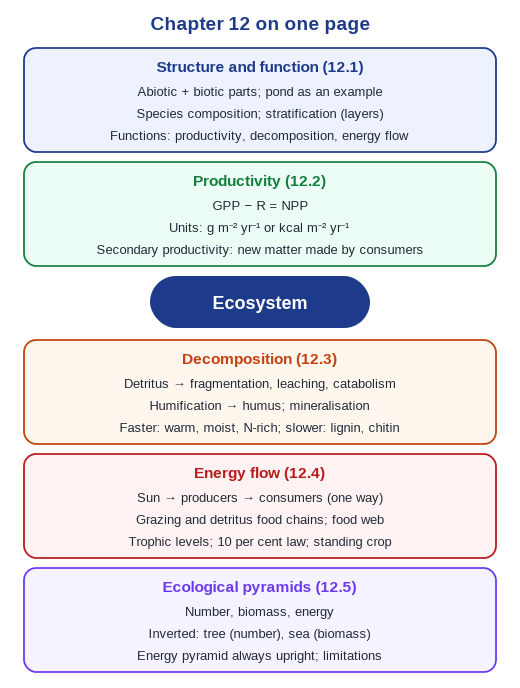
An ecosystem is a functional unit of nature in which living things interact with each other and with their physical surroundings. It works through productivity, decomposition, energy flow and nutrient cycling. Plants fix solar energy (GPP − R = NPP); energy then flows one way through grazing and detritus food chains, with only about 10 per cent passed to each next trophic level, as ecological pyramids show.
What is this chapter about?
This is the second chapter of Unit X, Ecology, after Chapter 11, Organisms and Populations. There we studied single populations; here we look at the whole system they live in. In the rationalised book the chapter has five sections: 12.1 Ecosystem – Structure and Function, 12.2 Productivity, 12.3 Decomposition, 12.4 Energy Flow and 12.5 Ecological Pyramids.
Two topic pages go deeper: productivity and decomposition and energy flow and ecological pyramids. All 11 exercises are answered in the NCERT solutions.
What is an ecosystem?
An ecosystem is a working unit of nature in which organisms interact with one another and with the physical environment around them. It can be as small as a pond or as big as a forest or an ocean. Some ecologists treat the whole biosphere as one global ecosystem made up of all the local ones. Because that is too large to study at once, ecosystems are grouped into two kinds:
- Terrestrial: forest, grassland, desert.
- Aquatic: pond, lake, wetland, river, estuary.
- Man-made: crop fields and an aquarium can also be treated as ecosystems.
Structure and function
The biotic and abiotic parts interact to give every type of ecosystem its own physical structure. Two structural features matter most:
- Species composition: which plant and animal species are present, identified and listed.
- Stratification: the vertical layering of species. In a forest, trees occupy the top layer, shrubs the second, and herbs and grasses the bottom layers.
The parts work together as one unit through four functions: productivity, decomposition, energy flow and nutrient cycling.
A pond as an example
A pond is shallow, fairly self-sustaining and simple enough to show all four functions clearly.
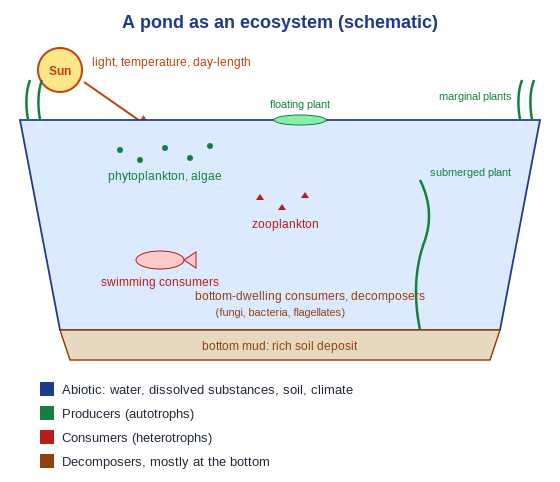
- Abiotic part: the water, with inorganic and organic substances dissolved in it, and the nutrient-rich soil on the floor of the pond. Sunlight, the temperature cycle, day-length and other climatic conditions set the pace of the whole pond.
- Producers (autotrophs): phytoplankton, some algae, and floating, submerged and marginal plants.
- Consumers: zooplankton, and animals that swim or live on the bottom.
- Decomposers: fungi, bacteria and flagellates, plentiful at the bottom.
The pond does what every ecosystem and the whole biosphere do: autotrophs use solar energy to turn inorganic matter into organic matter; heterotrophs eat the autotrophs; and dead matter is decomposed and mineralised so that its nutrients can be used again. Energy moves one way, towards higher trophic levels, and is lost as heat along the way.
Productivity
A steady input of solar energy is what keeps an ecosystem running.
- Primary production is the biomass (organic matter) that plants make per unit area in a given time by photosynthesis, expressed as weight (g m⁻²) or energy (kcal m⁻²).
- Productivity is the rate of biomass production, in g m⁻² yr⁻¹ or kcal m⁻² yr⁻¹, which lets us compare ecosystems.
- Gross primary productivity (GPP) is the rate of making organic matter in photosynthesis. Plants use a good part of it in respiration (R).
- Net primary productivity (NPP) is what is left: GPP − R = NPP. This is the biomass available to herbivores and decomposers.
- Secondary productivity is the rate at which consumers form new organic matter.
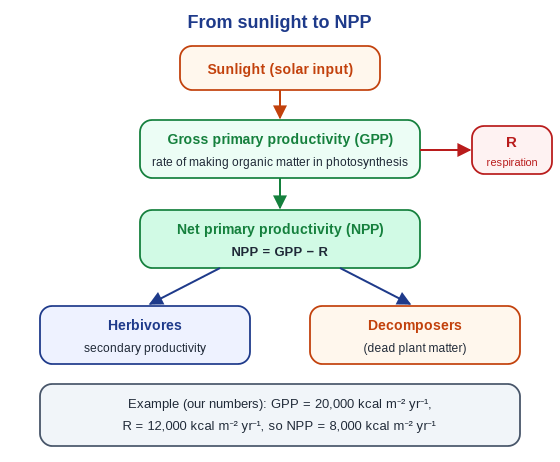
The plant species of an area, environmental factors, nutrient supply and the photosynthetic capacity of the plants all decide primary productivity, so it differs from one ecosystem to another. The whole biosphere’s annual NPP is about 170 billion tons (dry weight) of organic matter. The oceans cover about 70 per cent of the surface but produce only 55 billion tons; the rest, 115 billion tons (our subtraction), comes from land.
Decomposition
Decomposers break complex organic matter down into inorganic substances such as carbon dioxide, water and nutrients; this is decomposition. The earthworm is called the farmer’s ‘friend’ because it helps break down organic matter and loosens the soil. The raw material is detritus: dead leaves, bark and flowers, and dead animal remains including faecal matter.
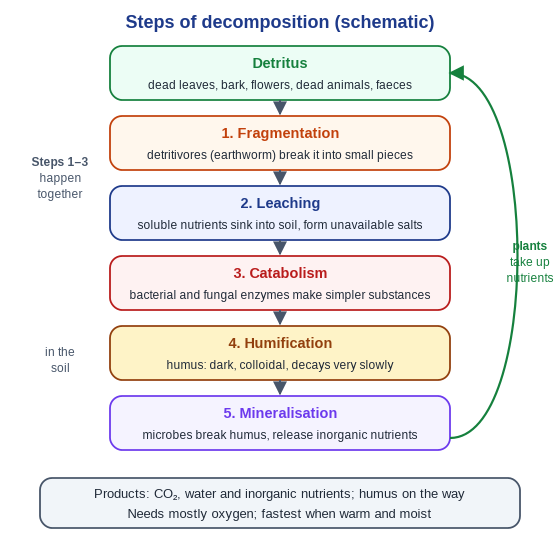
- Fragmentation: detritivores such as earthworms break detritus into small particles.
- Leaching: water-soluble inorganic nutrients move down into the soil and are precipitated as salts plants cannot use.
- Catabolism: bacterial and fungal enzymes break detritus into simpler inorganic substances.
These three steps go on at the same time on the same detritus. In the soil two more processes follow:
- Humification: forms humus, a dark, amorphous substance that resists microbes and decays extremely slowly. Being colloidal, it stores nutrients.
- Mineralisation: some microbes degrade humus further and release inorganic nutrients.
What controls the rate? Decomposition needs oxygen for the most part. It depends on the chemical make-up of the detritus and on climate. Detritus rich in lignin and chitin decays slowly; detritus rich in nitrogen and water-soluble substances such as sugars decays fast. Temperature and soil moisture are the key climatic factors because they control soil microbes: warm, moist conditions speed decomposition, while low temperature and lack of oxygen (anaerobiosis) slow it, so organic matter piles up.
Energy flow
Apart from the deep-sea hydrothermal ecosystem, the sun is the only energy source for ecosystems on Earth. Less than 50 per cent of incident sunlight is photosynthetically active radiation (PAR), and plants trap just 2–10 per cent of that PAR. That small amount supports all life. Energy flows one way: sun → producers → consumers. The second law of thermodynamics applies as well: an ecosystem needs a steady energy input to keep making its molecules in spite of the general drift towards disorder.
- Producers: green plants. On land, herbaceous and woody plants; in water, phytoplankton, algae and higher plants.
- Consumers (heterotrophs): primary consumers (herbivores: insects, birds and mammals on land, molluscs in water) eat plants; secondary consumers (primary carnivores) eat herbivores; tertiary consumers come next.
Food chains and the food web
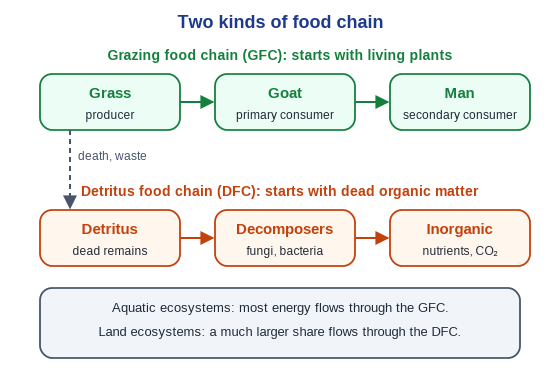
- Grazing food chain (GFC): starts with living plants, for example grass → goat → man.
- Detritus food chain (DFC): starts with dead organic matter. Its decomposers, mainly fungi and bacteria, are saprotrophs: they release digestive enzymes onto dead matter and absorb the simple products.
- In aquatic ecosystems the GFC carries most of the energy; on land a much larger share flows through the DFC.
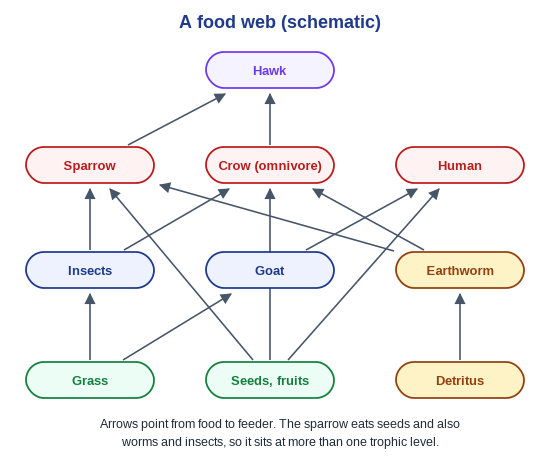
- The two chains are linked: some DFC organisms are eaten by GFC animals, and omnivores such as cockroaches and crows feed on many things. These links form a food web.
Trophic levels and the 10 per cent law
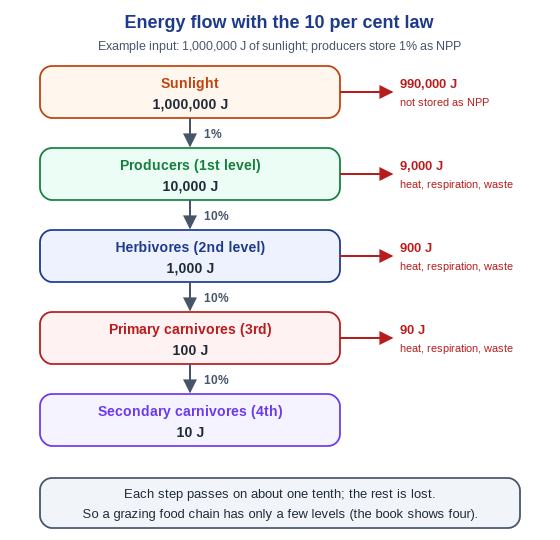
An organism’s trophic level is its feeding position: producers are the first, herbivores the second, carnivores the third. Energy decreases at each successive level. When any organism dies, it becomes detritus, which feeds decomposers.
Each level has a standing crop, the mass (biomass) or number of living organisms per unit area at a given time. Biomass is better measured as dry weight. Under the 10 per cent law, only about 10 per cent of the energy at one level reaches the next, so a grazing food chain has only a few levels: producer, herbivore, primary carnivore, secondary carnivore.
Ecological pyramids
When we draw the number, biomass or energy at each trophic level as bars, one above the other, we usually get a pyramid: a broad base of producers narrowing to the top consumer. The three pyramids are of number, biomass and energy.
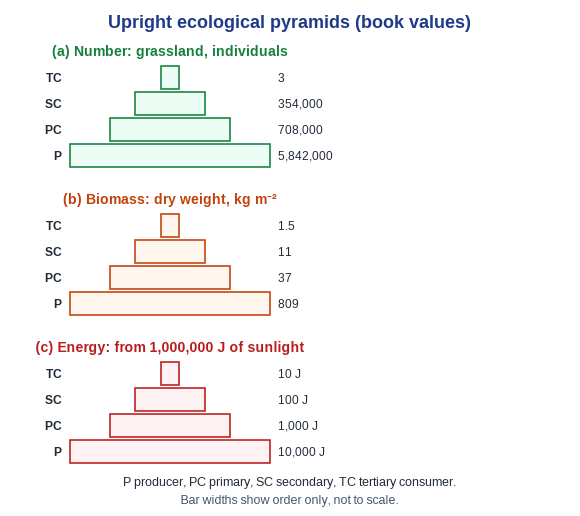
- In most ecosystems all three are upright.
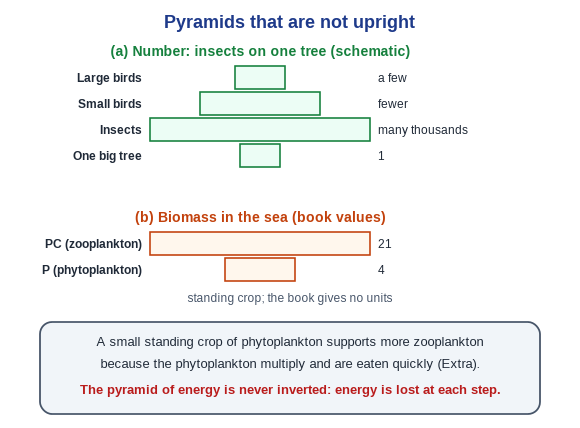
- Exceptions: count the insects on one big tree and the birds that eat them, and the pyramid of number is inverted at the base. In the sea, the pyramid of biomass is generally inverted because a small standing crop of phytoplankton supports a larger one of zooplankton and fishes.
- The pyramid of energy is always upright, because some energy is lost as heat at every step.
Any count must include all the organisms at a level. A species can also sit at more than one level: a sparrow feeding on seeds, fruits and peas is at the second level, but feeding on insects and worms it is at the third. The trophic level is a functional level, not a species.
Limitations of ecological pyramids: they ignore a species that belongs to two or more levels; they assume a simple food chain, which almost never exists, and cannot show a food web; and they give no place to saprophytes, although these play a vital role.
Before we move on
The chapter summary also mentions nutrient cycling (gaseous cycles such as carbon, with the atmosphere or hydrosphere as the reservoir, and sedimentary cycles such as phosphorus, with the Earth’s crust as the reservoir) and ecosystem services, such as forests purifying air and water; the rationalised text does not treat them as separate sections. Know GPP − R = NPP, the five steps of decomposition with the factors, the two food chains, the 10 per cent law with a worked example, and the pyramids with their exceptions. The last chapter of the unit, Biodiversity and Conservation, builds on these ideas. All 11 exercises are answered in the NCERT solutions for Chapter 12.
Key terms
| Term | Meaning |
|---|---|
| Ecosystem | A functional unit of nature: the living organisms of an area together with their physical (abiotic) surroundings, interacting with each other. It may be as small as a pond or as large as a forest or sea. |
| Stratification | The vertical arrangement of species in layers. In a forest, trees form the top layer, shrubs the second, and herbs and grasses the bottom layers. |
| Gross primary productivity (GPP) | The rate at which plants produce organic matter in photosynthesis. |
| Net primary productivity (NPP) | GPP minus the amount plants use up in respiration (GPP − R = NPP). It is the biomass available to herbivores and decomposers. |
| Secondary productivity | The rate at which consumers form new organic matter. |
| Detritus | Dead plant parts (leaves, bark, flowers) plus dead animals and their faecal matter. It is the raw material for decomposition. |
| Humus | A dark, amorphous, colloidal substance formed by humification. It resists microbes, decays very slowly and acts as a store of nutrients. |
| Trophic level | The feeding position of an organism in a food chain: producers first, herbivores (primary consumers) second, carnivores (secondary consumers) third, and so on. |
| Standing crop | The mass of living material (biomass) or the number of organisms at a trophic level in a unit area at a particular time. |
| 10 per cent law | Only about 10 per cent of the energy at one trophic level is transferred to the next; this limits the number of levels in a grazing food chain. |
| Ecological pyramid | A diagram of number, biomass or energy at successive trophic levels, with producers at the base and top consumers at the apex. |
| Photosynthetically active radiation (PAR) | The part of sunlight that plants can use in photosynthesis: less than 50 per cent of the incident solar radiation. Of this PAR, plants trap just 2 to 10 per cent. |
Topics in this chapter
Practice
-
In a forest, the vertical arrangement of trees, shrubs, and herbs and grasses in layers is called:
Show answer
Answer: (b) stratification
-
If the GPP of a field is 5,000 kcal m⁻² yr⁻¹ and respiration uses 3,000 kcal m⁻² yr⁻¹, the NPP is:
Show answer
Answer: (b) 2,000 kcal m⁻² yr⁻¹
-
The step of decomposition in which earthworms break detritus into smaller pieces is:
Show answer
Answer: (c) fragmentation
-
If producers store 10,000 J, the energy reaching secondary carnivores by the 10 per cent law is:
Show answer
Answer: (c) 10 J
-
Which ecological pyramid can never be inverted?
Show answer
Answer: (c) Pyramid of energy
-
In a terrestrial ecosystem, the larger share of energy flows through:
Show answer
Answer: (b) the detritus food chain
Questions students ask
What are the main topics of Class 12 Biology Chapter 12?
Ecosystem structure and function with a pond as the example, productivity (GPP, NPP and secondary productivity), decomposition and its steps and factors, energy flow through food chains, food webs and trophic levels, and ecological pyramids of number, biomass and energy.
Is Ecosystem in the 2026-27 NCERT Class 12 Biology book?
Yes. It is Chapter 12 of the Class 12 Biology textbook marked Reprint 2026-27, on pages 205 to 215, in Unit X, Ecology. It has 11 end-of-chapter exercises.
Why is the pyramid of energy always upright?
At every transfer from one trophic level to the next, some energy is lost as heat. So each level always holds less energy than the one below it, and the pyramid cannot be inverted.
Which diagrams should I practise for this chapter?
The pond as an ecosystem, the GPP and NPP flow, the steps of decomposition, the grazing and detritus food chains, a food web, energy flow through trophic levels with the 10 per cent law, and the upright and inverted pyramids.
Stuck on a question?
Take a photo and Lagnever AI explains it step by step. Try it for 7 days for ₹2.
Get it on Google Play Open in browser
For parents: after the trial, the plan renews monthly by UPI or card autopay. You can cancel anytime in the app.