
What are productivity and decomposition in an ecosystem?
Answer in short
Productivity is the rate at which biomass is made. Plants make organic matter at the gross primary productivity (GPP); after respiration (R), the net primary productivity is NPP = GPP − R. Decomposition returns dead matter to carbon dioxide, water and nutrients through fragmentation, leaching, catabolism, humification and mineralisation, fastest in warm, moist conditions.
Stuck on a question? Take a photo and Lagnever AI explains it step by step. Try it for 7 days for ₹2. Get it on Google Play
This page covers sections 12.1 to 12.3 of the chapter. Back to the Chapter 12 notes.
The ecosystem as a working unit
An ecosystem’s parts act together through four functions: productivity, decomposition, energy flow and nutrient cycling. A pond shows all four. Phytoplankton and plants make food from sunlight; zooplankton and fish eat it; fungi, bacteria and flagellates at the bottom break the dead matter down so its nutrients can be used again. This page follows the first two functions: how matter is made and how it is broken down.
Production and productivity
Primary production is the amount of biomass (organic matter) that plants make by photosynthesis on a unit area over a period. It is given as weight (g m⁻²) or energy (kcal m⁻²). Productivity is the rate of this production, in g m⁻² yr⁻¹ or kcal m⁻² yr⁻¹. Using a rate lets us compare a forest with a lake or a desert.
- Gross primary productivity (GPP): the rate at which plants produce organic matter in photosynthesis.
- Respiration (R): a considerable part of GPP is burnt by the plants themselves to stay alive.
- Net primary productivity (NPP): GPP − R = NPP. This is the biomass on offer to herbivores and decomposers.
- Secondary productivity: the rate at which consumers form new organic matter.
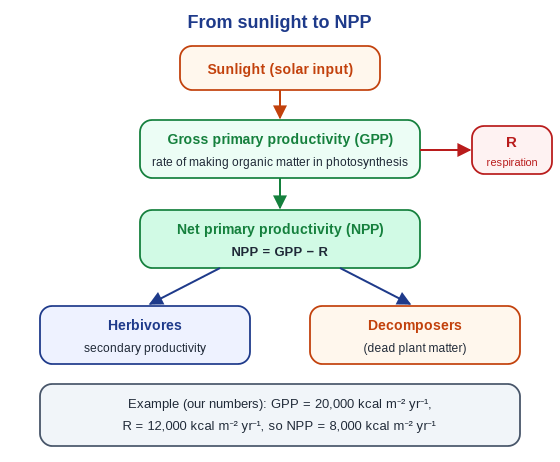
Worked example (our numbers). A field has GPP = 20,000 kcal m⁻² yr⁻¹ and its plants respire 12,000 kcal m⁻² yr⁻¹. Then NPP = 20,000 − 12,000 = 8,000 kcal m⁻² yr⁻¹, which is 40 per cent of GPP.
What decides primary productivity?
- the plant species living in the area;
- environmental factors such as light, temperature and water (Extra: the chapter says only “environmental factors”; these are common examples);
- the availability of nutrients;
- the photosynthetic capacity of the plants.
So productivity varies between ecosystems. The annual NPP of the whole biosphere is about 170 billion tons of organic matter (dry weight). The oceans, though they cover about 70 per cent of the surface, produce only about 55 billion tons; the remaining 115 billion tons come from land (our subtraction). Extra: the main reasons usually given are that sunlight reaches only the upper layer of water and that open-ocean water is poor in nutrients.
Decomposition
Decomposition is the breakdown of complex organic matter by decomposers into inorganic substances: carbon dioxide, water and nutrients. The raw material is detritus, which means dead plant parts (leaves, bark, flowers) and dead animals together with their faecal matter. Earthworms, called the farmer’s ‘friend’, help by breaking organic matter and loosening the soil.
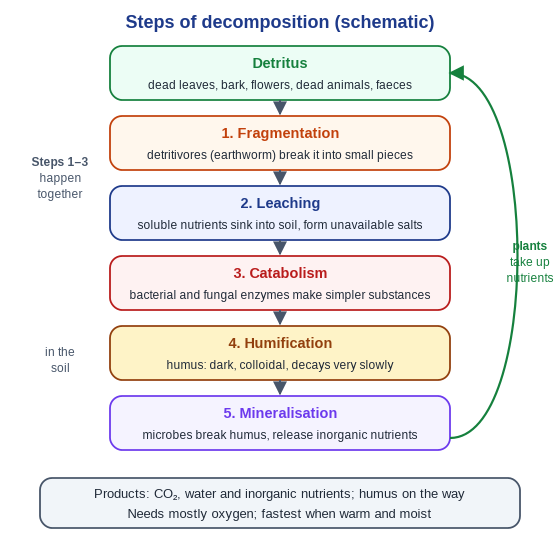
The steps
- Fragmentation. Detritivores such as the earthworm chew detritus into small particles (Extra: this gives microbes far more surface to work on).
- Leaching. Water carries water-soluble inorganic nutrients down into the soil horizon, where they are precipitated as unavailable salts.
- Catabolism. Bacterial and fungal enzymes break detritus into simpler inorganic substances.
These three act simultaneously on the same detritus. In the soil, two more processes take place:
- Humification. Builds up humus, a dark, amorphous material that is highly resistant to microbes and decays at an extremely slow rate. Being colloidal, it works as a reservoir of nutrients.
- Mineralisation. Some microbes break humus down further and release inorganic nutrients, which plants can absorb again.
What controls the rate of decomposition?
Decomposition is largely an oxygen-requiring process. Its rate depends on two things:
| Factor | Faster | Slower |
|---|---|---|
| Chemical make-up of detritus | rich in nitrogen and water-soluble substances such as sugars | rich in lignin and chitin |
| Temperature | warm | low |
| Soil moisture and air | moist, with oxygen | dry (Extra), or lacking oxygen (anaerobiosis) |
Among climatic factors, temperature and soil moisture matter most, because they control the activity of soil microbes. Where it is cold or the soil lacks oxygen, decomposition slows down and organic matter builds up.
Linking the two
NPP is the food that enters the ecosystem; decomposition releases the nutrients locked in what dies. Together they keep matter cycling, while energy flows one way through the system, as the next topic, energy flow and ecological pyramids, shows. Practise with the NCERT solutions for Chapter 12.
Practice
-
A grassland has a GPP of 12,000 kcal m⁻² yr⁻¹ and plants use 7,500 kcal m⁻² yr⁻¹ in respiration. Its NPP is:
Show answer
Answer: (b) 4,500 kcal m⁻² yr⁻¹
-
Which detritus will decompose most slowly?
Show answer
Answer: (c) Woody matter rich in lignin
-
The step in which bacterial and fungal enzymes turn detritus into simpler inorganic substances is:
Show answer
Answer: (c) catabolism
-
Why is humus called a reservoir of nutrients?
Show answer
Answer: Humus is colloidal and decays extremely slowly, so it holds nutrients for a long time. Some microbes slowly break it down and release the inorganic nutrients by mineralisation.
-
Why does organic matter pile up in cold or waterlogged soils?
Show answer
Answer: Decomposition mostly needs oxygen and active soil microbes. Low temperature and lack of oxygen (anaerobiosis) slow the microbes down, so dead matter is broken down slowly and builds up.
Questions students ask
What is the difference between GPP and NPP?
GPP is the total rate at which plants make organic matter in photosynthesis. NPP is what remains after the plants' own respiration, NPP = GPP − R. Only NPP is available to herbivores and decomposers.
Why are oceans less productive than land, although they are larger?
The chapter asks you to discuss this with your teacher. Extra: light fades quickly with depth, so photosynthesis happens only in a thin top layer, and the open ocean is usually short of nutrients such as nitrogen.
Which are the steps of decomposition?
Fragmentation, leaching and catabolism act together on detritus; humification and mineralisation then take place in the soil. The products are carbon dioxide, water and inorganic nutrients.
Stuck on a question?
Take a photo and Lagnever AI explains it step by step. Try it for 7 days for ₹2.
Get it on Google Play Open in browser
For parents: after the trial, the plan renews monthly by UPI or card autopay. You can cancel anytime in the app.