
How does energy flow through an ecosystem, and what do ecological pyramids show?
Answer in short
Plants capture only 2 to 10 per cent of the photosynthetically active radiation; this energy flows one way through grazing and detritus food chains. Only about 10 per cent passes from one trophic level to the next. Pyramids of number, biomass and energy show this; the first two can be inverted, but the energy pyramid is always upright.
Stuck on a question? Take a photo and Lagnever AI explains it step by step. Try it for 7 days for ₹2. Get it on Google Play
This page covers sections 12.4 and 12.5 of the chapter. Back to the Chapter 12 notes.
Where the energy comes from
Except for the deep-sea hydrothermal ecosystem, every ecosystem on Earth runs on sunlight. Of the sunlight that falls, less than 50 per cent is photosynthetically active radiation (PAR), and plants and photosynthetic bacteria capture only 2–10 per cent of that PAR. This small share feeds the whole living world.
All organisms depend on producers for food, directly or indirectly, so energy flows in one direction: sun → producers → consumers. The second law of thermodynamics applies too: without a steady energy input, an ecosystem could not keep building its molecules against the general drift towards disorder.
Producers and consumers
- Producers: green plants. On land, mainly herbaceous and woody plants; in water, phytoplankton, algae and higher plants.
- Primary consumers: herbivores that eat plants, such as insects, birds and mammals on land and molluscs in water.
- Secondary consumers: carnivores that eat herbivores; more exactly, primary carnivores.
- Tertiary consumers: secondary carnivores, which eat the primary carnivores.
Food chains and the food web
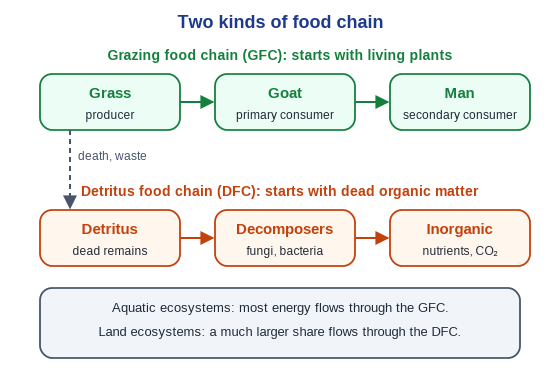
- Grazing food chain (GFC) begins with living plants: grass (producer) → goat (primary consumer) → man (secondary consumer).
- Detritus food chain (DFC) has dead organic matter as its first link. Its decomposers, mainly fungi and bacteria, are saprotrophs (sapro: to decompose). They secrete digestive enzymes onto dead material and absorb the simple inorganic products.
No energy stays in an organism for ever: it is passed to a consumer, or the organism dies and its death starts the detritus chain. In water, the GFC is the main route of energy; on land, a much larger fraction flows through the DFC.
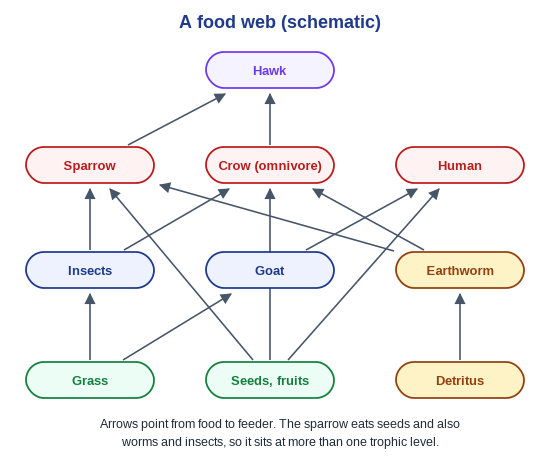
The two chains are joined at several points: some DFC organisms are eaten by GFC animals, and omnivores such as cockroaches and crows eat many kinds of food. These links turn chains into a food web.
Trophic levels and standing crop
The trophic level of an organism is its place in the chain by what it eats: producers first, herbivores second, carnivores third. Energy falls at each successive level, and every level depends on the one below.
Each level holds a standing crop: the mass of living organisms (biomass) or their number per unit area at a given time. Biomass can be fresh or dry weight; dry weight is more accurate (Extra: water content varies a lot between organisms and from day to day).
The 10 per cent law
Only about 10 per cent of the energy at one trophic level passes to the next. Our worked example, using the book’s starting value of 1,000,000 J of sunlight of which producers store 1 per cent:
| Level | Energy | Lost before the next level |
|---|---|---|
| Producers | 10,000 J | 9,000 J |
| Herbivores | 1,000 J | 900 J |
| Primary carnivores | 100 J | 90 J |
| Secondary carnivores | 10 J | — |
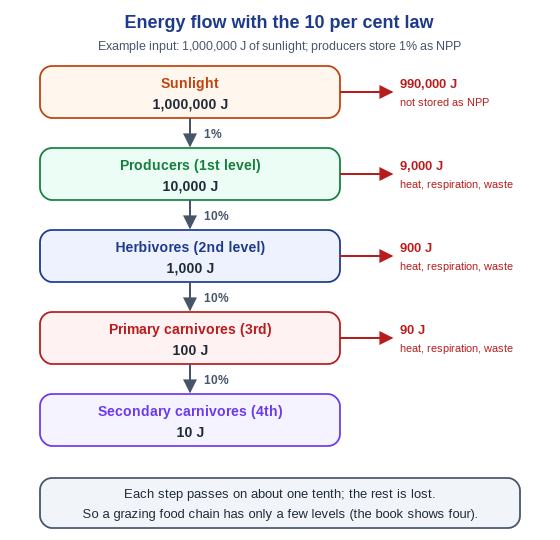
So a grazing food chain is limited to a few levels: producer, herbivore, primary carnivore and secondary carnivore.
Ecological pyramids
Draw each trophic level as a bar, producers at the base and the top consumer at the apex, and the bars usually form a pyramid. There are three kinds:
- Pyramid of number, for example a grassland with about 5.8 million plants supporting only 3 top carnivores.
- Pyramid of biomass, for example 809, 37, 11 and 1.5 kg m⁻² of dry weight from producers to tertiary consumers.
- Pyramid of energy, for example 10,000, 1,000, 100 and 10 J.
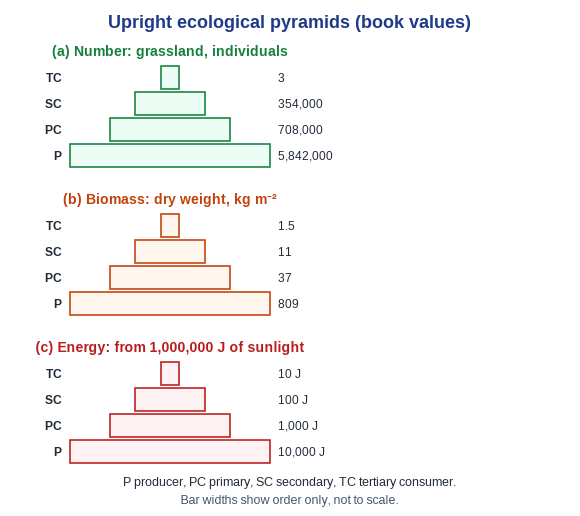
In most ecosystems all three are upright. The exceptions:
- Number, one big tree: a single tree supports thousands of insects, which feed fewer small birds and fewer large birds, so the pyramid is inverted at the base.
- Biomass, the sea: a small standing crop of phytoplankton (4 in the book’s figure) supports a larger standing crop of zooplankton (21), so the pyramid is inverted.
- Energy: always upright, since heat is lost at every step.
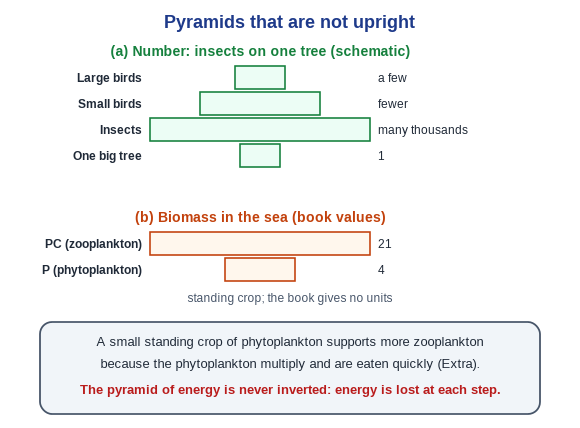
Every count must include all organisms at a level. Feeding on seeds puts a sparrow at the second level; feeding on insects puts it at the third. So a trophic level is a functional level, not a species.
Limitations: pyramids ignore species that belong to two or more levels, assume a simple food chain instead of a food web, and leave out saprophytes. Practise with the NCERT solutions for Chapter 12.
Practice
-
If producers in a pond store 20,000 J, how much reaches the third trophic level by the 10 per cent law?
Show answer
Answer: (b) 200 J
-
In the grazing food chain grass → goat → man, man is the:
Show answer
Answer: (c) secondary consumer
-
The pyramid of biomass in the sea is generally:
Show answer
Answer: (b) inverted
-
Why is the pyramid of energy never inverted?
Show answer
Answer: At each transfer from one trophic level to the next, some energy is always lost as heat. So every level has less energy than the level below it.
-
Name three limitations of ecological pyramids.
Show answer
Answer: They ignore a species that belongs to two or more trophic levels; they assume a simple food chain and cannot show a food web; and they give saprophytes no place, though these play a vital role.
Questions students ask
What is the 10 per cent law?
Only about 10 per cent of the energy at one trophic level is transferred to the next. For example, 10,000 J in producers gives about 1,000 J to herbivores, 100 J to primary carnivores and 10 J to secondary carnivores. This is why grazing food chains have only a few levels.
Why is the pyramid of numbers for a tree inverted?
A single big tree is one producer, but it feeds thousands of insects. So the base is narrow and the next level is wide; adding the birds that eat the insects gives a shape that is inverted at the base.
What is the difference between a food chain and a food web?
A food chain is a single straight sequence of who eats whom. A food web is many food chains linked together, because animals eat more than one kind of food and the grazing and detritus chains are connected.
Stuck on a question?
Take a photo and Lagnever AI explains it step by step. Try it for 7 days for ₹2.
Get it on Google Play Open in browser
For parents: after the trial, the plan renews monthly by UPI or card autopay. You can cancel anytime in the app.