
Ecosystem mein productivity aur decomposition kya hain?
Short mein jawab
Productivity biomass banne ka rate hai. Plants gross primary productivity (GPP) par organic matter banaate hain; respiration (R) ke baad net primary productivity NPP = GPP − R bachti hai. Decomposition mare hue matter ko fragmentation, leaching, catabolism, humification aur mineralisation se carbon dioxide, paani aur nutrients mein badalta hai, garam aur nam mahaul mein sabse tez.
Koi sawal atak gaya? Photo lo, Lagnever AI step-by-step samjhayega. 7 din ka trial sirf ₹2. Google Play se app lo
Yeh page chapter ke sections 12.1 se 12.3 cover karta hai. Wapas Chapter 12 notes par.
Ecosystem ek kaam karne wali unit
Ecosystem ke hisse chaar functions se saath kaam karte hain: productivity, decomposition, energy flow aur nutrient cycling. Pond chaaron dikhata hai. Phytoplankton aur plants sunlight se khaana banaate hain; zooplankton aur machhliyan use khaati hain; tal ke fungi, bacteria aur flagellates mare hue matter ko todte hain taaki nutrients phir se use ho sakein. Yeh page pehle do functions dekhta hai: matter kaise banta hai aur kaise tootta hai.
Production aur productivity
Primary production wo biomass (organic matter) hai jo plants photosynthesis se ek samay mein unit area par banaate hain. Ise weight (g m⁻²) ya energy (kcal m⁻²) mein likhte hain. Productivity is production ka rate hai, g m⁻² yr⁻¹ ya kcal m⁻² yr⁻¹ mein. Rate lene se hum jungle ki tulna lake ya desert se kar sakte hain.
- Gross primary productivity (GPP): wo rate jis par plants photosynthesis mein organic matter banaate hain.
- Respiration (R): GPP ka accha-khaasa hissa plants khud zinda rehne mein kharch karte hain.
- Net primary productivity (NPP): GPP − R = NPP. Yahi biomass herbivores aur decomposers ke liye hai.
- Secondary productivity: wo rate jis par consumers naya organic matter banaate hain.
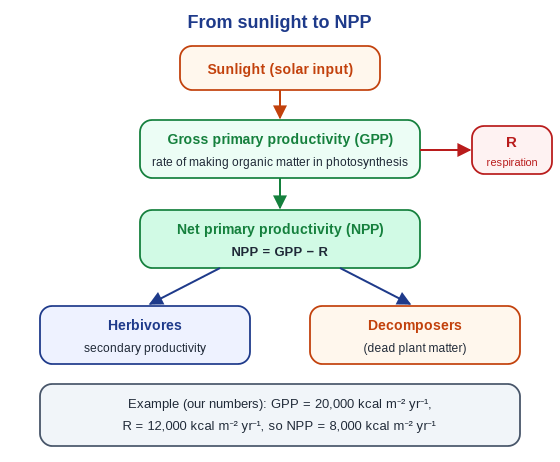
Worked example (hamare numbers). Ek khet ki GPP = 20,000 kcal m⁻² yr⁻¹ hai aur uske plants 12,000 kcal m⁻² yr⁻¹ respiration mein use karte hain. To NPP = 20,000 − 12,000 = 8,000 kcal m⁻² yr⁻¹, jo GPP ka 40 per cent hai.
Primary productivity kis par depend karti hai?
- area mein rehne wali plant species;
- environmental factors jaise light, temperature aur paani (Extra: chapter sirf “environmental factors” kehta hai; yeh aam examples hain);
- nutrients ki availability;
- plants ki photosynthetic capacity.
Isliye productivity har ecosystem mein alag hoti hai. Poore biosphere ki saalana NPP lagbhag 170 billion tons organic matter (dry weight) hai. Oceans lagbhag 70 per cent surface dhakte hain, phir bhi sirf lagbhag 55 billion tons dete hain; baaki 115 billion tons zameen se aata hai (hamara ghataav). Extra: iske main kaaran aam taur par yeh bataaye jaate hain ki sunlight sirf paani ki upar wali layer tak pahunchti hai aur khule samudra ke paani mein nutrients kam hote hain.
Decomposition
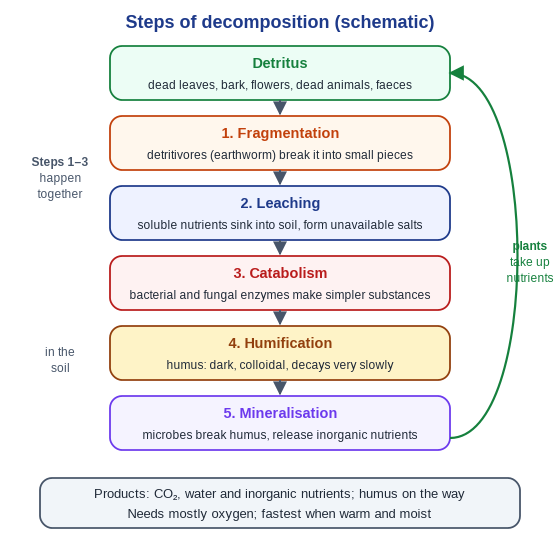
Decomposition wo process hai jismein decomposers complex organic matter ko inorganic padarthon mein todte hain: carbon dioxide, paani aur nutrients. Raw material detritus hai, yaani plants ke mare hue hisse (patte, chhaal, phool) aur animals ke mare hue remains, faecal matter samet. Earthworms, jinhe kisaan ka ‘dost’ kehte hain, organic matter todkar aur mitti bhurbhuri karke madad karte hain.
Steps
- Fragmentation. Earthworm jaise detritivores detritus ko chhote kanon mein todte hain (Extra: isse microbes ko kaam karne ke liye kahin zyada surface milta hai).
- Leaching. Paani ghulne wale inorganic nutrients ko mitti ki layers mein neeche le jaata hai, jahan wo aise salts ban kar jam jaate hain jo use nahi ho sakte.
- Catabolism. Bacteria aur fungi ke enzymes detritus ko simple inorganic padarthon mein todte hain.
Yeh teenon ek hi detritus par ek saath chalte hain. Mitti mein do aur processes hote hain:
- Humification. Humus banta hai, ek dark, amorphous padarth jo microbes ke saamne bahut tikta hai aur bahut hi dheere decompose hota hai. Colloidal hone se yeh nutrients ka reservoir hai.
- Mineralisation. Kuch microbes humus ko aur todkar inorganic nutrients chhodte hain, jinhe plants phir se absorb kar sakte hain.
Decomposition ka rate kaun control karta hai?
Decomposition zyaadatar oxygen maangne wala process hai. Iska rate do cheezon par depend karta hai:
| Factor | Tez | Dheema |
|---|---|---|
| Detritus ki chemical banawat | nitrogen aur sugars jaise ghulne wale padarth zyada | lignin aur chitin zyada |
| Temperature | garam | kam |
| Mitti ki nami aur hawa | nam, oxygen ke saath | sookhi (Extra), ya oxygen ki kami (anaerobiosis) |
Temperature aur mitti ki nami sabse zaroori climatic factors hain kyunki yeh soil microbes ki activity tay karte hain. Jahan thand ho ya mitti mein oxygen kam ho, decomposition dheema padta hai aur organic matter jama hota hai.
Dono ko jodna
NPP wo khaana hai jo ecosystem mein aata hai; decomposition mare hue organisms mein band nutrients ko chhodta hai. Dono milkar matter ko cycle karte rehte hain, jabki energy system mein ek hi disha mein behti hai, jaisa agla topic, energy flow aur ecological pyramids, dikhata hai. Chapter 12 ke NCERT solutions se practice karo.
Practice karo
-
Ek grassland ki GPP 12,000 kcal m⁻² yr⁻¹ hai aur plants 7,500 kcal m⁻² yr⁻¹ respiration mein use karte hain. Uski NPP hai:
Jawab dekho
Jawab: (b) 4,500 kcal m⁻² yr⁻¹
-
Kaun sa detritus sabse dheere decompose hoga?
Jawab dekho
Jawab: (c) Lignin wala lakdi jaisa matter
-
Wo step jismein bacteria aur fungi ke enzymes detritus ko simple inorganic padarthon mein todte hain:
Jawab dekho
Jawab: (c) catabolism
-
Humus ko nutrients ka reservoir kyon kehte hain?
Jawab dekho
Jawab: Humus colloidal hai aur bahut hi dheere decompose hota hai, isliye nutrients ko lambe samay tak rakhta hai. Kuch microbes ise dheere-dheere todkar mineralisation se inorganic nutrients chhodte hain.
-
Thandi ya paani bhari mitti mein organic matter jama kyon ho jaata hai?
Jawab dekho
Jawab: Decomposition ko zyaadatar oxygen aur active soil microbes chahiye. Kam temperature aur oxygen ki kami (anaerobiosis) microbes ko dheema kar dete hain, isliye mara hua matter dheere tootta hai aur jama hota hai.
Students ke sawal
GPP aur NPP mein kya fark hai?
GPP wo kul rate hai jis par plants photosynthesis mein organic matter banaate hain. NPP plants ki apni respiration ke baad bachta hai, NPP = GPP − R. Sirf NPP herbivores aur decomposers ke liye available hai.
Oceans bade hone ke bawajood zameen se kam productive kyon hain?
Chapter kehta hai ise teacher ke saath discuss karo. Extra: gehraai ke saath light jaldi kam ho jaati hai, isliye photosynthesis sirf upar ki patli layer mein hota hai, aur khule samudra mein nitrogen jaise nutrients aksar kam hote hain.
Decomposition ke steps kaun se hain?
Fragmentation, leaching aur catabolism detritus par ek saath chalte hain; phir mitti mein humification aur mineralisation hote hain. Products carbon dioxide, paani aur inorganic nutrients hain.
Koi sawal atak gaya?
Photo lo, Lagnever AI step-by-step samjhayega. 7 din ka trial sirf ₹2.
Google Play se app lo Browser mein kholo
Parents ke liye: trial ke baad plan har mahine UPI ya card autopay se renew hota hai. App mein kabhi bhi cancel kar sakte hain.