
Class 12 Biology Chapter 12: Ecosystem Notes Hinglish mein
Ye chapter 5 lines mein
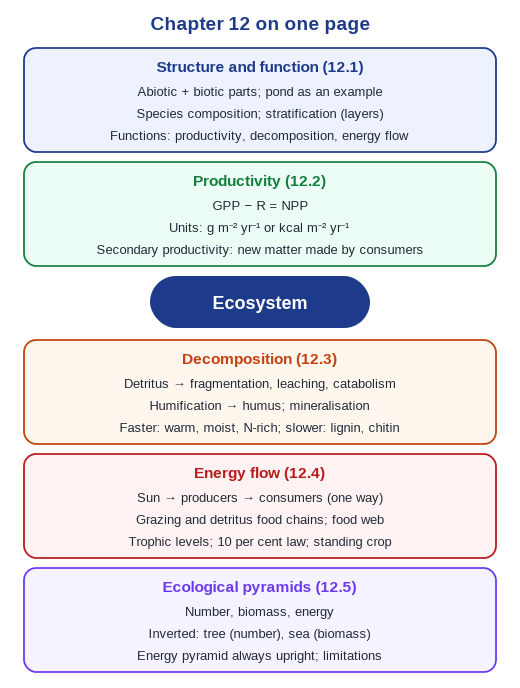
Ecosystem nature ki ek functional unit hai jismein living organisms aapas mein aur apne physical mahaul ke saath interact karte hain. Yeh productivity, decomposition, energy flow aur nutrient cycling se chalta hai. Plants solar energy fix karte hain (GPP − R = NPP); phir energy ek hi disha mein grazing aur detritus food chains se aage badhti hai, aur har agle trophic level tak sirf lagbhag 10 per cent pahunchti hai, jaisa ecological pyramids dikhaate hain.
Yeh chapter kis baare mein hai?
Yeh Unit X, Ecology, ka doosra chapter hai, Chapter 11, Organisms and Populations, ke baad. Wahan humne akeli populations padhi thi; yahan hum wo poora system dekhte hain jismein wo rehti hain. Rationalised book mein chapter ke paanch sections hain: 12.1 Ecosystem – Structure and Function, 12.2 Productivity, 12.3 Decomposition, 12.4 Energy Flow aur 12.5 Ecological Pyramids.
Do topic pages gehraai mein jaate hain: productivity aur decomposition aur energy flow aur ecological pyramids. Saari 11 exercises NCERT solutions mein hal hain.
Ecosystem kya hai?
Ecosystem nature ki ek kaam karne wali unit hai jismein organisms ek-doosre se aur apne aas-paas ke physical mahaul se interact karte hain. Iska size chhote talaab se lekar bade jungle ya ocean tak kuch bhi ho sakta hai. Kuch ecologists poore biosphere ko ek global ecosystem maante hain, jo saare local ecosystems se bana hai. Kyunki yeh ek saath padhne ke liye bahut bada hai, ecosystems ko do kismon mein baante hain:
- Terrestrial: forest, grassland, desert.
- Aquatic: pond, lake, wetland, river, estuary.
- Man-made: crop fields aur aquarium ko bhi ecosystem maana ja sakta hai.
Structure aur function
Biotic aur abiotic hisson ke interaction se har tarah ke ecosystem ka apna physical structure banta hai. Do structural features sabse zaroori hain:
- Species composition: kaun si plant aur animal species maujood hain, pehchaan kar ginti.
- Stratification: species ki vertical layering. Jungle mein trees sabse upar ki layer mein, shrubs doosri mein, aur herbs aur grasses neeche ki layers mein.
Saare hisse chaar functions se ek unit ki tarah kaam karte hain: productivity, decomposition, energy flow aur nutrient cycling.
Example: ek pond
Pond uthla, kaafi had tak khud-chalne wala aur itna simple hai ki chaaron functions saaf dikhte hain.
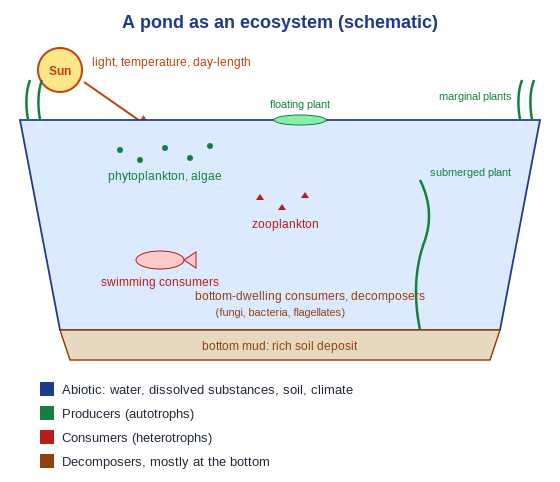
- Abiotic hissa: paani aur usmein ghule inorganic aur organic padarth, aur neeche ki upjaau mitti. Sunlight, temperature ka cycle, din ki lambai aur baaki climate poore pond ki raftaar tay karte hain.
- Producers (autotrophs): phytoplankton, kuch algae, aur floating, submerged aur kinaare ke (marginal) plants.
- Consumers: zooplankton, aur tairne wale ya tal par rehne wale animals.
- Decomposers: fungi, bacteria aur flagellates, jo tal mein zyada hote hain.
Pond wahi karta hai jo har ecosystem aur poora biosphere karta hai: autotrophs solar energy se inorganic matter ko organic matter mein badalte hain; heterotrophs autotrophs ko khaate hain; aur mara hua matter decompose aur mineralise hokar nutrients dobara use ke liye chhodta hai. Energy ek hi disha mein, oonche trophic levels ki taraf jaati hai, aur raaste mein heat ban kar khoti hai.
Productivity
Solar energy ka lagaataar aana hi ecosystem ko chalata hai.
- Primary production wo biomass (organic matter) hai jo plants photosynthesis se ek samay mein unit area par banaate hain, weight (g m⁻²) ya energy (kcal m⁻²) mein.
- Productivity biomass banne ka rate hai, g m⁻² yr⁻¹ ya kcal m⁻² yr⁻¹ mein, jisse ecosystems ki tulna hoti hai.
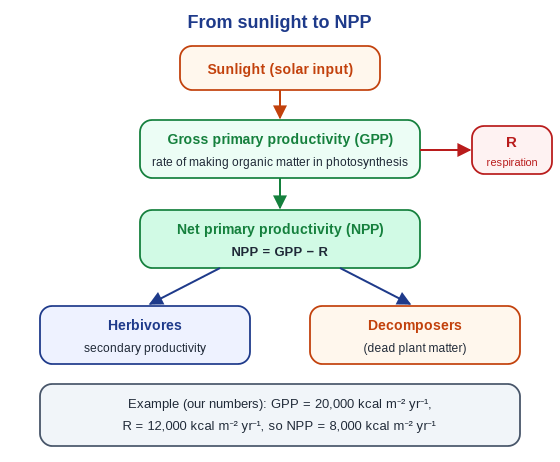
- Gross primary productivity (GPP) photosynthesis mein organic matter banne ka rate hai. Plants iska accha-khaasa hissa respiration (R) mein use kar lete hain.
- Net primary productivity (NPP) jo bachta hai: GPP − R = NPP. Yahi herbivores aur decomposers ke liye available biomass hai.
- Secondary productivity wo rate hai jis par consumers naya organic matter banaate hain.
Primary productivity area ki plant species, environmental factors, nutrients ki availability aur plants ki photosynthetic capacity par depend karti hai, isliye har ecosystem mein alag hoti hai. Poore biosphere ki saalana NPP lagbhag 170 billion tons (dry weight) organic matter hai. Oceans lagbhag 70 per cent surface dhakte hain par sirf 55 billion tons dete hain; baaki 115 billion tons (hamara ghataav) zameen se aata hai.
Decomposition
Decomposers complex organic matter ko carbon dioxide, paani aur nutrients jaise inorganic padarthon mein todte hain; yahi decomposition hai. Earthworm ko kisaan ka ‘dost’ kehte hain kyunki yeh organic matter todne aur mitti ko bhurbhura karne mein madad karta hai. Raw material detritus hai: mare hue patte, chhaal aur phool, aur animals ke mare hue remains, faecal matter samet.
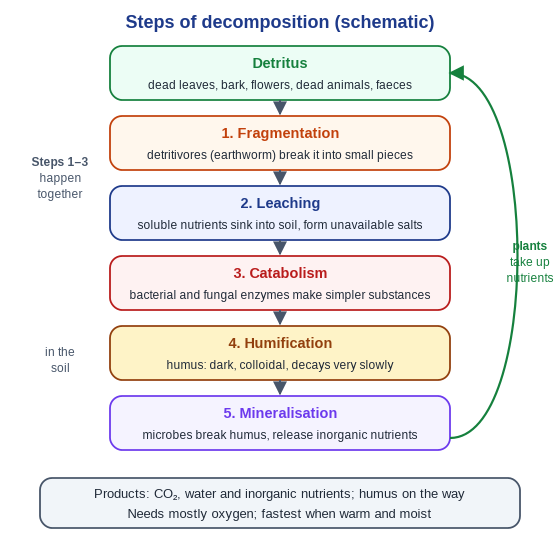
- Fragmentation: earthworm jaise detritivores detritus ko chhote kanon mein todte hain.
- Leaching: paani mein ghulne wale inorganic nutrients mitti mein neeche chale jaate hain aur aise salts ban kar jam jaate hain jo plants use nahi kar sakte.
- Catabolism: bacteria aur fungi ke enzymes detritus ko simple inorganic padarthon mein todte hain.
Yeh teenon steps ek hi detritus par ek saath chalte hain. Mitti mein do aur processes hote hain:
- Humification: humus banta hai, ek dark, amorphous padarth jo microbes ke saamne tikta hai aur bahut hi dheere decompose hota hai. Colloidal hone se yeh nutrients ka store hai.
- Mineralisation: kuch microbes humus ko aur todkar inorganic nutrients chhodte hain.
Rate kaun tay karta hai? Decomposition ko zyaadatar oxygen chahiye. Yeh detritus ki chemical banawat aur climate par depend karta hai. Lignin aur chitin wala detritus dheere sadta hai; nitrogen aur sugars jaise ghulne wale padarth wala jaldi. Temperature aur mitti ki nami sabse zaroori climatic factors hain kyunki yeh soil microbes ko control karte hain: garam aur nam mahaul mein decomposition tez hota hai, jabki kam temperature aur oxygen ki kami (anaerobiosis) mein dheema, aur organic matter jama hone lagta hai.
Energy flow
Deep-sea hydrothermal ecosystem ke alaawa, dharti ke ecosystems ke liye sun hi ek-maatra energy source hai. Girne wali sunlight ka 50 per cent se kam photosynthetically active radiation (PAR) hai, aur plants PAR ka sirf 2–10 per cent capture karte hain. Yahi chhoti si matra saare jeevan ko chalaati hai. Energy ek hi disha mein jaati hai: sun → producers → consumers. Ecosystems thermodynamics ka doosra niyam bhi maante hain: unhe apne molecules banaane aur disorder ki taraf ke natural jhukaav ke khilaaf lagaataar energy chahiye.
- Producers: hare plants. Zameen par herbaceous aur woody plants; paani mein phytoplankton, algae aur higher plants.
- Consumers (heterotrophs): primary consumers (herbivores: zameen par insects, birds aur mammals, paani mein molluscs) plants khaate hain; secondary consumers (primary carnivores) herbivores khaate hain; uske baad tertiary consumers aate hain.
Food chains aur food web
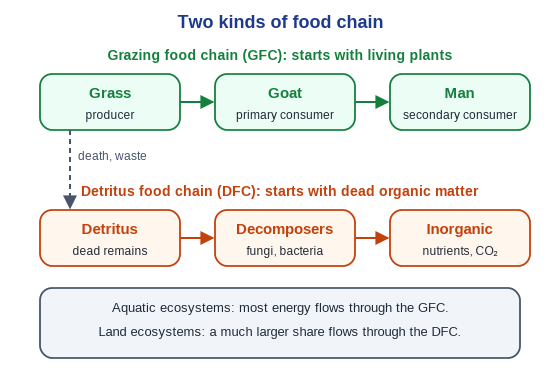
- Grazing food chain (GFC): zinda plants se shuru, jaise grass → goat → man.
- Detritus food chain (DFC): mare hue organic matter se shuru. Iske decomposers, mainly fungi aur bacteria, saprotrophs hain: yeh dead matter par digestive enzymes chhodte hain aur simple products absorb karte hain.
- Aquatic ecosystems mein GFC zyaadatar energy le jaati hai; zameen par energy ka kaafi bada hissa DFC se jaata hai.
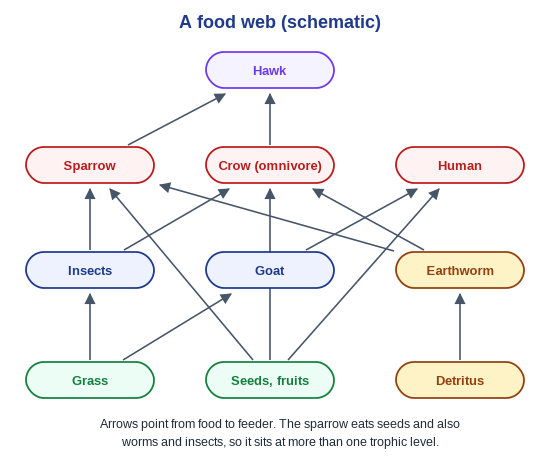
- Dono chains judi hain: DFC ke kuch organisms GFC ke animals ka shikaar bante hain, aur cockroach aur crow jaise omnivores kai cheezein khaate hain. In jodon se food web banta hai.
Trophic levels aur 10 per cent law
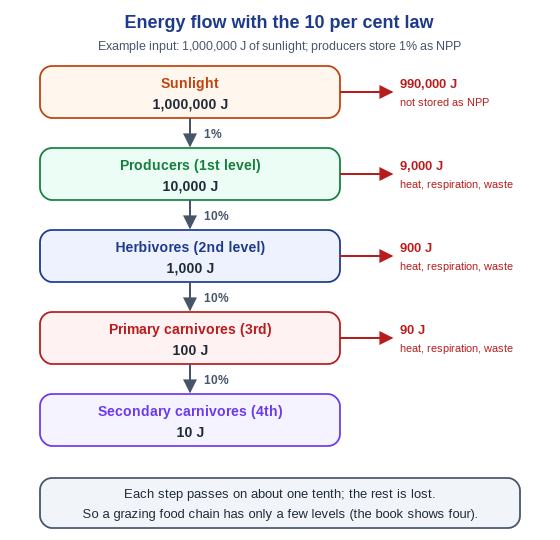
Organism ka trophic level uski khaane wali position hai: producers pehla, herbivores doosra, carnivores teesra. Har agle level par energy ghatti jaati hai. Koi bhi organism marta hai to detritus ban jaata hai, jo decomposers ka khaana hai.
Har level ki ek standing crop hoti hai: ek samay par unit area mein living organisms ka mass (biomass) ya ginti. Biomass dry weight mein naapna zyada accurate hai. 10 per cent law ke hisaab se ek level ki energy ka sirf lagbhag 10 per cent agle tak pahunchta hai, isliye grazing food chain mein kuch hi levels hote hain: producer, herbivore, primary carnivore, secondary carnivore.
Ecological pyramids
Har trophic level ka number, biomass ya energy bars mein ek ke upar ek banaao to aam taur par pyramid banta hai: producers ka chauda base aur top consumer tak patla hota hua. Teen pyramids hain: number, biomass aur energy ke.
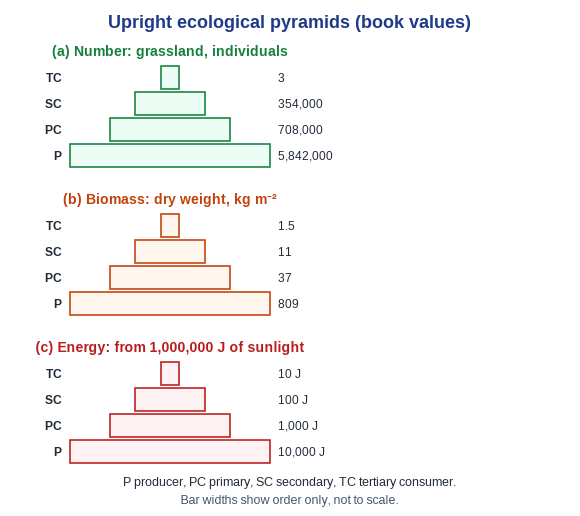
- Zyaadatar ecosystems mein teenon upright hote hain.
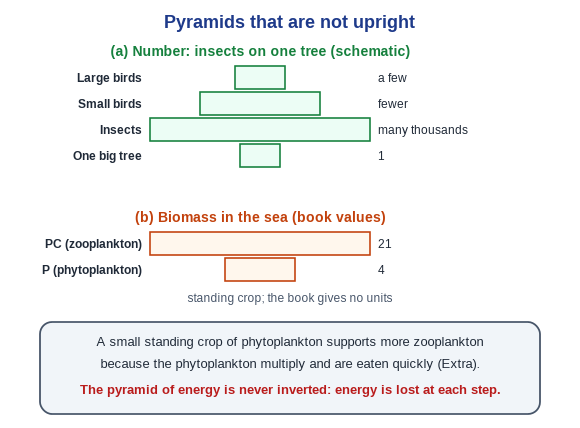
- Exceptions: ek bade tree par insects aur unhe khaane wale birds gino, to pyramid of number base par inverted hota hai. Samudra mein pyramid of biomass aam taur par inverted hota hai kyunki phytoplankton ki chhoti standing crop zooplankton aur machhliyon ki badi standing crop ko sambhaalti hai.
- Pyramid of energy hamesha upright hota hai, kyunki har step par kuch energy heat ban kar khoti hai.
Kisi bhi ginti mein us level ke saare organisms shaamil hone chahiye. Ek species ek se zyada levels par bhi ho sakti hai: sparrow seeds, fruits aur peas khaate waqt primary consumer hai, aur insects aur worms khaate waqt secondary consumer. Trophic level ek functional level hai, species nahi.
Ecological pyramids ki limitations: yeh do ya zyada levels wali species ko nahi dikhaate; simple food chain maante hain, jo nature mein lagbhag kabhi nahi hoti, aur food web nahi dikha sakte; aur saprophytes ko koi jagah nahi dete, jabki unka role bahut zaroori hai.
Aage badhne se pehle
Chapter ka summary nutrient cycling (carbon jaise gaseous cycles, jinka reservoir atmosphere ya hydrosphere hai, aur phosphorus jaise sedimentary cycles, jinka reservoir Earth’s crust hai) aur ecosystem services (jaise forests ka hawa aur paani saaf karna) ka bhi zikr karta hai; rationalised text inhe alag sections mein nahi padhaata. GPP − R = NPP, decomposition ke paanch steps aur factors, dono food chains, worked example ke saath 10 per cent law, aur pyramids aur unke exceptions yaad rakho. Unit ka aakhri chapter, Biodiversity and Conservation, inhi ideas par aage badhta hai. Saari 11 exercises Chapter 12 ke NCERT solutions mein hal hain.
Key terms (zaroori shabd)
| Term | Matlab |
|---|---|
| Ecosystem | Nature ki ek functional unit: kisi area ke living organisms aur unka physical (abiotic) mahaul, jo aapas mein interact karte hain. Yeh chhote talaab se lekar bade jungle ya samudra tak kisi bhi size ka ho sakta hai. |
| Stratification | Species ka vertical layers mein arrangement. Jungle mein trees sabse upar ki layer, shrubs doosri, aur herbs aur grasses neeche ki layers mein hote hain. |
| Gross primary productivity (GPP) | Photosynthesis mein plants jis rate se organic matter banaate hain. |
| Net primary productivity (NPP) | GPP mein se plants ki respiration mein lagi matra ghata do (GPP − R = NPP). Yahi biomass herbivores aur decomposers ke liye available hota hai. |
| Secondary productivity | Consumers jis rate se naya organic matter banaate hain. |
| Detritus | Plants ke mare hue hisse (patte, chhaal, phool) aur animals ke mare hue remains, faecal matter samet. Yahi decomposition ka raw material hai. |
| Humus | Humification se bana dark, amorphous, colloidal padarth. Yeh microbes ke saamne tikta hai, bahut dheere decompose hota hai aur nutrients ka store hai. |
| Trophic level | Food chain mein organism ki khaane ke hisaab se position: producers pehla, herbivores (primary consumers) doosra, carnivores (secondary consumers) teesra, aur aage. |
| Standing crop | Kisi trophic level par ek samay mein unit area mein living material ka mass (biomass) ya organisms ki ginti. |
| 10 per cent law | Ek trophic level ki energy ka sirf lagbhag 10 per cent agle level tak jaata hai; isi wajah se grazing food chain mein levels kam hote hain. |
| Ecological pyramid | Lagaataar trophic levels par number, biomass ya energy ka diagram, jismein base par producers aur apex par top consumer hota hai. |
| Photosynthetically active radiation (PAR) | Sunlight ka wo hissa jo plants photosynthesis mein use kar sakte hain: girne wali solar radiation ka 50 per cent se kam. Plants is PAR ka sirf 2 se 10 per cent capture karte hain. |
Is chapter ke topics
Practice karo
-
Jungle mein trees, shrubs, aur herbs aur grasses ka layers mein vertical arrangement kehlaata hai:
Jawab dekho
Jawab: (b) stratification
-
Agar ek khet ki GPP 5,000 kcal m⁻² yr⁻¹ hai aur respiration 3,000 kcal m⁻² yr⁻¹ use karta hai, to NPP hai:
Jawab dekho
Jawab: (b) 2,000 kcal m⁻² yr⁻¹
-
Decomposition ka wo step jismein earthworms detritus ko chhote tukdon mein todte hain:
Jawab dekho
Jawab: (c) fragmentation
-
Agar producers 10,000 J store karte hain, to 10 per cent law se secondary carnivores tak kitni energy pahunchegi?
Jawab dekho
Jawab: (c) 10 J
-
Kaun sa ecological pyramid kabhi inverted nahi ho sakta?
Jawab dekho
Jawab: (c) Pyramid of energy
-
Terrestrial ecosystem mein energy ka bada hissa kisse hokar jaata hai?
Jawab dekho
Jawab: (b) detritus food chain
Students ke sawal
Class 12 Biology Chapter 12 ke main topics kya hain?
Pond ke example ke saath ecosystem ka structure aur function, productivity (GPP, NPP aur secondary productivity), decomposition ke steps aur factors, food chains, food web aur trophic levels se energy flow, aur number, biomass aur energy ke ecological pyramids.
Kya Ecosystem 2026-27 ki NCERT Class 12 Biology book mein hai?
Haan. Yeh Reprint 2026-27 wali Class 12 Biology textbook ka Chapter 12 hai, pages 205 se 215, Unit X, Ecology mein. Ismein 11 end-of-chapter exercises hain.
Pyramid of energy hamesha upright kyon hota hai?
Ek trophic level se agle tak har transfer mein kuch energy heat ban kar kho jaati hai. Isliye har level mein neeche wale level se kam energy hoti hai, aur pyramid ulta nahi ho sakta.
Is chapter ke kaun se diagrams practise karne chahiye?
Pond ecosystem, GPP aur NPP ka flow, decomposition ke steps, grazing aur detritus food chains, food web, 10 per cent law ke saath trophic levels se energy flow, aur upright aur inverted pyramids.
Koi sawal atak gaya?
Photo lo, Lagnever AI step-by-step samjhayega. 7 din ka trial sirf ₹2.
Google Play se app lo Browser mein kholo
Parents ke liye: trial ke baad plan har mahine UPI ya card autopay se renew hota hai. App mein kabhi bhi cancel kar sakte hain.