
How do fertilisation and implantation happen?
Answer in short
Fertilisation is the fusion of a sperm with the ovum in the ampulla of the fallopian tube, giving a diploid zygote. The zygote divides into a morula and then a blastocyst, which embeds in the endometrium of the uterus: this is implantation, and pregnancy begins. A placenta then links mother and foetus until birth, about nine months later.
Stuck on a question? Take a photo and Lagnever AI explains it step by step. Try it for 7 days for ₹2. Get it on Google Play
Where and how does fertilisation happen?
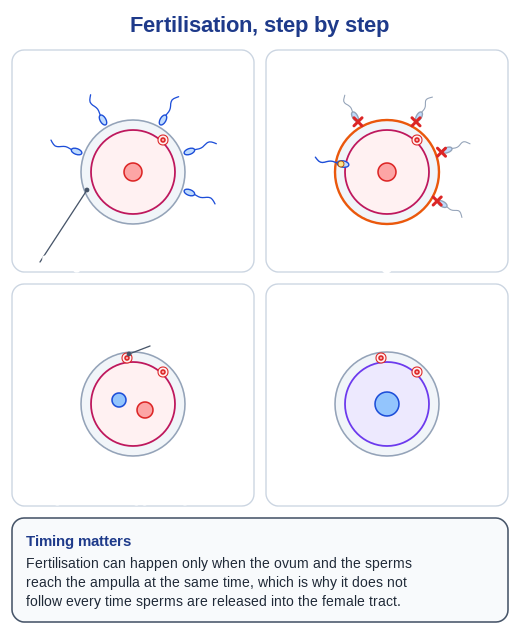
During coitus, semen is released into the vagina: this is insemination. The sperms swim quickly through the cervix and the uterus and reach the ampulla of the fallopian tube. The ovum released by the ovary is carried to the same place. Fertilisation can happen only if both arrive there at the same time, so not every insemination leads to pregnancy.
Fertilisation, the fusion of a sperm with the ovum, goes in steps:
- A sperm touches the zona pellucida around the ovum and sets off membrane changes that stop any more sperms from entering. So only one sperm can fertilise an ovum.
- Secretions of the acrosome help the sperm pass through the zona pellucida and the plasma membrane into the cytoplasm.
- Its entry makes the secondary oocyte finish meiosis II. This division is unequal too: a haploid ovum (ootid) and a small second polar body.
- The haploid nuclei of the sperm and the ovum fuse into a diploid zygote, with 46 chromosomes.
When is the sex of the baby decided?
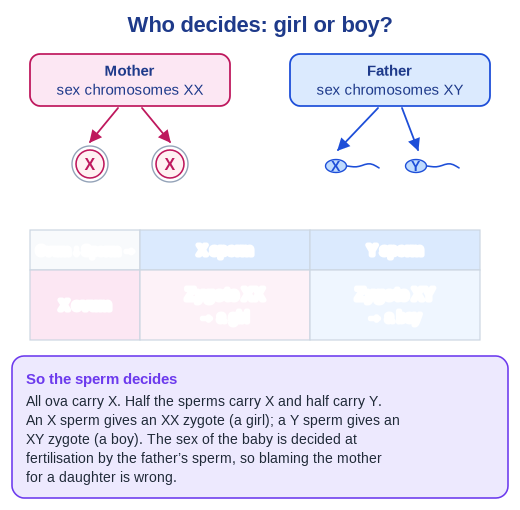
At fertilisation itself. A human female has the sex chromosomes XX and a male XY. So every ovum carries an X, while half of all sperms carry X and half carry Y. An X sperm gives an XX zygote, which develops into a girl; a Y sperm gives an XY zygote, a boy. The sex of the baby is therefore decided by the father’s sperm, not by the mother.
How does the zygote reach the uterus?
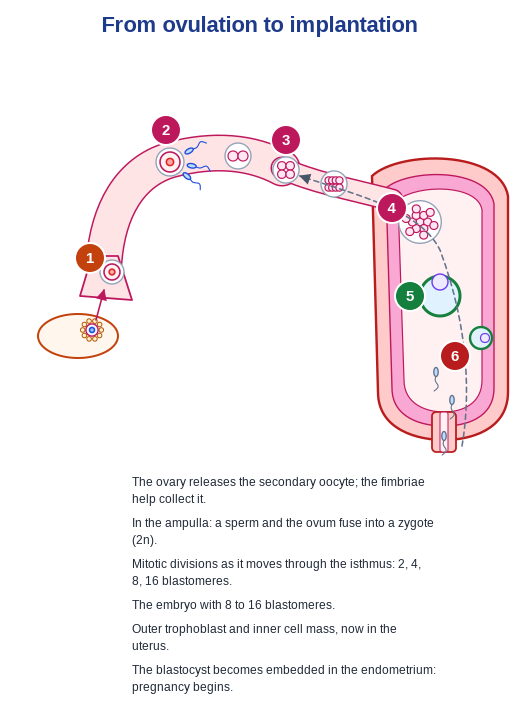
The zygote starts dividing by mitosis while it moves through the isthmus towards the uterus. This is cleavage, and it gives 2, 4, 8 and 16 daughter cells called blastomeres. An embryo of 8 to 16 blastomeres is a morula. The morula keeps dividing and, as it moves on into the uterus, becomes a blastocyst. Its blastomeres form an outer layer, the trophoblast, and an inner cell mass attached to it.
What is implantation?
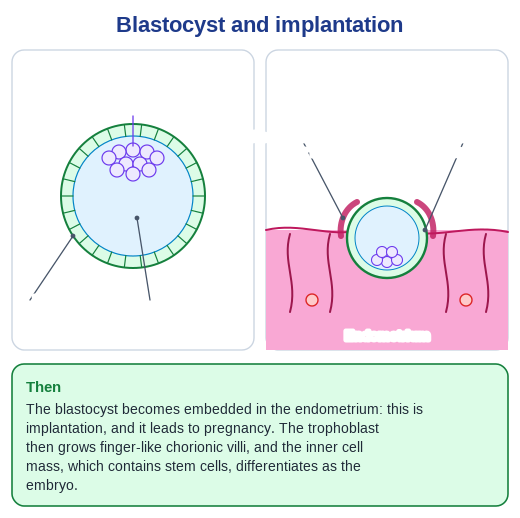
The trophoblast fixes itself to the endometrium, while the inner cell mass goes on to form the embryo. After the attachment, the uterine cells divide rapidly and cover the blastocyst, so it becomes embedded in the endometrium. This is implantation, and it leads to pregnancy.
How does the placenta form and work?
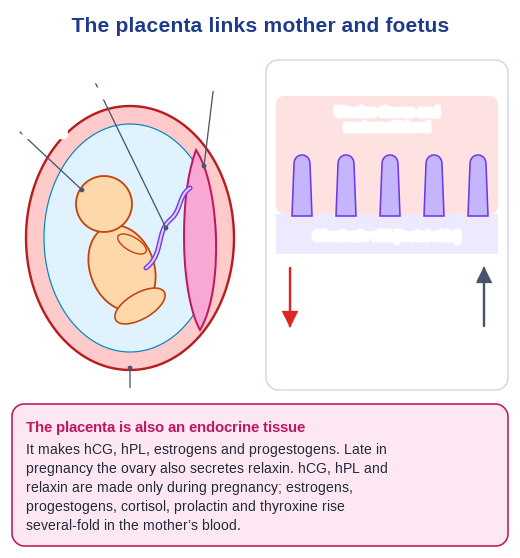
After implantation, finger-like chorionic villi grow from the trophoblast, surrounded by uterine tissue and maternal blood. The villi and the uterine tissue interlock to form the placenta, the structural and functional link between the foetus and the mother. Through the umbilical cord, the placenta supplies oxygen and nutrients and removes carbon dioxide and wastes.
The placenta is also an endocrine tissue. It makes hCG (human chorionic gonadotropin), hPL (human placental lactogen), estrogens and progestogens. Late in pregnancy the ovary also secretes relaxin. hCG, hPL and relaxin are made only during pregnancy, and several other hormones rise several-fold to support the foetus and the mother.
How does the embryo develop?
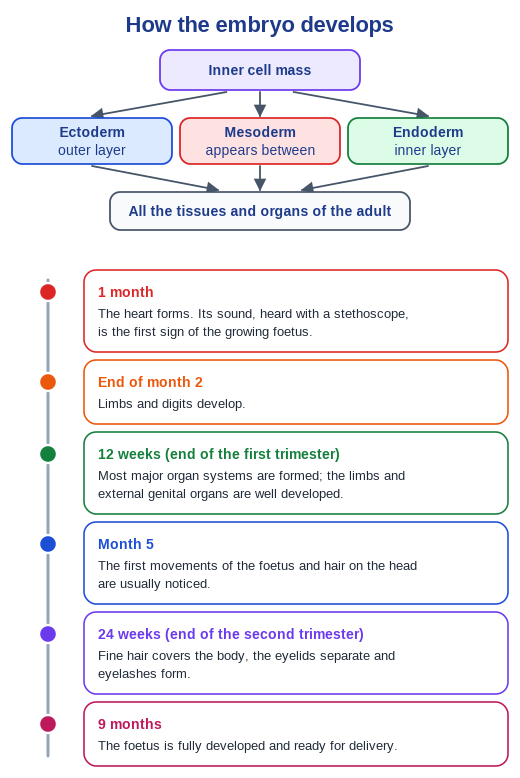
Soon after implantation, the inner cell mass forms an outer ectoderm and an inner endoderm; a mesoderm then appears between them. These three layers form every tissue and organ of the adult. The inner cell mass also contains stem cells, which can give rise to every tissue and organ. A human pregnancy lasts about nine months: the heart forms in the first month, most organ systems by 12 weeks, and the foetus is fully developed by nine months.
How do birth and lactation happen?
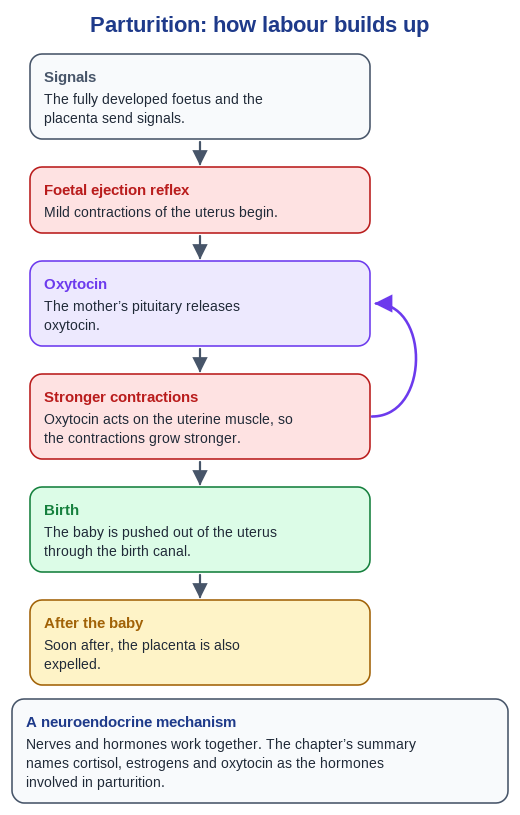
The nine months are the gestation period. Childbirth, or parturition, is set off by a neuroendocrine mechanism. Signals from the foetus and the placenta cause mild contractions, the foetal ejection reflex. These trigger oxytocin release from the mother’s pituitary. Oxytocin makes the uterine muscle contract more strongly, which releases more oxytocin, and so on, until the baby is pushed out through the birth canal. The placenta follows soon after.
Milk production, lactation, begins towards the end of pregnancy. The first milk, colostrum, carries antibodies that protect the newborn.
Previous topic: the menstrual cycle. See also the chapter notes and the NCERT solutions.
Practice
-
A morula is an embryo with:
Show answer
Answer: (b) 8 to 16 blastomeres
-
Which hormone is made only during pregnancy?
Show answer
Answer: (c) hCG
-
The germ layer that appears between the ectoderm and the endoderm is the:
Show answer
Answer: (b) mesoderm
-
Why does only one sperm fertilise an ovum?
Show answer
Answer: As soon as one sperm touches the zona pellucida, membrane changes follow that stop any further sperm from getting in.
-
Why is colostrum important for a newborn?
Show answer
Answer: Colostrum, the milk of the first few days, contains several antibodies that help the newborn develop resistance to infections.
Questions students ask
Where does fertilisation take place in humans?
In the ampulla, the wider part of the fallopian tube near the ovary. Sperms swim there from the vagina through the cervix and uterus, and the ovum is carried there after ovulation.
What is implantation?
Implantation is the embedding of the blastocyst in the endometrium. The trophoblast attaches to the endometrium, uterine cells divide and cover the blastocyst, and pregnancy begins.
What are the functions of the placenta?
It supplies oxygen and nutrients to the foetus and removes carbon dioxide and wastes, through the umbilical cord. It is also an endocrine tissue that makes hCG, hPL, estrogens and progestogens.
What is the foetal ejection reflex?
It is the set of mild uterine contractions set off by signals from the fully grown foetus and from the placenta. It triggers the release of oxytocin, which leads to the strong contractions of childbirth.
Stuck on a question?
Take a photo and Lagnever AI explains it step by step. Try it for 7 days for ₹2.
Get it on Google Play Open in browser
For parents: after the trial, the plan renews monthly by UPI or card autopay. You can cancel anytime in the app.