
How does the menstrual cycle work?
Answer in short
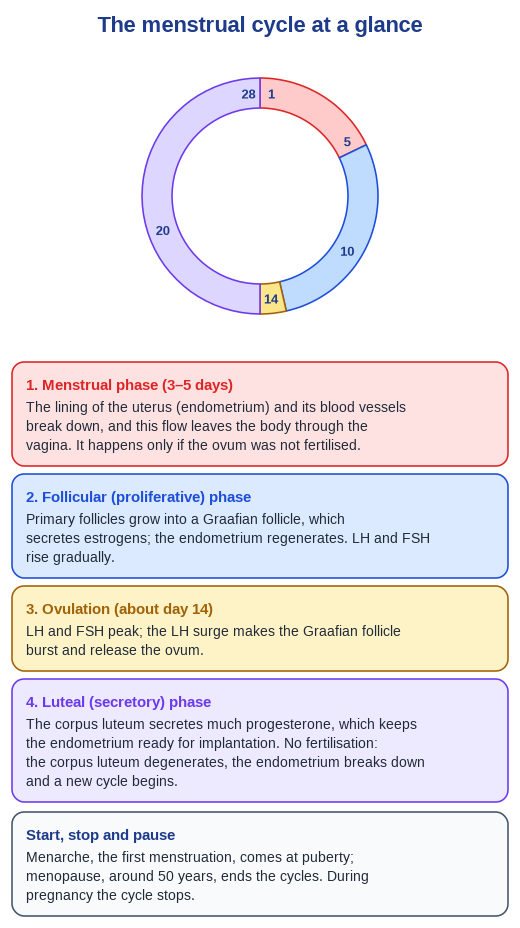
The menstrual cycle is the reproductive cycle of female primates, about 28/29 days long in humans. It has a menstrual phase, a follicular phase, ovulation around day 14 and a luteal phase. Pituitary hormones (FSH and LH) and ovarian hormones (estrogens and progesterone) drive matching changes in the ovary and the endometrium of the uterus.
Stuck on a question? Take a photo and Lagnever AI explains it step by step. Try it for 7 days for ₹2. Get it on Google Play
What is the menstrual cycle?
The reproductive cycle of female primates, such as monkeys, apes and humans, is called the menstrual cycle. In human females the first menstruation comes at puberty and is called menarche. After that, menstruation repeats about every 28/29 days, and the events from one menstruation to the next make one cycle. In the middle of each cycle, one ovum is released. The cycles continue until menopause, at around 50 years. Regular cycles show that the body is in its normal reproductive phase.
What happens in the menstrual phase?
The cycle starts with the menstrual phase, which lasts 3–5 days. The lining of the uterus, the endometrium, and its blood vessels break down, and this flow leaves the body through the vagina. Menstruation happens only when the released ovum was not fertilised. Missing it may be a sign of pregnancy, but stress, poor health and other causes can also stop it.
What happens in the follicular phase?
Next comes the follicular phase, also called the proliferative phase. Two things happen together:
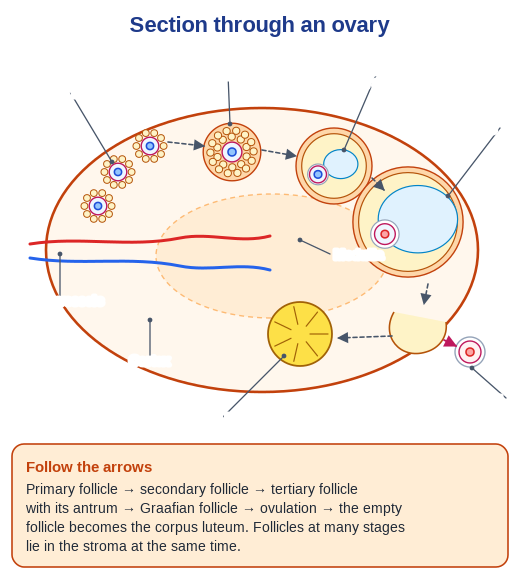
- In the ovary, primary follicles grow until one becomes a fully mature Graafian follicle.
- In the uterus, the endometrium regenerates by proliferation, growing thick again.
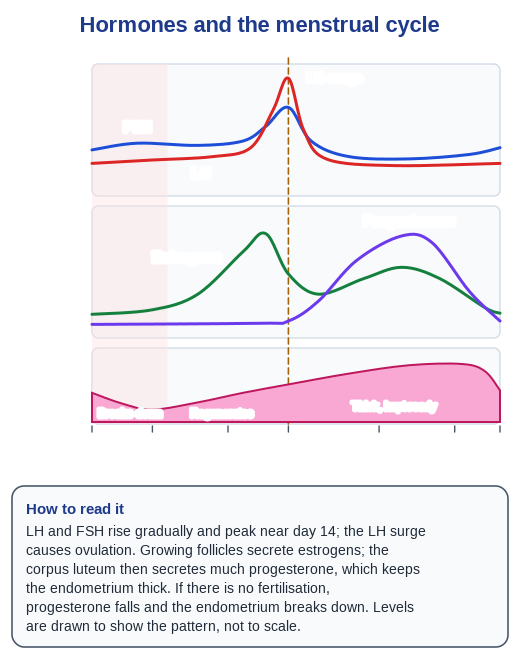
Hormones link the two. The pituitary’s gonadotropins, LH and FSH, rise gradually through this phase. They make the follicles develop, and the growing follicles secrete estrogens.
What causes ovulation?
Both LH and FSH reach a peak in the middle of the cycle, around day 14. LH rises fastest, to its maximum: this is the LH surge. The surge makes the Graafian follicle burst and release the ovum. This is ovulation, or the ovulatory phase.
What happens in the luteal phase?
After ovulation comes the luteal phase, also called the secretory phase. The parts of the Graafian follicle left in the ovary turn into the corpus luteum, the “yellow body”. It secretes large amounts of progesterone. Progesterone is essential to keep the endometrium in place, and such an endometrium is needed for the fertilised ovum to implant and for the other events of pregnancy.
Now there are two paths:
- No fertilisation: the corpus luteum degenerates, progesterone falls, the endometrium breaks down, and menstruation marks the start of a new cycle.
- Fertilisation: pregnancy begins, the cycle’s events halt, and menstruation does not return until after the pregnancy.
How do the ovary and uterus stay in step?
| Phase | Ovary | Uterus |
|---|---|---|
| Menstrual | Last corpus luteum has degenerated | Endometrium breaks down |
| Follicular | Follicle matures; estrogens rise | Endometrium regenerates |
| Ovulation | Graafian follicle bursts | Endometrium thick |
| Luteal | Corpus luteum: progesterone | Endometrium kept ready |
How should hygiene be kept during menstruation?
The chapter stresses that hygiene and sanitation during menstruation are very important:
- Bathe and clean yourself regularly.
- Use sanitary napkins or clean home-made pads, and change them every 4–5 hours, or as needed.
- Wrap a used napkin in paper before throwing it away. Never flush it down the toilet or leave it in the open.
- Wash your hands with soap after handling a napkin.
Previous topic: gametogenesis. Next topic: fertilisation, implantation and pregnancy. See also the chapter notes and the NCERT solutions.
Practice
-
The corpus luteum mainly secretes:
Show answer
Answer: (c) progesterone
-
Which phase of the cycle is also called the proliferative phase?
Show answer
Answer: (b) follicular
-
In a 28-day cycle, ovulation usually happens around day:
Show answer
Answer: (c) 14
-
Why does menstruation stop during pregnancy?
Show answer
Answer: In pregnancy the endometrium must stay intact for the embryo. All the events of the menstrual cycle stop, so there is no breakdown of the endometrium and no menstruation.
-
Name the hormones whose levels change in the menstrual cycle, and their source.
Show answer
Answer: FSH and LH from the anterior pituitary; estrogens from the growing follicles and progesterone from the corpus luteum, both in the ovary.
Questions students ask
What are the phases of the menstrual cycle?
The menstrual phase (days 1–5), the follicular or proliferative phase, ovulation around day 14, and the luteal or secretory phase until the next menstruation. The book counts the cycle from one menstruation to the next.
What is the LH surge?
It is the rapid rise of LH to its highest level in the middle of the cycle. The LH surge makes the mature Graafian follicle burst and release the ovum, which is ovulation.
What is the role of the corpus luteum?
The corpus luteum forms from the burst follicle in the luteal phase and secretes large amounts of progesterone. Progesterone keeps the endometrium ready for implantation. If there is no fertilisation, the corpus luteum degenerates.
Does a missed period always mean pregnancy?
No. A missed menstruation can be a sign of pregnancy, but it can also come from other causes such as stress or poor health, so it needs checking by a doctor.
Stuck on a question?
Take a photo and Lagnever AI explains it step by step. Try it for 7 days for ₹2.
Get it on Google Play Open in browser
For parents: after the trial, the plan renews monthly by UPI or card autopay. You can cancel anytime in the app.