
What is gametogenesis?
Answer in short
Gametogenesis is the making of gametes by the primary sex organs: sperms in the testes (spermatogenesis) and the ovum in the ovaries (oogenesis). In both, a diploid cell with 46 chromosomes divides by meiosis into haploid cells with 23. Spermatogenesis gives four sperms per cell; oogenesis gives one ovum and small polar bodies.
Stuck on a question? Take a photo and Lagnever AI explains it step by step. Try it for 7 days for ₹2. Get it on Google Play
Where are the gametes made?
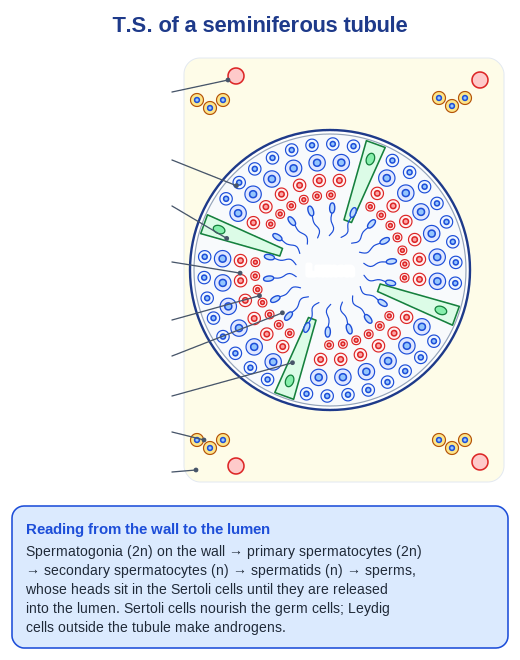
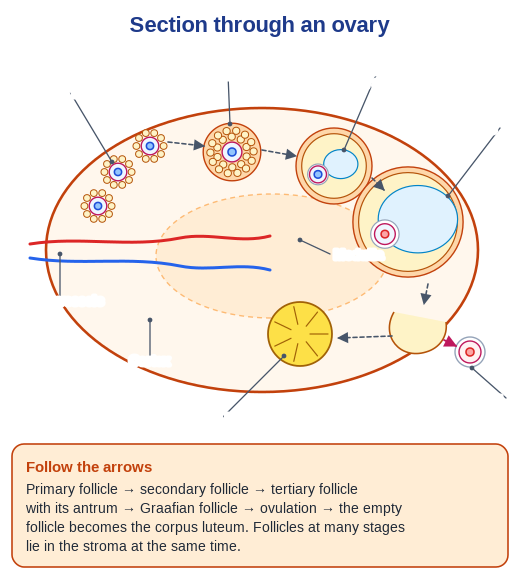
The primary sex organs make the gametes: the testes make sperms and the ovaries make the ovum. Inside a testis, about 250 lobules hold coiled seminiferous tubules. Their lining has spermatogonia, the immature male germ cells, and Sertoli cells, which feed them. Leydig cells sit outside the tubules and make androgens. In an ovary, the egg cells develop inside follicles in the stroma.
How does spermatogenesis work?
Spermatogenesis begins at puberty and continues even in old age. It runs from the wall of the tubule towards its lumen:
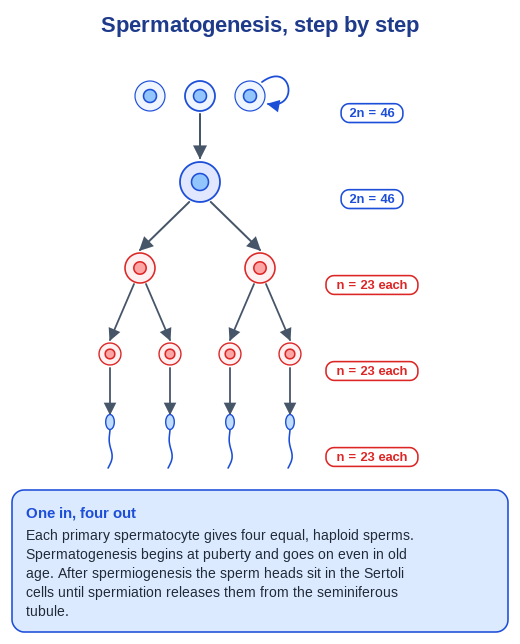
- Spermatogonia (2n = 46) on the inner wall multiply by mitosis.
- Some become primary spermatocytes (2n = 46), which from time to time enter meiosis.
- Meiosis I, the reduction division, gives two equal secondary spermatocytes with 23 chromosomes each.
- Meiosis II gives four equal, haploid spermatids.
- In spermiogenesis, each spermatid changes shape into a sperm (spermatozoon).
- Sperm heads stay embedded in Sertoli cells until spermiation releases the sperms into the tubule.
So one primary spermatocyte gives four sperms.
Which hormones control it?
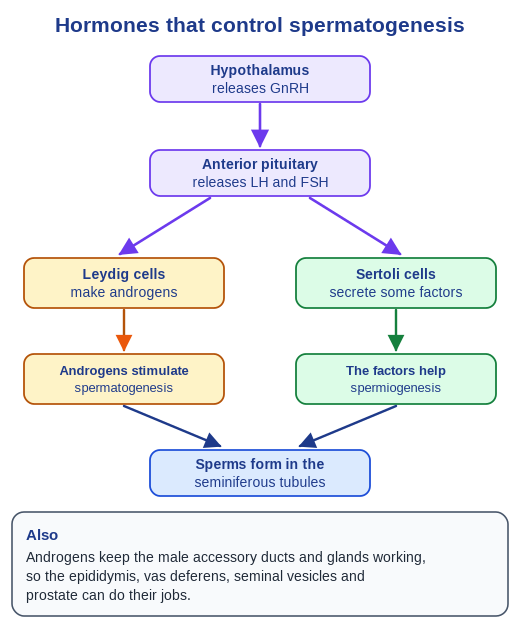
At puberty the hypothalamus greatly increases its secretion of GnRH (gonadotropin releasing hormone). GnRH acts on the anterior pituitary, which then releases two gonadotropins:
- LH (luteinising hormone) acts on the Leydig cells, which make and secrete androgens. Androgens stimulate spermatogenesis.
- FSH (follicle stimulating hormone) acts on the Sertoli cells, which secrete factors that help spermiogenesis.
Androgens also keep the accessory ducts and glands working.
What does a sperm look like?
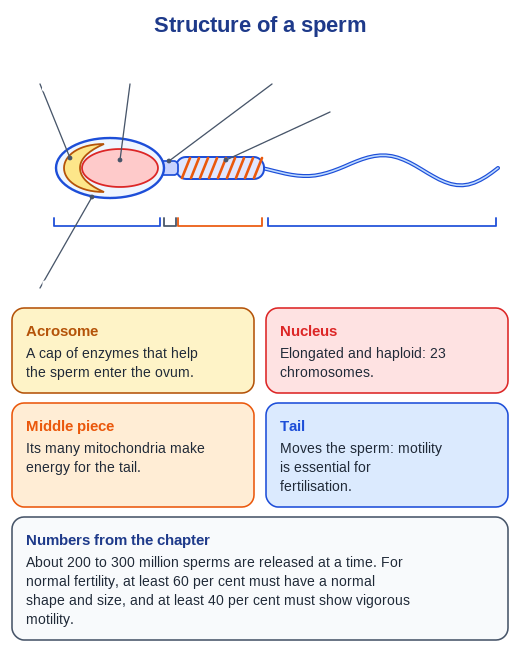
A sperm is microscopic, with four parts, all wrapped in a plasma membrane. The head holds an elongated haploid nucleus, and its front end carries a cap, the acrosome, filled with enzymes that help in fertilising the ovum. A short neck joins it to the middle piece, full of mitochondria that supply energy. The tail moves the sperm, and this motility is essential for fertilisation. About 200 to 300 million sperms are released at a time. For normal fertility, 60 per cent or more should be normal in shape and size, and 40 per cent or more should swim vigorously.
How does oogenesis work?
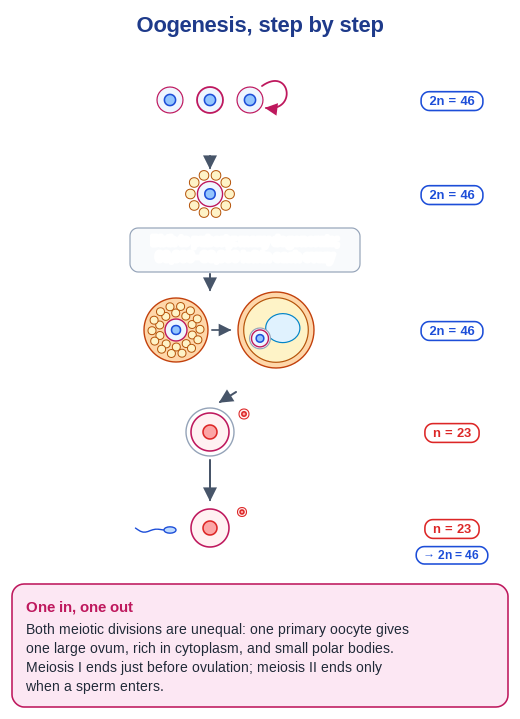
Oogenesis is very different. It starts before birth, in the fetal ovary:
- A couple of million oogonia form in each fetal ovary; no more are added after birth.
- They enter meiosis and stop in prophase I. These are primary oocytes.
- Each primary oocyte gets a layer of granulosa cells: a primary follicle. Many degenerate before puberty, leaving 60,000–80,000 in each ovary.
- After puberty, follicles grow. More granulosa layers and a new theca make a secondary follicle. A fluid-filled cavity, the antrum, marks a tertiary follicle, whose theca splits into theca interna and theca externa.
- In the tertiary follicle, the primary oocyte grows and finishes meiosis I. The division is unequal: a big haploid secondary oocyte and a very small first polar body.
- The follicle becomes a mature Graafian follicle, and the secondary oocyte forms a new membrane, the zona pellucida.
- The Graafian follicle bursts and releases the secondary oocyte: ovulation.
Meiosis II finishes only when a sperm enters. It is also unequal, giving the haploid ovum and a second polar body. So one primary oocyte gives just one ovum.
Spermatogenesis and oogenesis side by side
| Point | Spermatogenesis | Oogenesis |
|---|---|---|
| Starts | At puberty | Before birth |
| Goes on | Even in old age | Stops around 50 years |
| Divisions | Equal | Unequal (polar bodies) |
| Gametes per cell | Four sperms | One ovum |
Next topic: the menstrual cycle. See also the chapter notes and the NCERT solutions.
Practice
-
Which cells of the testis respond to FSH?
Show answer
Answer: (b) Sertoli cells
-
The first meiotic division of a primary oocyte is completed in the:
Show answer
Answer: (c) tertiary follicle
-
The part of a sperm that holds many mitochondria is the:
Show answer
Answer: (c) middle piece
-
How many sperms form from 10 primary spermatocytes, and how many ova from 10 primary oocytes?
Show answer
Answer: 40 sperms (4 from each primary spermatocyte) but only 10 ova (1 from each primary oocyte), because the divisions of oogenesis are unequal and the small polar bodies do not become eggs.
-
Why must the testes hang outside the abdominal cavity?
Show answer
Answer: Spermatogenesis needs the testes to be 2–2.5 °C cooler than the inside of the body, and the scrotum, outside the abdomen, keeps them that cool.
Questions students ask
What is the difference between spermatogenesis and spermiogenesis?
Spermatogenesis is the whole process of making sperms from spermatogonia, including two meiotic divisions. Spermiogenesis is only its last step, in which a round spermatid changes into a sperm with a head, middle piece and tail.
Which hormones control spermatogenesis?
GnRH from the hypothalamus makes the anterior pituitary release LH and FSH. LH acts on Leydig cells, which make androgens that stimulate spermatogenesis; FSH acts on Sertoli cells, which secrete factors that help spermiogenesis.
How many chromosomes does a human sperm have?
23, because it is haploid. The spermatogonium and the primary spermatocyte have 46; meiosis halves the number to 23 in the secondary spermatocytes, spermatids and sperms.
Why does a secondary oocyte keep most of the cytoplasm?
Its first division is unequal, so the large secondary oocyte keeps the nutrient-rich cytoplasm and the tiny first polar body gets very little. The stored food supports the zygote in its first divisions.
Stuck on a question?
Take a photo and Lagnever AI explains it step by step. Try it for 7 days for ₹2.
Get it on Google Play Open in browser
For parents: after the trial, the plan renews monthly by UPI or card autopay. You can cancel anytime in the app.