
NCERT Solutions Class 12 Biology Chapter 4: Principles of Inheritance and Variation
Answers to all 16 end-of-chapter exercises of Chapter 4, Principles of Inheritance and Variation, of Biology, the Class 12 NCERT textbook. Page numbers follow the 2026-27 reprint (pages 53–78). The exercises are quoted from the book as printed; the answers are our own, built from the chapter. Every Punnett square and ratio here was worked out by a script and then drawn. The questions that the chapter text asks along the way are answered in short at the end. The book prints no answer key for this chapter. Short notes: Chapter 4 notes.
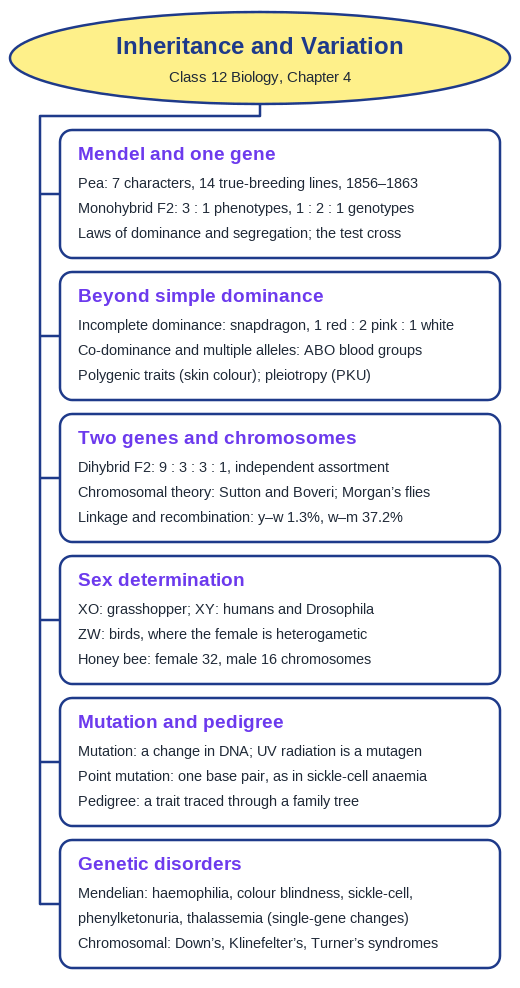
Exercises 1 to 5: Mendel’s work and one gene
1. “Mention the advantages of selecting pea plant for experiment by Mendel.”
From the chapter:
- The pea has many characters that show two clearly contrasting traits, such as tall or dwarf plants and yellow or green seeds. Mendel studied seven such characters.
- True-breeding lines were available: lines that show a stable trait for several generations on continuous self-pollination. Mendel chose 14 of them.
- Artificial cross-pollination is possible, so controlled crosses could be made between chosen parents.
- His experiments could use a large sample size, which made the data more credible.
Extra (not stated in this chapter): the pea is an annual with a short life cycle, its flowers are bisexual and normally self-pollinating, and it is easy to grow.
2. “Differentiate between the following – (a) Dominance and Recessive (b) Homozygous and Heterozygous (c) Monohybrid and Dihybrid.”
| First term | Second term | |
|---|---|---|
| (a) | Dominance: in a dissimilar pair of factors, the one that expresses itself and is seen in the F1, e.g. T (tall). It shows in both TT and Tt. | Recessive: the factor that is not expressed in the presence of the dominant one, e.g. t (dwarf). It shows only in tt. |
| (b) | Homozygous: the two alleles of a gene are identical (TT or tt). Forms one kind of gamete; breeds true. | Heterozygous: the two alleles are different (Tt). Forms two kinds of gametes in equal numbers. |
| (c) | Monohybrid: heterozygous for one character (Tt); a monohybrid cross follows one character. F2 ratio 3 : 1. | Dihybrid: heterozygous for two characters (RrYy); a dihybrid cross follows two characters. F2 ratio 9 : 3 : 3 : 1. |
3. “A diploid organism is heterozygous for 4 loci, how many types of gametes can be produced?”
Each heterozygous locus can give either of two alleles to a gamete. With independent assortment, the number of types of gametes = 2ⁿ, where n is the number of heterozygous loci.
For n = 4: 2⁴ = 2 × 2 × 2 × 2 = 16 types of gametes.
(For example, AaBbCcDd gives ABCD, ABCd, ABcD … abcd. If some of the loci are linked, fewer types are common.)
4. “Explain the Law of Dominance using a monohybrid cross.”
The law of dominance states that (i) characters are controlled by discrete units called factors, (ii) factors occur in pairs, and (iii) in a dissimilar pair of factors one member (dominant) dominates the other (recessive).
Take Mendel’s cross between a true-breeding tall pea plant (TT) and a dwarf plant (tt).
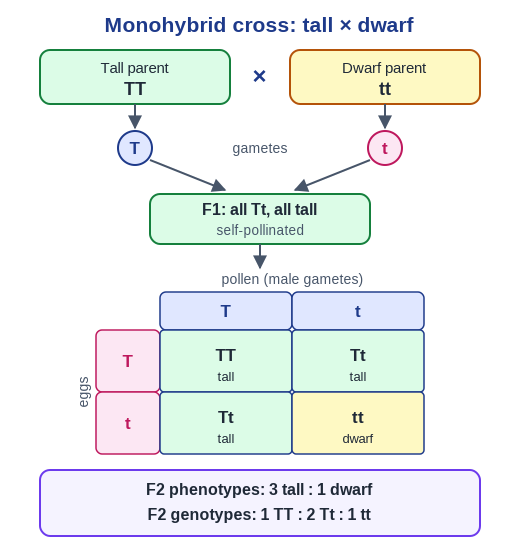
- The tall parent forms only T gametes and the dwarf parent only t gametes. Every F1 plant is Tt.
- Although each F1 plant carries t, all of them are tall. T has dominated t. So T is the dominant factor and t the recessive one.
- On selfing the F1, the F2 has 1 TT : 2 Tt : 1 tt. TT and Tt are both tall, so the phenotypes are 3 tall : 1 dwarf.
- The dwarf trait reappears only in tt plants, where no dominant factor is present.
So the law explains why only one parental trait is seen in the F1, why both are seen in the F2, and why the F2 ratio is 3 : 1.
5. “Define and design a test-cross.”
Definition: a test cross is a cross between an organism showing the dominant phenotype, whose genotype is to be found, and the homozygous recessive parent, instead of self-crossing.
Design: in pea, violet flower colour (W) is dominant over white (w). A violet-flowered plant may be WW or Ww. Cross it with a white-flowered plant (ww). (The book’s figure uses the letters V and v for the same gene; any letter works.)
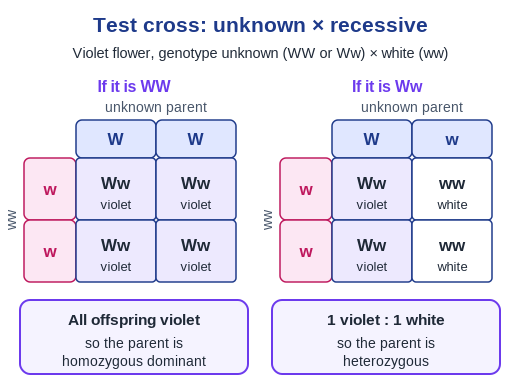
- If all the offspring have violet flowers, the plant is homozygous dominant (WW).
- If half have violet and half have white flowers (1 : 1), the plant is heterozygous (Ww).
Exercises 6 to 8: working out crosses
6. “Using a Punnett Square, workout the distribution of phenotypic features in the first filial generation after a cross between a homozygous female and a heterozygous male for a single locus.”
Take the gene for height in pea, T (tall) and t (dwarf). The male is Tt and forms T and t gametes. The homozygous female can be of two kinds, so there are two cases.
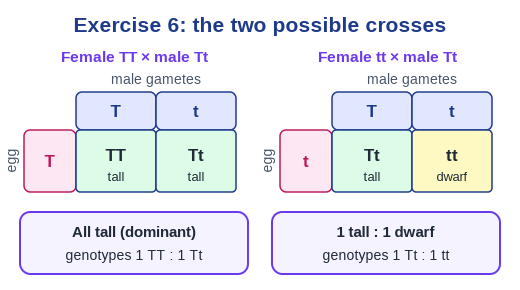
- Female homozygous dominant (TT) × male Tt: the F1 is 1 TT : 1 Tt. All the offspring show the dominant phenotype (all tall).
- Female homozygous recessive (tt) × male Tt: the F1 is 1 Tt : 1 tt. Half the offspring show the dominant phenotype and half the recessive one (1 tall : 1 dwarf). This is the same as a test cross.
7. “When a cross in made between tall plant with yellow seeds (TtYy) and tall plant with green seed (Ttyy), what proportions of phenotype in the offspring could be expected to be (a) tall and green. (b) dwarf and green.”
TtYy forms four kinds of gametes: TY, Ty, tY and ty. Ttyy forms two kinds: Ty and ty.
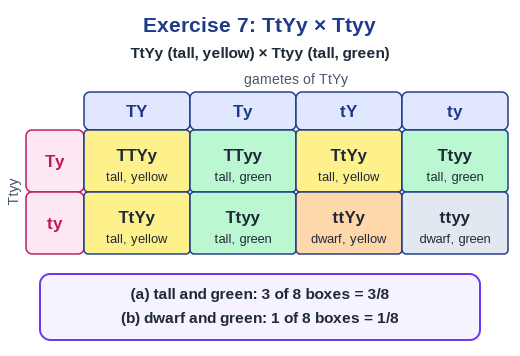
Counting the eight boxes: 3 tall yellow, 3 tall green, 1 dwarf yellow, 1 dwarf green.
- (a) Tall and green: 3/8 (37.5 per cent).
- (b) Dwarf and green: 1/8 (12.5 per cent).
Check by multiplying the two characters: Tt × Tt gives 3/4 tall and 1/4 dwarf; Yy × yy gives 1/2 yellow and 1/2 green. Tall and green = 3/4 × 1/2 = 3/8. Dwarf and green = 1/4 × 1/2 = 1/8.
8. “Two heterozygous parents are crossed. If the two loci are linked what would be the distribution of phenotypic features in F1 generation for a dibybrid cross?”
If the two loci were on different chromosomes, the cross AaBb × AaBb would give 9 : 3 : 3 : 1. Linked loci lie on the same chromosome and do not assort independently, so the ratio is different:
- The parental combinations of traits appear in much higher proportion than the recombinant (non-parental) combinations.
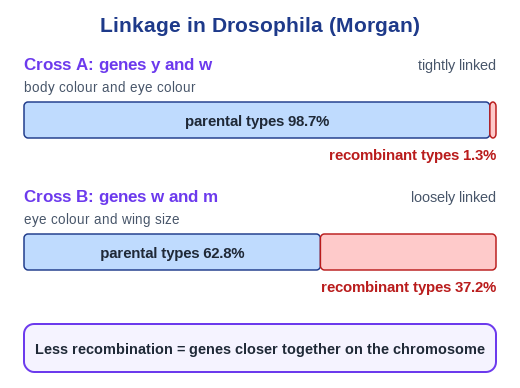
- How far the ratio departs from 9 : 3 : 3 : 1 depends on the strength of the linkage. Tightly linked genes give very few recombinants (Morgan found 1.3 per cent for the genes y and w); loosely linked genes give more (37.2 per cent for w and m).
- With complete linkage, when each parent carries A and B on one chromosome and a and b on the other, only two kinds of gametes form (AB and ab). The offspring then show only the two parental phenotypes, in the ratio 3 (both dominant traits) : 1 (both recessive traits).
The question does not say how strong the linkage is, so no single ratio can be given. The 3 : 1 figure is our own working for the limiting case of complete linkage; it is not printed in the chapter.
Exercises 9 to 12: Morgan, pedigree, sex and blood groups
9. “Briefly mention the contribution of T.H. Morgan in genetics.”
- Thomas Hunt Morgan and his colleagues gave the experimental verification of the chromosomal theory of inheritance.
- He chose the fruit fly, Drosophila melanogaster, which suits such work: it grows on a simple synthetic medium, completes its life cycle in about two weeks, gives many progeny from one mating, has easily distinguished sexes, and shows many hereditary variations.
- From dihybrid crosses with sex-linked genes he showed that genes on the same chromosome do not segregate independently.
- He coined the term linkage for the physical association of genes on a chromosome and recombination for the formation of non-parental gene combinations.
- He showed that linkage differs in strength: white and yellow showed only 1.3 per cent recombination, white and miniature 37.2 per cent.
- His student Alfred Sturtevant used recombination frequencies to map genes on the chromosome.
10. “What is pedigree analysis? Suggest how such an analysis, can be useful.”
Pedigree analysis is the study of a trait over several generations of a family. The inheritance of the trait is shown as a family tree, using standard symbols.
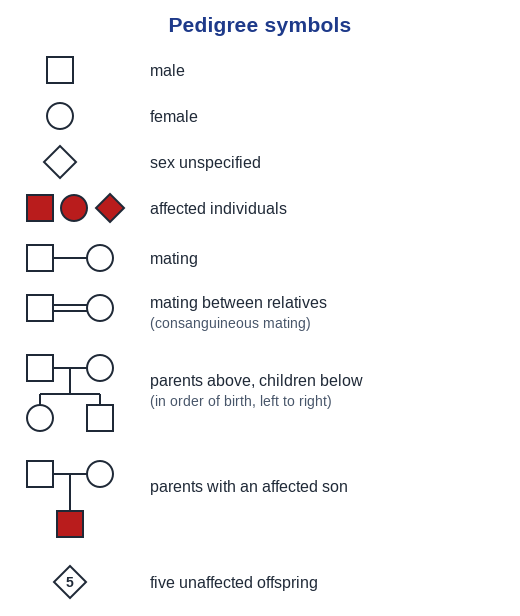
It is useful because:
- controlled crosses cannot be made in humans, so the family history is the alternative way to study inheritance;
- it traces the inheritance of a specific trait, abnormality or disease in a family;
- it shows whether a trait is dominant or recessive, and whether it is linked to an autosome or a sex chromosome;
- it helps to find carriers and to judge the chance that a disorder such as haemophilia, sickle-cell anaemia or thalassemia will appear in the children, which is the basis of genetic counselling (the last point is a common application; the chapter does not use the term).
11. “How is sex determined in human beings?”
Humans have the XY type of sex determination.
- Of the 23 pairs of chromosomes, 22 pairs are autosomes, the same in males and females. The 23rd pair is the sex chromosomes: XX in females and XY in males.
- Females form only one kind of ovum, each with an X-chromosome.
- Males form two kinds of sperm: 50 per cent carry an X-chromosome and 50 per cent carry a Y-chromosome.
- An ovum fertilised by an X-carrying sperm becomes a female (XX). An ovum fertilised by a Y-carrying sperm becomes a male (XY).
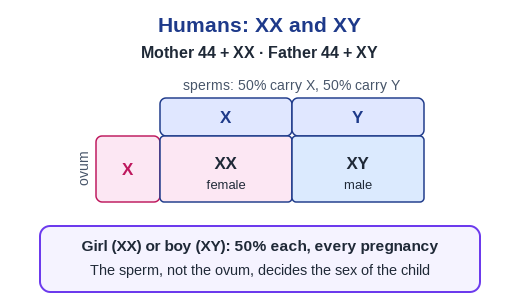
So the genetic make-up of the sperm determines the sex of the child, and in each pregnancy there is a 50 per cent probability of either a male or a female child. Blaming the mother for the sex of a child has no scientific basis.
12. “A child has blood group O. If the father has blood group A and mother blood group B, work out the genotypes of the parents and the possible genotypes of the other offsprings.”
- Blood group O has only one genotype, ii. The child received one i from each parent.
- So the father (group A) must be IAi and the mother (group B) must be IBi. Both are heterozygous.
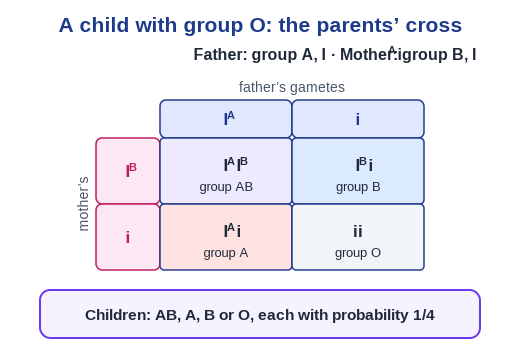
Possible genotypes of the other offspring:
| Genotype | Blood group | Chance |
|---|---|---|
| IAIB | AB | 1/4 |
| IAi | A | 1/4 |
| IBi | B | 1/4 |
| ii | O | 1/4 |
Exercises 13 to 16: dominance, mutation and disorders
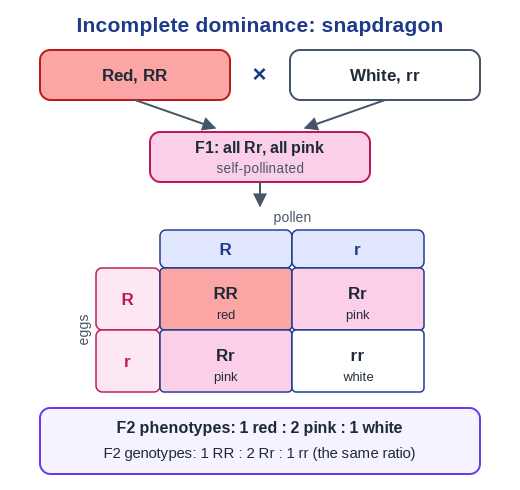
13. “Explain the following terms with example (a) Co-dominance (b) Incomplete dominance”
(a) Co-dominance: both alleles of a gene express themselves fully in the heterozygote, so the F1 resembles both parents. Example: the ABO blood groups in humans. The alleles IA and IB each produce their own type of sugar on the red blood cell. A person of genotype IAIB has both sugars and belongs to blood group AB.
(b) Incomplete dominance: neither allele is completely dominant, so the F1 has a phenotype in between those of the two parents. Example: flower colour in the dog flower (snapdragon, Antirrhinum sp.). Red (RR) × white (rr) gives a pink F1 (Rr). On selfing, the F2 is 1 red (RR) : 2 pink (Rr) : 1 white (rr).
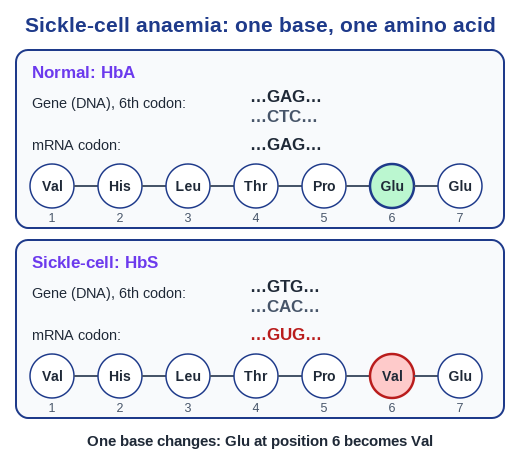
14. “What is point mutation? Give one example.”
A point mutation is a mutation that arises from a change in a single base pair of DNA.
Example: sickle-cell anaemia. In the sixth codon of the beta globin gene one base is substituted, so the codon changes from GAG to GUG. As a result valine (Val) replaces glutamic acid (Glu) at the sixth position of the beta globin chain of haemoglobin.
15. “Who had proposed the chromosomal theory of the inheritance?”
Walter Sutton and Theodore Boveri. They saw that chromosomes behave just as genes do, and explained Mendel’s laws by the way chromosomes move. Sutton joined chromosome segregation with Mendel’s principles and named the result the chromosomal theory of inheritance. Thomas Hunt Morgan and his colleagues later verified it by experiment.
16. “Mention any two autosomal genetic disorders with their symptoms.”
Any two of these:
- Sickle-cell anaemia (autosomal recessive): seen in individuals homozygous for HbS. The changed haemoglobin polymerises under low oxygen tension, and the red blood cells change from biconcave discs to long, sickle-like cells. The result is anaemia.
- Phenylketonuria (autosomal recessive): the enzyme that converts phenylalanine to tyrosine is lacking. Phenylalanine builds up and is converted to phenylpyruvic acid and other derivatives, which collect in the brain and affect mental development (the book’s term is mental retardation). These substances are also passed out in the urine, because the kidney absorbs them poorly. Extra (not in this chapter): hair and skin pigmentation is often reduced.
- Thalassemia (autosomal recessive): one of the globin chains of haemoglobin is made at a reduced rate, so abnormal haemoglobin molecules form. The characteristic symptom is anaemia.
- Down’s syndrome (an autosomal chromosomal disorder, trisomy 21): short stature, small round head, furrowed tongue, partially open mouth, broad palm with a characteristic palm crease, and slower physical, psychomotor and mental development.
Questions asked inside the chapter
These are not quoted; each is restated briefly with its page.
Page 56: the phenotype of a Tt plant. It is tall, exactly like the TT parent, because T is dominant over t.
Page 58: selfing a tall F2 plant. It depends on the plant. Of the tall F2 plants, 1/3 are TT and 2/3 are Tt. A TT plant gives only tall offspring. A Tt plant gives 3 tall : 1 dwarf, like the F1.
Page 58: the ratio in a test cross, and a general definition. With a heterozygous plant (Tt × tt) the Punnett square gives 1 Tt : 1 tt, that is, 1 tall : 1 dwarf. With a homozygous plant (TT × tt) all the offspring are Tt and tall. Definition: a cross between an individual with the dominant phenotype but unknown genotype and a homozygous recessive individual.
Page 61: the number of ABO phenotypes. Four: A, B, AB and O, from six genotypes.
Page 62: the dominant traits in the dihybrid cross. Yellow seed colour and round seed shape, since all the F1 seeds were yellow and round.
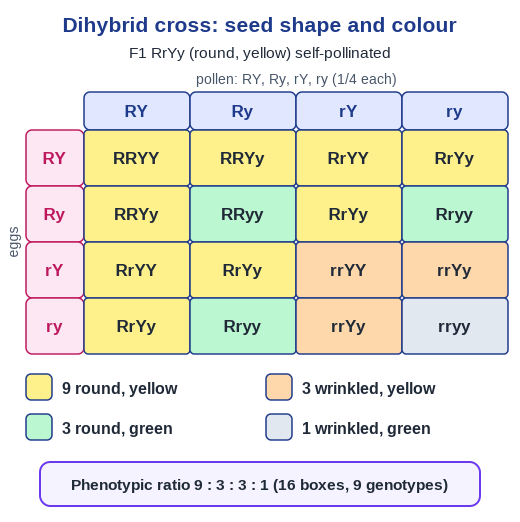
Page 64: genotypes and phenotypes in the 16 squares. There are 9 genotypes and 4 phenotypes.
| S.No. | Genotype in F2 | Boxes | Expected phenotype |
|---|---|---|---|
| 1 | RRYY | 1 | Round, yellow |
| 2 | RRYy | 2 | Round, yellow |
| 3 | RrYY | 2 | Round, yellow |
| 4 | RrYy | 4 | Round, yellow |
| 5 | RRyy | 1 | Round, green |
| 6 | Rryy | 2 | Round, green |
| 7 | rrYY | 1 | Wrinkled, yellow |
| 8 | rrYy | 2 | Wrinkled, yellow |
| 9 | rryy | 1 | Wrinkled, green |
The genotypic ratio is 1 : 2 : 2 : 4 : 1 : 2 : 1 : 2 : 1 in this order. It is not 9 : 3 : 3 : 1; that is the phenotypic ratio.
Page 66: which column of Table 4.3 is the chromosome and which is the gene. The two columns say the same three things in slightly different words: both occur in pairs, both segregate so that a gamete gets one of each pair, and one pair segregates independently of another. That is the point of the table: by behaviour alone they cannot be told apart, which is why Sutton and Boveri concluded that genes are carried on chromosomes. Column A is usually read as the chromosomes and column B as the genes (ask your teacher which reading your school follows).
Page 70: chromosome number in the XO type. The numbers are not equal. The male has only one X-chromosome while the female has two, so the male has one chromosome fewer than the female.
Page 71: sex determination in birds. Birds have the ZW type: the female is ZW and the male is ZZ. The female forms two kinds of eggs (Z or W) while all sperms carry Z. So in birds the egg, not the sperm, decides the sex of the chick. In humans it is the other way round.
Practice
-
A plant of genotype AaBbCc can form how many types of gametes?
Show answer
Answer: (c) 8
-
A man of blood group AB marries a woman of blood group O. Their children can have blood group:
Show answer
Answer: (a) A or B
-
In the cross Tt × tt, the fraction of dwarf offspring is:
Show answer
Answer: (b) 1/2
-
In the F2 of a dihybrid cross, how many of the 16 boxes are RrYy?
Show answer
Answer: Four. The genotypes are in the ratio 1 RRYY : 2 RRYy : 1 RRyy : 2 RrYY : 4 RrYy : 2 Rryy : 1 rrYY : 2 rrYy : 1 rryy.
-
A colour-blind man marries a woman with normal vision who is not a carrier. What will their children be like?
Show answer
Answer: All sons get their X from the mother, so they have normal vision. All daughters get the father's X with the colour blindness allele and a normal X from the mother, so they are carriers with normal vision.
Stuck on a question?
Take a photo and Lagnever AI explains it step by step. Try it for 7 days for ₹2.
Get it on Google Play Open in browser
For parents: after the trial, the plan renews monthly by UPI or card autopay. You can cancel anytime in the app.