
Class 12 Biology Chapter 4: Principles of Inheritance and Variation Notes
This chapter in five lines
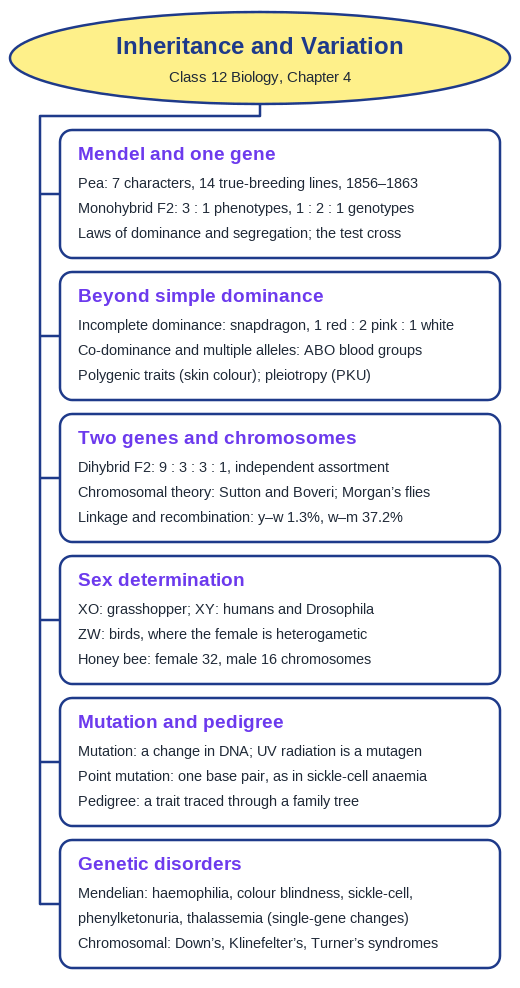
Genetics is the study of inheritance, the passing of characters from parents to offspring, and of variation, the degree to which offspring differ from their parents. Mendel's work on the garden pea gave the laws of dominance, segregation and independent assortment. The chapter then covers chromosomes and linkage, sex determination, mutation, pedigree analysis and genetic disorders.
What is this chapter about?
Children resemble their parents, yet no two siblings are exactly alike. Genetics is the branch of biology that studies both facts. Inheritance is the passing of characters from parents to their progeny, and heredity rests on it. Variation is how much the progeny differ from their parents.
People used variation long before they understood it. By selecting and breeding wild plants and animals with useful characters they produced domesticated breeds, such as the Sahiwal cows of Punjab. The scientific explanation began only in the mid-nineteenth century, with Gregor Mendel.
This is a long chapter. It moves from Mendel’s crosses to chromosomes, then to sex determination, mutation and genetic disorders. Three topic pages go deeper: Mendel’s laws of inheritance, independent assortment and linkage and sex determination and genetic disorders.
How did Mendel study inheritance?
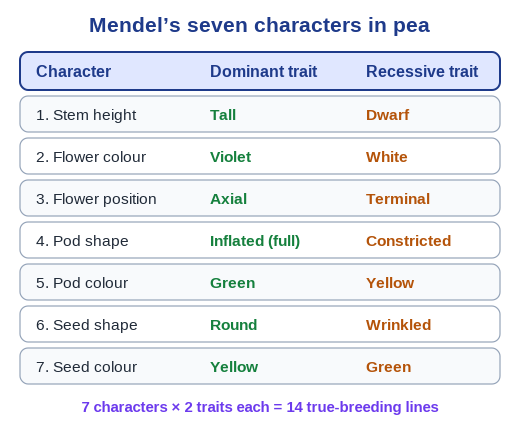
Mendel did hybridisation experiments on garden peas for seven years (1856–1863). Three things made his work reliable: he used statistics and mathematical logic, he had a large sample size, and he confirmed his conclusions on successive generations.
He chose characters that show two clearly opposite traits. He used 14 true-breeding lines, that is, lines which show a stable trait for several generations after continuous self-pollination. They made seven pairs, one for each character.
What happens when one gene is followed?
Mendel crossed tall and dwarf plants. All plants of the first filial generation (F1) were tall. When he self-pollinated the F1, the dwarf trait came back in the F2: 3/4 of the plants were tall and 1/4 were dwarf. No plant was of in-between height, so the traits had not blended.
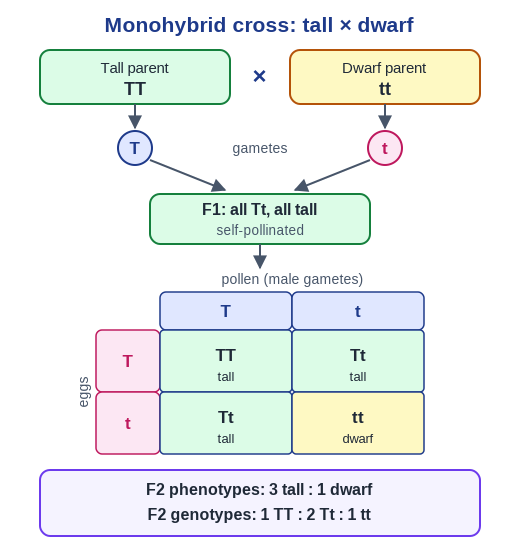
Mendel explained this with factors, which we now call genes. The forms of a gene that code for contrasting traits are alleles (T and t). TT and tt plants are homozygous; Tt plants are heterozygous. TT, Tt and tt are genotypes; tall and dwarf are phenotypes. The Punnett square, developed by the British geneticist Reginald C. Punnett, shows all the possible offspring of a cross.
From such monohybrid crosses come two laws:
- Law of dominance: characters are controlled by discrete units called factors; factors occur in pairs; in a dissimilar pair one factor (dominant) dominates the other (recessive).
- Law of segregation: the two alleles of a pair do not blend. They separate during gamete formation, so each gamete receives only one of them.
A test cross finds out whether a plant with the dominant phenotype is homozygous or heterozygous: it is crossed with the recessive parent. The details are in Mendel’s laws of inheritance.
Is one allele always dominant?
No. Later work showed three other patterns.
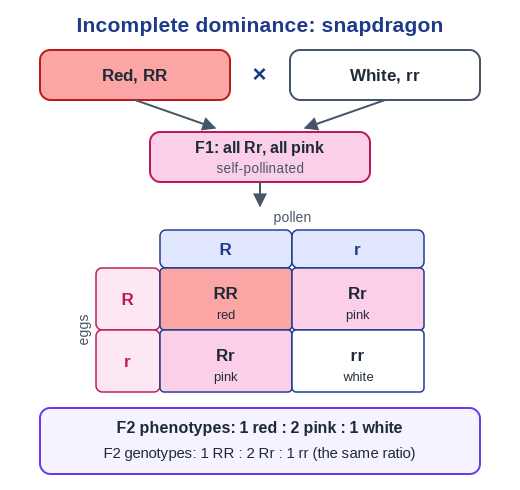
Incomplete dominance. In the dog flower (snapdragon, Antirrhinum sp.), red (RR) × white (rr) gives a pink F1 (Rr). The F2 is 1 red : 2 pink : 1 white. The genotype ratio is the usual 1 : 2 : 1, but now the phenotype ratio is the same, because Rr can be told apart from RR.
Co-dominance. The F1 resembles both parents. The ABO blood groups are controlled by the gene I, which decides the kind of sugar on the surface of red blood cells. It has three alleles: IA and IB make slightly different sugars, and i makes none. IA and IB are both dominant over i, but together they are co-dominant: both sugars are made, and the blood group is AB.
Multiple alleles. The same gene shows that a population can have more than two alleles of a gene, although one person carries only two.
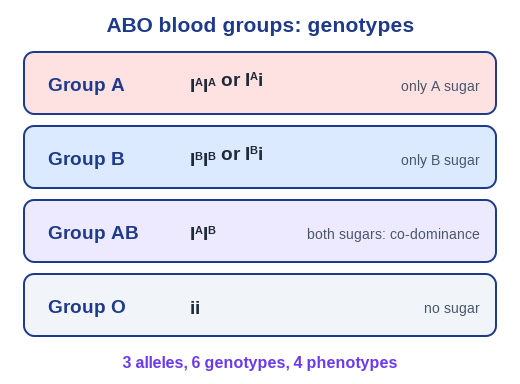
Why are some alleles dominant? A gene carries the information for a product, often an enzyme. A changed allele may make the normal enzyme, a non-functional enzyme or no enzyme at all. If the unchanged allele alone can produce the usual phenotype, it behaves as the dominant allele and the changed one as the recessive allele.
Dominance also depends on which phenotype we look at. In pea, the gene for starch synthesis has alleles B and b. BB seeds are round with large starch grains; bb seeds are wrinkled with small ones. Bb seeds are round, so B looks dominant for seed shape, but their starch grains are of intermediate size, which is incomplete dominance for grain size.
What happens when two genes are followed?
Mendel crossed round, yellow-seeded plants (RRYY) with wrinkled, green-seeded plants (rryy). The F1 (RrYy) was round and yellow. In the F2 four phenotypes appeared in the ratio 9 : 3 : 3 : 1.
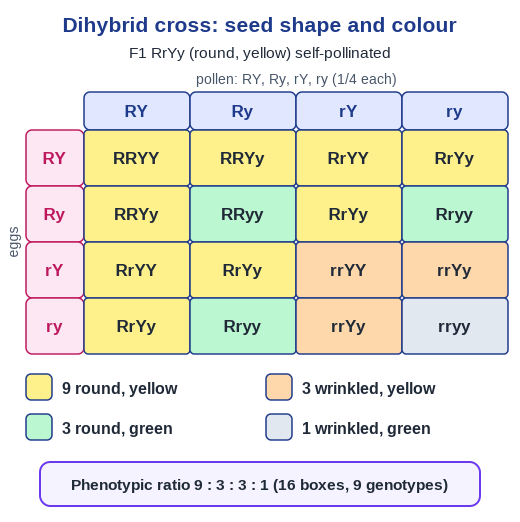
This gave the law of independent assortment: when two pairs of traits are combined in a hybrid, one pair of characters segregates independently of the other pair.
How do chromosomes explain Mendel’s laws?
Mendel published in 1865, but his work stayed unrecognised until 1900, when de Vries, Correns and von Tschermak each arrived at the same results on their own. By 1902 the movement of chromosomes in meiosis was known. Walter Sutton and Theodore Boveri saw that chromosomes behave just like Mendel’s factors: they occur in pairs, the pairs separate at gamete formation, and different pairs separate independently. Sutton joined the two ideas as the chromosomal theory of inheritance.
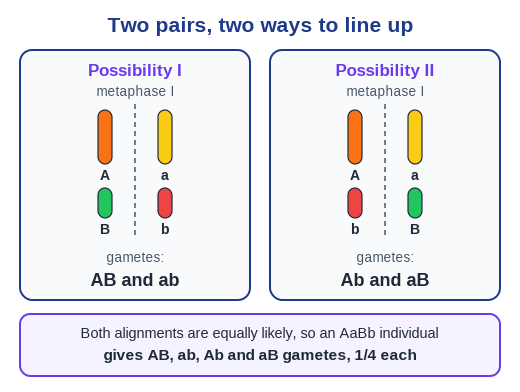
Thomas Hunt Morgan tested the theory on the fruit fly Drosophila melanogaster. He found that genes on the same chromosome do not assort independently. He called their physical association linkage, and the formation of non-parental combinations recombination.
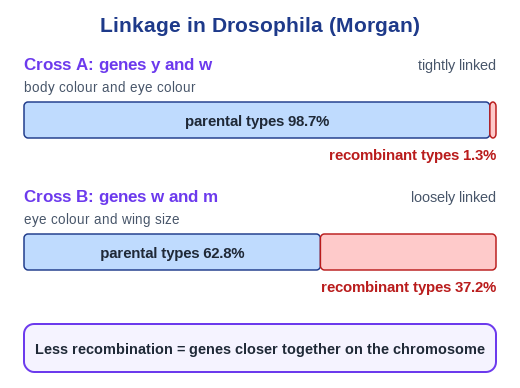
Both ideas are worked out in independent assortment and linkage.
What are polygenic inheritance and pleiotropy?
Polygenic inheritance. Mendel’s traits had two distinct forms. Many traits, such as human height and skin colour, instead show a whole range. They are generally controlled by three or more genes and are also influenced by the environment. The effect of each allele is additive.
Suppose three genes A, B and C control skin colour, with the dominant forms adding darkness. AABBCC is the darkest, aabbcc the lightest, and a genotype with three dominant and three recessive alleles is intermediate.
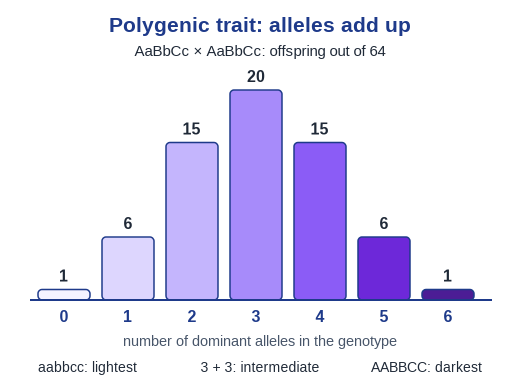
Extra: the chart is our own working of the book’s three-gene model. Crossing two AaBbCc parents gives 64 combinations, and counting the dominant alleles in each gives 1 : 6 : 15 : 20 : 15 : 6 : 1. Most offspring fall in the middle, which is why such traits show a smooth range.
Pleiotropy. Here a single gene has more than one phenotypic effect, usually because it acts on a metabolic pathway that feeds several traits. The example is phenylketonuria: a mutation in the single gene for the enzyme phenylalanine hydroxylase affects both mental development and the pigmentation of hair and skin.
How is sex determined?
Henking (1891) noticed a nuclear structure that reached only half the sperms of some insects and called it the X body; it was later found to be a chromosome. Chromosomes involved in sex determination are sex chromosomes; the rest are autosomes.
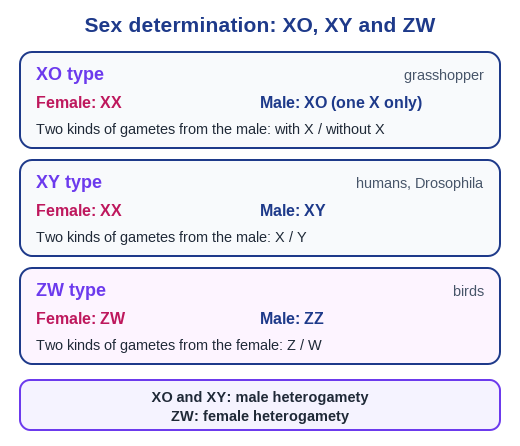
In humans, 22 of the 23 pairs of chromosomes are autosomes. Females have XX and males XY. All ova carry an X; half the sperms carry X and half carry Y. So the sperm decides the sex of the child, and in each pregnancy the chance of a girl or a boy is 50 per cent. The book stresses that blaming women for the birth of girls is a false notion with no basis in biology.
In the honey bee, fertilised eggs become females (32 chromosomes) and unfertilised eggs become males (16 chromosomes).
What are mutation and pedigree analysis?
Mutation is a change in the DNA sequence that changes the genotype and phenotype. Loss (deletion) or gain (insertion or duplication) of a DNA segment alters chromosomes; such chromosomal aberrations are commonly seen in cancer cells. A change in a single base pair is a point mutation, as in sickle-cell anaemia. Deletions and insertions of base pairs cause frame-shift mutations (Chapter 5). Agents that cause mutations are mutagens; UV radiation is one.
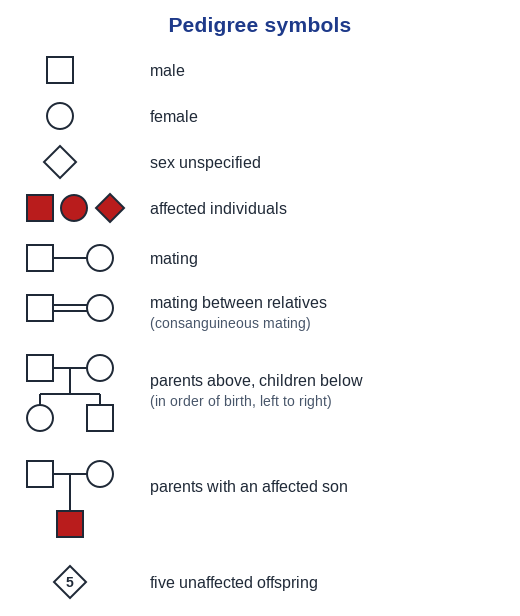
Controlled crosses are not possible in humans, so geneticists study the family history of a trait. This is pedigree analysis.
What are genetic disorders?
Genetic disorders fall into two groups.
| Mendelian disorders | Chromosomal disorders | |
|---|---|---|
| Cause | Change (mutation) in a single gene | Absence, excess or abnormal arrangement of one or more chromosomes |
| Inheritance | Follow Mendel’s principles; traced by pedigree | Usually seen in the karyotype |
| Examples | Haemophilia, colour blindness, sickle-cell anaemia, phenylketonuria, thalassemia, cystic fibrosis | Down’s syndrome, Klinefelter’s syndrome, Turner’s syndrome |
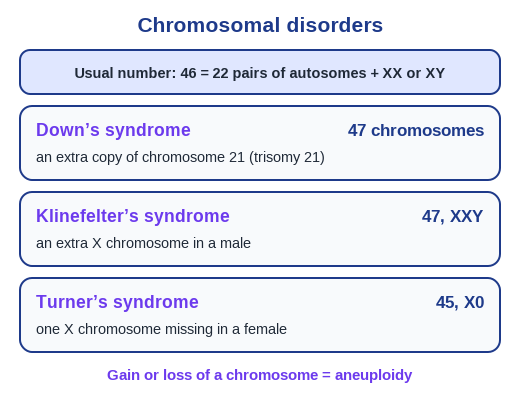
These are medical conditions that people are born with; they are nobody’s fault. Each is described in sex determination and genetic disorders.
Before we move on
Practise this chapter with a pencil: draw every Punnett square yourself and count the boxes. Learn the scientists with their years, the three types of sex determination, and one cause and one feature of each disorder. All 16 exercises are worked out in the NCERT solutions for Chapter 4.
Key terms
| Term | Meaning |
|---|---|
| Gene and allele | A gene is a unit of inheritance (Mendel's 'factor'). Alleles are slightly different forms of the same gene that code for a pair of contrasting traits, such as T and t. |
| Genotype and phenotype | The genotype is the genetic make-up, such as TT, Tt or tt. The phenotype is the trait that is seen, such as tall or dwarf. |
| Homozygous and heterozygous | Homozygous: both alleles of a gene are the same (TT, tt). Heterozygous: the two alleles differ (Tt). |
| Monohybrid cross | A cross that follows one character, such as TT × tt. Its F2 phenotypic ratio is 3 : 1 and its genotypic ratio is 1 : 2 : 1. |
| Test cross | A cross of an organism showing the dominant phenotype, whose genotype is unknown, with the homozygous recessive parent. |
| Incomplete dominance | The F1 is in between the two parents, as in the pink (Rr) flowers of snapdragon. The F2 ratio is 1 red : 2 pink : 1 white. |
| Co-dominance | Both alleles express themselves fully in the heterozygote, as Iᴬ and Iᴮ do in blood group AB. |
| Multiple alleles | More than two alleles of one gene in a population, such as Iᴬ, Iᴮ and i of the ABO blood group gene. One person has only two of them. |
| Linkage and recombination | Linkage is the physical association of genes on one chromosome. Recombination is the formation of non-parental gene combinations. |
| Polygenic inheritance | A trait controlled by three or more genes whose effects add up, such as human skin colour and height. The environment also has an influence. |
| Pleiotropy | A single gene showing more than one phenotypic effect, as in phenylketonuria. |
| Male and female heterogamety | Male heterogamety: the male forms two kinds of gametes (XO and XY types). Female heterogamety: the female does (ZW type in birds). |
| Mutation | A change in the DNA sequence that changes the genotype and the phenotype. A change in a single base pair is a point mutation. |
| Pedigree analysis | The study of a trait over several generations of a family, drawn as a family tree with standard symbols. |
| Aneuploidy and polyploidy | Aneuploidy: gain or loss of a chromosome when chromatids fail to segregate. Polyploidy: a whole extra set of chromosomes, often seen in plants. |
Topics in this chapter
Practice
-
How many true-breeding pea plant varieties did Mendel select?
Show answer
Answer: (b) 14
-
The F2 genotypic ratio of a monohybrid cross is:
Show answer
Answer: (c) 1 : 2 : 1
-
ABO blood grouping in humans is an example of:
Show answer
Answer: (b) co-dominance and multiple alleles
-
In Morgan's crosses, the recombination between the genes white and yellow was:
Show answer
Answer: (a) 1.3 per cent
-
Female heterogamety is seen in:
Show answer
Answer: (d) birds
-
The karyotype in Klinefelter's syndrome is:
Show answer
Answer: (b) 47, XXY
Questions students ask
What are the main topics of Class 12 Biology Chapter 4?
Mendel's laws of inheritance, inheritance of one gene and of two genes, the chromosomal theory, linkage and recombination, polygenic inheritance, pleiotropy, sex determination, mutation, pedigree analysis, and Mendelian and chromosomal disorders.
Is Principles of Inheritance and Variation in the 2026-27 NCERT Class 12 Biology book?
Yes. It is Chapter 4, the first chapter of Unit VII, Genetics and Evolution, in the Class 12 Biology textbook marked Reprint 2026-27, on pages 53 to 78. It has 16 end-of-chapter exercises.
What are Mendel's three laws?
The law of dominance, the law of segregation and the law of independent assortment. The first two come from monohybrid crosses and the third from dihybrid crosses.
Which ratios should I remember from this chapter?
Monohybrid F2: 3 : 1 (phenotype) and 1 : 2 : 1 (genotype). Test cross of a heterozygote: 1 : 1. Incomplete dominance F2: 1 : 2 : 1. Dihybrid F2: 9 : 3 : 3 : 1.
Stuck on a question?
Take a photo and Lagnever AI explains it step by step. Try it for 7 days for ₹2.
Get it on Google Play Open in browser
For parents: after the trial, the plan renews monthly by UPI or card autopay. You can cancel anytime in the app.