
Class 12 Biology Chapter 4: Principles of Inheritance and Variation Notes Hinglish mein
Ye chapter 5 lines mein
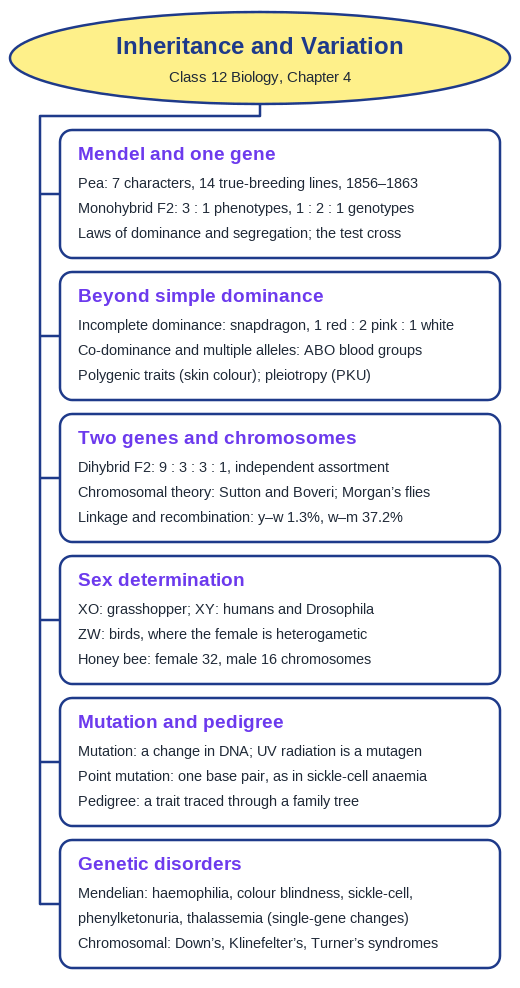
Genetics inheritance aur variation ki study hai. Inheritance mein characters parents se offspring mein jaate hain; variation batata hai ki offspring parents se kitne alag hain. Mendel ne garden pea par kaam karke dominance, segregation aur independent assortment ke laws diye. Chapter aage chromosomes aur linkage, sex determination, mutation, pedigree analysis aur genetic disorders samjhata hai.
Ye chapter kis baare mein hai?
Bachche apne parents jaise dikhte hain, phir bhi do bhai-behen bilkul ek jaise nahi hote. Genetics biology ki wo branch hai jo in dono baaton ki study karti hai. Inheritance wo process hai jisse characters parent se progeny mein jaate hain; yahi heredity ka basis hai. Variation batata hai ki progeny apne parents se kitni alag hai.
Log variation ko samajhne se bahut pehle use kar rahe the. Useful characters wale wild plants aur animals ko chun kar aur breed kar ke unhone domesticated breeds banayi, jaise Punjab ki Sahiwal cows. Scientific explanation mid-nineteenth century mein Gregor Mendel se shuru hui.
Ye lamba chapter hai. Ye Mendel ke crosses se chromosomes tak, phir sex determination, mutation aur genetic disorders tak jaata hai. Teen topic pages detail mein hain: Mendel ke laws, independent assortment aur linkage aur sex determination aur genetic disorders.
Mendel ne inheritance ki study kaise ki?
Mendel ne garden peas par saat saal (1856–1863) hybridisation experiments kiye. Teen baaton ne unke kaam ko reliable banaya: unhone statistics aur mathematical logic use kiya, sample size bada rakha, aur apne conclusions ko agli generations par confirm kiya.
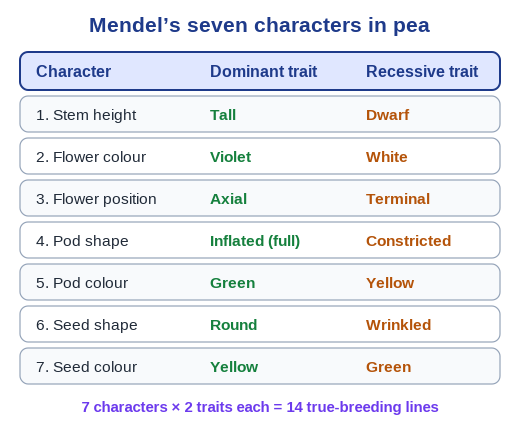
Unhone aise characters chune jinke do saaf opposite traits hote hain. Unhone 14 true-breeding lines li, yaani aisi lines jo lagataar self-pollination ke baad kai generations tak stable trait dikhati hain. Inse saat pairs bane, har character ke liye ek.
Ek gene ko follow karne par kya hota hai?
Mendel ne tall aur dwarf plants ko cross kiya. Pehli filial generation (F1) ke saare plants tall the. F1 ko self-pollinate karne par F2 mein dwarf trait wapas aaya: 3/4 plants tall aur 1/4 dwarf. Koi plant beech ki height ka nahi tha, yaani traits blend nahi hue.
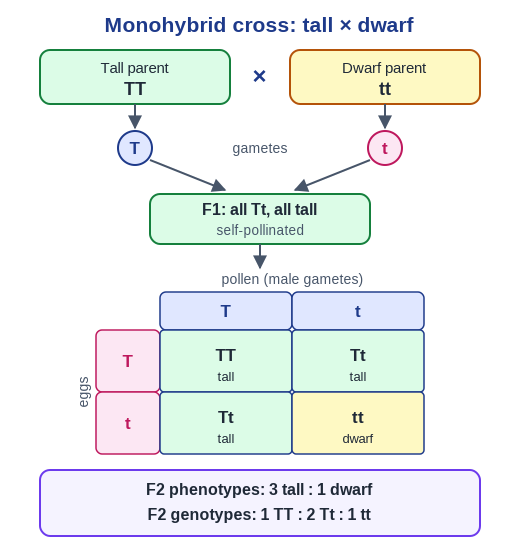
Mendel ne ise factors se samjhaya, jinhe ab hum genes kehte hain. Gene ke jo forms contrasting traits ke liye code karte hain wo alleles hain (T aur t). TT aur tt plants homozygous hain; Tt plants heterozygous. TT, Tt aur tt genotypes hain; tall aur dwarf phenotypes. Punnett square, jo British geneticist Reginald C. Punnett ne banaya, cross ke saare possible offspring dikhata hai.
Aise monohybrid crosses se do laws nikalte hain:
- Law of dominance: characters discrete units se control hote hain jinhe factors kehte hain; factors pairs mein hote hain; dissimilar pair mein ek factor (dominant) doosre (recessive) ko dominate karta hai.
- Law of segregation: pair ke dono alleles blend nahi hote. Gamete formation ke samay wo alag ho jaate hain, isliye har gamete ko inme se sirf ek milta hai.
Test cross se pata chalta hai ki dominant phenotype wala plant homozygous hai ya heterozygous: use recessive parent se cross karte hain. Details Mendel ke laws mein hain.
Kya ek allele hamesha dominant hota hai?
Nahi. Baad ke kaam se teen aur patterns mile.
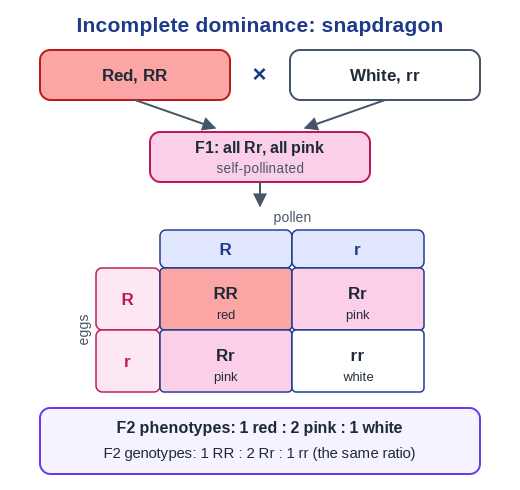
Incomplete dominance. Dog flower (snapdragon, Antirrhinum sp.) mein red (RR) × white (rr) se pink F1 (Rr) milta hai. F2 mein 1 red : 2 pink : 1 white aata hai. Genotype ratio wahi 1 : 2 : 1 hai, lekin ab phenotype ratio bhi yahi hai, kyunki Rr ko RR se alag pehchana ja sakta hai.
Co-dominance. F1 dono parents jaisa hota hai. ABO blood groups gene I se control hote hain, jo red blood cells ki surface par sugar ka type tay karta hai. Iske teen alleles hain: IA aur IB thodi alag sugars banate hain, aur i koi sugar nahi banata. IA aur IB dono i par dominant hain, lekin saath hone par co-dominant hain: dono sugars banti hain, aur blood group AB hota hai.
Multiple alleles. Yahi gene dikhata hai ki population mein ek gene ke do se zyada alleles ho sakte hain, jabki ek insaan mein sirf do hote hain.
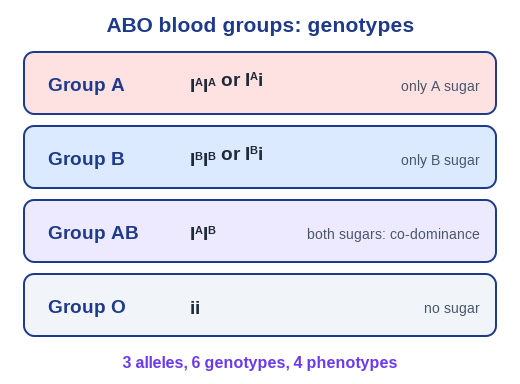
Kuch alleles dominant kyun hote hain? Gene mein kisi product, aksar enzyme, ki information hoti hai. Badla hua allele normal enzyme, non-functional enzyme ya koi enzyme nahi bana sakta hai. Agar bina badla allele akele hi usual phenotype de sakta hai, to wo dominant allele ki tarah behave karta hai aur badla hua allele recessive ki tarah.
Dominance is par bhi depend karta hai ki hum kaun sa phenotype dekh rahe hain. Pea mein starch synthesis ke gene ke alleles B aur b hain. BB seeds round hote hain, bade starch grains ke saath; bb seeds wrinkled, chhote grains ke saath. Bb seeds round hote hain, to seed shape ke liye B dominant lagta hai, lekin inke starch grains intermediate size ke hote hain, jo grain size ke liye incomplete dominance hai.
Do genes ko follow karne par kya hota hai?
Mendel ne round, yellow seeds wale plants (RRYY) ko wrinkled, green seeds wale plants (rryy) se cross kiya. F1 (RrYy) round aur yellow tha. F2 mein chaar phenotypes 9 : 3 : 3 : 1 ke ratio mein aaye.
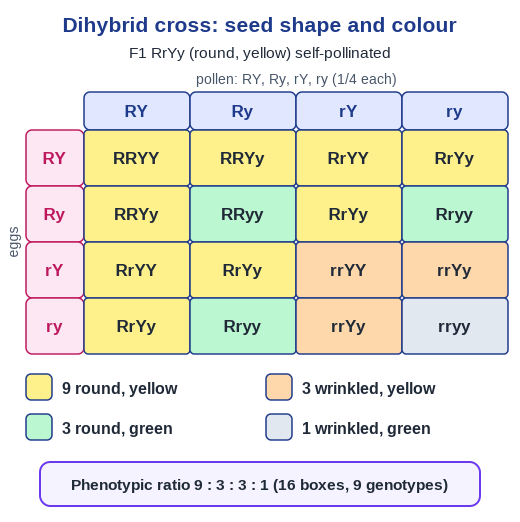
Isse law of independent assortment mila: jab hybrid mein traits ke do pairs saath hote hain, to characters ka ek pair doosre pair se independent segregate hota hai.
Chromosomes Mendel ke laws ko kaise samjhate hain?
Mendel ne 1865 mein publish kiya, lekin unka kaam 1900 tak unrecognised raha, jab de Vries, Correns aur von Tschermak ne independently unke results rediscover kiye. 1902 tak meiosis mein chromosomes ka movement pata chal chuka tha. Walter Sutton aur Theodore Boveri ne dekha ki chromosomes bilkul Mendel ke factors ki tarah behave karte hain: wo pairs mein hote hain, gamete formation par pairs alag hote hain, aur alag-alag pairs independently alag hote hain. Sutton ne dono ideas ko jod kar chromosomal theory of inheritance kaha.
Thomas Hunt Morgan ne is theory ko fruit fly Drosophila melanogaster par test kiya. Unhone paaya ki ek hi chromosome ke genes independently assort nahi hote. Is physical association ko unhone linkage kaha, aur non-parental combinations ke banne ko recombination.
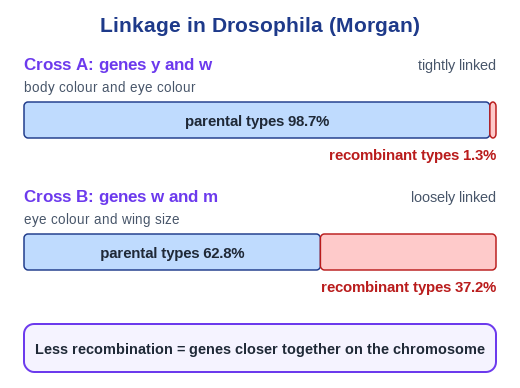
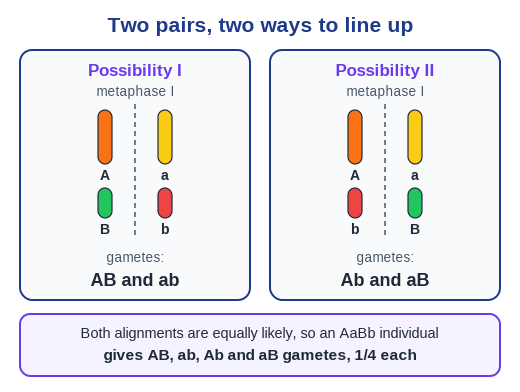
Dono ideas independent assortment aur linkage mein samjhaye gaye hain.
Polygenic inheritance aur pleiotropy kya hain?
Polygenic inheritance. Mendel ke traits ke do distinct forms the. Kai traits, jaise human height aur skin colour, poori range dikhate hain. Ye generally teen ya zyada genes se control hote hain aur environment ka bhi in par asar hota hai. Har allele ka effect additive hota hai.
Maan lo teen genes A, B aur C skin colour control karte hain, aur dominant forms darkness badhate hain. AABBCC sabse dark hai, aabbcc sabse light, aur teen dominant aur teen recessive alleles wala genotype intermediate.
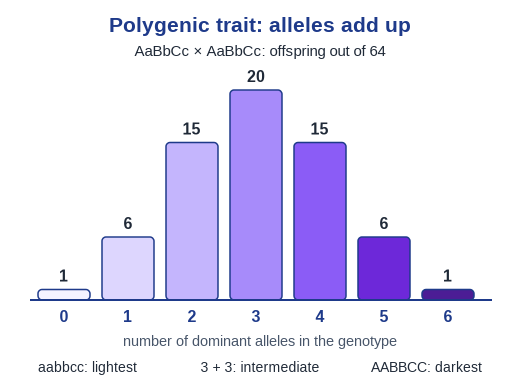
Extra: ye chart book ke three-gene model par hamari apni working hai. Do AaBbCc parents ke cross se 64 combinations bante hain, aur har ek mein dominant alleles ginne par 1 : 6 : 15 : 20 : 15 : 6 : 1 aata hai. Zyadatar offspring beech mein aate hain, isiliye aise traits smooth range dikhate hain.
Pleiotropy. Yahan ek hi gene ke ek se zyada phenotypic effects hote hain, aksar isliye ki wo aise metabolic pathway par kaam karta hai jo kai traits se juda hai. Example phenylketonuria hai: enzyme phenylalanine hydroxylase ke single gene mein mutation mental development aur hair aur skin ke pigmentation, dono par asar daalta hai.
Sex kaise determine hota hai?
Henking (1891) ne kuch insects mein ek nuclear structure dekha jo sirf aadhe sperms tak pahunchta tha, aur use X body kaha; baad mein pata chala ki ye chromosome hai. Sex determination se jude chromosomes sex chromosomes hain; baaki autosomes.
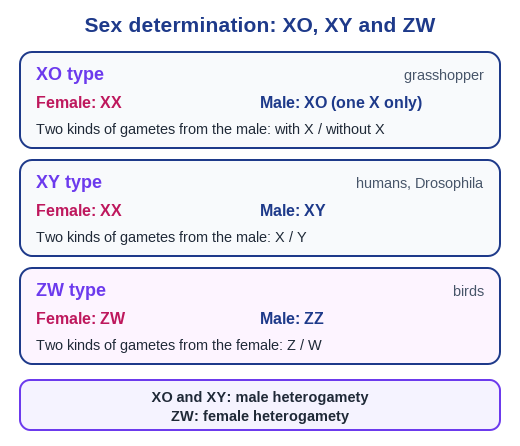
Humans mein chromosomes ke 23 pairs mein se 22 autosomes hain. Females mein XX aur males mein XY hota hai. Saare ova mein X hota hai; aadhe sperms mein X aur aadhe mein Y. Isliye sperm bachche ka sex tay karta hai, aur har pregnancy mein ladki ya ladke ka chance 50 per cent hai. Book zor dekar kehti hai ki ladkiyon ke janm ke liye women ko blame karna ek false notion hai, jiska biology mein koi basis nahi.
Honey bee mein fertilised eggs females (32 chromosomes) bante hain aur unfertilised eggs males (16 chromosomes).
Mutation aur pedigree analysis kya hain?
Mutation DNA sequence ka wo badlaav hai jo genotype aur phenotype badal deta hai. DNA segment ka loss (deletion) ya gain (insertion ya duplication) chromosomes ko badal deta hai; aise chromosomal aberrations cancer cells mein aksar dikhte hain. Ek single base pair ka badlaav point mutation hai, jaise sickle-cell anaemia mein. Base pairs ke deletions aur insertions se frame-shift mutations hote hain (Chapter 5). Mutation karne wale agents mutagens hain; UV radiation ek mutagen hai.
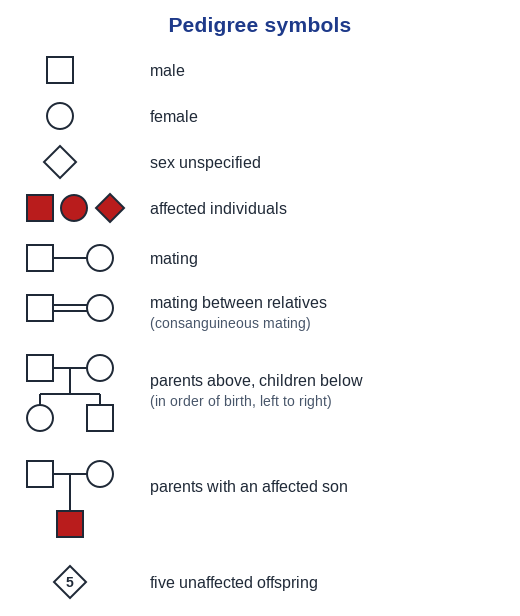
Humans mein controlled crosses mumkin nahi, isliye geneticists kisi trait ki family history study karte hain. Yahi pedigree analysis hai.
Genetic disorders kya hain?
Genetic disorders do groups mein aate hain.
| Mendelian disorders | Chromosomal disorders | |
|---|---|---|
| Cause | Single gene mein badlaav (mutation) | Ek ya zyada chromosomes ka absence, excess ya abnormal arrangement |
| Inheritance | Mendel ke principles follow karte hain; pedigree se trace hote hain | Aksar karyotype mein dikhte hain |
| Examples | Haemophilia, colour blindness, sickle-cell anaemia, phenylketonuria, thalassemia, cystic fibrosis | Down’s syndrome, Klinefelter’s syndrome, Turner’s syndrome |
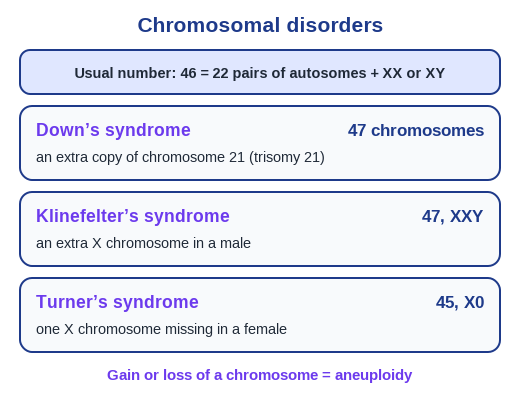
Ye medical conditions hain jinke saath log paida hote hain; isme kisi ki galti nahi hoti. Har ek ka description sex determination aur genetic disorders mein hai.
Aage badhne se pehle
Is chapter ko pencil ke saath practise karo: har Punnett square khud banao aur boxes gino. Scientists ko unke years ke saath, sex determination ke teen types, aur har disorder ka ek cause aur ek feature yaad karo. Saari 16 exercises Chapter 4 ke NCERT solutions mein solve ki gayi hain.
Key terms (zaroori shabd)
| Term | Matlab |
|---|---|
| Gene aur allele | Gene inheritance ki unit hai (Mendel ka 'factor'). Alleles ek hi gene ke thode alag forms hain jo contrasting traits ke liye code karte hain, jaise T aur t. |
| Genotype aur phenotype | Genotype genetic make-up hai, jaise TT, Tt ya tt. Phenotype wo trait hai jo dikhta hai, jaise tall ya dwarf. |
| Homozygous aur heterozygous | Homozygous: gene ke dono alleles same (TT, tt). Heterozygous: dono alleles alag (Tt). |
| Monohybrid cross | Ek character ka cross, jaise TT × tt. Iska F2 phenotypic ratio 3 : 1 aur genotypic ratio 1 : 2 : 1 hota hai. |
| Test cross | Dominant phenotype wale organism ka, jiska genotype pata nahi, homozygous recessive parent se cross. |
| Incomplete dominance | F1 dono parents ke beech ka hota hai, jaise snapdragon ke pink (Rr) phool. F2 ratio 1 red : 2 pink : 1 white. |
| Co-dominance | Heterozygote mein dono alleles poori tarah express hote hain, jaise blood group AB mein Iᴬ aur Iᴮ. |
| Multiple alleles | Population mein ek gene ke do se zyada alleles, jaise ABO blood group gene ke Iᴬ, Iᴮ aur i. Ek insaan mein inme se sirf do hote hain. |
| Linkage aur recombination | Linkage ek hi chromosome par genes ka physical association hai. Recombination non-parental gene combinations ka banna hai. |
| Polygenic inheritance | Teen ya zyada genes se control hone wala trait jisme alleles ka effect judta hai, jaise human skin colour aur height. Environment ka bhi asar hota hai. |
| Pleiotropy | Ek hi gene ke ek se zyada phenotypic effects, jaise phenylketonuria mein. |
| Male aur female heterogamety | Male heterogamety: male do tarah ke gametes banata hai (XO aur XY type). Female heterogamety: female banati hai (birds ka ZW type). |
| Mutation | DNA sequence mein badlaav jo genotype aur phenotype badal deta hai. Ek single base pair ka badlaav point mutation hai. |
| Pedigree analysis | Kisi trait ki family ki kai generations mein study, jo standard symbols wale family tree ke roop mein banti hai. |
| Aneuploidy aur polyploidy | Aneuploidy: chromatids ke segregate na hone se ek chromosome ka badhna ya ghatna. Polyploidy: chromosomes ka poora extra set, jo plants mein aksar dikhta hai. |
Is chapter ke topics
Practice karo
-
Mendel ne kitni true-breeding pea plant varieties chuni thi?
Jawab dekho
Jawab: (b) 14
-
Monohybrid cross ka F2 genotypic ratio hota hai:
Jawab dekho
Jawab: (c) 1 : 2 : 1
-
Humans mein ABO blood grouping kiska example hai?
Jawab dekho
Jawab: (b) co-dominance aur multiple alleles
-
Morgan ke crosses mein white aur yellow genes ke beech recombination kitna tha?
Jawab dekho
Jawab: (a) 1.3 per cent
-
Female heterogamety kisme dikhti hai?
Jawab dekho
Jawab: (d) birds
-
Klinefelter's syndrome ka karyotype hai:
Jawab dekho
Jawab: (b) 47, XXY
Students ke sawal
Class 12 Biology Chapter 4 ke main topics kya hain?
Mendel ke laws of inheritance, ek gene aur do genes ka inheritance, chromosomal theory, linkage aur recombination, polygenic inheritance, pleiotropy, sex determination, mutation, pedigree analysis, aur Mendelian aur chromosomal disorders.
Kya Principles of Inheritance and Variation 2026-27 ki NCERT Class 12 Biology book mein hai?
Haan. Ye Chapter 4 hai, Unit VII (Genetics and Evolution) ka pehla chapter, Reprint 2026-27 wali Class 12 Biology textbook ke pages 53 se 78 par. Isme 16 end-of-chapter exercises hain.
Mendel ke teen laws kaun se hain?
Law of dominance, law of segregation aur law of independent assortment. Pehle do monohybrid crosses se aate hain aur teesra dihybrid crosses se.
Is chapter se kaun se ratios yaad rakhne chahiye?
Monohybrid F2: 3 : 1 (phenotype) aur 1 : 2 : 1 (genotype). Heterozygote ka test cross: 1 : 1. Incomplete dominance F2: 1 : 2 : 1. Dihybrid F2: 9 : 3 : 3 : 1.
Koi sawal atak gaya?
Photo lo, Lagnever AI step-by-step samjhayega. 7 din ka trial sirf ₹2.
Google Play se app lo Browser mein kholo
Parents ke liye: trial ke baad plan har mahine UPI ya card autopay se renew hota hai. App mein kabhi bhi cancel kar sakte hain.