
What are independent assortment and linkage?
Answer in short
The law of independent assortment says that when two pairs of traits are combined in a hybrid, one pair segregates independently of the other, giving a 9 : 3 : 3 : 1 ratio in the F2 of a dihybrid cross. Linkage is the exception: genes on the same chromosome tend to stay together, so parental combinations are far more common than recombinants.
Stuck on a question? Take a photo and Lagnever AI explains it step by step. Try it for 7 days for ₹2. Get it on Google Play
What did Mendel’s dihybrid cross show?
Mendel crossed a pea plant with round, yellow seeds with one that had wrinkled, green seeds. All F1 seeds were round and yellow, so round is dominant over wrinkled and yellow over green.
Take R for round, r for wrinkled, Y for yellow and y for green. The parents are RRYY and rryy; their gametes RY and ry unite to give the F1 hybrid RrYy.
In the F2, each character on its own still gave 3 : 1 (3 yellow : 1 green, and 3 round : 1 wrinkled). Taken together, the phenotypes appeared as 9 : 3 : 3 : 1.
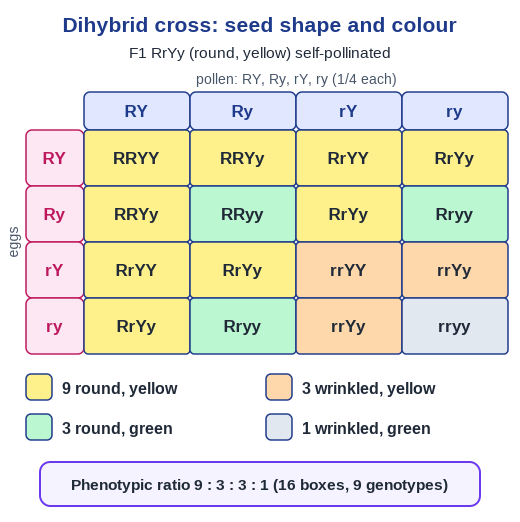
The ratio is simply two 3 : 1 ratios multiplied:
(3 round : 1 wrinkled) × (3 yellow : 1 green) = 9 round yellow : 3 wrinkled yellow : 3 round green : 1 wrinkled green.
What is the law of independent assortment?
When two pairs of traits are combined in a hybrid, the segregation of one pair of characters is independent of the other pair.
In the RrYy plant, half the gametes get R and half get r. Independently of this, half get Y and half get y. So four kinds of gametes form, RY, Ry, rY and ry, each 1/4 of the total. Four kinds of pollen meeting four kinds of eggs fill the 16 boxes of the Punnett square. Counting them gives 9 genotypes and 4 phenotypes.
| Phenotype | Genotypes (boxes) | Total |
|---|---|---|
| Round, yellow | RRYY (1), RRYy (2), RrYY (2), RrYy (4) | 9 |
| Wrinkled, yellow | rrYY (1), rrYy (2) | 3 |
| Round, green | RRyy (1), Rryy (2) | 3 |
| Wrinkled, green | rryy (1) | 1 |
How did chromosomes come into the picture?
Mendel published his work in 1865, but it remained unrecognised until 1900. In that year de Vries, Correns and von Tschermak, working separately, arrived at the same results. By this time better microscopes had shown structures in the nucleus that double and divide before each cell division: the chromosomes (“coloured bodies”, seen by staining). By 1902 scientists understood how they move in meiosis.
Walter Sutton and Theodore Boveri then pointed out that chromosomes and genes behave in the same way:
- both occur in pairs;
- both segregate at gamete formation, so that a gamete gets only one of each pair;
- different pairs segregate independently of each other.
The two alleles of a gene lie at matching sites on homologous chromosomes. At meiosis I, two chromosome pairs can line up in either of two ways, and this is the physical basis of independent assortment.
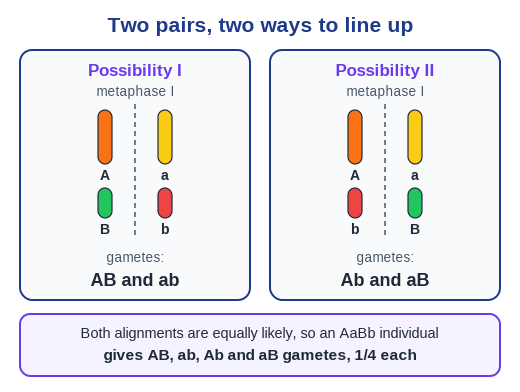
Sutton united chromosomal segregation with Mendel’s principles as the chromosomal theory of inheritance.
Why did Morgan choose Drosophila?
Thomas Hunt Morgan and his colleagues tested the theory by experiment on the tiny fruit fly, Drosophila melanogaster. It suited the work because:
- it grows on a simple synthetic medium in the laboratory;
- its life cycle takes about two weeks;
- one mating produces a large number of progeny;
- males and females are easily told apart;
- it has many hereditary variations that can be seen with a low-power microscope.
What are linkage and recombination?
Morgan made dihybrid crosses with sex-linked genes. In one, he crossed yellow-bodied, white-eyed females with brown-bodied, red-eyed males and intercrossed the F1. The two genes did not segregate independently, and the F2 ratio was far from 9 : 3 : 3 : 1.
Both genes were on the X chromosome. When two genes lie on the same chromosome, parental combinations are much more common than non-parental ones. Morgan called this physical association linkage, and the formation of non-parental combinations recombination.
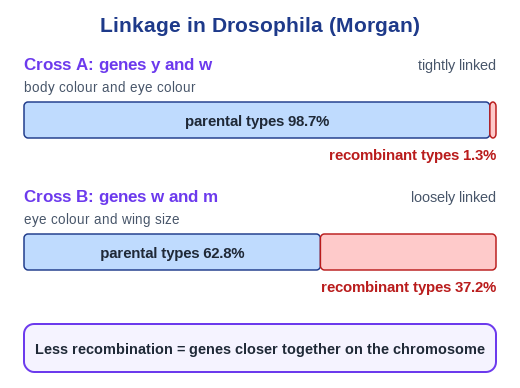
Linkage is not equally strong for all pairs:
| Gene pair | Recombination | Linkage |
|---|---|---|
| white (w) and yellow (y) | 1.3 per cent | very tight |
| white (w) and miniature wing (m) | 37.2 per cent | loose |
Alfred Sturtevant, a student of Morgan, treated how often two genes on a chromosome recombine as a measure of how far apart they are, and so “mapped” their positions. Genetic maps are now used as a starting point for sequencing whole genomes, as in the Human Genome Sequencing Project.
Next: sex determination and genetic disorders. Back to the Chapter 4 notes.
Practice
-
How many types of gametes does a plant of genotype RrYy form?
Show answer
Answer: (b) 4
-
In the F2 of Mendel's dihybrid cross, what fraction of the plants has wrinkled, green seeds?
Show answer
Answer: (c) 1/16
-
Who used recombination frequencies to map genes on a chromosome?
Show answer
Answer: (c) Sturtevant
-
Give three reasons why Drosophila suited Morgan's work.
Show answer
Answer: Any three: it grows on a simple synthetic medium in the laboratory; it completes its life cycle in about two weeks; a single mating gives a large number of progeny; males and females are easy to tell apart; it has many hereditary variations visible under a low-power microscope.
-
Why did Morgan's F2 ratio differ from 9 : 3 : 3 : 1?
Show answer
Answer: The two genes he followed were on the same chromosome (the X chromosome). Being physically linked, they did not assort independently, so parental combinations were much more frequent than non-parental ones.
Questions students ask
What is a dihybrid cross?
It is a cross between plants that differ in two pairs of contrasting traits, such as round yellow (RRYY) and wrinkled green (rryy) pea seeds. Its F2 phenotypic ratio is 9 : 3 : 3 : 1.
Why was Mendel's work ignored until 1900?
Communication was poor, so his work was not widely known. His idea of stable, non-blending factors did not fit the continuous variation seen in nature. His use of mathematics in biology was new. And he could give no physical proof of what the factors were.
What is the chromosomal theory of inheritance?
Sutton and Boveri reasoned that when the two chromosomes of a pair come together and then part, the two factors on them are separated as well. Sutton joined this with Mendel's principles and named the result the chromosomal theory of inheritance.
What is the difference between linkage and recombination?
Linkage is the physical association of genes on a chromosome, which keeps parental combinations together. Recombination is the formation of non-parental gene combinations. Tightly linked genes show very low recombination.
Stuck on a question?
Take a photo and Lagnever AI explains it step by step. Try it for 7 days for ₹2.
Get it on Google Play Open in browser
For parents: after the trial, the plan renews monthly by UPI or card autopay. You can cancel anytime in the app.