
What are Mendel's laws of inheritance?
Answer in short
Mendel's laws explain how characters pass from parents to offspring. The law of dominance says that factors occur in pairs and one member of a dissimilar pair dominates the other. The law of segregation says that the two alleles of a pair separate during gamete formation, so each gamete receives only one. A third law, independent assortment, covers two genes.
Stuck on a question? Take a photo and Lagnever AI explains it step by step. Try it for 7 days for ₹2. Get it on Google Play
What did Mendel’s monohybrid cross show?
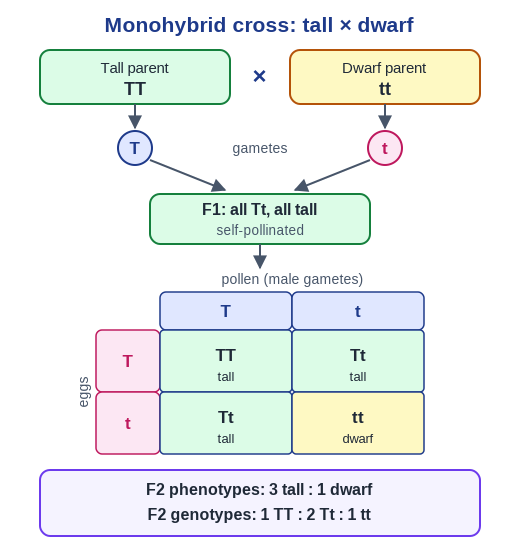
Mendel crossed a true-breeding tall pea plant with a true-breeding dwarf plant. Following one character like this is a monohybrid cross.
- F1: every plant was tall. The dwarf trait was not seen at all.
- F2 (F1 self-pollinated): the dwarf trait reappeared. 3/4 of the plants were tall and 1/4 were dwarf.
- The dwarf plants were exactly like the dwarf parent. No plant was of in-between height, so the traits had not blended.
He got the same 3 : 1 result with the other six characters.
How do we explain it with symbols?
Mendel proposed that something stable passes unchanged from parent to offspring through the gametes. He called these things factors; we call them genes. Forms of a gene that code for a pair of contrasting traits are alleles.
Use a capital letter for the trait seen in the F1 and the small letter for the other one: T for tall, t for dwarf.
- True-breeding plants are homozygous: TT or tt. The hybrid Tt is heterozygous.
- TT, Tt and tt are genotypes; tall and dwarf are phenotypes.
- A TT plant makes only T gametes and a tt plant only t gametes, so the F1 is Tt.
- A Tt plant makes T and t gametes in equal numbers, because the alleles separate at meiosis and the separation is random.
In the Punnett square for Tt × Tt, 1/4 of the boxes are TT, 1/2 are Tt and 1/4 are tt. TT and Tt both look tall, so the phenotypic ratio is 3 : 1 while the genotypic ratio is 1 : 2 : 1. The same result comes from the binomial expansion (½T + ½t)² = ¼TT + ½Tt + ¼tt.
What are the laws of dominance and segregation?
Law of dominance
- Characters are controlled by discrete units called factors.
- Factors occur in pairs.
- In a dissimilar pair of factors, one member (dominant) dominates the other (recessive).
This law explains why only one parental trait is seen in the F1, why both appear in the F2, and why the F2 ratio is 3 : 1.
Law of segregation
The alleles of a pair do not blend, and both traits are recovered unchanged in the F2. During gamete formation the two alleles separate, so a gamete receives only one of them. A homozygous parent therefore forms one kind of gamete, and a heterozygous parent forms two kinds in equal proportion.
What is a test cross?
A tall plant may be TT or Tt; we cannot tell by looking. In a test cross the organism with the dominant phenotype is crossed with the homozygous recessive parent instead of being selfed. The book’s figure uses flower colour in pea, where violet (W) is dominant over white (w).
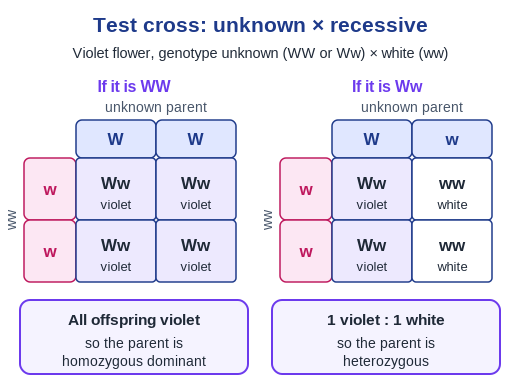
- All offspring violet: the unknown plant is homozygous dominant (WW).
- Half violet and half white (1 : 1): the unknown plant is heterozygous (Ww).
What is incomplete dominance?
In some crosses the F1 looks like neither parent but lies in between. In the dog flower (snapdragon, Antirrhinum sp.), a true-breeding red plant (RR) crossed with a true-breeding white plant (rr) gives a pink F1 (Rr).
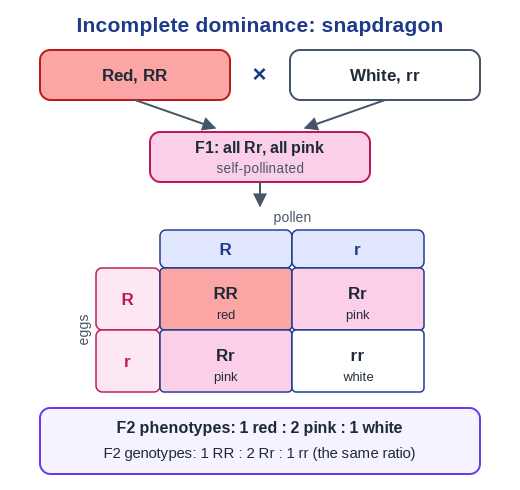
Selfing the F1 gives 1 red (RR) : 2 pink (Rr) : 1 white (rr). The genotype ratio is the same as in any monohybrid cross. Only the phenotype ratio has changed from 3 : 1, because R is not completely dominant over r. The alleles still segregate, so the law of segregation holds.
What are co-dominance and multiple alleles?
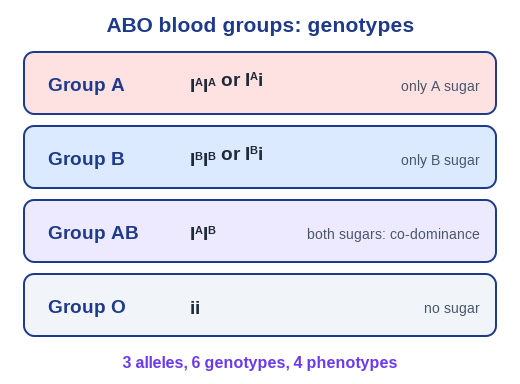
In co-dominance the F1 resembles both parents. The example is the ABO blood group system in humans, controlled by the gene I. The plasma membrane of a red blood cell carries sugar polymers, and the gene decides their kind.
- IA and IB produce two slightly different sugars; i produces none.
- IA and IB are each completely dominant over i.
- When IA and IB are together, both express themselves, and the cells carry both sugars.
| Genotype | Blood group |
|---|---|
| IAIA or IAi | A |
| IBIB or IBi | B |
| IAIB | AB |
| ii | O |
The same gene is an example of multiple alleles: more than two alleles govern one character. Since one person has only two alleles of a gene, multiple alleles can be found only by studying a population.
Is dominance a fixed property of an allele?
No. A gene usually carries the information for a product such as an enzyme. If a changed allele gives a non-functional enzyme or none, the phenotype depends on the unchanged allele alone, which then appears dominant.
Dominance can also depend on the phenotype we choose. In pea, BB seeds are round with large starch grains and bb seeds are wrinkled with small grains. Bb seeds are round, so B is dominant for seed shape, but their starch grains are intermediate in size, so for grain size the same alleles show incomplete dominance.
Next: independent assortment and linkage. Back to the Chapter 4 notes.
Practice
-
A tall pea plant crossed with a dwarf plant gives 50 per cent tall and 50 per cent dwarf offspring. The tall parent is:
Show answer
Answer: (b) Tt
-
In snapdragon, the cross Rr × Rr gives pink-flowered plants in what fraction of the offspring?
Show answer
Answer: (b) 1/2
-
How many genotypes are possible for the ABO blood groups?
Show answer
Answer: (c) 6
-
Why did Mendel conclude that the dwarf F2 plants were homozygous?
Show answer
Answer: When he self-pollinated them, they produced only dwarf plants in the F3 and F4 generations. A plant that breeds true for the recessive trait must carry two recessive alleles, tt.
-
State the law of segregation in one sentence.
Show answer
Answer: The two alleles of a pair do not blend; they separate from each other during gamete formation, so that each gamete receives only one of the two.
Questions students ask
What is the difference between a gene and an allele?
A gene is a unit of inheritance that carries the information for a trait. Alleles are slightly different forms of the same gene that code for a pair of contrasting traits, for example T (tall) and t (dwarf).
What is a Punnett square?
It is a square diagram that gives all the possible genotypes of the offspring of a cross. The gametes of the two parents are written along the top and the left side, and each box shows one combination. It was developed by Reginald C. Punnett.
Why is the F2 ratio 1 : 2 : 1 in snapdragon instead of 3 : 1?
Because R is not completely dominant over r. The heterozygote Rr is pink and can be told apart from red RR, so the phenotype ratio becomes the same as the genotype ratio, 1 red : 2 pink : 1 white.
Why is blood group AB an example of co-dominance?
In a person of genotype IᴬIᴮ, both alleles express themselves: the red blood cells carry both the A type and the B type of sugar. Neither allele hides the other.
Stuck on a question?
Take a photo and Lagnever AI explains it step by step. Try it for 7 days for ₹2.
Get it on Google Play Open in browser
For parents: after the trial, the plan renews monthly by UPI or card autopay. You can cancel anytime in the app.