
How is sex determined, and what are genetic disorders?
Answer in short
Sex is determined by chromosomes: XO type in the grasshopper, XY type in humans and Drosophila, ZW type in birds, and the number of chromosome sets in the honey bee. Genetic disorders are of two kinds. Mendelian disorders come from a change in a single gene; chromosomal disorders come from the absence, excess or abnormal arrangement of chromosomes.
Stuck on a question? Take a photo and Lagnever AI explains it step by step. Try it for 7 days for ₹2. Get it on Google Play
What are the chromosomal types of sex determination?
The first clue came from insects. Henking (1891) traced a nuclear structure that reached only 50 per cent of the sperms and named it the X body. It turned out to be a chromosome, the X-chromosome. Chromosomes involved in sex determination are sex chromosomes; the others are autosomes.
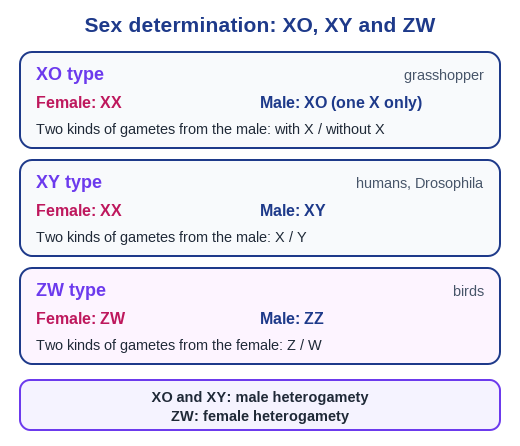
- XO type (grasshopper and many insects): females have a pair of X-chromosomes; males have only one. Sperms with an X give females; sperms without it give males. So males have one chromosome fewer.
- XY type (humans, Drosophila): both sexes have the same number. Males have an X and a smaller Y; females have XX.
- ZW type (birds): females have Z and W; males have ZZ.
In the first two the male forms two kinds of gametes: male heterogamety. In birds the female does: female heterogamety.
How is sex determined in humans?
Of the 23 pairs of chromosomes, 22 pairs are autosomes, the same in both sexes. Females have XX and males XY. Females form only one kind of ovum, with an X. Males form two kinds of sperm, 50 per cent with X and 50 per cent with Y.
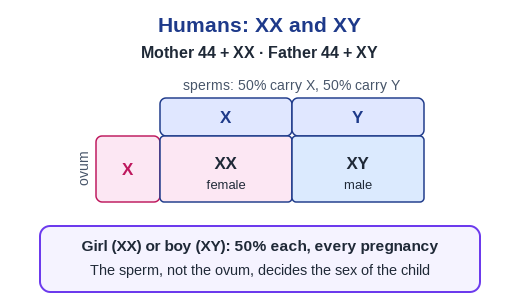
So the genetic make-up of the sperm decides the sex of the child, and in every pregnancy the chance of a girl or a boy is 50 per cent. Blaming women for giving birth to girls is, as the book says, a false notion.
How is sex determined in the honey bee?
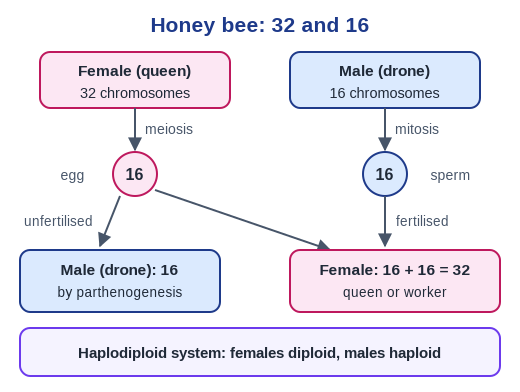
Here it depends on the number of chromosome sets. A fertilised egg develops into a female (queen or worker). An unfertilised egg develops into a male (drone) by parthenogenesis. This is the haplodiploid system. Males make sperms by mitosis. A male has no father and cannot have sons, but has a grandfather and can have grandsons.
What is pedigree analysis?
Controlled crosses cannot be done in humans, so a trait is studied over several generations of a family and drawn as a family tree. This is pedigree analysis. It shows whether a trait is dominant or recessive, and whether it is linked to an autosome or a sex chromosome.
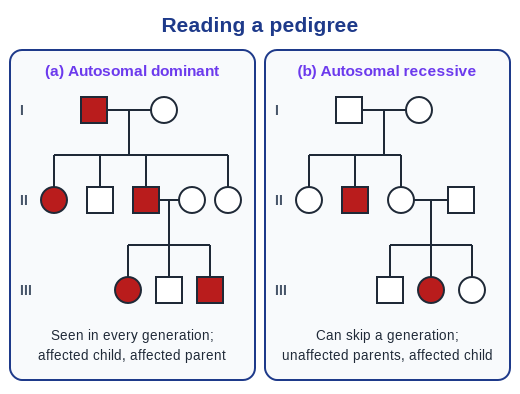
These two families are our own examples. The book’s examples are myotonic dystrophy (autosomal dominant) and sickle-cell anaemia (autosomal recessive).
Which are the Mendelian disorders?
They come from a change in a single gene and follow Mendel’s principles.
| Disorder | Inheritance | Cause and effect |
|---|---|---|
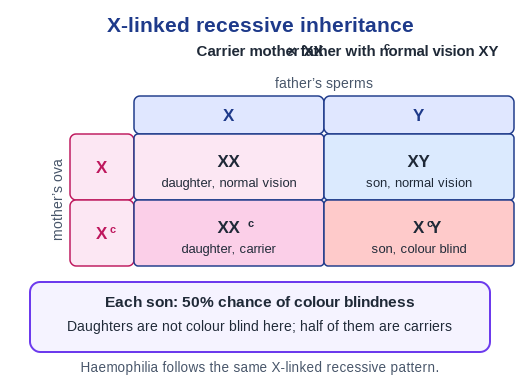
| Colour blindness | X-linked recessive | Defect in the red or green cone of the eye; red and green cannot be told apart |
| Haemophilia | X-linked recessive | One protein of the blood-clotting cascade is affected; bleeding does not stop easily |
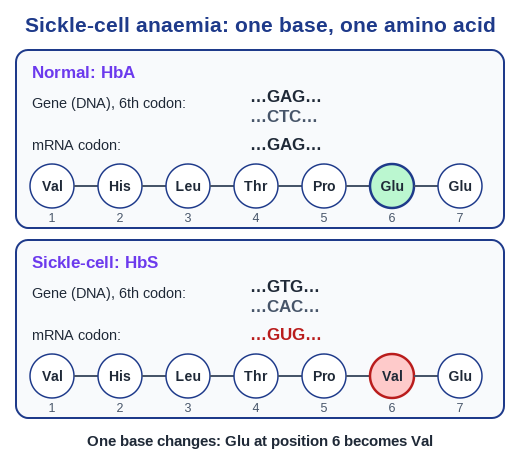
| Sickle-cell anaemia | Autosomal recessive | Valine replaces glutamic acid in beta globin; red blood cells become sickle-shaped |
| Phenylketonuria | Autosomal recessive | The enzyme that converts phenylalanine to tyrosine is missing |
| Thalassemia | Autosomal recessive | Reduced synthesis of alpha or beta globin chains; anaemia |
X-linked traits. A carrier mother passes the allele to half her sons on average. A daughter is colour blind only if her mother is at least a carrier and her father is colour blind. A female with haemophilia is extremely rare for the same reason. Queen Victoria was a carrier of haemophilia, and several of her descendants had it.
Sickle-cell anaemia. The alleles are HbA and HbS. Only HbSHbS individuals show the disease; HbAHbS individuals are carriers. The sixth codon of the beta globin gene changes from GAG to GUG. The changed haemoglobin polymerises under low oxygen tension, and the red blood cell changes from a biconcave disc to a long sickle shape.
Phenylketonuria. Phenylalanine builds up and is converted to phenylpyruvic acid and other derivatives. Their build-up in the brain affects mental development (the book’s term is mental retardation). They are also passed out in urine, because the kidney absorbs them poorly.
Thalassemia. Alpha thalassemia involves the closely linked genes HBA1 and HBA2 on chromosome 16; beta thalassemia involves the single gene HBB on chromosome 11.
Which are the chromosomal disorders?
Failure of chromatids to segregate gives aneuploidy, the gain or loss of a chromosome. An extra copy is trisomy; a missing one is monosomy. Failure of cytokinesis after telophase gives a whole extra set, polyploidy, often seen in plants.
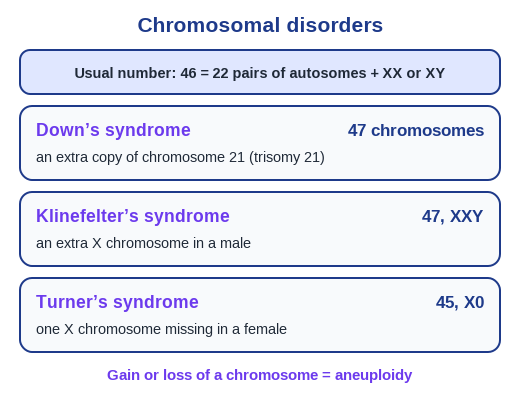
- Down’s syndrome (trisomy 21; first described by Langdon Down, 1866): short stature, small round head, furrowed tongue, partially open mouth, broad palm with a characteristic crease; physical, psychomotor and mental development is slower.
- Klinefelter’s syndrome (47, XXY): overall masculine development with some feminine development, such as development of the breast (gynaecomastia); such individuals are sterile.
- Turner’s syndrome (45, X0): females are sterile because the ovaries are rudimentary, and other secondary sexual characters are lacking.
Back to the Chapter 4 notes or on to the NCERT solutions.
Practice
-
A male honey bee (drone) has how many chromosomes?
Show answer
Answer: (b) 16
-
A carrier woman and a man with normal colour vision have a son. The chance that he is colour blind is:
Show answer
Answer: (c) 50 per cent
-
Beta thalassemia is controlled by the gene HBB on chromosome:
Show answer
Answer: (a) 11
-
Why can a male honey bee have a grandfather but no father?
Show answer
Answer: A drone develops from an unfertilised egg, so it has a mother but no father. Its mother, the queen, developed from a fertilised egg, so she has a father. That male is the drone's grandfather.
-
How does thalassemia differ from sickle-cell anaemia?
Show answer
Answer: Thalassemia is a quantitative problem: too few globin molecules are made. Sickle-cell anaemia is a qualitative problem: a globin that functions incorrectly is made.
Questions students ask
What is the difference between male and female heterogamety?
In male heterogamety the male makes two kinds of gametes, as in the XO type (with or without an X) and the XY type (X or Y). In female heterogamety the female makes two kinds, Z and W, as in birds.
Why is colour blindness more common in males?
The genes for red-green colour blindness are on the X chromosome and the trait is recessive. A male has only one X, so one copy of the gene is enough. A female has two X chromosomes and is colour blind only if both carry it.
What is aneuploidy?
It is the gain or loss of one or more chromosomes, caused by failure of chromatids to segregate during cell division. Down's syndrome (an extra chromosome 21) and Turner's syndrome (one X missing) are examples.
What is a carrier?
A carrier is a heterozygous individual who has one copy of a recessive disease allele. The person is usually unaffected but can pass the allele on to the children.
Stuck on a question?
Take a photo and Lagnever AI explains it step by step. Try it for 7 days for ₹2.
Get it on Google Play Open in browser
For parents: after the trial, the plan renews monthly by UPI or card autopay. You can cancel anytime in the app.