
NCERT Solutions Class 12 Chemistry Chapter 1: Solutions
Answers to all 41 end-of-unit exercises, all 12 Intext Questions and all 13 worked examples of Unit 1, Solutions, of Chemistry Part I, the Class 12 NCERT textbook. Page numbers follow the 2026-27 reprint (pages 1–30). The exercises come first, quoted from the book; the Intext Questions and the examples follow, restated in short. Short notes: Chapter 1 notes.
We use the molar masses the chapter’s own examples use: H = 1, C = 12, N = 14, O = 16, F = 19, Na = 23, S = 32, Cl = 35.5, K = 39, Ca = 40, Co = 59 and I = 127 g mol⁻¹, so water is 18 g mol⁻¹. From the book’s Appendix II: 1 atm = 1.013 bar = 1.013 × 10⁵ Pa = 760 mm Hg. R = 0.083 L bar mol⁻¹ K⁻¹, as in Example 1.11; the same constant is 0.0821 L atm mol⁻¹ K⁻¹ and 8.314 J mol⁻¹ K⁻¹ (Extra: these two values are not printed in the unit).
Stay safe. Benzene, chloroform, carbon tetrachloride, acetonitrile and the acids in these problems are toxic or corrosive. Any experiment with them is done only in the school laboratory with your teacher.
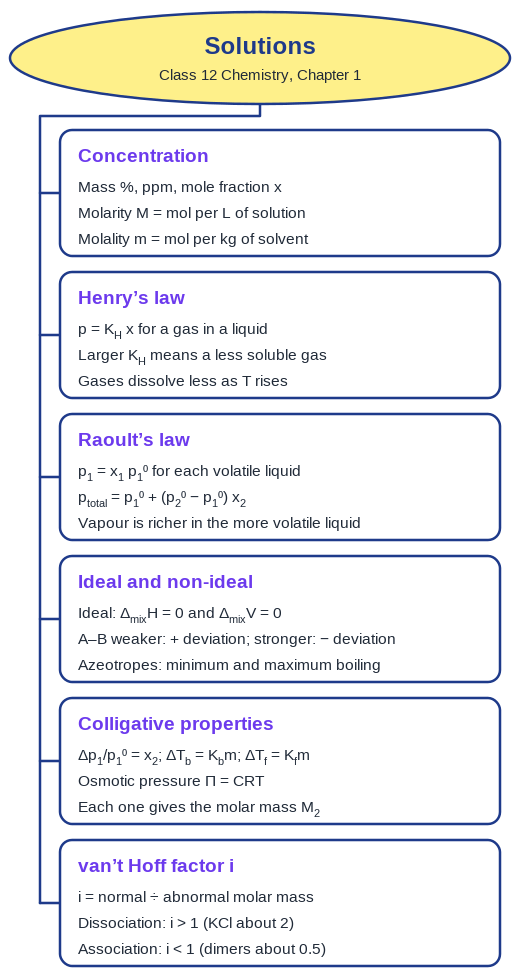
Exercises 1.1 to 1.9: solutions and concentration
1.1 “Define the term solution. How many types of solutions are formed? Write briefly about each type with an example.”
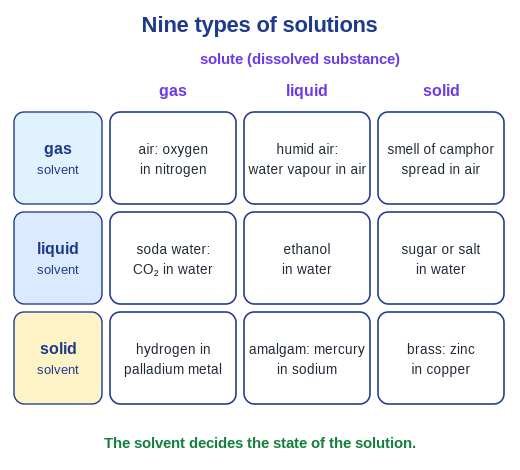
A solution is a homogeneous mixture of two or more substances: its composition and properties are the same throughout. In a binary solution, the solvent and the solute can each be a gas, a liquid or a solid, so there are nine types. The solvent decides the state of the solution:
- Gaseous solutions (solvent a gas): gas in gas, such as oxygen in nitrogen in air; liquid in gas, such as water vapour in humid air (or chloroform vapour in nitrogen); solid in gas, such as camphor vapour in nitrogen.
- Liquid solutions (solvent a liquid): gas in liquid, such as oxygen or CO₂ dissolved in water; liquid in liquid, such as ethanol in water; solid in liquid, such as glucose or salt in water.
- Solid solutions (solvent a solid): gas in solid, such as hydrogen in palladium; liquid in solid, such as an amalgam of mercury with sodium; solid in solid, such as copper dissolved in gold, or zinc in copper (brass).
1.2 “Give an example of a solid solution in which the solute is a gas.”
Hydrogen dissolved in palladium. Palladium metal (a solid) takes up hydrogen gas into its structure.
1.3 “Define the following terms: (i) Mole fraction (ii) Molality (iii) Molarity (iv) Mass percentage.”
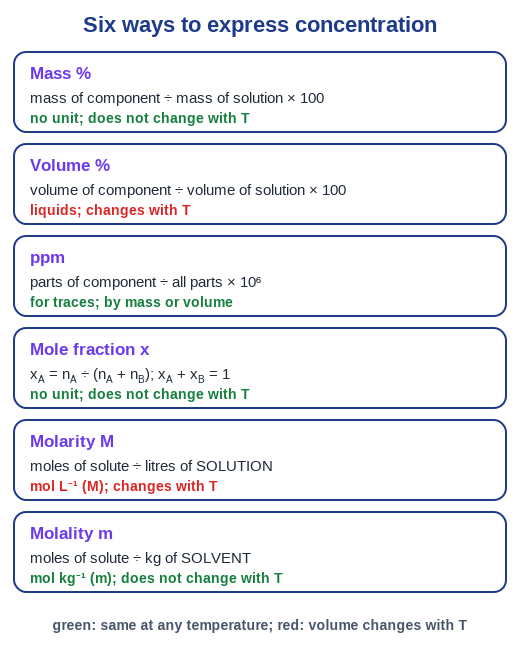
(i) Mole fraction of a component = its number of moles ÷ the total number of moles of all components. For A in a mixture of A and B, xA = nA/(nA + nB). It has no unit, and all the mole fractions add up to 1.
(ii) Molality (m) = moles of solute ÷ mass of solvent in kilograms. Unit: mol kg⁻¹. It does not change with temperature.
(iii) Molarity (M) = moles of solute ÷ volume of solution in litres. Unit: mol L⁻¹. It changes with temperature, because volume does.
(iv) Mass percentage of a component = (mass of the component ÷ total mass of the solution) × 100.
1.4 “Concentrated nitric acid used in laboratory work is 68% nitric acid by mass in aqueous solution. What should be the molarity of such a sample of the acid if the density of the solution is 1.504 g mL⁻¹?”
Take 100 g of solution: it holds 68 g of HNO₃.
Molar mass of HNO₃ = 1 + 14 + 3 × 16 = 63 g mol⁻¹
Moles of HNO₃ = 68 ÷ 63 = 1.079 mol
Volume of solution = mass ÷ density = 100 g ÷ 1.504 g mL⁻¹ = 66.49 mL = 0.06649 L
Molarity = 1.079 mol ÷ 0.06649 L = 16.23 M
1.5 “A solution of glucose in water is labelled as 10% w/w, what would be the molality and mole fraction of each component in the solution? If the density of solution is 1.2 g mL⁻¹, then what shall be the molarity of the solution?”
Take 100 g of solution: 10 g of glucose (C₆H₁₂O₆, 180 g mol⁻¹) and 90 g of water.
Moles of glucose = 10 ÷ 180 = 0.0556 mol; moles of water = 90 ÷ 18 = 5.00 mol
Molality = 0.0556 mol ÷ 0.090 kg = 0.617 mol kg⁻¹
x(glucose) = 0.0556 ÷ (0.0556 + 5.00) = 0.011; x(water) = 1 − 0.011 = 0.989
Volume = 100 g ÷ 1.2 g mL⁻¹ = 83.33 mL = 0.08333 L
Molarity = 0.0556 ÷ 0.08333 = 0.667 M
(The answer key rounds these to 0.617 m, 0.01 and 0.99, and 0.67 M.)
1.6 “How many mL of 0.1 M HCl are required to react completely with 1 g mixture of Na₂CO₃ and NaHCO₃ containing equimolar amounts of both?”
Molar masses: Na₂CO₃ = 46 + 12 + 48 = 106 g mol⁻¹; NaHCO₃ = 23 + 1 + 12 + 48 = 84 g mol⁻¹.
Let the mixture hold x mol of each: 106x + 84x = 1 g, so 190x = 1 and x = 0.005263 mol.
The reactions: Na₂CO₃ + 2HCl → 2NaCl + H₂O + CO₂ and NaHCO₃ + HCl → NaCl + H₂O + CO₂.
Moles of HCl needed = 2x + x = 3x = 0.01579 mol
Volume of 0.1 M HCl = 0.01579 ÷ 0.1 = 0.1579 L = 157.9 mL (the key prints 157.8 mL).
1.7 “A solution is obtained by mixing 300 g of 25% solution and 400 g of 40% solution by mass. Calculate the mass percentage of the resulting solution.”
Solute from the first solution = 25% of 300 g = 75 g
Solute from the second = 40% of 400 g = 160 g
Total solute = 235 g in 300 + 400 = 700 g of solution
Mass % of solute = 235 ÷ 700 × 100 = 33.57%, so the solvent is 66.43%.
1.8 “An antifreeze solution is prepared from 222.6 g of ethylene glycol (C₂H₆O₂) and 200 g of water. Calculate the molality of the solution. If the density of the solution is 1.072 g mL⁻¹, then what shall be the molarity of the solution?”
Molar mass of C₂H₆O₂ = 24 + 6 + 32 = 62 g mol⁻¹
Moles of ethylene glycol = 222.6 ÷ 62 = 3.590 mol
Molality = 3.590 mol ÷ 0.200 kg = 17.95 mol kg⁻¹
Mass of solution = 222.6 + 200 = 422.6 g; volume = 422.6 ÷ 1.072 = 394.2 mL = 0.3942 L
Molarity = 3.590 ÷ 0.3942 = 9.11 M (the key prints 9.10 M).
1.9 “A sample of drinking water was found to be severely contaminated with chloroform (CHCl₃) supposed to be a carcinogen. The level of contamination was 15 ppm (by mass): (i) express this in percent by mass (ii) determine the molality of chloroform in the water sample.”
15 ppm by mass means 15 g of chloroform in 10⁶ g of solution.
(i) Mass % = 15 ÷ 10⁶ × 100 = 1.5 × 10⁻³ %
(ii) Molar mass of CHCl₃ = 12 + 1 + 3 × 35.5 = 119.5 g mol⁻¹, so moles = 15 ÷ 119.5 = 0.1255 mol. The chloroform is so little that the water is practically 10⁶ g = 1000 kg.
Molality = 0.1255 mol ÷ 1000 kg = 1.26 × 10⁻⁴ mol kg⁻¹ (the key gives 1.25 × 10⁻⁴ m).
Exercises 1.10 to 1.14: interactions, Henry’s law and deviations
1.10 “What role does the molecular interaction play in a solution of alcohol and water?”
Both alcohol (ethanol) and water are held together by hydrogen bonds. On mixing, the alcohol molecules get between the water molecules and break some of their hydrogen bonds, and the new alcohol–water attractions do not make up for them. The molecules escape more easily, so the solution has a higher vapour pressure than Raoult’s law predicts: it shows positive deviation. That is why the mixture forms a minimum-boiling azeotrope at about 95% ethanol by volume and boils at a lower temperature than expected.
1.11 “Why do gases always tend to be less soluble in liquids as the temperature is raised?”
Dissolving a gas is like condensing it: the gas molecules go into the liquid and heat is given out, so dissolution is exothermic. The dissolved gas and the gas above are in dynamic equilibrium. By Le Chatelier’s principle, raising the temperature favours the change that absorbs heat, which is the gas leaving the solution. In terms of Henry’s law, KH rises with temperature, so at the same pressure the mole fraction of dissolved gas, x = p/KH, falls.
1.12 “State Henry’s law and mention some important applications.”
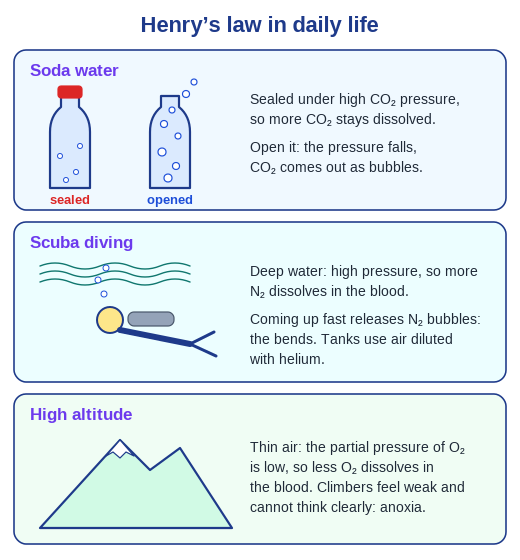
Henry’s law: at a fixed temperature, the amount of a gas that dissolves in a liquid is directly proportional to the partial pressure of that gas above the liquid. In its common form, the partial pressure of the gas is proportional to its mole fraction in the solution: p = KHx.
Applications:
- Soft drinks and soda water are sealed under high CO₂ pressure so that more CO₂ dissolves.
- Scuba diving: at depth, air is breathed at high pressure and more nitrogen dissolves in the blood. Rising too fast releases it as bubbles that block capillaries (the bends), so tanks hold air diluted with helium (11.7% helium, 56.2% nitrogen, 32.1% oxygen).
- High altitudes: the partial pressure of oxygen is low, so the blood carries less oxygen and climbers become weak and unable to think clearly (anoxia).
1.13 “The partial pressure of ethane over a solution containing 6.56 × 10⁻³ g of ethane is 1 bar. If the solution contains 5.00 × 10⁻² g of ethane, then what shall be the partial pressure of the gas?”
By Henry’s law the amount of gas dissolved is proportional to its partial pressure (for such small amounts, the mole fraction is proportional to the mass dissolved). So
p₂/p₁ = m₂/m₁
p₂ = 1 bar × (5.00 × 10⁻²)/(6.56 × 10⁻³) = 7.62 bar
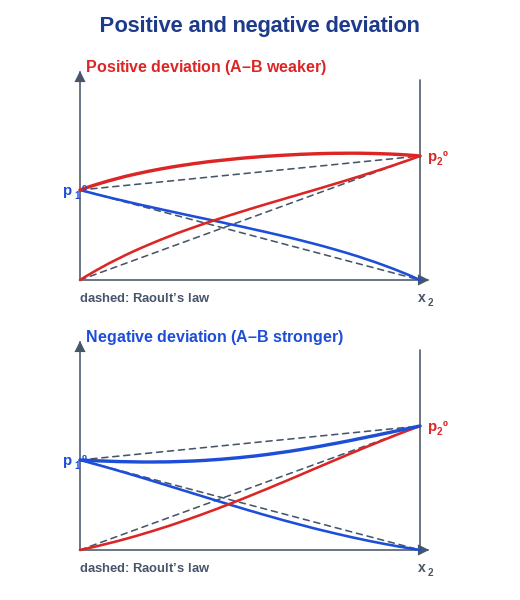
1.14 “What is meant by positive and negative deviations from Raoult’s law and how is the sign of ΔmixH related to positive and negative deviations from Raoult’s law?”
A solution that does not obey Raoult’s law over the whole range of composition shows a deviation.
- Positive deviation: the vapour pressure is higher than Raoult’s law predicts. The A–B attractions are weaker than the A–A and B–B attractions, so molecules escape more easily (ethanol + acetone, carbon disulphide + acetone). Breaking the stronger like-like attractions needs energy, so heat is absorbed on mixing: ΔmixH is positive (and the volume increases, ΔmixV > 0).
- Negative deviation: the vapour pressure is lower than predicted. The A–B attractions are stronger, so molecules escape less easily (chloroform + acetone, phenol + aniline). Forming the stronger unlike attractions releases energy, so heat is given out on mixing: ΔmixH is negative (and ΔmixV < 0).
For an ideal solution, ΔmixH = 0.
Exercises 1.15 to 1.22: colligative properties
1.15 “An aqueous solution of 2% non-volatile solute exerts a pressure of 1.004 bar at the normal boiling point of the solvent. What is the molar mass of the solute?”
At the normal boiling point the vapour pressure of pure water is 1 atm = 1.013 bar, so p₁⁰ = 1.013 bar and p₁ = 1.004 bar. In 100 g of solution, w₂ = 2 g and w₁ = 98 g of water (M₁ = 18 g mol⁻¹). For a dilute solution (equation 1.28):
(p₁⁰ − p₁)/p₁⁰ = (w₂ × M₁)/(M₂ × w₁)
(1.013 − 1.004)/1.013 = (2 × 18)/(M₂ × 98)
0.008885 = 36/(98 M₂)
M₂ = 36 ÷ (98 × 0.008885) = 41.35 g mol⁻¹
(The answer key prints 40.907 g mol⁻¹. Without the dilute-solution approximation, using (p₁⁰ − p₁)/p₁ = n₂/n₁, the working gives 40.98 g mol⁻¹. Either way the molar mass is about 41 g mol⁻¹.)
1.16 “Heptane and octane form an ideal solution. At 373 K, the vapour pressures of the two liquid components are 105.2 kPa and 46.8 kPa respectively. What will be the vapour pressure of a mixture of 26.0 g of heptane and 35 g of octane?”
Molar masses: heptane C₇H₁₆ = 84 + 16 = 100 g mol⁻¹; octane C₈H₁₈ = 96 + 18 = 114 g mol⁻¹.
Moles: heptane = 26.0 ÷ 100 = 0.260 mol; octane = 35 ÷ 114 = 0.307 mol; total = 0.567 mol
x(heptane) = 0.260 ÷ 0.567 = 0.4585; x(octane) = 0.5415
p(heptane) = 0.4585 × 105.2 = 48.24 kPa; p(octane) = 0.5415 × 46.8 = 25.34 kPa
ptotal = 48.24 + 25.34 = 73.58 kPa
1.17 “The vapour pressure of water is 12.3 kPa at 300 K. Calculate vapour pressure of 1 molal solution of a non-volatile solute in it.”
A 1 molal solution has 1 mol of solute in 1 kg of water, which is 1000 ÷ 18 = 55.56 mol.
x(water) = 55.56 ÷ (55.56 + 1) = 0.9823
p = x₁p₁⁰ = 0.9823 × 12.3 kPa = 12.08 kPa
1.18 “Calculate the mass of a non-volatile solute (molar mass 40 g mol⁻¹) which should be dissolved in 114 g octane to reduce its vapour pressure to 80%.”
Moles of octane (114 g mol⁻¹) = 114 ÷ 114 = 1 mol. The vapour pressure is to fall to 80%, so p₁ = 0.80 p₁⁰, and by Raoult’s law x₁ = p₁/p₁⁰ = 0.80. The lowering is large, so we use the full form, not the dilute approximation:
x₁ = 1/(1 + n₂) = 0.80, so 1 + n₂ = 1.25 and n₂ = 0.25 mol
Mass of solute = 0.25 mol × 40 g mol⁻¹ = 10 g
1.19 “A solution containing 30 g of non-volatile solute exactly in 90 g of water has a vapour pressure of 2.8 kPa at 298 K. Further, 18 g of water is then added to the solution and the new vapour pressure becomes 2.9 kPa at 298 K. Calculate: (i) molar mass of the solute (ii) vapour pressure of water at 298 K.”
Let the solute be n₂ = 30/M₂ mol and the pure water vapour pressure p⁰. Water: 90 g = 5 mol at first, then 108 g = 6 mol. By Raoult’s law, p = x₁p⁰:
2.8 = p⁰ × 5/(5 + n₂) … (1)
2.9 = p⁰ × 6/(6 + n₂) … (2)
Divide (1) by (2): 2.8/2.9 = 5(6 + n₂)/[6(5 + n₂)]
16.8(5 + n₂) = 14.5(6 + n₂), so 84 + 16.8n₂ = 87 + 14.5n₂ and 2.3n₂ = 3
n₂ = 1.304 mol
(i) M₂ = 30 ÷ 1.304 = 23 g mol⁻¹
(ii) From (1): p⁰ = 2.8 × (5 + 1.304)/5 = 3.53 kPa
1.20 “A 5% solution (by mass) of cane sugar in water has freezing point of 271K. Calculate the freezing point of 5% glucose in water if freezing point of pure water is 273.15 K.”
Both solutions have 5 g of solute in 95 g of water. Molar masses: cane sugar C₁₂H₂₂O₁₁ = 342 g mol⁻¹, glucose = 180 g mol⁻¹.
For cane sugar: ΔTf = 273.15 − 271 = 2.15 K; m = (5/342) ÷ 0.095 = 0.1539 mol kg⁻¹
Kf = ΔTf/m = 2.15 ÷ 0.1539 = 13.97 K kg mol⁻¹ (as these data give it)
For glucose: m = (5/180) ÷ 0.095 = 0.2924 mol kg⁻¹; ΔTf = 13.97 × 0.2924 = 4.085 K
Freezing point = 273.15 − 4.085 = 269.07 K
(A quicker route: with equal masses of solute and solvent, ΔTf is inversely proportional to the molar mass, so ΔTf(glucose) = 2.15 × 342/180 = 4.085 K.)
1.21 “Two elements A and B form compounds having formula AB₂ and AB₄. When dissolved in 20 g of benzene (C₆H₆), 1 g of AB₂ lowers the freezing point by 2.3 K whereas 1.0 g of AB₄ lowers it by 1.3 K. The molar depression constant for benzene is 5.1 K kg mol⁻¹. Calculate atomic masses of A and B.”
Using M₂ = (1000 × Kf × w₂)/(ΔTf × w₁):
M(AB₂) = (1000 × 5.1 × 1)/(2.3 × 20) = 110.87 g mol⁻¹
M(AB₄) = (1000 × 5.1 × 1.0)/(1.3 × 20) = 196.15 g mol⁻¹
Let the atomic masses be a and b: a + 2b = 110.87 and a + 4b = 196.15.
Subtracting: 2b = 85.28, so b = 42.64 u; then a = 110.87 − 85.28 = 25.59 u (the key gives 25.58 u and 42.64 u).
1.22 “At 300 K, 36 g of glucose present in a litre of its solution has an osmotic pressure of 4.98 bar. If the osmotic pressure of the solution is 1.52 bars at the same temperature, what would be its concentration?”
Molarity of the first solution: C₁ = (36 ÷ 180) mol ÷ 1 L = 0.20 M. (Check: Π = CRT = 0.20 × 0.083 × 300 = 4.98 bar.)
At the same temperature Π is proportional to C, so
C₂ = C₁ × Π₂/Π₁ = 0.20 × 1.52/4.98 = 0.061 M
Exercises 1.23 to 1.31: interactions and concentration problems
1.23 “Suggest the most important type of intermolecular attractive interaction in the following pairs. (i) n-hexane and n-octane (ii) I₂ and CCl₄ (iii) NaClO₄ and water (iv) methanol and acetone (v) acetonitrile (CH₃CN) and acetone (C₃H₆O).”
(i) Both are non-polar: London dispersion forces (van der Waals forces).
(ii) Both are non-polar: London dispersion forces.
(iii) Na⁺ and ClO₄⁻ ions attract the polar water molecules: ion–dipole interaction.
(iv) Both are polar; the O–H of methanol can form a hydrogen bond with the oxygen of acetone’s C=O, a strong dipole–dipole attraction.
(v) Both are polar molecules without O–H or N–H: dipole–dipole interaction.
1.24 “Based on solute-solvent interactions, arrange the following in order of increasing solubility in n-octane and explain. Cyclohexane, KCl, CH₃OH, CH₃CN.”
KCl < CH₃OH < CH₃CN < cyclohexane
n-Octane is non-polar, and like dissolves like. KCl is ionic, held by strong ionic forces that octane cannot overcome, so it is the least soluble. Methanol is polar and its molecules hold one another by hydrogen bonds, so it mixes poorly with octane. Acetonitrile is polar but has no O–H, so its molecules are held less tightly than methanol’s, and it dissolves a little more. Cyclohexane is non-polar like octane, so it is the most soluble.
1.25 “Amongst the following compounds, identify which are insoluble, partially soluble and highly soluble in water? (i) phenol (ii) toluene (iii) formic acid (iv) ethylene glycol (v) chloroform (vi) pentanol.”
- Insoluble: toluene and chloroform. They cannot form hydrogen bonds with water.
- Partially soluble: phenol and pentanol. Their O–H forms hydrogen bonds with water, but the large non-polar part (the benzene ring, the five-carbon chain) does not.
- Highly soluble: formic acid and ethylene glycol. They are small molecules that form strong hydrogen bonds with water (ethylene glycol has two O–H groups).
1.26 “If the density of some lake water is 1.25g mL⁻¹ and contains 92 g of Na⁺ ions per kg of water, calculate the molarity of Na⁺ ions in the lake.”
Moles of Na⁺ = 92 g ÷ 23 g mol⁻¹ = 4 mol
Taking the sample as 1 kg of lake water (the answer key’s approach): volume = 1000 g ÷ 1.25 g mL⁻¹ = 800 mL = 0.800 L
Molarity of Na⁺ = 4 mol ÷ 0.800 L = 5 M
(The key prints “5 m”; the answer is a molarity, 5 mol L⁻¹. Strictly, 1 kg of water plus 92 g of Na⁺ weighs 1092 g even before the negative ions, whose mass is not given; that gives a volume of 873.6 mL and about 4.58 M. The molality of Na⁺ is 4 mol kg⁻¹.)
1.27 “If the solubility product of CuS is 6 × 10⁻¹⁶, calculate the maximum molarity of CuS in aqueous solution.”
CuS(s) ⇌ Cu²⁺(aq) + S²⁻(aq). If S mol L⁻¹ dissolves, [Cu²⁺] = [S²⁻] = S, so Ksp = S². (Extra: solubility product is from the Class 11 unit on equilibrium.)
S = √(6 × 10⁻¹⁶) = 2.45 × 10⁻⁸ M
1.28 “Calculate the mass percentage of aspirin (C₉H₈O₄) in acetonitrile (CH₃CN) when 6.5 g of C₉H₈O₄ is dissolved in 450 g of CH₃CN.”
Mass of solution = 6.5 + 450 = 456.5 g
Mass % of aspirin = 6.5 ÷ 456.5 × 100 = 1.424%
1.29 “Nalorphene (C₁₉H₂₁NO₃), similar to morphine, is used to combat withdrawal symptoms in narcotic users. Dose of nalorphene generally given is 1.5 mg. Calculate the mass of 1.5 × 10⁻³ m aqueous solution required for the above dose.”
Molar mass of C₁₉H₂₁NO₃ = 19 × 12 + 21 × 1 + 14 + 3 × 16 = 311 g mol⁻¹
Moles in one dose = 1.5 × 10⁻³ g ÷ 311 g mol⁻¹ = 4.82 × 10⁻⁶ mol
A 1.5 × 10⁻³ m solution has 1.5 × 10⁻³ mol per kg of water, so the water needed = 4.82 × 10⁻⁶ ÷ 1.5 × 10⁻³ = 3.215 × 10⁻³ kg = 3.215 g
Mass of solution = 3.215 g + 0.0015 g ≈ 3.22 g (the key gives 3.2 g of water).
1.30 “Calculate the amount of benzoic acid (C₆H₅COOH) required for preparing 250 mL of 0.15 M solution in methanol.”
Moles needed = 0.15 mol L⁻¹ × 0.250 L = 0.0375 mol
Molar mass of C₆H₅COOH = 7 × 12 + 6 × 1 + 2 × 16 = 122 g mol⁻¹
Mass = 0.0375 × 122 = 4.575 g
1.31 “The depression in freezing point of water observed for the same amount of acetic acid, trichloroacetic acid and trifluoroacetic acid increases in the order given above. Explain briefly.”
ΔTf depends on the number of particles, so it grows as the acid dissociates more (larger van’t Hoff factor i). Chlorine and fluorine pull electrons towards themselves (the −I effect) and weaken the O–H bond, so the acid gives up H⁺ more easily. Three Cl atoms make trichloroacetic acid much stronger than acetic acid, and fluorine, the most electronegative element, makes trifluoroacetic acid stronger still. So the order of acid strength, of ions formed, and of ΔTf is
acetic acid < trichloroacetic acid < trifluoroacetic acid
Exercises 1.32 to 1.41: van’t Hoff factor, Raoult’s and Henry’s laws
1.32 “Calculate the depression in the freezing point of water when 10 g of CH₃CH₂CHClCOOH is added to 250 g of water. Ka = 1.4 × 10⁻³, Kf = 1.86 K kg mol⁻¹.”
Molar mass of CH₃CH₂CHClCOOH (C₄H₇ClO₂) = 48 + 7 + 35.5 + 32 = 122.5 g mol⁻¹
Moles = 10 ÷ 122.5 = 0.0816 mol; m = 0.0816 ÷ 0.250 = 0.3265 mol kg⁻¹
The acid is weak: HA ⇌ H⁺ + A⁻. For a dilute solution we take its concentration C ≈ 0.3265 mol L⁻¹. If α is the degree of dissociation, Ka = Cα²/(1 − α):
0.3265α² + 1.4 × 10⁻³α − 1.4 × 10⁻³ = 0, which gives α = 0.0634
(The shortcut α ≈ √(Ka/C) = 0.0655 gives nearly the same answer.)
Each molecule that dissociates gives 2 particles, so i = 1 + α = 1.063
ΔTf = iKfm = 1.063 × 1.86 × 0.3265 = 0.65 K
1.33 “19.5 g of CH₂FCOOH is dissolved in 500 g of water. The depression in the freezing point of water observed is 1.0° C. Calculate the van’t Hoff factor and dissociation constant of fluoroacetic acid.”
A fall of 1.0 °C is a fall of 1.0 K.
Molar mass of CH₂FCOOH = 24 + 3 + 19 + 32 = 78 g mol⁻¹; moles = 19.5 ÷ 78 = 0.25 mol
m = 0.25 ÷ 0.500 = 0.50 mol kg⁻¹
Calculated ΔTf (no dissociation) = 1.86 × 0.50 = 0.93 K
i = observed ÷ calculated = 1.0 ÷ 0.93 = 1.0753
For HA ⇌ H⁺ + A⁻, i = 1 + α, so α = 0.0753. Taking C ≈ 0.50 mol L⁻¹:
Ka = Cα²/(1 − α) = 0.50 × (0.0753)² ÷ 0.9247 = 3.07 × 10⁻³
1.34 “Vapour pressure of water at 293 K is 17.535 mm Hg. Calculate the vapour pressure of water at 293 K when 25 g of glucose is dissolved in 450 g of water.”
Moles: glucose = 25 ÷ 180 = 0.1389 mol; water = 450 ÷ 18 = 25 mol
x(water) = 25 ÷ 25.1389 = 0.99448
p = x₁p₁⁰ = 0.99448 × 17.535 = 17.44 mm Hg
1.35 “Henry’s law constant for the molality of methane in benzene at 298 K is 4.27 × 10⁵ mm Hg. Calculate the solubility of methane in benzene at 298 K under 760 mm Hg.”
By Henry’s law, p = KHx, so
x(methane) = p/KH = 760 ÷ (4.27 × 10⁵) = 1.78 × 10⁻³
The key prints this as 178 × 10⁻⁵. The question calls KH a constant “for the molality” but gives it in mm Hg, the unit used in p = KHx. Read as a molality instead, the number is the same, 1.78 × 10⁻³ mol kg⁻¹.
1.36 “100 g of liquid A (molar mass 140 g mol⁻¹) was dissolved in 1000 g of liquid B (molar mass 180 g mol⁻¹). The vapour pressure of pure liquid B was found to be 500 torr. Calculate the vapour pressure of pure liquid A and its vapour pressure in the solution if the total vapour pressure of the solution is 475 Torr.”
Moles: A = 100 ÷ 140 = 0.7143 mol; B = 1000 ÷ 180 = 5.556 mol; total = 6.270 mol
xA = 0.7143 ÷ 6.270 = 0.1139; xB = 0.8861
pB = xBpB⁰ = 0.8861 × 500 = 443.0 torr
pA = ptotal − pB = 475 − 443.0 = 32 torr (vapour pressure of A in the solution)
pA⁰ = pA/xA = 31.96 ÷ 0.1139 = 280.5 torr (the key gives 280.7 torr, from rounding xA to 0.114)
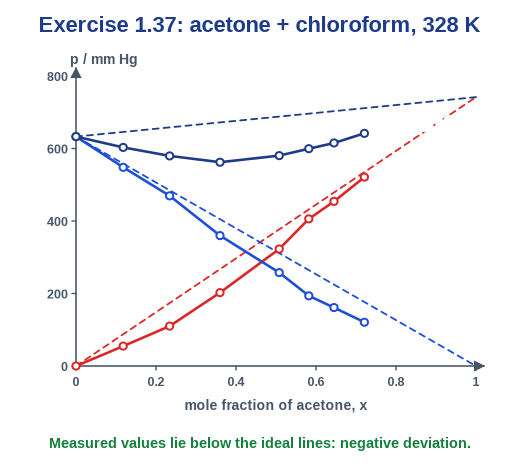
1.37 “Vapour pressures of pure acetone and chloroform at 328 K are 741.8 mm Hg and 632.8 mm Hg respectively. Assuming that they form ideal solution over the entire range of composition, plot ptotal, pchloroform, and pacetone as a function of xacetone. The experimental data observed for different compositions of mixture is:”
| 100 × xacetone | pacetone / mm Hg | pchloroform / mm Hg |
|---|---|---|
| 0 | 0 | 632.8 |
| 11.8 | 54.9 | 548.1 |
| 23.4 | 110.1 | 469.4 |
| 36.0 | 202.4 | 359.7 |
| 50.8 | 322.7 | 257.7 |
| 58.2 | 405.9 | 193.6 |
| 64.5 | 454.1 | 161.2 |
| 72.1 | 521.1 | 120.7 |
“Plot this data also on the same graph paper. Indicate whether it has positive deviation or negative deviation from the ideal solution.”
For an ideal solution (x = xacetone):
pacetone = 741.8x, pchloroform = 632.8(1 − x), ptotal = 632.8 + 109.0x
All three are straight lines. The measured totals are pacetone + pchloroform from the table:
| xacetone | measured ptotal / mm Hg | ideal ptotal / mm Hg |
|---|---|---|
| 0 | 632.8 | 632.8 |
| 0.118 | 603.0 | 645.7 |
| 0.234 | 579.5 | 658.3 |
| 0.360 | 562.1 | 672.0 |
| 0.508 | 580.4 | 688.2 |
| 0.582 | 599.5 | 696.2 |
| 0.645 | 615.3 | 703.1 |
| 0.721 | 641.8 | 711.4 |
Every measured value, total and partial, lies below its ideal line, and the measured total dips to a minimum near x = 0.36. The solution shows negative deviation from Raoult’s law, as expected: chloroform forms a hydrogen bond with acetone, so the A–B attraction is stronger than in either pure liquid.
1.38 “Benzene and toluene form ideal solution over the entire range of composition. The vapour pressure of pure benzene and toluene at 300 K are 50.71 mm Hg and 32.06 mm Hg respectively. Calculate the mole fraction of benzene in vapour phase if 80 g of benzene is mixed with 100 g of toluene.”
Molar masses: benzene C₆H₆ = 78 g mol⁻¹; toluene C₇H₈ = 92 g mol⁻¹.
Moles: benzene = 80 ÷ 78 = 1.026 mol; toluene = 100 ÷ 92 = 1.087 mol; total = 2.113 mol
x(benzene) = 1.026 ÷ 2.113 = 0.4855; x(toluene) = 0.5145
p(benzene) = 0.4855 × 50.71 = 24.62 mm Hg; p(toluene) = 0.5145 × 32.06 = 16.50 mm Hg
ptotal = 41.11 mm Hg
y(benzene) = 24.62 ÷ 41.11 = 0.60 (and y(toluene) = 0.40)
1.39 “The air is a mixture of a number of gases. The major components are oxygen and nitrogen with approximate proportion of 20% is to 79% by volume at 298 K. The water is in equilibrium with air at a pressure of 10 atm. At 298 K if the Henry’s law constants for oxygen and nitrogen at 298 K are 3.30 × 10⁷ mm and 6.51 × 10⁷ mm respectively, calculate the composition of these gases in water.”
Total pressure = 10 atm = 10 × 760 = 7600 mm Hg. For gases, volume % equals mole %, so
p(O₂) = 0.20 × 7600 = 1520 mm Hg; p(N₂) = 0.79 × 7600 = 6004 mm Hg
By Henry’s law, x = p/KH:
x(O₂) = 1520 ÷ (3.30 × 10⁷) = 4.61 × 10⁻⁵
x(N₂) = 6004 ÷ (6.51 × 10⁷) = 9.22 × 10⁻⁵
1.40 “Determine the amount of CaCl₂ (i = 2.47) dissolved in 2.5 litre of water such that its osmotic pressure is 0.75 atm at 27° C.”
T = 27 + 273 = 300 K; R = 0.0821 L atm mol⁻¹ K⁻¹; for a dilute solution the volume is about 2.5 L.
Π = i(n/V)RT, so n = ΠV/(iRT)
n = (0.75 × 2.5)/(2.47 × 0.0821 × 300) = 1.875 ÷ 60.84 = 0.0308 mol
Molar mass of CaCl₂ = 40 + 71 = 111 g mol⁻¹, so mass = 0.0308 × 111 = 3.42 g (the key gives 0.03 mol).
1.41 “Determine the osmotic pressure of a solution prepared by dissolving 25 mg of K₂SO₄ in 2 litre of water at 25° C, assuming that it is completely dissociated.”
K₂SO₄ → 2K⁺ + SO₄²⁻ gives 3 ions, so i = 3. Molar mass of K₂SO₄ = 78 + 32 + 64 = 174 g mol⁻¹.
n = 0.025 g ÷ 174 g mol⁻¹ = 1.437 × 10⁻⁴ mol; C = n/V = 7.18 × 10⁻⁵ mol L⁻¹; T = 298 K
Π = iCRT = 3 × 7.18 × 10⁻⁵ × 0.0821 × 298 = 5.27 × 10⁻³ atm
Intext Questions 1.1 to 1.12
Intext 1.1 (page 5): A solution is made from 22 g of benzene and 122 g of carbon tetrachloride. Find the mass percentage of each.
Total mass = 22 + 122 = 144 g
Benzene = 22 ÷ 144 × 100 = 15.28%; CCl₄ = 122 ÷ 144 × 100 = 84.72%
Intext 1.2 (page 5): A solution in carbon tetrachloride is 30% benzene by mass. Find the mole fraction of benzene.
In 100 g: 30 g of benzene (78 g mol⁻¹) and 70 g of CCl₄ (12 + 4 × 35.5 = 154 g mol⁻¹).
Moles: benzene = 30 ÷ 78 = 0.3846 mol; CCl₄ = 70 ÷ 154 = 0.4545 mol
x(benzene) = 0.3846 ÷ 0.8391 = 0.458; x(CCl₄) = 0.542 (the key prints 0.459 and 0.541; the small difference is rounding).
Intext 1.3 (page 5): Find the molarity of (a) 30 g of Co(NO₃)₂·6H₂O in 4.3 L of solution, (b) 30 mL of 0.5 M H₂SO₄ diluted to 500 mL.
(a) Molar mass = 59 + 2 × (14 + 48) + 6 × 18 = 291 g mol⁻¹; moles = 30 ÷ 291 = 0.1031 mol
Molarity = 0.1031 ÷ 4.3 = 0.024 M
(b) Moles of H₂SO₄ = 0.5 mol L⁻¹ × 0.030 L = 0.015 mol, unchanged by dilution
Molarity = 0.015 ÷ 0.500 = 0.03 M
Intext 1.4 (page 5): What mass of urea is needed to make 2.5 kg of a 0.25 molal aqueous solution?
Urea, NH₂CONH₂ = 60 g mol⁻¹. A 0.25 m solution has 0.25 mol = 15 g of urea per 1000 g of water, that is, 15 g in 1015 g of solution.
Urea in 2500 g of solution = 15 × 2500 ÷ 1015 = 36.95 g (the key gives 36.946 g).
Intext 1.5 (page 5): Aqueous KI is 20% by mass, with density 1.202 g mL⁻¹. Find its (a) molality, (b) molarity and (c) mole fraction of KI.
In 100 g: 20 g of KI (39 + 127 = 166 g mol⁻¹) and 80 g of water. Moles of KI = 20 ÷ 166 = 0.1205 mol.
(a) Molality = 0.1205 ÷ 0.080 = 1.51 mol kg⁻¹
(b) Volume = 100 ÷ 1.202 = 83.19 mL; molarity = 0.1205 ÷ 0.08319 = 1.45 M
(c) Moles of water = 80 ÷ 18 = 4.444; x(KI) = 0.1205 ÷ (0.1205 + 4.444) = 0.0263
Intext 1.6 (page 9): The solubility of H₂S in water at STP is 0.195 m. Find its Henry’s law constant.
0.195 mol of H₂S in 1 kg of water (1000 ÷ 18 = 55.56 mol):
x(H₂S) = 0.195 ÷ (55.56 + 0.195) = 3.50 × 10⁻³
Taking STP as 273.15 K and 1 bar (Extra: the standard definition, not printed in this unit), p = 1 bar:
KH = p/x = 1 bar ÷ 3.50 × 10⁻³ = 286 bar (2.86 × 10⁷ Pa)
If STP is taken at 1 atm (1.013 bar), KH comes to about 290 bar.
Intext 1.7 (page 9): KH for CO₂ in water is 1.67 × 10⁸ Pa at 298 K. Find the amount of CO₂ in 500 mL of soda water packed under 2.5 atm of CO₂.
p = 2.5 atm = 2.5 × 1.013 × 10⁵ Pa = 2.533 × 10⁵ Pa
x(CO₂) = p/KH = 2.533 × 10⁵ ÷ 1.67 × 10⁸ = 1.517 × 10⁻³
500 mL of soda water is about 500 g of water = 27.78 mol. The CO₂ is tiny next to it, so
n(CO₂) = 1.517 × 10⁻³ × 27.78 = 0.0421 mol
Mass of CO₂ = 0.0421 × 44 = 1.85 g
Intext 1.8 (page 15): Pure A and B have vapour pressures 450 and 700 mm Hg at 350 K. Their mixture has a total vapour pressure of 600 mm Hg. Find the composition of the liquid and of the vapour.
ptotal = pA⁰ + (pB⁰ − pA⁰)xB: 600 = 450 + 250xB, so xB = 0.6 and xA = 0.4
pA = 0.4 × 450 = 180 mm Hg; pB = 0.6 × 700 = 420 mm Hg
Vapour: yA = 180 ÷ 600 = 0.30; yB = 420 ÷ 600 = 0.70
Intext 1.9 (page 23): Pure water has a vapour pressure of 23.8 mm Hg at 298 K. 50 g of urea is dissolved in 850 g of water. Find the vapour pressure and its relative lowering.
Moles: urea = 50 ÷ 60 = 0.833 mol; water = 850 ÷ 18 = 47.22 mol
Relative lowering = x(urea) = 0.833 ÷ (0.833 + 47.22) = 0.0173
p = 23.8 × (1 − 0.0173) = 23.39 mm Hg (the key gives 23.4 mm Hg)
Intext 1.10 (page 23): Water boils at 99.63 °C under 750 mm Hg. How much sucrose must be added to 500 g of water to make it boil at 100 °C?
ΔTb = 100 − 99.63 = 0.37 K; Kb = 0.52 K kg mol⁻¹
m = ΔTb/Kb = 0.37 ÷ 0.52 = 0.7115 mol kg⁻¹
Moles in 0.500 kg = 0.3558 mol; sucrose C₁₂H₂₂O₁₁ = 342 g mol⁻¹
Mass = 0.3558 × 342 = 121.67 g
Intext 1.11 (page 23): How much ascorbic acid (C₆H₈O₆) in 75 g of acetic acid brings the acid’s melting point down by 1.5 °C? Take Kf = 3.9 K kg mol⁻¹.
m = ΔTf/Kf = 1.5 ÷ 3.9 = 0.3846 mol kg⁻¹
Moles in 0.075 kg = 0.02885 mol; C₆H₈O₆ = 72 + 8 + 96 = 176 g mol⁻¹
Mass = 0.02885 × 176 = 5.077 g
Intext 1.12 (page 23): Find, in pascals, the osmotic pressure of 1.0 g of a polymer of molar mass 185,000 g mol⁻¹ dissolved in 450 mL of water at 37 °C.
n = 1.0 ÷ 185 000 = 5.405 × 10⁻⁶ mol; V = 450 mL = 4.50 × 10⁻⁴ m³; T = 310 K
Π = (n/V)RT = (5.405 × 10⁻⁶ ÷ 4.50 × 10⁻⁴) × 8.314 × 310 = 30.96 Pa
Worked examples 1.1 to 1.7 (pages 4–18)
Example 1.1 (page 4): Find the mole fraction of ethylene glycol in a solution that is 20% ethylene glycol by mass.
In 100 g: 20 g of C₂H₆O₂ (62 g mol⁻¹) = 0.3226 mol and 80 g of water = 4.444 mol.
x(glycol) = 0.3226 ÷ 4.767 = 0.068; x(water) = 1 − 0.068 = 0.932
Example 1.2 (page 4): Find the molarity of 5 g of NaOH in 450 mL of solution.
Moles = 5 ÷ 40 = 0.125 mol; molarity = 0.125 ÷ 0.450 = 0.278 M (0.278 mol L⁻¹).
(The book’s working says “equation (2.8)”; it means equation (1.8). Its later examples also cite (2.16), (2.19), (2.28), (2.33) and (2.42) for (1.16), (1.19), (1.28), (1.33) and (1.42), numbers left from the older book, in which Solutions was Unit 2.)
Example 1.3 (page 5): Find the molality of 2.5 g of ethanoic acid in 75 g of benzene.
Moles of CH₃COOH (60 g mol⁻¹) = 2.5 ÷ 60 = 0.0417 mol
Molality = 0.0417 ÷ 0.075 = 0.556 mol kg⁻¹
Example 1.4 (page 8): N₂ at a partial pressure of 0.987 bar is bubbled through water at 293 K, where KH = 76.48 kbar. How many millimoles of N₂ dissolve in 1 litre of water?
x(N₂) = p/KH = 0.987 ÷ 76 480 = 1.29 × 10⁻⁵
1 L of water is about 55.5 mol, and n(N₂) is tiny beside it, so n = 1.29 × 10⁻⁵ × 55.5 = 7.16 × 10⁻⁴ mol = 0.716 mmol
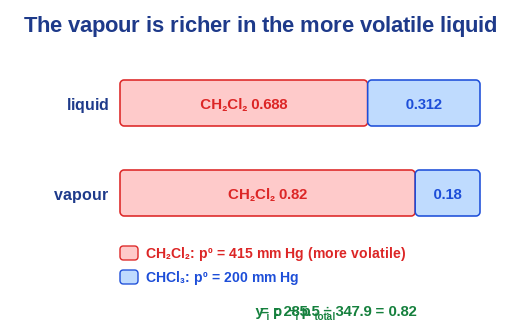
Example 1.5 (page 11): At 298 K, CHCl₃ and CH₂Cl₂ have vapour pressures of 200 and 415 mm Hg. 25.5 g of CHCl₃ is mixed with 40 g of CH₂Cl₂. Find (i) the vapour pressure of the solution and (ii) the mole fractions in the vapour.
Molar masses: CH₂Cl₂ = 12 + 2 + 71 = 85 g mol⁻¹; CHCl₃ = 12 + 1 + 106.5 = 119.5 g mol⁻¹.
Moles: CH₂Cl₂ = 40 ÷ 85 = 0.470 mol; CHCl₃ = 25.5 ÷ 119.5 = 0.213 mol; total = 0.684 mol
x(CH₂Cl₂) = 0.688; x(CHCl₃) = 0.312
(i) ptotal = 200 + (415 − 200) × 0.688 = 347.9 mm Hg
(ii) p(CH₂Cl₂) = 0.688 × 415 = 285.5 mm Hg; p(CHCl₃) = 0.312 × 200 = 62.4 mm Hg
y(CH₂Cl₂) = 285.5 ÷ 347.9 = 0.82; y(CHCl₃) = 0.18
The more volatile CH₂Cl₂ is richer in the vapour than in the liquid.
Example 1.6 (page 16): Pure benzene (78 g mol⁻¹) has a vapour pressure of 0.850 bar. 0.5 g of a non-volatile non-electrolyte in 39.0 g of benzene lowers it to 0.845 bar. Find the molar mass of the solid.
(p₁⁰ − p₁)/p₁⁰ = (w₂M₁)/(M₂w₁)
(0.850 − 0.845)/0.850 = (0.5 × 78)/(M₂ × 39)
M₂ = (0.5 × 78 × 0.850)/(0.005 × 39) = 170 g mol⁻¹
Example 1.7 (pages 17–18): 18 g of glucose is dissolved in 1 kg of water. At what temperature does it boil at 1.013 bar? Kb = 0.52 K kg mol⁻¹.
m = (18 ÷ 180) mol ÷ 1 kg = 0.1 mol kg⁻¹
ΔTb = 0.52 × 0.1 = 0.052 K
Boiling point = 373.15 + 0.052 = 373.202 K
Worked examples 1.8 to 1.13 (pages 18–26)
Example 1.8 (page 18): 1.80 g of a non-volatile solute in 90 g of benzene raises its boiling point from 353.23 K to 354.11 K. Kb = 2.53 K kg mol⁻¹. Find the molar mass.
ΔTb = 354.11 − 353.23 = 0.88 K
M₂ = (1000 × Kb × w₂)/(ΔTb × w₁) = (1000 × 2.53 × 1.8)/(0.88 × 90) = 57.5 ≈ 58 g mol⁻¹
Example 1.9 (page 20): 45 g of ethylene glycol is mixed with 600 g of water. Find (a) the depression of freezing point and (b) the freezing point.
Moles = 45 ÷ 62 = 0.726 mol; m = 0.726 ÷ 0.600 = 1.21 mol kg⁻¹
(a) ΔTf = 1.86 × 1.21 = 2.25 K
(b) Freezing point = 273.15 − 2.25 = 270.90 K
(The book rounds the molality to 1.2 mol kg⁻¹ and gets 2.2 K and 270.95 K.)
Example 1.10 (page 20): 1.00 g of a non-electrolyte in 50 g of benzene lowers its freezing point by 0.40 K. Kf = 5.12 K kg mol⁻¹. Find the molar mass.
M₂ = (1000 × 5.12 × 1.00)/(0.40 × 50) = 256 g mol⁻¹
Example 1.11 (page 22): 200 cm³ of an aqueous protein solution holds 1.26 g of protein and has an osmotic pressure of 2.57 × 10⁻³ bar at 300 K. Find the molar mass of the protein.
M₂ = w₂RT/(ΠV) = (1.26 × 0.083 × 300)/(2.57 × 10⁻³ × 0.200)
= 31.37 ÷ 5.14 × 10⁻⁴ = 6.10 × 10⁴ g mol⁻¹ (61 039 g mol⁻¹; the book prints 61 022 g mol⁻¹)
Example 1.12 (pages 25–26): 2 g of benzoic acid in 25 g of benzene lowers its freezing point by 1.62 K (Kf = 4.9 K kg mol⁻¹). If the acid forms dimers, what percentage of it is associated?
Observed molar mass: M₂ = (1000 × 4.9 × 2)/(1.62 × 25) = 241.98 g mol⁻¹
Normal molar mass of C₆H₅COOH = 122 g mol⁻¹, so i = 122 ÷ 241.98 = 0.504
For 2C₆H₅COOH ⇌ (C₆H₅COOH)₂, if a fraction x associates, the particles are (1 − x) + x/2 = 1 − x/2, so i = 1 − x/2
1 − x/2 = 0.504, so x = 0.992: 99.2% associated
Example 1.13 (page 26): 0.6 mL of acetic acid (density 1.06 g mL⁻¹) in 1 L of water lowers the freezing point by 0.0205 °C. Find the van’t Hoff factor and the dissociation constant.
Mass = 0.6 × 1.06 = 0.636 g; moles = 0.636 ÷ 60 = 0.0106 mol; m = 0.0106 mol kg⁻¹ (1 L of water ≈ 1 kg)
Calculated ΔTf = 1.86 × 0.0106 = 0.01972 K
i = 0.0205 ÷ 0.01972 = 1.040
CH₃COOH ⇌ CH₃COO⁻ + H⁺ gives i = 1 + x, so x = 0.0398
Ka = nx²/(1 − x) = 0.0106 × (0.0398)² ÷ 0.960 = 1.75 × 10⁻⁵
(The book rounds the calculated ΔTf to 0.0197 K and gets i = 1.041, x = 0.041 and Ka = 1.86 × 10⁻⁵. Because x is small and squared, this rounding moves Ka noticeably; both answers are about 2 × 10⁻⁵.)
Practice
-
0.5 mol of a solute is dissolved in 250 g of water. The molality is:
Show answer
Answer: (c) 2 mol kg⁻¹
-
Which 0.1 m aqueous solution has the highest boiling point?
Show answer
Answer: (c) K₂SO₄
-
Two liquids with p₁⁰ = 120 mm Hg and p₂⁰ = 80 mm Hg form an ideal solution with x₁ = 0.25. The total vapour pressure is:
Show answer
Answer: (a) 90 mm Hg
-
1.8 g of glucose (180 g mol⁻¹) is dissolved in 100 g of water. Find its freezing point (Kf = 1.86 K kg mol⁻¹).
Show answer
Answer: m = 0.01 mol ÷ 0.100 kg = 0.10 mol kg⁻¹; ΔTf = 1.86 × 0.10 = 0.186 K; freezing point = 273.15 − 0.186 = 272.96 K.
-
Find the osmotic pressure of a 0.01 M glucose solution at 300 K (R = 0.083 L bar mol⁻¹ K⁻¹).
Show answer
Answer: Π = CRT = 0.01 × 0.083 × 300 = 0.249 bar.
Stuck on a question?
Take a photo and Lagnever AI explains it step by step. Try it for 7 days for ₹2.
Get it on Google Play Open in browser
For parents: after the trial, the plan renews monthly by UPI or card autopay. You can cancel anytime in the app.