
Class 12 Chemistry Chapter 1: Solutions Notes
This chapter in five lines
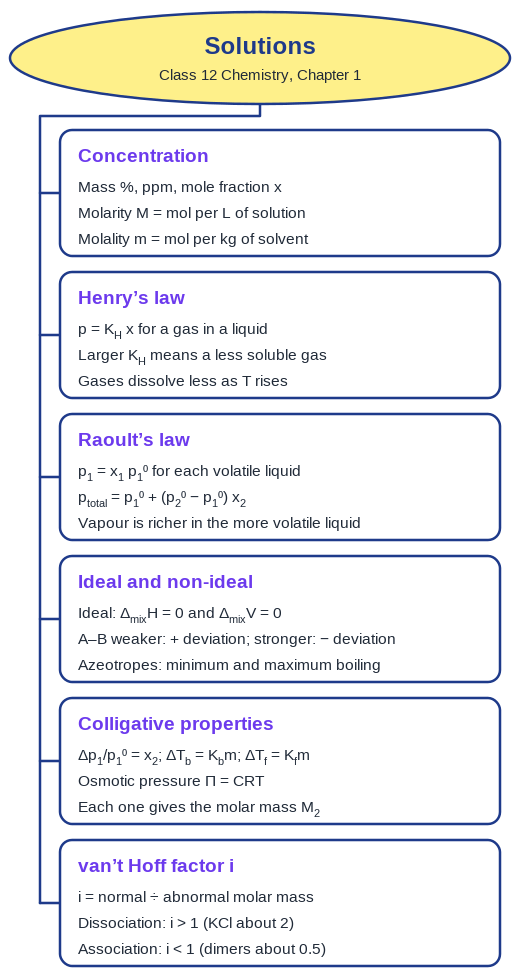
A solution is a uniform mixture whose concentration can be given as mass %, ppm, mole fraction, molarity or molality. Henry’s law, p = KH x, governs gases in liquids; Raoult’s law, p₁ = x₁p₁⁰, governs vapour pressure. Ideal solutions obey Raoult’s law throughout. Colligative properties depend only on the number of solute particles and give molar masses, corrected by the van’t Hoff factor i.
What is this chapter about?
Almost nothing around us is a pure substance. Sea water, blood, a soft drink, the steel in a bridge and the air we breathe are all mixtures, and what they can do depends on what is in them and how much. The water in a saline drip must match the salt level of blood; a little fluoride in drinking water protects teeth, while too much spots them. This chapter, Unit 1 of Chemistry Part I, is about solutions: how to state their make-up in numbers, how gases and solids dissolve, how solutions evaporate, and the properties that depend only on how many solute particles are present.
What is a solution, and how many types are there?
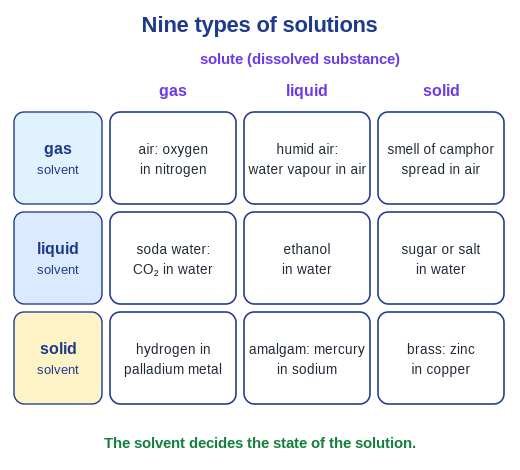
A solution is a homogeneous mixture: its composition and properties are the same everywhere in it. The component present in the largest amount is usually the solvent, and it decides whether the solution is a gas, a liquid or a solid. The others are solutes. This chapter deals with binary solutions, which have just two components. Each can be a gas, a liquid or a solid, which gives nine types.
How do we express the concentration of a solution?
Words such as “dilute” and “concentrated” are too vague, so we use numbers:
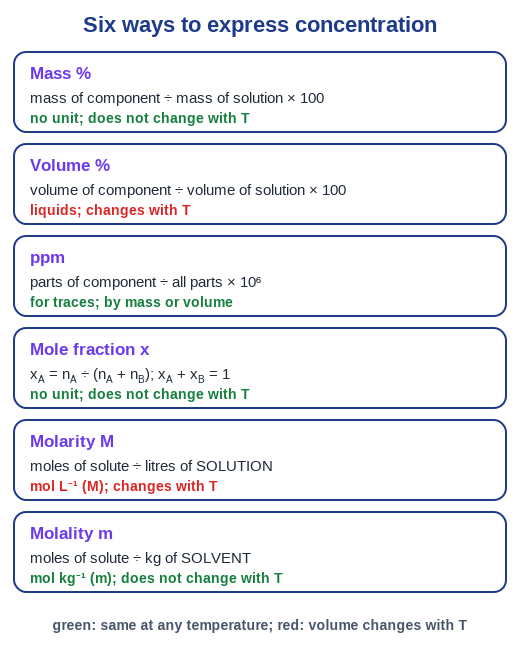
- Mass percentage (w/w) = mass of the component ÷ mass of the solution × 100. A 10% glucose solution by mass has 10 g of glucose in 100 g of solution.
- Volume percentage (V/V) = volume of the component ÷ volume of the solution × 100, used for liquids. A 35% (v/v) solution of ethylene glycol in water is used as antifreeze in car engines: it does not freeze until about 255.4 K (−17.6 °C).
- Mass by volume percentage (w/V): grams of solute in 100 mL of solution, common in medicine.
- Parts per million (ppm) = parts of the component ÷ total parts × 10⁶, for traces such as dissolved oxygen in sea water or pollutants in air.
- Mole fraction, xA = nA/(nA + nB). All the mole fractions in a solution add up to 1.
- Molarity (M) = moles of solute ÷ volume of solution in litres; unit mol L⁻¹.
- Molality (m) = moles of solute ÷ mass of solvent in kilograms; unit mol kg⁻¹.
Mass %, ppm, mole fraction and molality are based on masses, so they stay the same when the temperature changes. Molarity changes, because a solution expands when warmed. Read concentration terms and Henry’s law.
What decides how much of a solid dissolves?
Solubility is the largest amount of a substance that dissolves in a given amount of solvent at a given temperature and pressure. Salt and sugar dissolve in water but not in benzene, while naphthalene does the opposite: polar solutes dissolve in polar solvents and non-polar solutes in non-polar ones, or like dissolves like. As a solid dissolves, some particles also come back out of solution. When the two processes run at the same rate, a dynamic equilibrium is reached and the solution is saturated; a solution that can still take more solute is unsaturated.
Temperature shifts this equilibrium, as Le Chatelier’s principle predicts. If dissolving takes in heat (ΔsolH > 0), solubility rises with temperature; if it gives out heat (ΔsolH < 0), solubility falls. Pressure hardly matters for solids, because solids and liquids barely compress.
How does pressure change the solubility of a gas?
Squeeze the gas above a liquid and more gas molecules strike the surface each second, so more dissolve until a new equilibrium is reached. Henry’s law puts this in numbers: at a constant temperature, the partial pressure of a gas over a solution is proportional to its mole fraction in the solution,
p = KH x
KH, the Henry’s law constant, depends on the gas and the temperature. For a given pressure, the larger KH is, the less the gas dissolves. At 293 K, KH is 34.86 kbar for oxygen and 76.48 kbar for nitrogen, so oxygen is the more soluble of the two. KH grows with temperature (for oxygen, 46.82 kbar at 303 K), because dissolving a gas gives out heat, like condensing a vapour. That is why gases dissolve less in warm water, and why fish and other water animals are more comfortable in cold water.
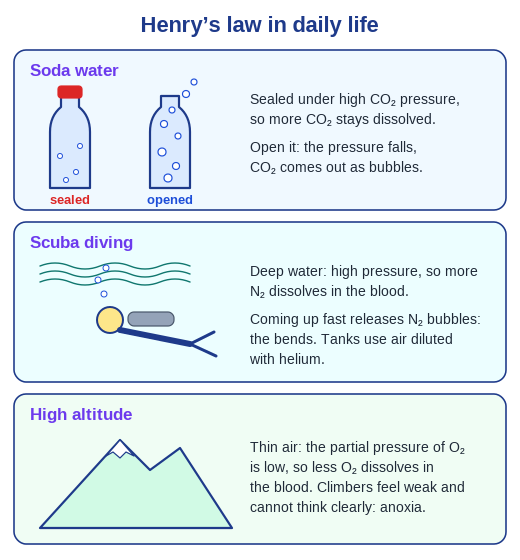
Henry’s law at work: soft drinks are sealed under high CO₂ pressure; scuba divers breathing compressed air can get “the bends” when dissolved nitrogen forms bubbles in the blood as they rise, so their tanks hold air diluted with helium (11.7% helium, 56.2% nitrogen, 32.1% oxygen); and at high altitudes the low partial pressure of oxygen leaves climbers weak and confused, a condition called anoxia.
What does Raoult’s law say?
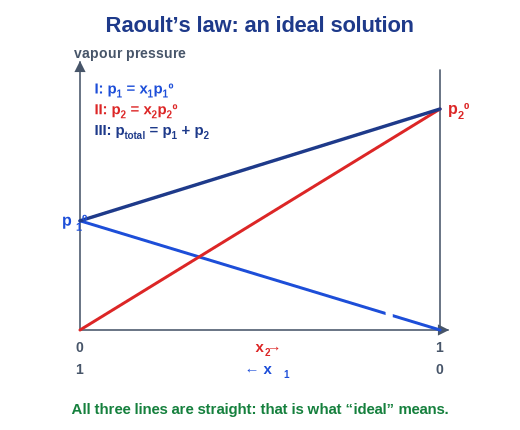
Mix two volatile liquids in a closed vessel and both evaporate until the vapour is in equilibrium with the liquid. Raoult’s law says that the partial vapour pressure of each component equals its mole fraction in the solution times its vapour pressure when pure:
p₁ = x₁p₁⁰ and p₂ = x₂p₂⁰
By Dalton’s law of partial pressures the total is ptotal = p₁ + p₂ = p₁⁰ + (p₂⁰ − p₁⁰)x₂, a straight line between p₁⁰ and p₂⁰. The vapour’s composition follows from pi = yiptotal, and the vapour is always richer in the more volatile liquid. Raoult’s law is a special case of Henry’s law in which KH equals p₁⁰.
When the solute is non-volatile, such as glucose or salt in water, only the solvent evaporates, so p₁ = x₁p₁⁰. Solute particles take up part of the surface, fewer solvent molecules escape, and the vapour pressure falls. Read Raoult’s law and ideal solutions.
What are ideal and non-ideal solutions?
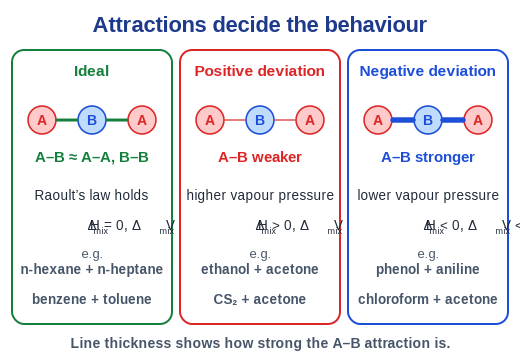
An ideal solution obeys Raoult’s law at every concentration. Mixing its components gives out or takes in no heat and causes no change in volume: ΔmixH = 0 and ΔmixV = 0. This happens when the attraction between unlike molecules (A–B) is about the same as between like ones (A–A and B–B). No solution is perfectly ideal, but n-hexane with n-heptane, bromoethane with chloroethane, and benzene with toluene come close.
A non-ideal solution does not obey Raoult’s law over the whole range:
- Positive deviation: A–B attractions are weaker, molecules escape more easily, and the vapour pressure is higher than Raoult’s law predicts. Acetone breaks some of the hydrogen bonds in ethanol, so ethanol and acetone behave this way; so do carbon disulphide and acetone.
- Negative deviation: A–B attractions are stronger, molecules escape less easily, and the vapour pressure is lower. Phenol and aniline form strong hydrogen bonds with each other, and chloroform forms a hydrogen bond with acetone.
What is an azeotrope?
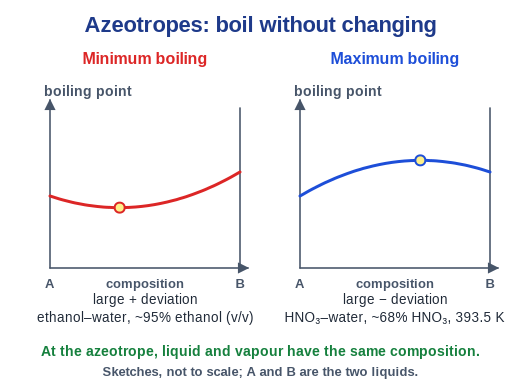
An azeotrope is a binary mixture that boils at a constant temperature, giving a vapour with the same composition as the liquid, so fractional distillation cannot separate it further. A large positive deviation gives a minimum-boiling azeotrope: distilling the ethanol–water mixture from fermented sugars stops at about 95% ethanol by volume. A large negative deviation gives a maximum-boiling azeotrope: nitric acid and water at about 68% acid and 32% water by mass, boiling at 393.5 K.
What are colligative properties?
Four properties of a dilute solution of a non-volatile solute depend only on the number of solute particles compared with the total, not on what the particles are. They are called colligative properties (from the Latin for “bound together”):
- Relative lowering of vapour pressure: (p₁⁰ − p₁)/p₁⁰ = x₂. For a dilute solution this is about n₂/n₁ = w₂M₁/(M₂w₁).
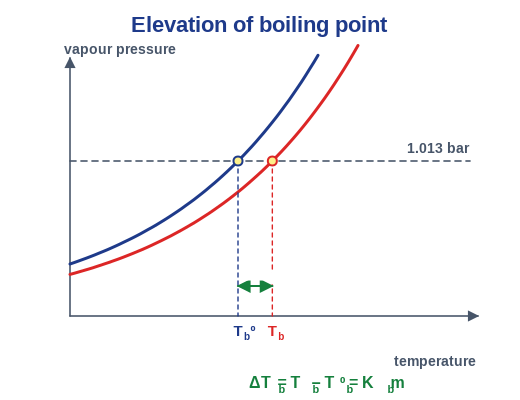
- Elevation of boiling point: the solution must be hotter before its vapour pressure reaches the outside pressure, so ΔTb = Tb − Tb⁰ = Kbm. For water Kb = 0.52 K kg mol⁻¹; 1 mol of sucrose in 1 kg of water boils at 373.52 K.
- Depression of freezing point: ΔTf = Tf⁰ − Tf = Kfm. For water Kf = 1.86 K kg mol⁻¹, and for benzene 5.12 K kg mol⁻¹.
- Osmotic pressure: Π = CRT, where C is the molarity.
Each one gives the molar mass of the solute, for example M₂ = 1000 × Kb × w₂/(ΔTb × w₁), with masses in grams. The constants depend only on the solvent: Kb = R × M₁ × Tb²/(1000 × ΔvapH) and Kf = R × M₁ × Tf²/(1000 × ΔfusH). Read colligative properties.
What are osmosis and osmotic pressure?
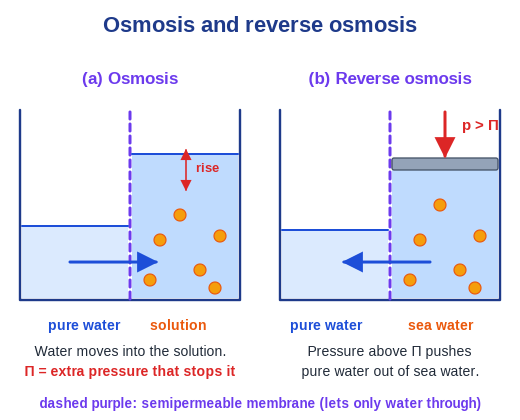
A semipermeable membrane, such as a pig’s bladder, parchment or cellophane, has pores that let small solvent molecules through but hold back solute particles. When it separates a solvent from a solution, solvent flows into the solution. This flow is osmosis, and solvent always moves from the lower to the higher solute concentration. The extra pressure that must be put on the solution to stop the flow is its osmotic pressure, Π = CRT = (n₂/V)RT, so M₂ = w₂RT/(ΠV). Osmotic pressure is large even for very dilute solutions and is measured near room temperature, so it is the method of choice for the molar masses of proteins and polymers.
Solutions with equal osmotic pressure are isotonic. Blood cells are isotonic with 0.9% (mass/volume) sodium chloride, normal saline, which is why it is safe to inject into a vein. In a stronger, hypertonic salt solution cells lose water and shrink; in a weaker, hypotonic one they take in water and swell. Osmosis explains why raw mangoes shrivel in brine for pickles, wilted flowers revive in fresh water, salty food causes puffiness (edema), and salt or sugar preserves meat and fruit by drying out bacteria.
If a pressure larger than Π is applied on the solution side, the flow reverses and pure water is pushed out: reverse osmosis. Desalination plants use it to make drinking water from sea water, with membranes such as cellulose acetate.
Why do some solutes give abnormal molar masses?
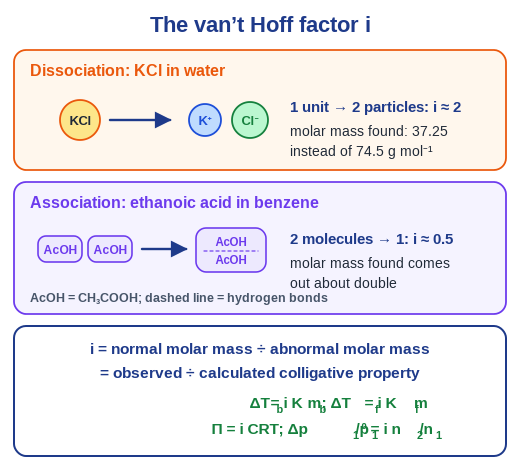
Colligative properties count particles. KCl splits into K⁺ and Cl⁻ in water, so one mole gives about two moles of particles and the boiling point rises about twice as much as expected (2 × 0.52 K = 1.04 K for 1 mol in 1 kg of water, if the ions do not attract each other). A molar mass worked out from it would come out near 37.25 g mol⁻¹ instead of 74.5 g mol⁻¹. Ethanoic acid molecules pair up into dimers in benzene through hydrogen bonds, so the particles halve and the molar mass found comes out about double. A molar mass lower or higher than the true one is called abnormal.
In 1880 van’t Hoff introduced the factor i to account for this:
i = normal molar mass ÷ abnormal molar mass = observed colligative property ÷ calculated colligative property
i is greater than 1 for dissociation and less than 1 for association. The colligative formulas become ΔTb = iKbm, ΔTf = iKfm, Π = i n₂RT/V and (p₁⁰ − p₁)/p₁⁰ = i n₂/n₁. For NaCl and KCl, i approaches 2 as the solution gets very dilute (1.97 and 1.98 at 0.001 m); for K₂SO₄ it approaches 3.
Stay safe
Many liquids in this chapter, such as benzene, chloroform, carbon tetrachloride, carbon disulphide and nitric acid, are toxic, flammable or corrosive. Any experiment with them, and any osmosis or boiling-point experiment, is done only in the school laboratory with your teacher.
Before we move on
The chapter rests on three ideas: concentration in numbers, the two laws that link pressure to mole fraction (Henry’s and Raoult’s), and colligative properties that count particles. Learn each formula with its unit and practise turning it round to find M₂. Every exercise, in-text question and worked example of the unit is solved in the NCERT solutions for Chapter 1.
Key terms
| Term | Meaning |
|---|---|
| Solution | A homogeneous mixture of two or more substances, with the same composition and properties throughout. |
| Solvent and solute | The solvent is usually the component present in the largest amount and decides the state of the solution; the other components are solutes. |
| Mole fraction (x) | Moles of a component divided by the total moles of all components; no unit, and all mole fractions add up to 1. |
| Molarity (M) | Moles of solute in 1 litre of solution; unit mol L⁻¹. It changes with temperature because volume does. |
| Molality (m) | Moles of solute per kilogram of solvent; unit mol kg⁻¹. It does not change with temperature. |
| Solubility | The largest amount of a substance that dissolves in a given amount of solvent at a given temperature and pressure. |
| Henry’s law | The partial pressure of a gas over a solution is proportional to its mole fraction in the solution: p = KH x. |
| Raoult’s law | The partial vapour pressure of each volatile component equals its mole fraction times its vapour pressure when pure: p₁ = x₁p₁⁰. |
| Ideal solution | A solution that obeys Raoult’s law at every concentration, with ΔmixH = 0 and ΔmixV = 0. |
| Azeotrope | A liquid mixture that boils at a constant temperature with the same composition in the liquid and the vapour. |
| Colligative property | A property that depends on the number of solute particles, not on what they are: lowering of vapour pressure, ΔTb, ΔTf and osmotic pressure. |
| Semipermeable membrane | A film with tiny pores that lets solvent molecules through but holds back larger solute particles. |
| Osmotic pressure (Π) | The extra pressure that must be put on a solution to stop solvent flowing into it through a semipermeable membrane; Π = CRT. |
| van’t Hoff factor (i) | Normal molar mass divided by abnormal molar mass; above 1 when the solute dissociates, below 1 when it associates. |
Topics in this chapter
Practice
-
Which concentration term changes when a solution is warmed?
Show answer
Answer: (c) molarity
-
At the same temperature, gas X has a larger KH than gas Y. Which is true?
Show answer
Answer: (b) X is less soluble
-
A mixture of chloroform and acetone shows:
Show answer
Answer: (c) negative deviation
-
Which of these is NOT a colligative property?
Show answer
Answer: (c) vapour pressure of the pure solvent
-
The SI unit of the molal elevation constant Kb is:
Show answer
Answer: (b) K kg mol⁻¹
-
For K₂SO₄ that dissociates completely in water, the van’t Hoff factor is:
Show answer
Answer: (c) 3
Questions students ask
What are the main topics of Class 12 Chemistry Chapter 1?
Types of solutions, the ways to express concentration, the solubility of solids and gases with Henry’s law, the vapour pressure of solutions and Raoult’s law, ideal and non-ideal solutions with azeotropes, the four colligative properties and how they give molar masses, and abnormal molar masses with the van’t Hoff factor.
Which formulas must I learn in the Solutions chapter?
p = KH x; p₁ = x₁p₁⁰ and p_total = p₁⁰ + (p₂⁰ − p₁⁰)x₂; (p₁⁰ − p₁)/p₁⁰ = x₂; ΔTb = Kb m; ΔTf = Kf m; Π = CRT; and i = normal molar mass ÷ abnormal molar mass, which multiplies each colligative formula. Learn the rearranged forms for M₂ too.
Is Solutions in the 2026-27 NCERT Class 12 Chemistry book?
Yes. It is Unit 1 of Chemistry Part I, the Class 12 textbook marked Reprint 2026-27, on pages 1 to 30. The rationalised book no longer has the old Solid State unit, so Solutions now comes first.
What is the difference between molarity and molality?
Molarity counts moles of solute per litre of the whole solution, while molality counts moles of solute per kilogram of the solvent alone. Volume changes with temperature, so molarity does too; mass does not, so molality stays the same when the solution is warmed.
Stuck on a question?
Take a photo and Lagnever AI explains it step by step. Try it for 7 days for ₹2.
Get it on Google Play Open in browser
For parents: after the trial, the plan renews monthly by UPI or card autopay. You can cancel anytime in the app.