
What are molarity, molality and Henry’s law?
Answer in short
Molarity is moles of solute per litre of solution (mol L⁻¹); molality is moles of solute per kilogram of solvent (mol kg⁻¹). Mass %, ppm and mole fraction also express concentration. Henry’s law says the partial pressure of a gas over a solution is proportional to its mole fraction in it: p = KH x.
Stuck on a question? Take a photo and Lagnever AI explains it step by step. Try it for 7 days for ₹2. Get it on Google Play
What is a solution made of?
A solution is a mixture that is the same all through. The component present in the largest amount is usually the solvent, and it fixes the state of the solution; the rest are solutes. Air, soda water, sugar syrup and brass are all solutions. Here we deal with two-component, or binary, solutions.
How do we put the amount of solute into numbers?
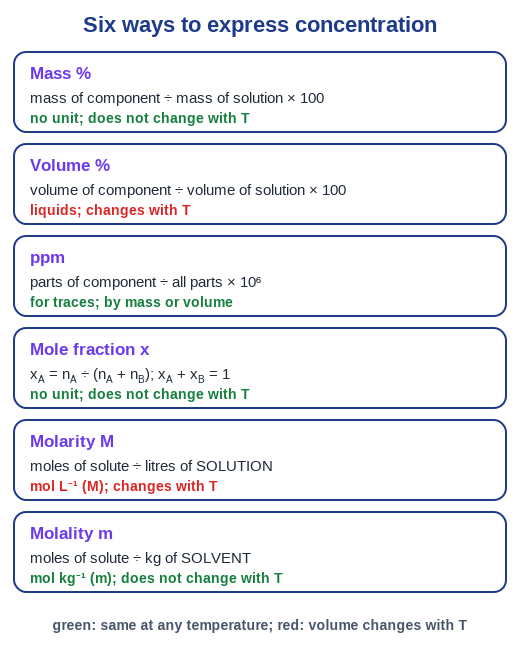
The concentration of a solution tells us how much solute it holds. There are several ways to state it, and each suits a different job:
- Mass percentage = (mass of component ÷ mass of solution) × 100. Used widely in industry; household bleach, for example, is a few percent sodium hypochlorite by mass.
- Volume percentage = (volume of component ÷ volume of solution) × 100, used for liquids mixed with liquids.
- Mass by volume percentage = grams of solute in 100 mL of solution, common in medicine and pharmacy.
- Parts per million (ppm) = (parts of component ÷ total parts) × 10⁶. It suits traces: 1 ppm of fluoride in drinking water helps prevent tooth decay, while 1.5 ppm can spot the teeth.
- Mole fraction: xA = nA/(nA + nB). It has no unit, and all the mole fractions add up to 1. It is the natural measure for vapour pressure and for gas mixtures.
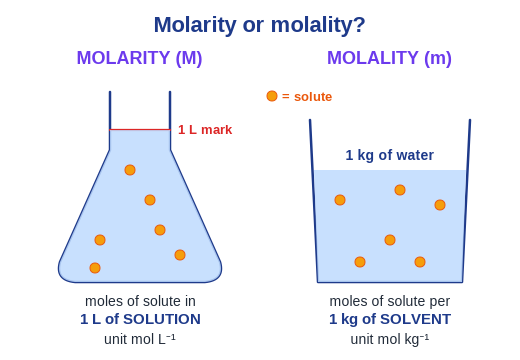
- Molarity (M) = moles of solute ÷ volume of solution in litres. A 0.25 M NaOH solution has 0.25 mol of NaOH in every litre of solution.
- Molality (m) = moles of solute ÷ mass of solvent in kilograms. A 1.00 m KCl solution has 1 mol (74.5 g) of KCl in 1 kg of water.
Molarity or molality: which one changes with temperature?
Molarity is based on the volume of the solution, and liquids expand when warmed. So the same solution has a slightly lower molarity on a hot day. Mass %, ppm, mole fraction and molality depend only on masses or moles, so they do not change with temperature. That is why the boiling and freezing point formulas later in the chapter use molality.
Our own example. 9.0 g of glucose (C₆H₁₂O₆, 180 g mol⁻¹) is dissolved in 100 g of water.
Mass % of glucose = 9.0 ÷ (9.0 + 100) × 100 = 8.26%
Moles of glucose = 9.0 ÷ 180 = 0.050 mol; moles of water = 100 ÷ 18 = 5.56 mol
Molality = 0.050 mol ÷ 0.100 kg = 0.50 mol kg⁻¹
Mole fraction of glucose = 0.050 ÷ (0.050 + 5.56) = 0.0089
What decides solubility?
Solubility is the most solute that dissolves in a given amount of solvent at a given temperature and pressure. Polar solutes dissolve in polar solvents and non-polar ones in non-polar solvents: like dissolves like. When dissolving and crystallising go on at the same rate, the solution is saturated. For a solid, temperature matters: if dissolving absorbs heat, more dissolves when it is warmer, by Le Chatelier’s principle. Pressure hardly affects solids.
What does Henry’s law say?
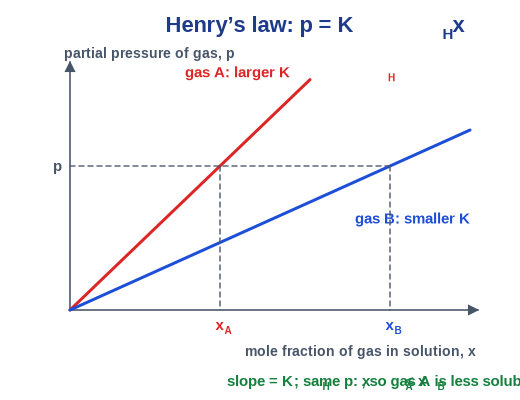
Gases behave differently. Pushing more gas against the surface of a liquid makes more of it dissolve. Henry’s law says that at a constant temperature the partial pressure of a gas over a solution is proportional to its mole fraction in the solution:
p = KH x
A graph of p against x is a straight line through the origin with slope KH. Each gas has its own KH, and the larger it is, the less soluble the gas. KH rises with temperature, so gases dissolve less in warm water: dissolving a gas gives out heat, so warming pushes the gas back out.
Our own example. Oxygen at 1 bar is bubbled through water at 293 K, where KH for oxygen is 34.86 kbar.
x = p ÷ KH = 1 bar ÷ 34 860 bar = 2.87 × 10⁻⁵
One litre of water is about 55.5 mol, so the oxygen dissolved is 2.87 × 10⁻⁵ × 55.5 = 1.59 × 10⁻³ mol, about 51 mg.
Where do we see Henry’s law?
Soft drinks are bottled under high CO₂ pressure; open the cap and the gas fizzes out. Scuba divers breathe air at high pressure, so extra nitrogen dissolves in their blood and can form painful, dangerous bubbles if they rise too fast (the bends); their tanks hold air diluted with helium. High in the mountains the partial pressure of oxygen is low, so climbers’ blood carries less oxygen and they suffer anoxia.
Next topic: Raoult’s law and ideal solutions. See also the chapter notes and the NCERT solutions.
Practice
-
4.0 g of NaOH (molar mass 40 g mol⁻¹) is dissolved to make 250 mL of solution. Its molarity is:
Show answer
Answer: (b) 0.4 M
-
Which concentration term does NOT change with temperature?
Show answer
Answer: (c) molality
-
Why are soft-drink bottles sealed under high pressure?
Show answer
Answer: (b) to dissolve more CO₂, as Henry’s law predicts
-
A solution has 1 mol of A and 3 mol of B. What are the mole fractions?
Show answer
Answer: xA = 1/(1 + 3) = 0.25 and xB = 3/4 = 0.75. They add up to 1.
-
Why do fish find it harder to breathe in warm water?
Show answer
Answer: KH for oxygen rises with temperature, so at the same partial pressure less oxygen dissolves in warm water than in cold water.
Questions students ask
What is the difference between molarity and molality?
Molarity is moles of solute per litre of solution, while molality is moles of solute per kilogram of solvent. Molarity changes slightly with temperature because the solution expands; molality does not, because masses stay the same.
What is the formula of mole fraction?
For a component A in a mixture of A and B, xA = nA/(nA + nB), where n is the number of moles. Mole fraction has no unit, and the mole fractions of all components add up to 1.
What is Henry’s law and its formula?
At a constant temperature, the partial pressure of a gas over a solution is directly proportional to the mole fraction of the gas in the solution: p = KH x. KH, the Henry’s law constant, depends on the gas and the temperature.
Does high KH mean high solubility?
No. Since x = p/KH, a larger KH gives a smaller mole fraction at the same pressure, so the gas is less soluble. At 293 K, nitrogen (KH = 76.48 kbar) is less soluble in water than oxygen (34.86 kbar).
Stuck on a question?
Take a photo and Lagnever AI explains it step by step. Try it for 7 days for ₹2.
Get it on Google Play Open in browser
For parents: after the trial, the plan renews monthly by UPI or card autopay. You can cancel anytime in the app.