
What is Raoult’s law?
Answer in short
Raoult’s law says that in a solution the partial vapour pressure of each volatile component equals its mole fraction times its vapour pressure when pure: p₁ = x₁p₁⁰. For two volatile liquids the total pressure is p₁⁰ + (p₂⁰ − p₁⁰)x₂. Solutions that obey it at all concentrations are called ideal.
Stuck on a question? Take a photo and Lagnever AI explains it step by step. Try it for 7 days for ₹2. Get it on Google Play
What is the vapour pressure of a solution?
Put a liquid in a closed bottle and some of it evaporates until the vapour above it stops growing. The pressure of that vapour at equilibrium is the liquid’s vapour pressure. Now mix two volatile liquids, 1 and 2. Both evaporate, and each one contributes a partial vapour pressure, p₁ and p₂, to the vapour.
What does Raoult’s law say?
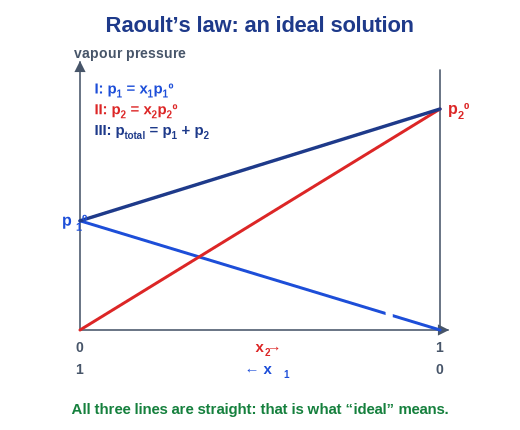
In 1886 the French chemist F. M. Raoult found how these partial pressures depend on composition. For a solution of volatile liquids, the partial vapour pressure of each component is proportional to its mole fraction in the solution:
p₁ = x₁p₁⁰ and p₂ = x₂p₂⁰
Here p₁⁰ and p₂⁰ are the vapour pressures of the pure liquids at the same temperature. By Dalton’s law of partial pressures, the total pressure is the sum:
ptotal = x₁p₁⁰ + x₂p₂⁰ = p₁⁰ + (p₂⁰ − p₁⁰)x₂
All three, p₁, p₂ and ptotal, are straight lines against mole fraction. The total runs from p₁⁰ (pure liquid 1) to p₂⁰ (pure liquid 2).
What is the composition of the vapour?
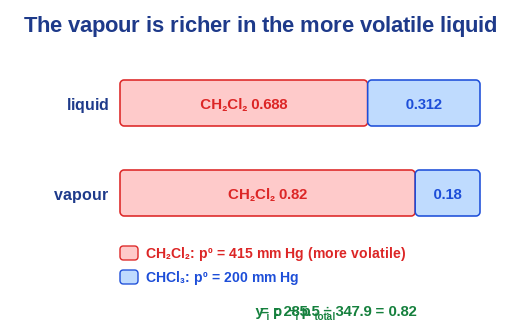
Dalton’s law also gives the mole fraction of each component in the vapour: pi = yi × ptotal, so yi = pi/ptotal.
Our own example. Liquids A and B have pA⁰ = 300 mm Hg and pB⁰ = 100 mm Hg and form an ideal solution with xA = xB = 0.5.
pA = 0.5 × 300 = 150 mm Hg; pB = 0.5 × 100 = 50 mm Hg
ptotal = 150 + 50 = 200 mm Hg
yA = 150 ÷ 200 = 0.75; yB = 0.25
The liquid is half A, but the vapour is three-quarters A. The vapour is always richer in the more volatile component, which is why distillation can separate liquids.
How is Raoult’s law linked to Henry’s law?
Henry’s law says p = KHx for a gas dissolved in a liquid. Raoult’s law says p₁ = x₁p₁⁰. Both make the partial pressure proportional to the mole fraction; only the constant differs. So Raoult’s law is a special case of Henry’s law with KH = p₁⁰.
What if the solute does not evaporate?
Glucose, urea, salt and sugar are non-volatile: only the solvent goes into the vapour. Raoult’s law then reads p₁ = x₁p₁⁰. Since x₁ is less than 1, the solution’s vapour pressure is lower than the pure solvent’s. Solute particles occupy part of the surface, so fewer solvent molecules escape. This lowering is the starting point of the colligative properties.
What makes a solution ideal?
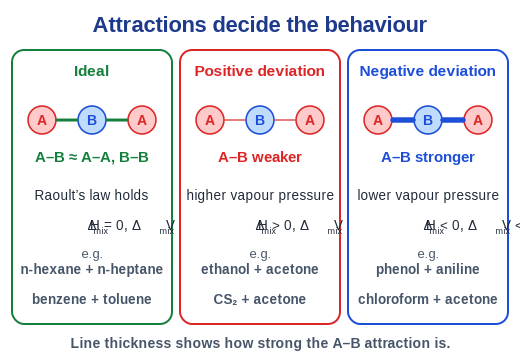
An ideal solution obeys Raoult’s law at every concentration. Two more things follow: mixing the components gives out or takes in no heat, and the final volume is just the sum of the two volumes:
ΔmixH = 0 and ΔmixV = 0
At the level of molecules, the attraction between unlike molecules (A–B) is about the same as between like ones (A–A, B–B). No solution is perfectly ideal, but n-hexane with n-heptane, bromoethane with chloroethane, and benzene with toluene come close.
What are positive and negative deviations?
A non-ideal solution does not follow Raoult’s law over the whole range of composition.
- Positive deviation: A–B attractions are weaker than A–A or B–B, so molecules escape more easily and the vapour pressure is higher than predicted. Mixing absorbs heat. In ethanol, molecules are held by hydrogen bonds; acetone molecules squeeze in and break some of them. Carbon disulphide with acetone behaves the same way.
- Negative deviation: A–B attractions are stronger, so molecules escape less easily and the vapour pressure is lower. Mixing gives out heat. Phenol and aniline form a strong hydrogen bond between the O–H of phenol and the nitrogen of aniline; chloroform, through its C–H, forms a hydrogen bond with the oxygen of acetone.
What is an azeotrope?
When the deviation is large, a mixture of one particular composition boils at a constant temperature, and its vapour has the same composition as the liquid. Such a mixture is an azeotrope, and fractional distillation cannot separate it. Large positive deviation gives a minimum-boiling azeotrope: ethanol–water stops at about 95% ethanol by volume. Large negative deviation gives a maximum-boiling azeotrope: nitric acid–water at about 68% acid by mass, boiling at 393.5 K.
Next topic: colligative properties. Previous topic: concentration terms and Henry’s law. See also the chapter notes and the NCERT solutions.
Practice
-
Two liquids with p₁⁰ = 200 and p₂⁰ = 400 mm Hg form an ideal solution with x₂ = 0.5. The total vapour pressure is:
Show answer
Answer: (b) 300 mm Hg
-
For an ideal solution, which pair is correct?
Show answer
Answer: (c) ΔmixH = 0, ΔmixV = 0
-
Ethanol and acetone show positive deviation because:
Show answer
Answer: (b) acetone breaks some hydrogen bonds between ethanol molecules
-
A solution of A and B shows negative deviation. What happens to the temperature when they are mixed?
Show answer
Answer: It rises. The A–B attractions are stronger than A–A and B–B, so heat is given out on mixing (ΔmixH < 0).
-
Why can fractional distillation not give pure ethanol from an ethanol–water mixture?
Show answer
Answer: At about 95% ethanol by volume the mixture forms a minimum-boiling azeotrope: the vapour has the same composition as the liquid, so distillation cannot separate them further.
Questions students ask
What is Raoult’s law for a solution of volatile liquids?
For a solution of volatile liquids, the partial vapour pressure of each component is directly proportional to its mole fraction in the solution: p₁ = x₁p₁⁰, where p₁⁰ is the vapour pressure of the pure component at the same temperature.
How is Raoult’s law a special case of Henry’s law?
Both say that the partial pressure of a component is proportional to its mole fraction in the solution. In Henry’s law the constant is KH; in Raoult’s law it is p₁⁰, the vapour pressure of the pure liquid. So Raoult’s law is Henry’s law with KH = p₁⁰.
What is the difference between ideal and non-ideal solutions?
An ideal solution obeys Raoult’s law at all concentrations, with no heat change and no volume change on mixing, as in benzene and toluene. A non-ideal solution does not: its vapour pressure is higher (positive deviation) or lower (negative deviation) than Raoult’s law predicts.
What are minimum and maximum boiling azeotropes?
A large positive deviation gives a minimum-boiling azeotrope, such as ethanol–water at about 95% ethanol by volume. A large negative deviation gives a maximum-boiling azeotrope, such as nitric acid–water at about 68% acid by mass, which boils at 393.5 K.
Stuck on a question?
Take a photo and Lagnever AI explains it step by step. Try it for 7 days for ₹2.
Get it on Google Play Open in browser
For parents: after the trial, the plan renews monthly by UPI or card autopay. You can cancel anytime in the app.