
What are colligative properties?
Answer in short
Colligative properties are properties of a dilute solution that depend only on the number of solute particles, not on what they are. There are four: relative lowering of vapour pressure, elevation of boiling point, depression of freezing point and osmotic pressure. Each can be used to find the molar mass of the solute.
Stuck on a question? Take a photo and Lagnever AI explains it step by step. Try it for 7 days for ₹2. Get it on Google Play
Why do some properties depend only on the number of particles?
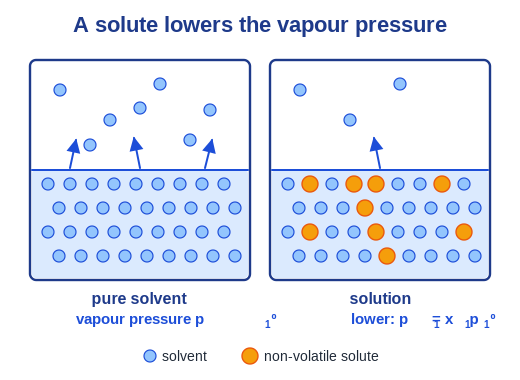
Dissolve a non-volatile solute such as glucose in water and the vapour pressure drops, because solute particles take up part of the surface. A whole family of effects follows from that drop. In a dilute solution they depend only on how many solute particles there are compared with solvent particles, and not on what the particles are: 1 mol of sucrose and 1 mol of urea in 1 kg of water lower the vapour pressure by nearly the same amount. Such properties are called colligative, from Latin words meaning “bound together”.
1. What is the relative lowering of vapour pressure?
By Raoult’s law p₁ = x₁p₁⁰, so the fall is Δp₁ = p₁⁰ − p₁ = x₂p₁⁰, and
(p₁⁰ − p₁)/p₁⁰ = x₂ = n₂/(n₁ + n₂)
The relative lowering equals the mole fraction of the solute. For a dilute solution n₂ is tiny next to n₁, so (p₁⁰ − p₁)/p₁⁰ ≈ n₂/n₁ = (w₂ × M₁)/(M₂ × w₁), where w and M are masses and molar masses, 1 for the solvent and 2 for the solute. Measure the lowering and you can find M₂.
2. Why does a solution boil at a higher temperature?
A liquid boils when its vapour pressure equals the outside pressure; water does so at 373.15 K and 1.013 bar. A solution has a lower vapour pressure, so it must be heated further before it boils. For dilute solutions the rise is proportional to the molality m:
ΔTb = Tb − Tb⁰ = Kb × m
Kb is the molal elevation constant (ebullioscopic constant), with unit K kg mol⁻¹; for water it is 0.52 and for benzene 2.53. Writing m = (w₂/M₂) × 1000/w₁, with masses in grams, gives
M₂ = (1000 × Kb × w₂)/(ΔTb × w₁)
3. Why does a solution freeze at a lower temperature?
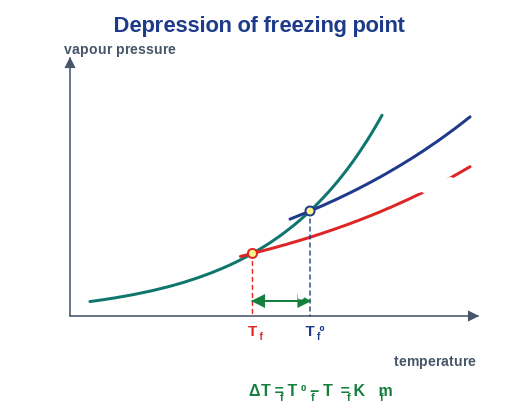
At the freezing point, the liquid and the solid have the same vapour pressure. The solution’s lower vapour pressure meets that of the solid solvent at a lower temperature, so
ΔTf = Tf⁰ − Tf = Kf × m and M₂ = (1000 × Kf × w₂)/(ΔTf × w₁)
Kf is the molal depression constant (cryoscopic constant): 1.86 K kg mol⁻¹ for water, 5.12 for benzene. Both constants depend only on the solvent: Kf = R × M₁ × Tf²/(1000 × ΔfusH) and Kb = R × M₁ × Tb²/(1000 × ΔvapH).
Our own example. 6.0 g of urea (60 g mol⁻¹) in 500 g of water:
m = (6.0 ÷ 60) ÷ 0.500 = 0.20 mol kg⁻¹
ΔTb = 0.52 × 0.20 = 0.104 K, so it boils at 373.25 K
ΔTf = 1.86 × 0.20 = 0.372 K, so it freezes at 272.78 K
4. What is osmotic pressure?
A semipermeable membrane lets solvent molecules through but not solute particles. Put one between water and a solution, and water flows into the solution: this is osmosis. The extra pressure needed on the solution to stop the flow is its osmotic pressure Π. For dilute solutions
Π = CRT = (n₂/V)RT, so M₂ = (w₂ × R × T)/(Π × V)
where C is the molarity, R the gas constant (0.083 L bar mol⁻¹ K⁻¹) and V the volume in litres. Osmotic pressure is large even when the solution is very dilute, and it is measured near room temperature, so it is the method used for proteins and polymers.
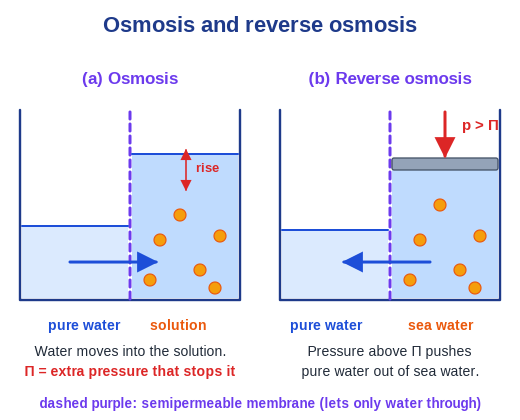
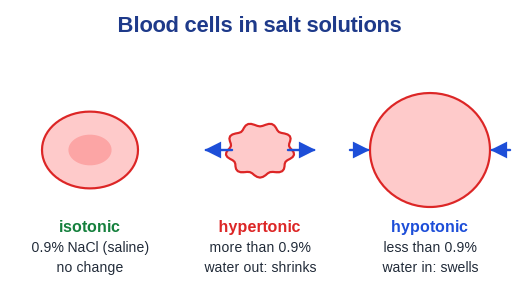
Two solutions with the same osmotic pressure are isotonic. Fluid inside blood cells is isotonic with 0.9% (mass/volume) NaCl, normal saline. In a hypertonic solution (more salt) cells lose water and shrink; in a hypotonic one (less salt) they gain water and swell. A pressure larger than Π on the solution side reverses the flow, which is reverse osmosis, used to purify sea water.
What if the solute splits up or pairs up?
Colligative properties count particles. KCl gives K⁺ and Cl⁻, nearly two particles per formula unit, so its effects are nearly doubled and the molar mass worked out comes out too low. Ethanoic acid pairs up into dimers in benzene, so the effects are halved and the molar mass comes out too high. The van’t Hoff factor corrects for this:
i = normal molar mass ÷ abnormal molar mass
Then ΔTb = iKbm, ΔTf = iKfm and Π = iCRT. For KCl i is close to 2; for ethanoic acid in benzene, close to 0.5.
Previous topic: Raoult’s law and ideal solutions. See also the chapter notes and the NCERT solutions.
Practice
-
Which of these has the largest depression of freezing point? (all 0.1 m in water)
Show answer
Answer: (c) NaCl
-
The osmotic pressure of a solution is proportional to its:
Show answer
Answer: (b) molarity
-
In a hypertonic salt solution, red blood cells:
Show answer
Answer: (b) shrink
-
6.0 g of urea (60 g mol⁻¹) is dissolved in 500 g of water. Find the freezing point of the solution (Kf = 1.86 K kg mol⁻¹).
Show answer
Answer: m = (6.0/60) ÷ 0.500 = 0.20 mol kg⁻¹; ΔTf = 1.86 × 0.20 = 0.372 K, so it freezes at 273.15 − 0.372 = 272.78 K.
-
Why is osmotic pressure the method of choice for the molar mass of a protein?
Show answer
Answer: It is large even for very dilute solutions and is measured near room temperature, where proteins do not break down, and it uses molarity, which is easy to know.
Questions students ask
What are the four colligative properties?
Relative lowering of vapour pressure of the solvent, elevation of the boiling point, depression of the freezing point, and osmotic pressure. All four depend on the number of solute particles in a given amount of solvent or solution, not on their identity.
What is the unit of Kb and Kf?
Both have the unit K kg mol⁻¹. Kb is the molal elevation (ebullioscopic) constant and Kf the molal depression (cryoscopic) constant. For water Kb = 0.52 K kg mol⁻¹ and Kf = 1.86 K kg mol⁻¹.
What is reverse osmosis?
If a pressure larger than the osmotic pressure is applied on the solution side of a semipermeable membrane, solvent flows out of the solution instead of into it. This is reverse osmosis, used to make drinking water from sea water.
What is the van’t Hoff factor?
It is the factor i = normal molar mass ÷ abnormal molar mass, or observed ÷ calculated colligative property. It is more than 1 when the solute dissociates (KCl about 2) and less than 1 when it associates (ethanoic acid in benzene about 0.5).
Stuck on a question?
Take a photo and Lagnever AI explains it step by step. Try it for 7 days for ₹2.
Get it on Google Play Open in browser
For parents: after the trial, the plan renews monthly by UPI or card autopay. You can cancel anytime in the app.