
NCERT Solutions Class 12 Chemistry Chapter 10: Biomolecules
Answers to all 25 end-of-unit exercises and all 8 Intext Questions of Unit 10, Biomolecules, of Chemistry Part II, the Class 12 NCERT textbook. Page numbers follow the 2026-27 reprint (pages 281–302). The exercises come first, quoted from the book; the Intext Questions follow, restated in short. This unit has no worked examples. Short notes: Chapter 10 notes.
How the answers were checked. Every equation was checked atom by atom with a script, and every structure (ring size, anomeric carbon, glycosidic link, peptide bond, base pairs) against the drawings in the book. The Answers section at the back of Part II (pages 303–307) covers Units 7, 8 and 9 only, and the book prints no answers to this unit’s Intext Questions, so there was no answer key to compare with; every answer below is our own, built from the chapter.
Stay safe. Tests on sugars and proteins use acids, alkalis, nitric acid, bromine water or heat. Any practical work is done only in the school laboratory with your teacher, never at home; never taste a sample. Vitamin answers are chemistry information from the book; for any health question, ask a doctor.
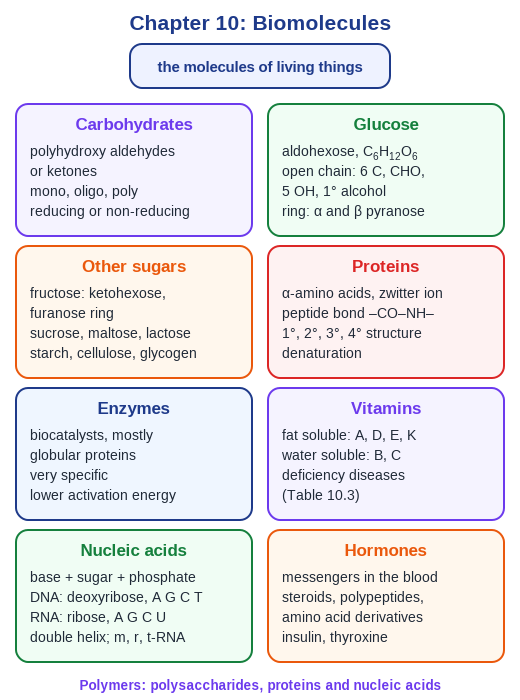
Exercises 10.1 to 10.10: carbohydrates
10.1 “What are monosaccharides?”
Monosaccharides are carbohydrates that cannot be hydrolysed into simpler polyhydroxy aldehydes or ketones. About 20 occur in nature, for example glucose and fructose (C₆H₁₂O₆) and ribose (C₅H₁₀O₅). If the group is an aldehyde the sugar is an aldose (glucose, an aldohexose); if a ketone, a ketose (fructose, a ketohexose).
10.2 “What are reducing sugars?”
Reducing sugars are carbohydrates that reduce Fehling’s solution and Tollens’ reagent, because they have, or can form by ring opening, an uncombined aldehyde or ketone group. All monosaccharides are reducing sugars, and so are the disaccharides maltose and lactose. Sucrose is non-reducing, since both its reducing groups are used in the glycosidic link.
10.3 “Write two main functions of carbohydrates in plants.”
- Storage of food: plants store carbohydrate as starch (in cereals, roots, tubers).
- Structure: cellulose builds the cell walls of plant cells.
10.4 “Classify the following into monosaccharides and disaccharides. Ribose, 2-deoxyribose, maltose, galactose, fructose and lactose.”
- Monosaccharides: ribose, 2-deoxyribose, galactose, fructose.
- Disaccharides: maltose (two glucose units), lactose (galactose + glucose).
10.5 “What do you understand by the term glycosidic linkage?”
It is the link through an oxygen atom, C–O–C, that joins two monosaccharide units. It forms when a water molecule is lost between them, usually between the anomeric carbon of one unit and an –OH of the other. Examples: C1–C4 in maltose, and C1 of glucose to C2 of fructose in sucrose.
10.6 “What is glycogen? How is it different from starch?”
Glycogen is the polysaccharide in which animals store carbohydrate, found in the liver, muscles and brain (also in yeast and fungi). Enzymes break glycogen down to glucose whenever the body needs it.
| Starch | Glycogen | |
|---|---|---|
| Found in | plants | animals |
| Make-up | amylose (unbranched) + amylopectin (branched) | one branched polymer |
| Branching | amylopectin branched through C1–C6 | similar, but more highly branched |
Both are polymers of α-D-glucose with C1–C4 chains.
10.7 “What are the hydrolysis products of (i) sucrose and (ii) lactose?”
- (i) Sucrose gives D-(+)-glucose and D-(–)-fructose in equal amounts: C₁₂H₂₂O₁₁ + H₂O → C₆H₁₂O₆ + C₆H₁₂O₆.
- (ii) Lactose gives D-galactose and D-glucose (from β-D-galactose and β-D-glucose units): C₁₂H₂₂O₁₁ + H₂O → C₆H₁₂O₆ + C₆H₁₂O₆.
10.8 “What is the basic structural difference between starch and cellulose?”
Starch is made of α-D-glucose units: amylose is an unbranched C1–C4 chain and amylopectin has C1–C4 chains branched through C1–C6. Cellulose is an unbranched, straight chain of β-D-glucose units joined C1–C4. The α versus β link is the basic difference.
10.9 “What happens when D-glucose is treated with the following reagents? (i) HI (ii) Bromine water (iii) HNO₃”
- (i) HI (prolonged heating): glucose is reduced to n-hexane, CH₃CH₂CH₂CH₂CH₂CH₃, which shows that its six carbons are in a straight chain.
- (ii) Bromine water: the –CHO group is oxidised to –COOH, giving gluconic acid, HOOC–(CHOH)₄–CH₂OH. This shows the carbonyl group is an aldehyde.
- (iii) HNO₃: both ends are oxidised, the –CHO and the primary –CH₂OH, giving the dicarboxylic acid saccharic acid, HOOC–(CHOH)₄–COOH.
10.10 “Enumerate the reactions of D-glucose which cannot be explained by its open chain structure.”
- Glucose does not give Schiff’s test, although it has an aldehyde group.
- It gives no addition product (hydrogensulphite compound) with NaHSO₃.
- Glucose pentaacetate does not react with hydroxylamine, so it has no open –CHO group.
- Glucose exists in two crystalline forms, α (m.p. 419 K, crystallised from a concentrated solution at 303 K) and β (m.p. 423 K, from a hot saturated solution at 371 K).
These are explained by the ring (cyclic hemiacetal) structure formed when the –OH on C-5 adds to the –CHO group.
Exercises 10.11 to 10.18: amino acids, proteins and enzymes
10.11 “What are essential and non-essential amino acids? Give two examples of each type.”
- Essential amino acids cannot be made in the body and must come from the diet. Examples from the book’s table: valine, leucine (also lysine, threonine and others).
- Non-essential amino acids can be made in the body. Examples: glycine, alanine (also serine, glutamic acid and others).
10.12 “Define the following as related to proteins (i) Peptide linkage (ii) Primary structure (iii) Denaturation.”
- (i) Peptide linkage: the amide bond, –CO–NH–, formed between the –COOH group of one amino acid and the –NH₂ group of another with loss of a water molecule. Glycine and alanine give glycylalanine: C₂H₅NO₂ + C₃H₇NO₂ → C₅H₁₀N₂O₃ + H₂O.
- (ii) Primary structure: the specific sequence in which amino acids are linked in each polypeptide chain of a protein. Any change in this sequence gives a different protein.
- (iii) Denaturation: the loss of biological activity of a native protein when a physical change (such as heating) or a chemical change (such as a change of pH) disturbs its hydrogen bonds, so globules unfold and helices uncoil. Example: egg white coagulates on boiling.
10.13 “What are the common types of secondary structure of proteins?”
Two: the α-helix, in which the chain twists into a right-handed screw, and the β-pleated sheet, in which stretched chains lie side by side. Both arise from hydrogen bonds between the C=O and –NH– groups of peptide bonds.
10.14 “What type of bonding helps in stabilising the α-helix structure of proteins?”
Hydrogen bonding. Every residue’s –NH group forms a hydrogen bond with the C=O group of a residue in the next turn of the helix (–N–H···O=C–).
10.15 “Differentiate between globular and fibrous proteins.”
| Fibrous proteins | Globular proteins | |
|---|---|---|
| Shape | fibre-like; chains run parallel | spherical; chains coil up |
| Held by | hydrogen and disulphide bonds between chains | folding of the chain |
| In water | generally insoluble | usually soluble |
| Examples | keratin (hair, wool), myosin (muscles) | insulin, albumins |
10.16 “How do you explain the amphoteric behaviour of amino acids?”
An amino acid has an acidic –COOH group and a basic –NH₂ group in the same molecule. In water the –COOH gives a proton to the –NH₂, forming the zwitter ion R–CH(NH₃⁺)–COO⁻. This ion reacts with acids, because –COO⁻ accepts a proton (giving R–CH(NH₃⁺)–COOH), and with bases, because –NH₃⁺ gives up a proton (giving R–CH(NH₂)–COO⁻). Reacting with both acids and bases is amphoteric behaviour.
10.17 “What are enzymes?”
Enzymes are biological catalysts that speed up the reactions of living systems under mild conditions. Almost all are globular proteins. They are needed in small amounts, are very specific for a reaction and a substrate, and lower the activation energy. Their names usually end in -ase: maltase catalyses C₁₂H₂₂O₁₁ + H₂O → 2C₆H₁₂O₆ (maltose to glucose).
10.18 “What is the effect of denaturation on the structure of proteins?”
The hydrogen bonds are disturbed, so the globules unfold and the helices uncoil: the secondary and tertiary structures are destroyed, while the primary structure (the sequence of amino acids) stays intact. The protein loses its biological activity. Coagulation of egg white on boiling and curdling of milk are examples.
Exercises 10.19 to 10.25: vitamins and nucleic acids
10.19 “How are vitamins classified? Name the vitamin responsible for the coagulation of blood.”
By solubility:
- Fat-soluble vitamins: A, D, E and K; soluble in fats and oils, not in water; stored in the liver and adipose tissue.
- Water-soluble vitamins: the B group and C; excreted in urine and, except B₁₂, not stored.
Vitamin K is responsible for the coagulation of blood; the book lists increased blood clotting time as its deficiency disease.
10.20 “Why are vitamin A and vitamin C essential to us? Give their important sources.”
- Vitamin A: its lack causes xerophthalmia (hardening of the cornea of the eye) and night blindness. Sources (book): fish liver oil, carrots, butter and milk.
- Vitamin C: its lack causes scurvy (bleeding gums). Being water soluble it is not stored and must be supplied regularly. Sources (book): citrus fruits, amla and green leafy vegetables.
10.21 “What are nucleic acids? Mention their two important functions.”
Nucleic acids are long-chain polymers of nucleotides (polynucleotides) found in the nucleus, in chromosomes, as DNA and RNA. Each nucleotide is a nitrogen base, a pentose sugar and a phosphate group. Two functions:
- Heredity: DNA is the chemical basis of heredity; it copies itself during cell division and passes identical strands to the daughter cells, keeping each species’ identity.
- Protein synthesis: RNA molecules make proteins in the cell, using the message for each protein that is stored in DNA.
10.22 “What is the difference between a nucleoside and a nucleotide?”
| Nucleoside | Nucleotide |
|---|---|
| base + pentose sugar | base + pentose sugar + phosphate |
| base joined at C-1′ of the sugar | the nucleoside joined to phosphoric acid at C-5′ |
10.23 “The two strands in DNA are not identical but are complementary. Explain.”
In the double helix the two strands are held together by hydrogen bonds between bases, and these bonds form only between specific pairs: adenine with thymine and cytosine with guanine. So the sequence of one strand fixes the other: opposite every A is a T, opposite every G a C. The strands are therefore not identical, but each is the complement of the other. For example, a strand reading A–G–C–T is paired with T–C–G–A.
10.24 “Write the important structural and functional differences between DNA and RNA.”
| DNA | RNA | |
|---|---|---|
| Sugar | β-D-2-deoxyribose | β-D-ribose |
| Bases | A, G, C and thymine (T) | A, G, C and uracil (U) |
| Structure | double-stranded helix | single-stranded helix, sometimes folded back |
| Function | chemical basis of heredity; stores the coded message for proteins; replicates itself | carries out protein synthesis (m-RNA, r-RNA, t-RNA) |
10.25 “What are the different types of RNA found in the cell?”
Three: messenger RNA (m-RNA), ribosomal RNA (r-RNA) and transfer RNA (t-RNA). They perform different functions in making proteins.
Intext Questions
Intext 10.1 (page 290): glucose and sucrose dissolve in water, but cyclohexane and benzene do not. Why? Glucose has five –OH groups and sucrose eight. These form many hydrogen bonds with water molecules, so the sugars dissolve. Cyclohexane and benzene have only C–H bonds, no –OH groups and almost no polarity, so they cannot hydrogen bond with water and do not dissolve.
Intext 10.2 (page 290): products of hydrolysis of lactose. β-D-galactose and β-D-glucose (one of each): C₁₂H₂₂O₁₁ + H₂O → C₆H₁₂O₆ + C₆H₁₂O₆.
Intext 10.3 (page 290): why the pentaacetate of D-glucose shows no aldehyde group. In the pentaacetate glucose is held in its cyclic hemiacetal form, with the –OH on C-1 acetylated. The ring cannot open to give an open –CHO group, so the pentaacetate does not react with hydroxylamine.
Intext 10.4 (page 295): why amino acids have higher melting points and solubility in water than the corresponding halo acids. Amino acids exist as zwitter ions, R–CH(NH₃⁺)–COO⁻. Strong electrostatic attractions between these ions make them salt-like, high-melting solids, and the charged groups are strongly hydrated, so they dissolve well. A halo acid, such as chloroacetic acid, has no such ionic form; its molecules are held only by hydrogen bonds and dipole forces.
Intext 10.5 (page 295): where the water in an egg goes after boiling. Boiling denatures the egg-white proteins. As they unfold and coagulate, the water that was held by hydrogen bonds to the proteins is taken up and trapped inside the solid network of protein chains. That is why the white sets into a solid instead of staying a liquid.
Intext 10.6 (page 301): why vitamin C cannot be stored in the body. Vitamin C is water soluble. It is readily excreted in urine, so the body cannot keep a store of it, and it must be supplied regularly in the diet.
Intext 10.7 (page 301): products of hydrolysis of a DNA nucleotide containing thymine. Thymine (the base), β-D-2-deoxyribose (the sugar) and phosphoric acid.
Intext 10.8 (page 301): RNA hydrolysis gives no fixed ratio among its bases. What does this suggest? In DNA the paired bases come in equal amounts (A with T, G with C) because the two strands are complementary. RNA shows no such relation, which suggests that RNA is a single strand, with no base pairing between two complementary chains.
Notes on the book’s text
- Page 289: the book says the cell wall of bacteria and plants is made of cellulose. Plant cell walls are cellulose; our answers name plants only.
- Page 292: the book lists keratin in “hair, wool, silk”. The answers give hair and wool.
- Page 295: the maltase equation is printed without H₂O; the balanced form, with water, is used here. The section “Mechanism of Enzyme Action” keeps its heading but no longer describes a mechanism.
Practice
-
Which of these gives only glucose on hydrolysis?
Show answer
Answer: (c) maltose
-
The anomeric carbon of fructose is:
Show answer
Answer: (b) C-2
-
Which change keeps the primary structure of a protein?
Show answer
Answer: (b) denaturation
-
A DNA strand has the base sequence A G C T T. Write the complementary strand.
Show answer
Answer: T C G A A. Adenine pairs with thymine and guanine with cytosine, so each base is replaced by its partner.
-
Why is glycogen called animal starch?
Show answer
Answer: It is the form in which animals store carbohydrate, and its structure is like amylopectin, a part of starch: chains of α-D-glucose joined C1–C4 with C1–C6 branches, only more highly branched.
Stuck on a question?
Take a photo and Lagnever AI explains it step by step. Try it for 7 days for ₹2.
Get it on Google Play Open in browser
For parents: after the trial, the plan renews monthly by UPI or card autopay. You can cancel anytime in the app.