
NCERT Solutions Class 12 Chemistry Chapter 2: Electrochemistry
Answers to all 18 end-of-unit exercises, all 15 Intext Questions and all 10 worked examples of Unit 2, Electrochemistry, of Chemistry Part I, the Class 12 NCERT textbook. Page numbers follow the 2026-27 reprint (pages 31–60). The exercises come first, quoted from the book; the Intext Questions and the examples follow, restated in short. Short notes: Chapter 2 notes.
Constants used. F = 96487 C mol⁻¹, as in the book’s Examples 2.3 and 2.10 (the book allows 96500 C mol⁻¹ for rough work); R = 8.314 J K⁻¹ mol⁻¹; at 298 K, 2.303RT/F = 0.059 V. Standard electrode potentials come from Table 2.1 (page 37) and, for cadmium, the book’s Appendix III (page 143). Molar masses are rounded from the book’s Appendix I: Ca 40, Al 27, Ni 58.7, Cu 63.5, Zn 65.4 and Ag 108 g mol⁻¹ (Example 2.10 rounds copper to 63).
Stay safe. Acids, alkalis, silver and mercury salts and chlorine are corrosive or poisonous. Any experiment with cells or electrolysis is done only in the school laboratory with your teacher.
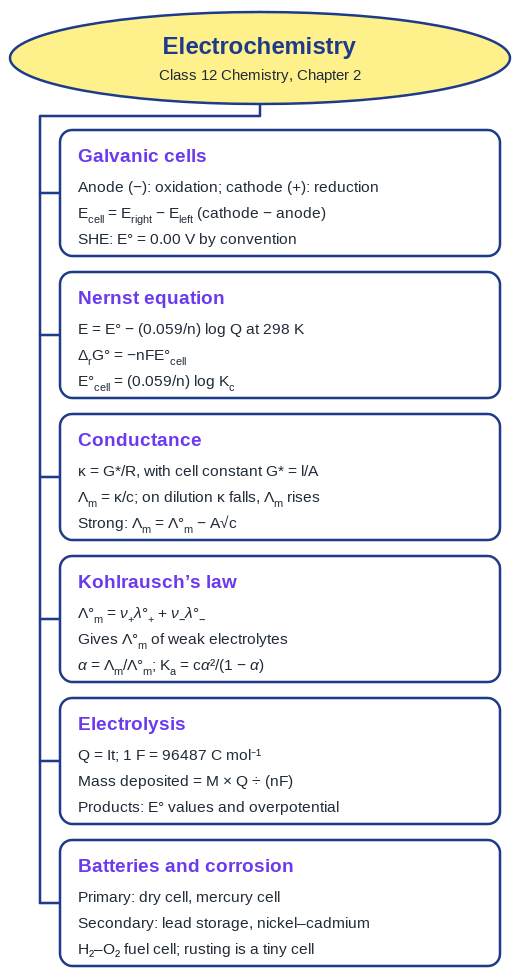
Exercises 2.1 to 2.6: cells, potentials and the Nernst equation
2.1 “Arrange the following metals in the order in which they displace each other from the solution of their salts. Al, Cu, Fe, Mg and Zn.”
A metal displaces another from its salt solution if it is a stronger reducing agent, that is, if its E° is lower. From Table 2.1: Mg²⁺/Mg −2.36 V, Al³⁺/Al −1.66 V, Zn²⁺/Zn −0.76 V, Fe²⁺/Fe −0.44 V, Cu²⁺/Cu +0.34 V. So the order is
Mg > Al > Zn > Fe > Cu
Magnesium can displace all the others from their salts; copper displaces none of them.
2.2 “Given the standard electrode potentials, K⁺/K = –2.93V, Ag⁺/Ag = 0.80V, Hg²⁺/Hg = 0.79V, Mg²⁺/Mg = –2.37 V, Cr³⁺/Cr = – 0.74V. Arrange these metals in their increasing order of reducing power.”
The lower the E°, the more easily the metal gives up electrons, so the stronger it is as a reducing agent. Arranging E° from highest to lowest gives the increasing order of reducing power:
Ag (0.80 V) < Hg (0.79 V) < Cr (−0.74 V) < Mg (−2.37 V) < K (−2.93 V)
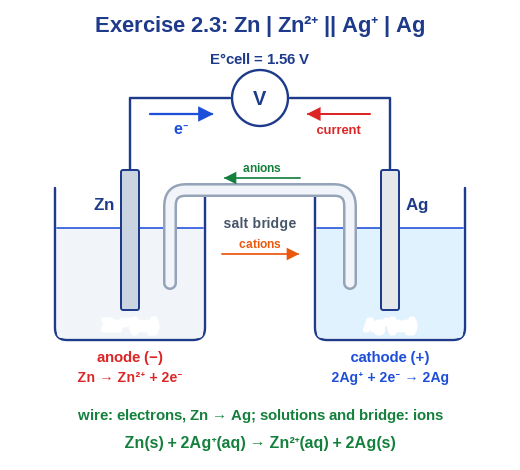
2.3 “Depict the galvanic cell in which the reaction Zn(s)+2Ag⁺(aq) →Zn²⁺(aq)+2Ag(s) takes place. Further show: (i) Which of the electrode is negatively charged? (ii) The carriers of the current in the cell. (iii) Individual reaction at each electrode.”
Zinc is oxidised, so it is the anode (left); silver ions are reduced, so silver is the cathode (right):
Zn(s) | Zn²⁺(aq) || Ag⁺(aq) | Ag(s), with E°cell = 0.80 − (−0.76) = 1.56 V.
(i) The zinc electrode (the anode) is negatively charged.
(ii) In the outside wire, electrons carry the current, flowing from zinc to silver (conventional current flows from silver to zinc). Inside the cell, ions carry it: through the solutions and the salt bridge, anions move towards the zinc side and cations towards the silver side.
(iii) Anode (oxidation): Zn(s) → Zn²⁺(aq) + 2e⁻. Cathode (reduction): Ag⁺(aq) + e⁻ → Ag(s), taken twice, 2Ag⁺(aq) + 2e⁻ → 2Ag(s).
2.4 “Calculate the standard cell potentials of galvanic cell in which the following reactions take place: (i) 2Cr(s) + 3Cd²⁺(aq) → 2Cr³⁺(aq) + 3Cd (ii) Fe²⁺(aq) + Ag⁺(aq) → Fe³⁺(aq) + Ag(s). Calculate the ΔrG° and equilibrium constant of the reactions.”
(i) Chromium is oxidised (anode) and Cd²⁺ reduced (cathode); 2 Cr give 6 electrons, so n = 6. E°(Cr³⁺/Cr) = −0.74 V (Table 2.1); E°(Cd²⁺/Cd) = −0.40 V (Appendix III).
E°cell = E°cathode − E°anode = −0.40 − (−0.74) = 0.34 V
ΔrG° = −nFE°cell = −6 × 96487 × 0.34 = −196 833 J mol⁻¹ = −196.83 kJ mol⁻¹ (−196.86 kJ mol⁻¹ with F = 96500, as the key prints)
log Kc = nE°/0.059 = 6 × 0.34 ÷ 0.059 = 34.58, so Kc ≈ 3.8 × 10³⁴
Through ΔrG° = −RT ln K instead: ln K = 196 833 ÷ (8.314 × 298) = 79.45, so K ≈ 3.2 × 10³⁴; the answer key prints 3.124 × 10³⁴. The routes differ only because 2.303RT/F is rounded to 0.059 V, and with an exponent near 34 a small rounding moves K noticeably.
(ii) Fe²⁺ is oxidised (anode couple Fe³⁺/Fe²⁺, 0.77 V) and Ag⁺ reduced (cathode, 0.80 V); n = 1.
E°cell = 0.80 − 0.77 = 0.03 V
ΔrG° = −1 × 96487 × 0.03 = −2895 J mol⁻¹ = −2.89 kJ mol⁻¹ (the key, with 96500, prints −2.895 kJ mol⁻¹)
log Kc = 0.03 ÷ 0.059 = 0.508, so Kc ≈ 3.2
2.5 “Write the Nernst equation and emf of the following cells at 298 K: (i) Mg(s)|Mg²⁺(0.001M)||Cu²⁺(0.0001 M)|Cu(s) (ii) Fe(s)|Fe²⁺(0.001M)||H⁺(1M)|H₂(g)(1bar)| Pt(s) (iii) Sn(s)|Sn²⁺(0.050 M)||H⁺(0.020 M)|H₂(g) (1 bar)|Pt(s) (iv) Pt(s)|Br⁻(0.010 M)|Br₂(l)||H⁺(0.030 M)| H₂(g) (1 bar)|Pt(s).”
In each cell the left electrode is the anode, and n = 2.
(i) Mg(s) + Cu²⁺(aq) → Mg²⁺(aq) + Cu(s)
Ecell = E°cell − (0.059/2) log ([Mg²⁺]/[Cu²⁺])
E°cell = 0.34 − (−2.36) = 2.70 V; log (0.001/0.0001) = log 10 = 1
Ecell = 2.70 − 0.0295 × 1 = 2.67 V
(The key prints 2.68 V because it takes E°(Mg²⁺/Mg) = −2.37 V, the value in Exercise 2.2; Table 2.1 gives −2.36 V.)
(ii) Fe(s) + 2H⁺(aq) → Fe²⁺(aq) + H₂(g)
Ecell = E°cell − (0.059/2) log ([Fe²⁺] pH₂/[H⁺]²), with pH₂ = 1 bar
E°cell = 0.00 − (−0.44) = 0.44 V; Q = 0.001/1² = 10⁻³, log Q = −3
Ecell = 0.44 − 0.0295 × (−3) = 0.44 + 0.0885 = 0.53 V
(iii) Sn(s) + 2H⁺(aq) → Sn²⁺(aq) + H₂(g)
Ecell = E°cell − (0.059/2) log ([Sn²⁺]/[H⁺]²)
E°cell = 0.00 − (−0.14) = 0.14 V; Q = 0.050/(0.020)² = 0.050/0.0004 = 125, log Q = 2.097
Ecell = 0.14 − 0.0295 × 2.097 = 0.14 − 0.062 = 0.08 V
(iv) Anode: 2Br⁻(aq) → Br₂(l) + 2e⁻; cathode: 2H⁺(aq) + 2e⁻ → H₂(g). Overall 2Br⁻(aq) + 2H⁺(aq) → Br₂(l) + H₂(g)
Ecell = E°cell − (0.059/2) log (1/([Br⁻]²[H⁺]²))
E°cell = 0.00 − 1.09 = −1.09 V; Q = 1/((0.010)² × (0.030)²) = 1/(9.0 × 10⁻⁸) = 1.11 × 10⁷, log Q = 7.046
Ecell = −1.09 − 0.0295 × 7.046 = −1.09 − 0.208 = −1.298 V
The negative emf means the reaction does not go as written; in practice the reverse happens, hydrogen reducing bromine.
2.6 “In the button cells widely used in watches and other devices the following reaction takes place: Zn(s) + Ag₂O(s) + H₂O(l) → Zn²⁺(aq) + 2Ag(s) + 2OH⁻(aq). Determine ΔrG° and E° for the reaction.”
Zinc is oxidised, Zn → Zn²⁺ + 2e⁻ (anode), and silver(I) in Ag₂O is reduced to silver (cathode), so n = 2. Taking the Table 2.1 values for the two metals, as the book’s answer does:
E° = E°(Ag⁺/Ag) − E°(Zn²⁺/Zn) = 0.80 − (−0.76) = 1.56 V
ΔrG° = −2 × 96487 × 1.56 = −301 039 J mol⁻¹ = −301.04 kJ mol⁻¹ (−301.08 kJ mol⁻¹ with 96500)
(The Ag₂O/Ag couple itself is not in Table 2.1; the key’s 1.56 V comes from the Ag⁺/Ag value.)
Exercises 2.7 to 2.11: conductance
2.7 “Define conductivity and molar conductivity for the solution of an electrolyte. Discuss their variation with concentration.”
Conductivity (κ) is the inverse of resistivity. It is the conductance of a solution 1 m long with a cross-section of 1 m² (or 1 cm by 1 cm²), that is, of a unit cube between electrodes. Unit: S m⁻¹ (often S cm⁻¹).
Molar conductivity (Λm) is the conductivity divided by the molar concentration, Λm = κ/c. It is the conductance of the volume of solution that contains one mole of electrolyte, kept between electrodes a unit distance apart and of area large enough to hold it. Unit: S m² mol⁻¹ (often S cm² mol⁻¹, with Λm = κ × 1000/molarity).
Variation with concentration:
- κ decreases on dilution for every electrolyte, strong or weak, because each unit volume holds fewer ions to carry the current.
- Λm increases on dilution, because Λm = κV and the volume V that holds one mole grows faster than κ falls.
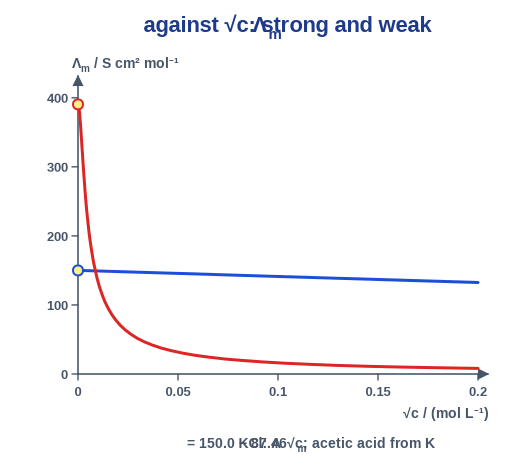
- For a strong electrolyte, Λm rises slowly and follows Λm = Λ°m − A√c, so a plot against √c is a straight line whose intercept is Λ°m.
- For a weak electrolyte, Λm rises steeply at low concentration because the degree of dissociation increases; its Λ°m is found from Kohlrausch’s law, not by extrapolation.
2.8 “The conductivity of 0.20 M solution of KCl at 298 K is 0.0248 S cm⁻¹. Calculate its molar conductivity.”
Λm = κ × 1000 ÷ molarity = 0.0248 S cm⁻¹ × 1000 cm³ L⁻¹ ÷ 0.20 mol L⁻¹ = 124 S cm² mol⁻¹
2.9 “The resistance of a conductivity cell containing 0.001M KCl solution at 298 K is 1500 Ω. What is the cell constant if conductivity of 0.001M KCl solution at 298 K is 0.146 × 10⁻³ S cm⁻¹.”
G* = R × κ = 1500 Ω × 0.146 × 10⁻³ S cm⁻¹ = 0.219 cm⁻¹
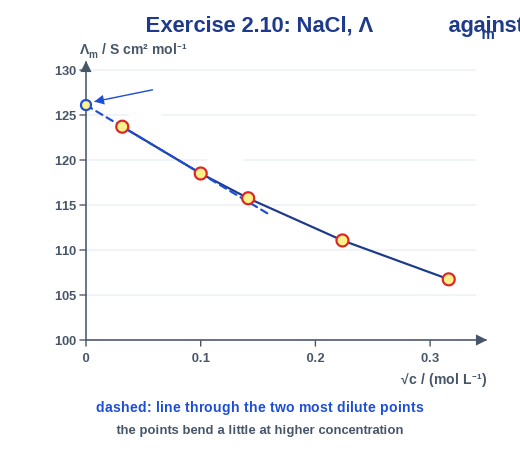
2.10 “The conductivity of sodium chloride at 298 K has been determined at different concentrations and the results are given below: Concentration/M 0.001 0.010 0.020 0.050 0.100; 10² × κ/S m⁻¹ 1.237 11.85 23.15 55.53 106.74. Calculate Λm for all concentrations and draw a plot between Λm and c½. Find the value of Λ°m.”
Convert each concentration to mol m⁻³ (× 1000) and κ to S m⁻¹ (÷ 100); then Λm = κ/c in S m² mol⁻¹, and × 10⁴ gives S cm² mol⁻¹. For 0.001 M: κ = 1.237 × 10⁻² S m⁻¹, c = 1 mol m⁻³, Λm = 1.237 × 10⁻² S m² mol⁻¹ = 123.7 S cm² mol⁻¹. In the same way:
| c (M) and √c | Λm (S m² mol⁻¹) | Λm (S cm² mol⁻¹) |
|---|---|---|
| 0.001, √c = 0.0316 | 1.237 × 10⁻² | 123.7 |
| 0.010, √c = 0.1000 | 1.185 × 10⁻² | 118.5 |
| 0.020, √c = 0.1414 | 1.1575 × 10⁻² | 115.75 |
| 0.050, √c = 0.2236 | 1.1106 × 10⁻² | 111.06 |
| 0.100, √c = 0.3162 | 1.0674 × 10⁻² | 106.74 |
Plotting Λm against √c gives points close to a straight line that bends slightly at the higher concentrations, as expected for a strong electrolyte. The line through the two most dilute points has slope (118.5 − 123.7)/(0.1000 − 0.0316) = −76.0 and meets √c = 0 at
Λ°m ≈ 126 S cm² mol⁻¹ (1.26 × 10⁻² S m² mol⁻¹)
This agrees with the value the book itself uses for NaCl in Example 2.8, 126.4 S cm² mol⁻¹. (A single straight line forced through all five points would give about 124.7, because the higher concentrations pull it down. The book prints no key answer for this exercise.)
2.11 “Conductivity of 0.00241 M acetic acid is 7.896 × 10⁻⁵ S cm⁻¹. Calculate its molar conductivity. If Λ°m for acetic acid is 390.5 S cm² mol⁻¹, what is its dissociation constant?”
Λm = 7.896 × 10⁻⁵ × 1000 ÷ 0.00241 = 32.76 S cm² mol⁻¹
α = Λm/Λ°m = 32.76 ÷ 390.5 = 0.0839
Ka = cα²/(1 − α) = 0.00241 × (0.0839)² ÷ (1 − 0.0839) = 1.696 × 10⁻⁵ ÷ 0.9161 = 1.85 × 10⁻⁵ mol L⁻¹
Exercises 2.12 to 2.18: electrolysis and feasibility
2.12 “How much charge is required for the following reductions: (i) 1 mol of Al³⁺ to Al? (ii) 1 mol of Cu²⁺ to Cu? (iii) 1 mol of MnO₄⁻ to Mn²⁺?”
(i) Al³⁺ + 3e⁻ → Al: 3 F = 3 × 96487 = 289 461 C ≈ 2.89 × 10⁵ C
(ii) Cu²⁺ + 2e⁻ → Cu: 2 F = 192 974 C ≈ 1.93 × 10⁵ C
(iii) MnO₄⁻ + 8H⁺ + 5e⁻ → Mn²⁺ + 4H₂O (manganese goes from +7 to +2): 5 F = 482 435 C ≈ 4.82 × 10⁵ C
2.13 “How much electricity in terms of Faraday is required to produce (i) 20.0 g of Ca from molten CaCl₂? (ii) 40.0 g of Al from molten Al₂O₃?”
(i) Ca²⁺ + 2e⁻ → Ca. Moles of Ca = 20.0 ÷ 40 = 0.500 mol, needing 2 × 0.500 = 1 F (96 487 C).
(ii) Al³⁺ + 3e⁻ → Al. Moles of Al = 40.0 ÷ 27 = 1.481 mol, needing 3 × 1.481 = 4.44 F (about 4.29 × 10⁵ C).
2.14 “How much electricity is required in coulomb for the oxidation of (i) 1 mol of H₂O to O₂? (ii) 1 mol of FeO to Fe₂O₃?”
(i) 2H₂O → O₂ + 4H⁺ + 4e⁻: oxygen goes from −2 to 0, so each H₂O gives 2 electrons. 1 mol of H₂O needs 2 F = 2 × 96487 = 192 974 C ≈ 1.93 × 10⁵ C.
(ii) 2FeO + H₂O → Fe₂O₃ + 2H⁺ + 2e⁻: iron goes from +2 in FeO to +3 in Fe₂O₃, one electron per Fe. 1 mol of FeO needs 1 F = 96 487 C ≈ 9.65 × 10⁴ C.
2.15 “A solution of Ni(NO₃)₂ is electrolysed between platinum electrodes using a current of 5 amperes for 20 minutes. What mass of Ni is deposited at the cathode?”
t = 20 × 60 = 1200 s; Q = It = 5 × 1200 = 6000 C
Ni²⁺ + 2e⁻ → Ni, so 2 × 96487 C deposit 58.7 g of nickel
Mass = 58.7 × 6000 ÷ (2 × 96487) = 1.825 g (the key prints 1.8258 g; both round to 1.83 g)
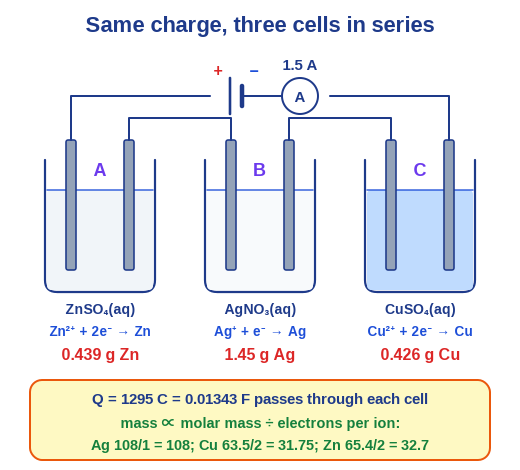
2.16 “Three electrolytic cells A,B,C containing solutions of ZnSO₄, AgNO₃ and CuSO₄, respectively are connected in series. A steady current of 1.5 amperes was passed through them until 1.45 g of silver deposited at the cathode of cell B. How long did the current flow? What mass of copper and zinc were deposited?”
Moles of Ag = 1.45 ÷ 108 = 0.013426 mol. Ag⁺ + e⁻ → Ag, so this is also the number of moles of electrons.
Q = 0.013426 × 96487 = 1295.4 C
t = Q/I = 1295.4 ÷ 1.5 = 863.6 s = 14.39 min (about 14.4 minutes; the key prints 14.40 min)
The cells are in series, so the same 0.013426 mol of electrons passes through each:
- Copper, Cu²⁺ + 2e⁻ → Cu: 0.013426 ÷ 2 = 0.006713 mol × 63.5 = 0.426 g (key 0.427 g)
- Zinc, Zn²⁺ + 2e⁻ → Zn: 0.006713 mol × 65.4 = 0.439 g (the key prints 0.437 g; with Zn = 65.4 g mol⁻¹ the mass is 0.439 g)
2.17 “Using the standard electrode potentials given in Table 3.1, predict if the reaction between the following is feasible: (i) Fe³⁺(aq) and I⁻(aq) (ii) Ag⁺ (aq) and Cu(s) (iii) Fe³⁺ (aq) and Br⁻ (aq) (iv) Ag(s) and Fe³⁺ (aq) (v) Br₂ (aq) and Fe²⁺ (aq).”
“Table 3.1” is the old number of the table now printed as Table 2.1. A reaction is feasible when E°cell = E°(couple reduced) − E°(couple oxidised) is positive.
(i) 2Fe³⁺ + 2I⁻ → 2Fe²⁺ + I₂: 0.77 − 0.54 = +0.23 V, feasible.
(ii) 2Ag⁺ + Cu → 2Ag + Cu²⁺: 0.80 − 0.34 = +0.46 V, feasible.
(iii) 2Fe³⁺ + 2Br⁻ → 2Fe²⁺ + Br₂: 0.77 − 1.09 = −0.32 V, not feasible.
(iv) Ag + Fe³⁺ → Ag⁺ + Fe²⁺: 0.77 − 0.80 = −0.03 V, not feasible (the reverse reaction is the one in Exercise 2.4 (ii)).
(v) Br₂ + 2Fe²⁺ → 2Br⁻ + 2Fe³⁺: 1.09 − 0.77 = +0.32 V, feasible.
2.18 “Predict the products of electrolysis in each of the following: (i) An aqueous solution of AgNO₃ with silver electrodes. (ii) An aqueous solution of AgNO₃ with platinum electrodes. (iii) A dilute solution of H₂SO₄ with platinum electrodes. (iv) An aqueous solution of CuCl₂ with platinum electrodes.”
(i) Cathode: Ag⁺(aq) + e⁻ → Ag(s), silver is deposited. Anode: the silver anode is oxidised, Ag(s) → Ag⁺(aq) + e⁻, so the anode dissolves. Silver is in effect moved from anode to cathode, and the solution stays the same.
(ii) Cathode: silver is deposited, since Ag⁺/Ag (0.80 V) is reduced far more easily than water. Anode: platinum is inert and nitrate ions are not oxidised, so water is oxidised to oxygen, 2H₂O(l) → O₂(g) + 4H⁺(aq) + 4e⁻. The solution becomes nitric acid.
(iii) Cathode: 2H⁺(aq) + 2e⁻ → H₂(g). Anode: in dilute acid water is oxidised, 2H₂O(l) → O₂(g) + 4H⁺(aq) + 4e⁻. (Concentrated acid would give S₂O₈²⁻ instead.)
(iv) Cathode: Cu²⁺(aq) + 2e⁻ → Cu(s), since 0.34 V is far above the reduction of water. Anode: as with sodium chloride, the overpotential of oxygen makes chloride oxidise, 2Cl⁻(aq) → Cl₂(g) + 2e⁻.
Intext Questions 2.1 to 2.15
Intext 2.1 (page 36): How would you find the standard electrode potential of Mg²⁺|Mg?
Build a cell with the standard hydrogen electrode on the left and a magnesium strip in 1 M Mg²⁺ solution on the right, and measure its emf at 298 K: Pt(s) | H₂(g, 1 bar) | H⁺(aq, 1 M) || Mg²⁺(aq, 1 M) | Mg(s). Then E°cell = E°R − 0 = E°(Mg²⁺/Mg). The voltmeter shows that magnesium is actually the negative electrode, so the value is negative: E° = −2.36 V.
Intext 2.2 (page 36): Can copper sulphate solution be kept in a zinc pot?
No. E°(Zn²⁺/Zn) = −0.76 V is lower than E°(Cu²⁺/Cu) = +0.34 V, so zinc reduces copper ions: Zn(s) + Cu²⁺(aq) → Zn²⁺(aq) + Cu(s), with E°cell = 1.10 V. The pot would dissolve and copper would be deposited.
Intext 2.3 (page 36): Name three substances from the table that can oxidise ferrous ions.
To oxidise Fe²⁺ to Fe³⁺ (E° = 0.77 V), the oxidising agent’s couple must have a higher E°. Any three of: chlorine (1.36 V), bromine (1.09 V), acidified permanganate (1.51 V), acidified dichromate (1.33 V), hydrogen peroxide in acid (1.78 V), fluorine (2.87 V), or oxygen in acid (1.23 V).
Intext 2.4 (page 41): Find the potential of a hydrogen electrode in contact with a solution of pH 10.
For H⁺(aq) + e⁻ → ½H₂(g) with H₂ at 1 bar, E = 0 − 0.059 log (1/[H⁺]) = −0.059 × pH.
[H⁺] = 10⁻¹⁰ M, so E = −0.059 × 10 = −0.59 V
Intext 2.5 (page 41): Find the emf of the cell for Ni(s) + 2Ag⁺(0.002 M) → Ni²⁺(0.160 M) + 2Ag(s), with E°cell = 1.05 V.
n = 2; Q = [Ni²⁺]/[Ag⁺]² = 0.160/(0.002)² = 0.160/(4 × 10⁻⁶) = 4 × 10⁴; log Q = 4.602
Ecell = 1.05 − (0.059/2) × 4.602 = 1.05 − 0.136 = 0.91 V (matches the book’s answer)
Intext 2.6 (page 41): For 2Fe³⁺(aq) + 2I⁻(aq) → 2Fe²⁺(aq) + I₂(s), E°cell = 0.236 V at 298 K. Find the standard Gibbs energy and the equilibrium constant.
n = 2. ΔrG° = −2 × 96487 × 0.236 = −45 542 J mol⁻¹ = −45.54 kJ mol⁻¹
From ΔrG° = −RT ln K: ln K = 45 542 ÷ (8.314 × 298) = 18.38, so Kc = 9.62 × 10⁷ (the book’s answer).
With E°cell = (0.059/n) log Kc: log Kc = 2 × 0.236 ÷ 0.059 = 8.00, Kc ≈ 1.0 × 10⁸. The small gap comes from rounding 2.303RT/F to 0.059 V.
Intext 2.7 (page 51): Why does the conductivity of a solution fall on dilution?
Conductivity is the conductance of a unit volume of solution. On dilution the same unit volume holds fewer ions to carry the current, so κ decreases.
Intext 2.8 (page 51): Suggest a way to find Λ°m of water.
Use Kohlrausch’s law: water ionises into H⁺ and OH⁻, so Λ°m(H₂O) = λ°(H⁺) + λ°(OH⁻) = 349.6 + 199.1 = 548.7 S cm² mol⁻¹ (Table 2.4). The same value comes from strong electrolytes: Λ°m(HCl) + Λ°m(NaOH) − Λ°m(NaCl) = 425.9 + 249.2 − 126.4 = 548.7 S cm² mol⁻¹.
Intext 2.9 (page 51): 0.025 mol L⁻¹ methanoic acid has Λm = 46.1 S cm² mol⁻¹. With λ°(H⁺) = 349.6 and λ°(HCOO⁻) = 54.6 S cm² mol⁻¹, find α and Ka.
Λ°m = 349.6 + 54.6 = 404.2 S cm² mol⁻¹
α = 46.1 ÷ 404.2 = 0.114
Ka = cα²/(1 − α) = 0.025 × (0.114)² ÷ (1 − 0.114) = 3.67 × 10⁻⁴ mol L⁻¹ (matches the book’s answer)
Intext 2.10 (page 54): A current of 0.5 A flows through a metal wire for 2 hours. How many electrons flow?
Q = It = 0.5 × 2 × 3600 = 3600 C
Number of electrons = 3600 ÷ (1.6021 × 10⁻¹⁹) = 2.25 × 10²² electrons
Intext 2.11 (page 54): List metals extracted by electrolysis.
Very reactive metals with no suitable chemical reducing agent: sodium, magnesium and aluminium, the three the chapter names (sodium and magnesium from their fused chlorides, aluminium from Al₂O₃ with cryolite). Extra: potassium, lithium and calcium are also made by electrolysis of their molten compounds.
Intext 2.12 (page 54): How many coulombs reduce 1 mol of Cr₂O₇²⁻ in Cr₂O₇²⁻ + 14H⁺ + 6e⁻ → 2Cr³⁺ + 7H₂O?
6 mol of electrons: Q = 6 F = 6 × 96487 = 578 922 C ≈ 5.79 × 10⁵ C
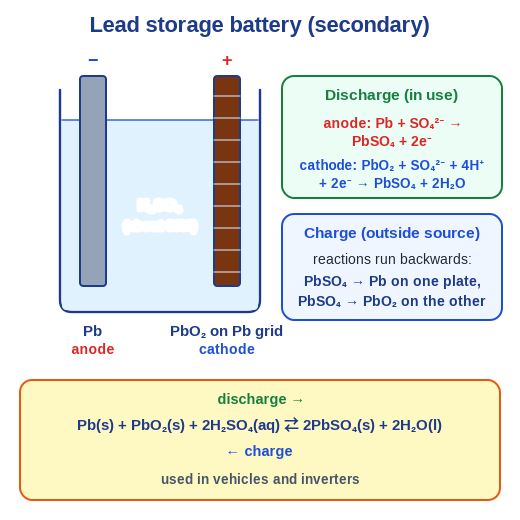
Intext 2.13 (page 58): Write the chemistry of recharging a lead storage battery.
While charging, an outside DC source pushes current through the battery in the direction opposite to discharge, and both electrode reactions run backwards:
- At the electrode that was the anode (now made the cathode): PbSO₄(s) + 2e⁻ → Pb(s) + SO₄²⁻(aq)
- At the electrode that was the cathode (now the anode): PbSO₄(s) + 2H₂O(l) → PbO₂(s) + SO₄²⁻(aq) + 4H⁺(aq) + 2e⁻
- Overall: 2PbSO₄(s) + 2H₂O(l) → Pb(s) + PbO₂(s) + 2H₂SO₄(aq)
The materials involved are the lead sulphate coating on both plates, water, the sulphuric acid that is re-formed (the acid gets stronger again), the lead and lead dioxide that are restored, and the outside source of electricity.
Intext 2.14 (page 58): Name two fuels other than hydrogen for fuel cells.
Methane and methanol, the two the chapter names.
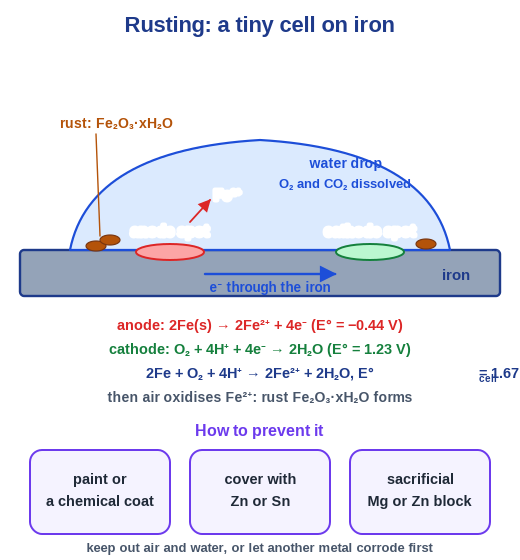
Intext 2.15 (page 58): Explain how rusting of iron can be seen as an electrochemical cell.
A wet iron surface works like a tiny cell:
- Anode. At one spot iron is oxidised: 2Fe(s) → 2Fe²⁺ + 4e⁻ (E° = −0.44 V).
- Electrons travel through the metal to another spot.
- Cathode. At that spot oxygen is reduced. The H⁺ comes from carbonic acid (dissolved CO₂) or other acidic oxides: O₂(g) + 4H⁺(aq) + 4e⁻ → 2H₂O(l) (E° = 1.23 V).
- Electrolyte. The film of water on the iron carries the ions.
- Overall: 2Fe + O₂ + 4H⁺ → 2Fe²⁺ + 2H₂O, with E°cell = 1.67 V. The value is positive, so the process is spontaneous.
- Rust. Air oxidises Fe²⁺ further: 2Fe²⁺ + 2H₂O + ½O₂ → Fe₂O₃ + 4H⁺. Rust, Fe₂O₃·xH₂O, forms.
Worked examples 2.1 to 2.5 (pages 39–46)
Example 2.1 (page 39): Write the cell for Mg(s) + 2Ag⁺(0.0001 M) → Mg²⁺(0.130 M) + 2Ag(s) and find its emf, given E°cell = 3.17 V.
Cell: Mg(s) | Mg²⁺(0.130 M) || Ag⁺(0.0001 M) | Ag(s); n = 2
Q = 0.130/(0.0001)² = 1.3 × 10⁷; log Q = 7.114
Ecell = 3.17 − (0.059/2) × 7.114 = 3.17 − 0.21 = 2.96 V
Example 2.2 (page 40): Find Kc for Cu(s) + 2Ag⁺(aq) → Cu²⁺(aq) + 2Ag(s), with E°cell = 0.46 V.
log Kc = nE°/0.059 = 2 × 0.46 ÷ 0.059 = 15.59
Kc = 3.92 × 10¹⁵
Example 2.3 (page 40): Find ΔrG° for the Daniell cell reaction, with E°cell = 1.1 V.
ΔrG° = −nFE° = −2 × 96487 × 1.1 = −212 271 J mol⁻¹ = −212.27 kJ mol⁻¹
(The book prints the intermediate value as “−21227 J mol⁻¹”, a digit short; the kJ value it gives, −212.27 kJ mol⁻¹, is right.)
Example 2.4 (page 45): A cell filled with 0.1 mol L⁻¹ KCl (κ = 1.29 S m⁻¹) has a resistance of 100 Ω; with 0.02 mol L⁻¹ KCl it has 520 Ω. Find κ and Λm of the 0.02 mol L⁻¹ solution.
Cell constant G* = κR = 1.29 S m⁻¹ × 100 Ω = 129 m⁻¹ = 1.29 cm⁻¹
κ = G*/R = 129 m⁻¹ ÷ 520 Ω = 0.248 S m⁻¹ (= 0.248 × 10⁻² S cm⁻¹)
c = 0.02 mol L⁻¹ = 20 mol m⁻³
Λm = κ/c = 0.248 ÷ 20 = 124 × 10⁻⁴ S m² mol⁻¹ = 124 S cm² mol⁻¹
Example 2.5 (page 46): A column of 0.05 mol L⁻¹ NaOH, 1 cm in diameter and 50 cm long, has a resistance of 5.55 × 10³ Ω. Find its resistivity, conductivity and molar conductivity.
A = πr² = 3.14 × (0.5 cm)² = 0.785 cm²; l = 50 cm
ρ = RA/l = 5.55 × 10³ × 0.785 ÷ 50 = 87.135 Ω cm (= 0.871 Ω m)
κ = 1/ρ = 0.01148 S cm⁻¹ (= 1.148 S m⁻¹)
Λm = κ × 1000 ÷ molarity = 0.01148 × 1000 ÷ 0.05 = 229.6 S cm² mol⁻¹ (= 229.6 × 10⁻⁴ S m² mol⁻¹)
(The book uses π = 3.14. With π = 3.1416, ρ = 87.18 Ω cm and Λm = 229.4 S cm² mol⁻¹.)
Worked examples 2.6 to 2.10 (pages 48–52)
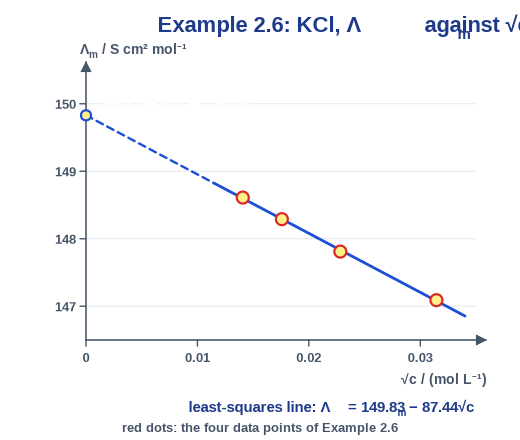
Example 2.6 (page 48): KCl solutions have Λm = 148.61, 148.29, 147.81 and 147.09 S cm² mol⁻¹ at c = 0.000198, 0.000309, 0.000521 and 0.000989 mol L⁻¹. Show that Λm against c½ is a straight line and find Λ°m and A.
√c = 0.01407, 0.01758, 0.02283 and 0.03145 (mol L⁻¹)^½. The four points lie on a straight line. A least-squares fit gives
Λm = 149.83 − 87.44√c
so Λ°m ≈ 150.0 S cm² mol⁻¹ (the intercept) and A ≈ 87.4 S cm² mol⁻¹ per (mol L⁻¹)^½ (minus the slope). The book reads 150.0 and 87.46 from its graph. (The book’s working calls the graph “Fig. 3.7”, a number left from the older book; it means Fig. 2.7.)
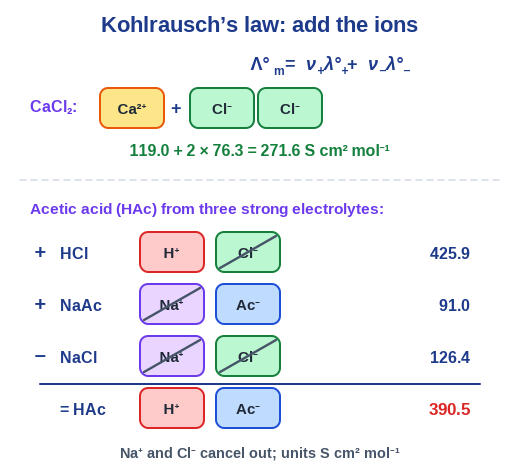
Example 2.7 (page 50): Find Λ°m of CaCl₂ and MgSO₄ from Table 2.4.
Λ°m(CaCl₂) = λ°(Ca²⁺) + 2λ°(Cl⁻) = 119.0 + 2 × 76.3 = 271.6 S cm² mol⁻¹
Λ°m(MgSO₄) = λ°(Mg²⁺) + λ°(SO₄²⁻) = 106.0 + 160.0 = 266 S cm² mol⁻¹
(The book’s question says “Table 3.4”; it means Table 2.4.)
Example 2.8 (page 50): Λ°m of NaCl, HCl and NaAc are 126.4, 425.9 and 91.0 S cm² mol⁻¹. Find Λ°m of HAc.
Λ°m(HAc) = Λ°m(HCl) + Λ°m(NaAc) − Λ°m(NaCl) = 425.9 + 91.0 − 126.4 = 390.5 S cm² mol⁻¹
Example 2.9 (page 50): 0.001028 mol L⁻¹ acetic acid has κ = 4.95 × 10⁻⁵ S cm⁻¹ and Λ°m = 390.5 S cm² mol⁻¹. Find its dissociation constant.
Λm = 4.95 × 10⁻⁵ × 1000 ÷ 0.001028 = 48.15 S cm² mol⁻¹ (the book prints the unit as “S cm³ mol⁻¹”; it should be S cm² mol⁻¹)
α = 48.15 ÷ 390.5 = 0.1233
Ka = cα²/(1 − α) = 0.001028 × (0.1233)² ÷ (1 − 0.1233) = 1.78 × 10⁻⁵ mol L⁻¹
Example 2.10 (page 52): CuSO₄ solution is electrolysed for 10 minutes at 1.5 A. What mass of copper is deposited?
Q = It = 1.5 × 600 = 900 C
Cu²⁺ + 2e⁻ → Cu: 2 × 96487 C deposit 1 mol, which the book takes as 63 g
Mass = 63 × 900 ÷ (2 × 96487) = 0.2938 g (with 63.5 g mol⁻¹, 0.296 g)
Practice
-
E°(Fe²⁺/Fe) = −0.44 V and E°(Cu²⁺/Cu) = 0.34 V. E°cell for Fe(s) | Fe²⁺(aq) || Cu²⁺(aq) | Cu(s) is:
Show answer
Answer: (c) 0.78 V
-
The conductivity of a 0.05 M solution is 0.0060 S cm⁻¹. Its molar conductivity is:
Show answer
Answer: (c) 120 S cm² mol⁻¹
-
How many coulombs reduce 0.5 mol of Cu²⁺ to Cu? (F = 96487 C mol⁻¹)
Show answer
Answer: (b) 96 487 C
-
A cell reaction has n = 1 and E°cell = 0.118 V at 298 K. Find Kc.
Show answer
Answer: log Kc = nE°/0.059 = 0.118/0.059 = 2, so Kc = 100.
-
Find the potential of a hydrogen electrode (1 bar H₂) in a solution of pH 3 at 298 K.
Show answer
Answer: E = −0.059 × pH = −0.059 × 3 = −0.177 V.
Stuck on a question?
Take a photo and Lagnever AI explains it step by step. Try it for 7 days for ₹2.
Get it on Google Play Open in browser
For parents: after the trial, the plan renews monthly by UPI or card autopay. You can cancel anytime in the app.