
Class 12 Chemistry Chapter 2: Electrochemistry Notes
This chapter in five lines
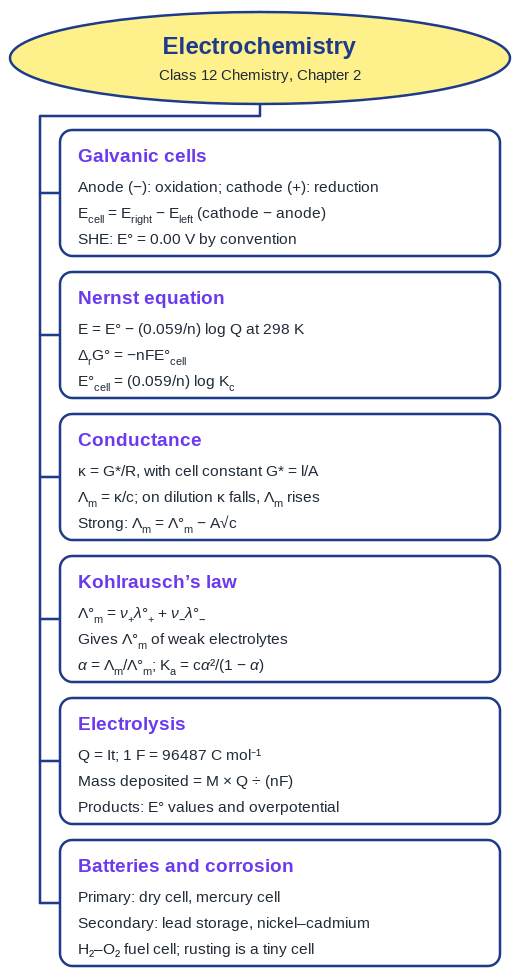
A galvanic cell turns the Gibbs energy of a spontaneous redox reaction into electricity; an electrolytic cell uses electricity to drive a non-spontaneous one. Electrode potentials are measured against the standard hydrogen electrode, and the Nernst equation adds the effect of concentration. Conductance of solutions follows Kohlrausch’s law, electrolysis follows Faraday’s laws, and batteries, fuel cells and rusting are all cells.
What is this chapter about?
A torch cell, a phone battery, the shiny chrome on a bicycle bell and the rust on an old gate all come from the same idea: chemical reactions and electricity can be turned into each other. Electrochemistry studies both directions. A spontaneous redox reaction can push electrons through a wire, and electricity from outside can force a reaction that would not go by itself. Sodium, aluminium, sodium hydroxide and chlorine are made this way on a large scale, and even the signals that travel along our nerves are electrochemical. This chapter, Unit 2 of Chemistry Part I, covers cells, electrode potentials, the conductance of solutions, electrolysis, batteries, fuel cells and corrosion.
What are galvanic and electrolytic cells?
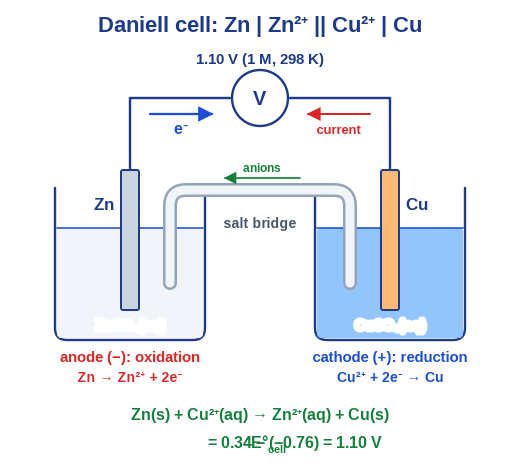
In the Daniell cell a zinc rod stands in zinc sulphate solution and a copper rod in copper sulphate solution. Joined by a wire, the rods carry electrons from zinc to copper while this reaction runs:
Zn(s) + Cu²⁺(aq) → Zn²⁺(aq) + Cu(s)
With both solutions at 1 mol dm⁻³ the cell gives 1.1 V. A device like this, in which a spontaneous redox reaction produces electrical energy, is a galvanic (or voltaic) cell.
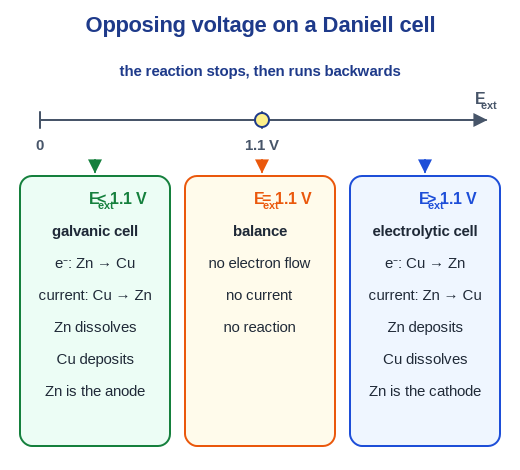
Now push back with an outside voltage, Eext. While Eext is below 1.1 V the cell still works as before. At exactly 1.1 V the current and the reaction stop. Above 1.1 V the reaction runs backwards: zinc is deposited and copper dissolves. The device is now an electrolytic cell, which uses electrical energy to carry out a non-spontaneous reaction.
How does a galvanic cell work?
The overall reaction is the sum of two half-reactions, which happen in separate halves of the cell:
- Oxidation at the zinc electrode, the anode: Zn(s) → Zn²⁺(aq) + 2e⁻
- Reduction at the copper electrode, the cathode: Cu²⁺(aq) + 2e⁻ → Cu(s)
Each half, a metal dipping in a solution of its ions, is a half-cell or redox couple. At each metal–solution surface, metal atoms tend to leave as ions and ions tend to settle on the metal. The balance between the two leaves a charge on the metal and a potential difference between metal and solution, the electrode potential. In a galvanic cell the anode is negative and the cathode positive, so electrons flow through the wire from anode to cathode, and conventional current flows the other way. A salt bridge joins the two solutions so that ions can move and the circuit is complete.
How do we write a cell, and what is its emf?
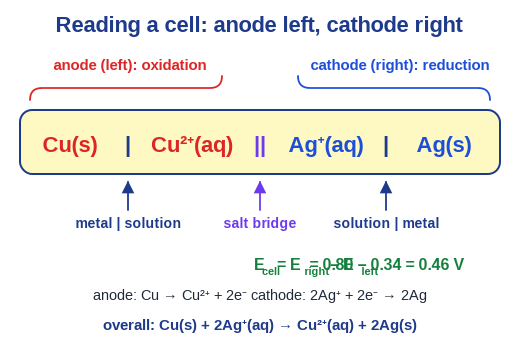
By convention the anode is written first, on the left, and the cathode last, on the right. A single vertical line separates a metal from its solution, and a double line stands for the salt bridge. The reaction Cu(s) + 2Ag⁺(aq) → Cu²⁺(aq) + 2Ag(s) runs in the cell
Cu(s) | Cu²⁺(aq) || Ag⁺(aq) | Ag(s)
The potential difference between the electrodes when no current is drawn is the cell emf, and it is positive when written this way:
Ecell = Eright − Eleft = EAg⁺/Ag − ECu²⁺/Cu
How is an electrode potential measured?
A single half-cell’s potential cannot be measured; only the difference between two can. So one half-cell is given a fixed value. The standard hydrogen electrode (SHE), Pt(s) | H₂(g) | H⁺(aq), is a platinum foil coated with platinum black, dipped in an acid with H⁺ at 1 M, with pure hydrogen gas at 1 bar bubbled over it. Its potential is taken as zero at all temperatures for H⁺(aq) + e⁻ → ½H₂(g).
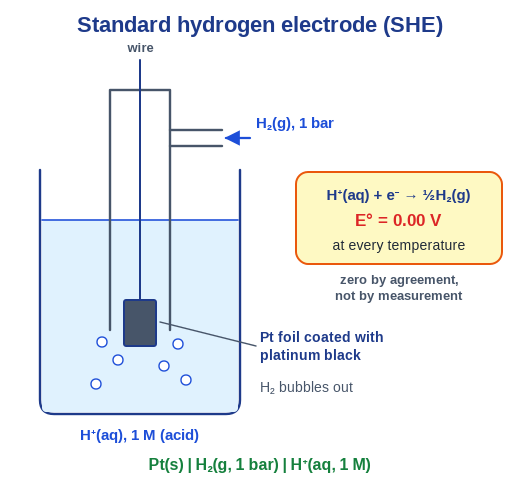
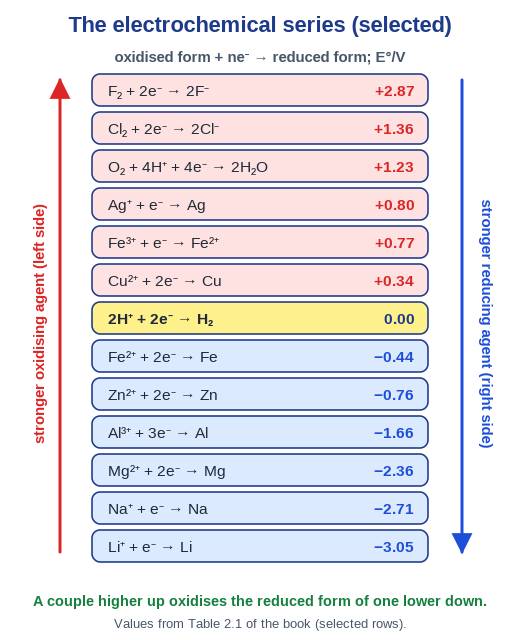
The SHE is placed on the left as the anode and the other half-cell on the right. When everything in the right half-cell is at unit concentration, the cell’s emf at 298 K equals that half-cell’s standard electrode potential, E°. By IUPAC convention these are reduction potentials. Measured this way, E°(Cu²⁺/Cu) = +0.34 V: Cu²⁺ ions are reduced more easily than H⁺, which is why copper does not dissolve in hydrochloric acid. E°(Zn²⁺/Zn) = −0.76 V: H⁺ ions can oxidise zinc. For the Daniell cell, E°cell = 0.34 − (−0.76) = 1.10 V.
When a half-cell has no metal of its own, an inert electrode of platinum or gold provides a surface and carries the electrons, as in the hydrogen electrode and the bromine electrode, Pt(s) | Br₂(aq) | Br⁻(aq).
What does the table of standard electrode potentials tell us?
Table 2.1 of the book lists reduction half-reactions from fluorine, E° = 2.87 V, at the top to lithium, −3.05 V, at the bottom. A positive E° means the reduced form is more stable than hydrogen gas; a negative one means hydrogen gas is more stable. Going down the table, the species on the left become weaker oxidising agents and those on the right stronger reducing agents. So F₂ is the strongest oxidising agent and Li the strongest reducing agent in water. Cells built on these values are used to find pH, solubility products and equilibrium constants, and for potentiometric titrations.
What is the Nernst equation?
Concentrations are not always 1 M. For an electrode reaction Mⁿ⁺(aq) + ne⁻ → M(s), Nernst showed that
E = E° − (RT/nF) ln (1/[Mⁿ⁺])
where R = 8.314 J K⁻¹ mol⁻¹, F = 96487 C mol⁻¹ and T is in kelvin; the concentration of the solid metal is taken as 1. For a whole cell, aA + bB → cC + dD with n electrons,
Ecell = E°cell − (RT/nF) ln ([C]c[D]d/[A]a[B]b)
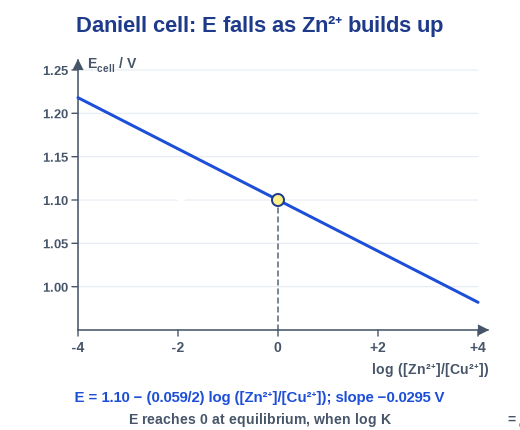
At 298 K, changing to base-10 logarithms gives Ecell = E°cell − (0.059/n) log Q. For the Daniell cell, Ecell = 1.10 − (0.059/2) log ([Zn²⁺]/[Cu²⁺]): it rises with more Cu²⁺ and falls with more Zn²⁺. Use the same n for both electrodes; for Ni(s) + 2Ag⁺(aq) → Ni²⁺(aq) + 2Ag(s), n = 2 and Q = [Ni²⁺]/[Ag⁺]². Read galvanic cells and the Nernst equation.
How are E°cell, Gibbs energy and K related?
As a Daniell cell runs, [Zn²⁺] rises, [Cu²⁺] falls and the voltmeter reading drops. When it reads zero, the reaction is at equilibrium and Q has become Kc. Putting E = 0 in the Nernst equation gives
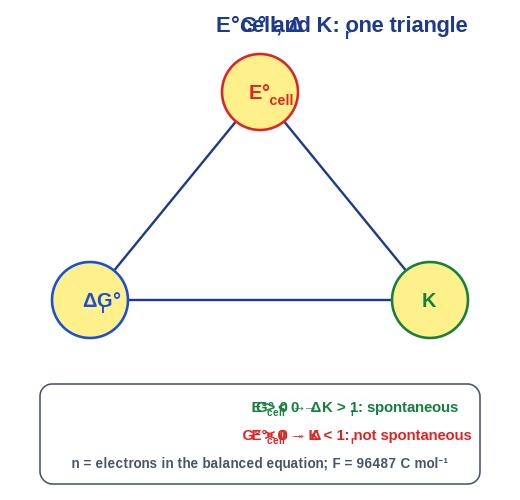
E°cell = (2.303RT/nF) log Kc = (0.059/n) log Kc at 298 K
For the Daniell cell, log Kc = 2 × 1.1/0.059 = 37.3, so Kc ≈ 2 × 10³⁷: the reaction goes practically to completion.
The largest electrical work a cell can do equals the fall in its Gibbs energy, so ΔrG = −nFEcell and, with everything at unit concentration, ΔrG° = −nFE°cell. Ecell is an intensive property, but ΔrG depends on how the equation is written: doubling the Daniell equation doubles n from 2 to 4 and doubles ΔrG. For the Daniell cell, ΔrG° = −2 × 96487 × 1.1 J mol⁻¹ = −212.27 kJ mol⁻¹. With ΔrG° = −RT ln K, one measurement of E° gives both ΔrG° and K.
What are conductivity and molar conductivity?
The resistance R of a conductor grows with its length l and falls with its area A: R = ρl/A, where ρ is the resistivity (Ω m; 1 Ω m = 100 Ω cm). The inverse of resistance is conductance, G = 1/R, measured in siemens (S = Ω⁻¹). The inverse of resistivity is conductivity, κ (kappa), in S m⁻¹; 1 S cm⁻¹ = 100 S m⁻¹. IUPAC prefers the words resistivity and conductivity to “specific resistance” and “specific conductance”.
Conductivity varies enormously. Metals are conductors; glass and Teflon are insulators; silicon and germanium are semiconductors; superconductors have zero resistivity, once only metals near 0 to 15 K but now also some ceramics and mixed oxides at up to 150 K. In metals, electrons carry the current (electronic conductance), which falls as temperature rises. Certain polymers conduct like metals too; their discovery won the 2000 Nobel Prize in Chemistry. In solutions, ions carry the current (ionic conductance), and κ depends on the electrolyte, the size and solvation of its ions, the solvent and its viscosity, the concentration and the temperature (κ rises with temperature). Even pure water conducts a little, about 3.5 × 10⁻⁵ S m⁻¹, from its tiny amounts of H⁺ and OH⁻.
To compare electrolytes fairly we use molar conductivity, Λm = κ/c. With κ in S cm⁻¹ and molarity in mol L⁻¹, Λm (S cm² mol⁻¹) = κ × 1000/molarity; 1 S m² mol⁻¹ = 10⁴ S cm² mol⁻¹.
How is the conductivity of a solution measured?
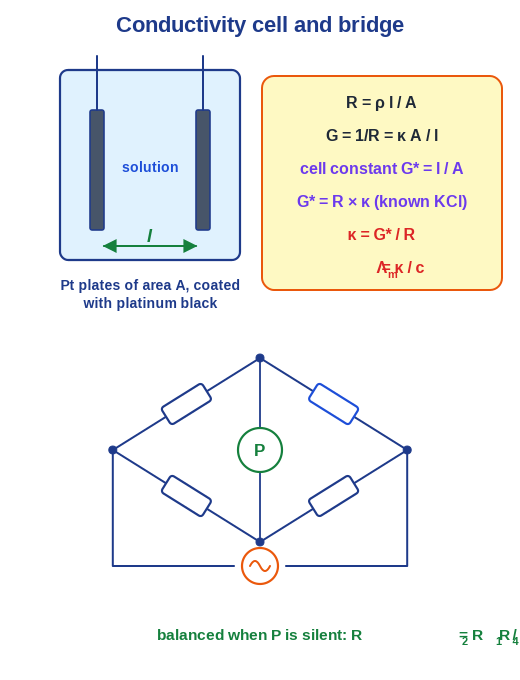
Direct current would change the solution’s composition, so an alternating current source is used, with a conductivity cell: two platinised platinum plates of area A, a distance l apart. The quantity l/A is the cell constant, G*. Measuring l and A is unreliable, so G* is found from a KCl solution of known conductivity: G = Rκ*. The resistance is measured on a Wheatstone bridge (R₂ = R₁R₄/R₃ at balance) or read off a conductivity meter, and then κ = G/R*.
How do κ and Λm change on dilution?
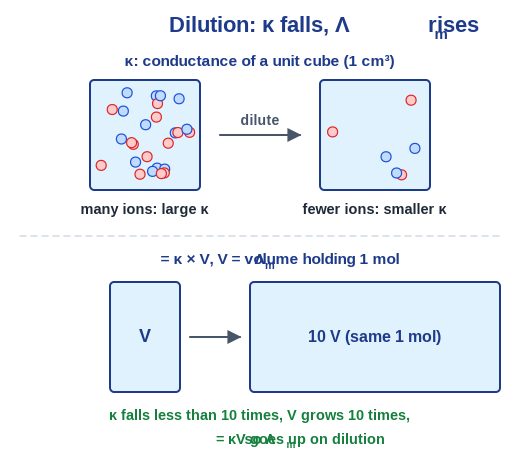
Conductivity always falls on dilution, for strong and weak electrolytes alike, because each cubic centimetre holds fewer ions. Molar conductivity rises, because Λm = κV, where V is the volume that holds one mole, and V grows faster than κ falls. The value as c approaches zero is the limiting molar conductivity, Λ°m.
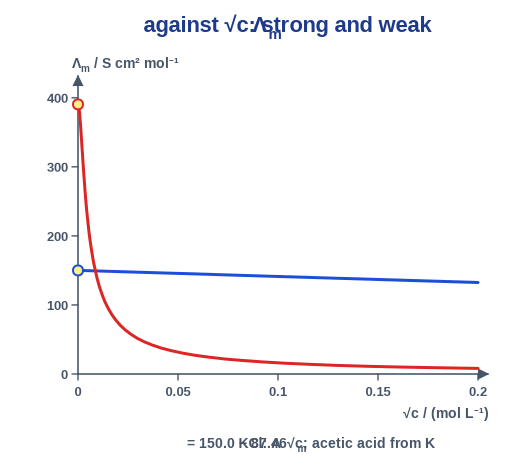
- Strong electrolytes such as KCl: Λm rises slowly and follows Λm = Λ°m − A√c. A graph of Λm against √c is a straight line with intercept Λ°m and slope −A. A depends on the solvent, the temperature and the type of electrolyte: NaCl is a 1-1, CaCl₂ a 2-1 and MgSO₄ a 2-2 electrolyte.
- Weak electrolytes such as acetic acid: Λm rises steeply near zero concentration because the degree of dissociation grows. Λ°m cannot be found by extending the curve, and at very low concentrations κ is too small to measure accurately.
What is Kohlrausch’s law?
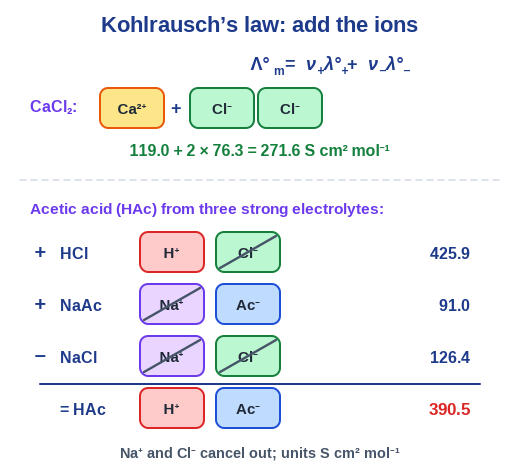
Kohlrausch noticed that Λ°m(KX) − Λ°m(NaX) is about 23.4 S cm² mol⁻¹ whatever X is, and Λ°m(MBr) − Λ°m(MCl) about 1.8 S cm² mol⁻¹ whatever M is. Each ion seems to add its own fixed share. His law of independent migration of ions says that the limiting molar conductivity of an electrolyte is the sum of the contributions of its cation and anion:
Λ°m = ν₊λ°₊ + ν₋λ°₋
where ν₊ and ν₋ are the numbers of cations and anions per formula unit. With λ°(Ca²⁺) = 119.0 and λ°(Cl⁻) = 76.3 S cm² mol⁻¹, Λ°m(CaCl₂) = 119.0 + 2 × 76.3 = 271.6 S cm² mol⁻¹. Its main uses: finding Λ°m of a weak electrolyte from strong ones, and then its degree of dissociation, α = Λm/Λ°m, and dissociation constant, Ka = cα²/(1 − α). Read conductance and Kohlrausch’s law.
What happens in an electrolytic cell?
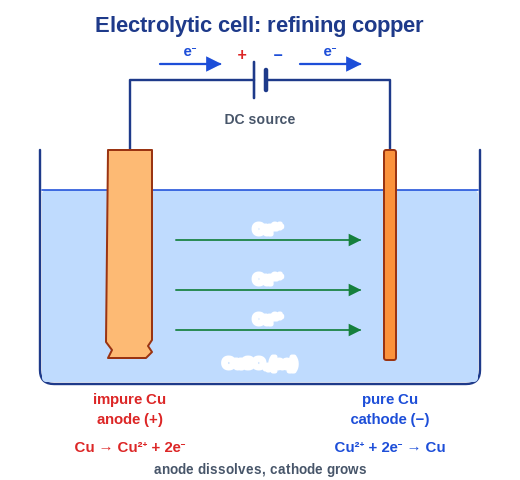
In the simplest electrolytic cell, two copper strips dip in copper sulphate solution and a DC voltage is applied. Copper is oxidised and dissolves at the anode, Cu(s) → Cu²⁺(aq) + 2e⁻, and Cu²⁺ ions are reduced at the cathode, Cu²⁺(aq) + 2e⁻ → Cu(s). Making impure copper the anode and pure copper the cathode refines copper. Metals with no suitable chemical reducing agent are made the same way: sodium and magnesium from their molten chlorides, and aluminium from aluminium oxide with cryolite.
What are Faraday’s laws of electrolysis?
Michael Faraday published two laws in 1833–34:
- First law: the amount of chemical reaction at an electrode is proportional to the charge that flows through the cell.
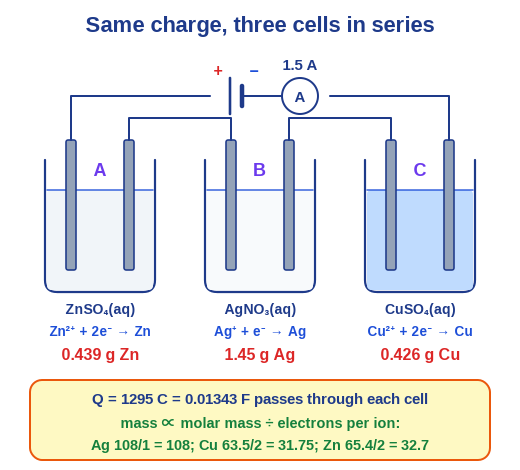
- Second law: the same quantity of electricity liberates different substances in proportion to their chemical equivalent weights (molar mass of the metal ÷ electrons needed to reduce its ion).
Charge is Q = It (coulombs from amperes and seconds). One mole of electrons carries 6.02 × 10²³ × 1.6021 × 10⁻¹⁹ C = 96487 C, the faraday (F); about 96500 C mol⁻¹ in rough work. Ag⁺ + e⁻ → Ag needs 1 F per mole of silver; Mg²⁺ needs 2 F and Al³⁺ 3 F. So the mass deposited is M × Q ÷ (nF). A current of 50,000 A, used in industry, is about 0.518 F every second. Read electrolysis and Faraday’s laws.
What decides the products of electrolysis?
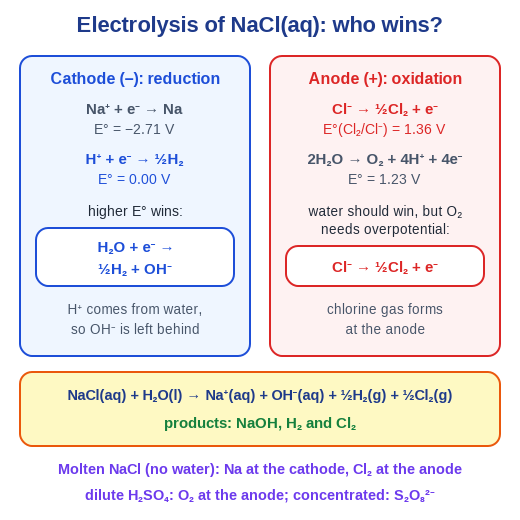
The products depend on what is being electrolysed and on the electrodes. An inert electrode (platinum, gold) only gives or takes electrons; a reactive one can take part. When several species could react, compare their electrode potentials (with Nernst corrections for concentration): at the cathode the reduction with the higher E° wins, and at the anode the oxidation with the lower E°. Some reactions are so slow that they need an extra voltage, the overpotential.
- Molten NaCl: sodium at the cathode, chlorine at the anode.
- Aqueous NaCl: at the cathode, H₂O + e⁻ → ½H₂ + OH⁻ (E° of H⁺/H₂ is 0.00 V, far above −2.71 V for Na⁺/Na). At the anode, water (1.23 V) should be oxidised before Cl⁻ (1.36 V), but the overpotential of oxygen makes chlorine form. The products are NaOH, H₂ and Cl₂.
- Sulphuric acid: dilute acid gives O₂ at the anode; concentrated acid gives peroxodisulphate, 2SO₄²⁻ → S₂O₈²⁻ + 2e⁻ (E° = 1.96 V).
What are primary and secondary batteries?
A battery is one galvanic cell, or several in series. To be useful it should be light, compact and keep a fairly steady voltage.
Primary batteries work once and are then dead:
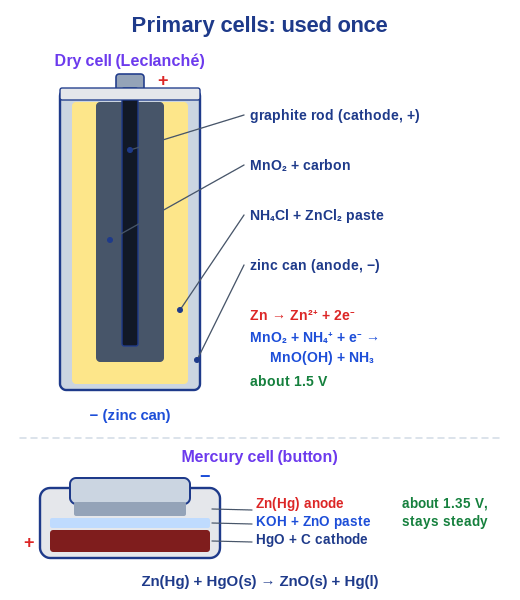
- Dry cell (Leclanché cell), used in clocks and transistor radios: a zinc container is the anode; a graphite rod surrounded by powdered MnO₂ and carbon is the cathode; a moist paste of NH₄Cl and ZnCl₂ fills the space between. Anode: Zn(s) → Zn²⁺ + 2e⁻. Cathode: MnO₂ + NH₄⁺ + e⁻ → MnO(OH) + NH₃, with manganese going from +4 to +3. The NH₃ forms [Zn(NH₃)₄]²⁺ with zinc ions. About 1.5 V.
- Mercury cell, for hearing aids and watches: anode zinc–mercury amalgam, cathode a paste of HgO and carbon, electrolyte a paste of KOH and ZnO. Anode: Zn(Hg) + 2OH⁻ → ZnO(s) + H₂O + 2e⁻. Cathode: HgO + H₂O + 2e⁻ → Hg(l) + 2OH⁻. Overall Zn(Hg) + HgO(s) → ZnO(s) + Hg(l), about 1.35 V. The voltage stays steady because the overall reaction has no ion whose concentration changes.
Secondary batteries are recharged by passing current the opposite way:
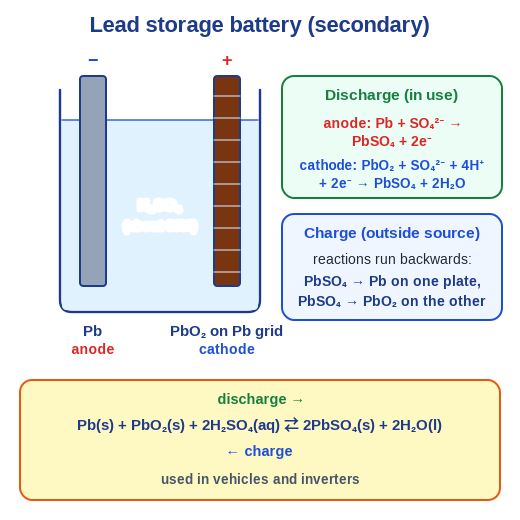
- Lead storage battery, used in vehicles and inverters: lead anode, a lead grid packed with PbO₂ as cathode, about 38% sulphuric acid as electrolyte. In use, anode: Pb(s) + SO₄²⁻(aq) → PbSO₄(s) + 2e⁻; cathode: PbO₂(s) + SO₄²⁻(aq) + 4H⁺(aq) + 2e⁻ → PbSO₄(s) + 2H₂O(l); overall Pb + PbO₂ + 2H₂SO₄ → 2PbSO₄ + 2H₂O. Charging reverses this, turning PbSO₄ back into Pb and PbO₂.
- Nickel–cadmium cell: lasts longer than the lead cell but costs more to make. Overall discharge reaction: Cd(s) + 2Ni(OH)₃(s) → CdO(s) + 2Ni(OH)₂(s) + H₂O(l).
What is a fuel cell?
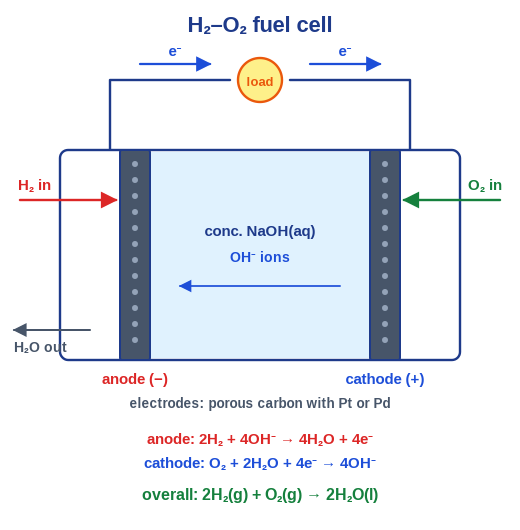
A thermal power plant burns fuel to boil water, and the steam turns a turbine: a long chain that wastes energy and pollutes. A fuel cell is a galvanic cell that turns the energy of combustion of a fuel such as hydrogen, methane or methanol straight into electricity, with reactants fed in and products removed all the time. In the hydrogen–oxygen cell, the gases bubble through porous carbon electrodes, with platinum or palladium as catalyst, into concentrated NaOH solution:
- Cathode: O₂(g) + 2H₂O(l) + 4e⁻ → 4OH⁻(aq)
- Anode: 2H₂(g) + 4OH⁻(aq) → 4H₂O(l) + 4e⁻
- Overall: 2H₂(g) + O₂(g) → 2H₂O(l)
This cell powered the Apollo space programme, and its water was condensed for the astronauts to drink. Fuel cells reach about 70% efficiency, against about 40% for thermal plants, and the book counts them as non-polluting. Hydrogen made by splitting water with solar energy and used in fuel cells is the idea behind the hydrogen economy; both steps are electrochemical.
Why is corrosion an electrochemical process?
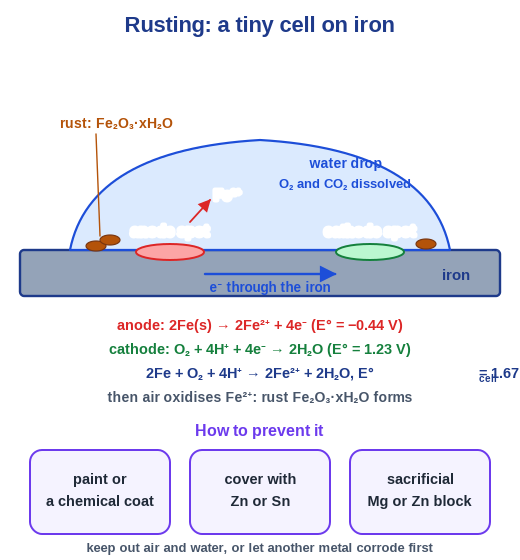
Corrosion slowly coats metals with oxides or other salts: rusting of iron, tarnishing of silver, the green coat on copper and bronze. It damages buildings, bridges and ships and costs crores of rupees every year. Rusting needs both water and air. At one spot iron is oxidised, and that spot acts as an anode: 2Fe(s) → 2Fe²⁺ + 4e⁻ (E° = −0.44 V). The electrons travel through the metal to another spot, the cathode, where oxygen is reduced with H⁺ from carbonic acid (CO₂ dissolved in water) or other acidic oxides: O₂(g) + 4H⁺(aq) + 4e⁻ → 2H₂O(l) (E° = 1.23 V). Overall, 2Fe + O₂ + 4H⁺ → 2Fe²⁺ + 2H₂O, with E°cell = 1.67 V. Air then oxidises Fe²⁺ further, and rust forms as hydrated iron(III) oxide, Fe₂O₃·xH₂O.
To prevent corrosion: keep air and water away with paint or a chemical coat (such as bisphenol); cover the iron with another metal such as tin or zinc; or join it to a sacrificial electrode of a more active metal such as magnesium or zinc, which corrodes instead.
Stay safe
Acids, alkalis, mercury compounds and lead compounds in this chapter are corrosive or poisonous, and electrolysis of salt water gives off chlorine. Never open a cell or a car battery. Do any experiment with cells or electrolysis only in the school laboratory with your teacher.
Before we move on
Three ideas run through the chapter: E° values tell which way a redox reaction goes and how strongly, the Nernst equation corrects them for concentration and links them to ΔG and K, and charge is counted in faradays. Learn the cell conventions, the Nernst equation and Kohlrausch’s law with their units. Every exercise, in-text question and worked example of the unit is solved in the NCERT solutions for Chapter 2.
Key terms
| Term | Meaning |
|---|---|
| Galvanic (voltaic) cell | A cell in which a spontaneous redox reaction drives electrons through an outside circuit, giving electrical energy; the Daniell cell is one. |
| Electrolytic cell | A cell in which an outside voltage drives a non-spontaneous chemical reaction, as in refining copper. |
| Anode and cathode | Oxidation happens at the anode and reduction at the cathode. In a galvanic cell the anode is negative; in an electrolytic cell it is positive. |
| Salt bridge | A tube of electrolyte that joins the two solutions of a cell, so ions can move and the circuit is completed. |
| Standard electrode potential (E°) | The reduction potential of a half-cell when every species in it is at unit concentration (1 M, gases at 1 bar), measured against the SHE. |
| Standard hydrogen electrode (SHE) | Pt(s) | H₂(g, 1 bar) | H⁺(aq, 1 M); its potential is taken as 0.00 V at all temperatures. |
| Cell emf (Ecell) | The potential difference between the electrodes when no current is drawn: Ecell = Eright − Eleft = Ecathode − Eanode. |
| Nernst equation | E = E° − (RT/nF) ln Q; at 298 K, E = E° − (0.059/n) log Q. It gives the potential at any concentration. |
| Faraday (F) | The charge on one mole of electrons: 96487 C mol⁻¹, taken as about 96500 C mol⁻¹ in rough work. |
| Conductivity (κ) | The inverse of resistivity; the conductance of a unit cube of the solution. Unit S m⁻¹ (often S cm⁻¹). |
| Cell constant (G*) | l/A for a conductivity cell, found from a KCl solution of known κ: G* = Rκ. Unit m⁻¹ or cm⁻¹. |
| Molar conductivity (Λm) | κ divided by the molar concentration, Λm = κ/c; unit S m² mol⁻¹ (often S cm² mol⁻¹). |
| Limiting molar conductivity (Λ°m) | The molar conductivity as the concentration approaches zero (infinite dilution). |
| Kohlrausch’s law | Λ°m of an electrolyte is the sum of the limiting molar conductivities of its cation and anion: Λ°m = ν₊λ°₊ + ν₋λ°₋. |
| Overpotential | The extra voltage a slow electrode reaction needs beyond what E° predicts; it is why Cl₂, not O₂, forms from brine. |
Topics in this chapter
Practice
-
In a galvanic cell, the anode is:
Show answer
Answer: (b) negative, where oxidation occurs
-
Using E°(Cu²⁺/Cu) = 0.34 V and E°(Ag⁺/Ag) = 0.80 V, E°cell for Cu | Cu²⁺ || Ag⁺ | Ag is:
Show answer
Answer: (b) 0.46 V
-
On diluting a solution of KCl, which is true?
Show answer
Answer: (c) κ falls, Λm rises
-
How many faradays are needed to deposit 1 mol of Al from Al³⁺?
Show answer
Answer: (c) 3 F
-
Which cell keeps an almost constant voltage through its life?
Show answer
Answer: (b) mercury cell
-
In the electrolysis of aqueous NaCl with inert electrodes, the cathode gives:
Show answer
Answer: (c) hydrogen
Questions students ask
What are the main topics of Class 12 Chemistry Chapter 2?
Electrochemical cells and the Daniell cell, galvanic cells and electrode potentials with the standard hydrogen electrode, the Nernst equation with equilibrium constant and Gibbs energy, conductance of solutions with Kohlrausch’s law, electrolysis with Faraday’s laws and products, batteries, fuel cells and corrosion.
Which formulas of Electrochemistry should I learn?
E°cell = E°cathode − E°anode; E = E° − (0.059/n) log Q; ΔrG° = −nFE°cell; E°cell = (0.059/n) log Kc; κ = G*/R; Λm = κ/c (× 1000 for S cm² mol⁻¹); Λm = Λ°m − A√c; Λ°m = ν₊λ°₊ + ν₋λ°₋; α = Λm/Λ°m; Ka = cα²/(1 − α); Q = It; m = MQ/(nF).
Is Electrochemistry in the 2026-27 NCERT Class 12 Chemistry book?
Yes. It is Unit 2 of Chemistry Part I, the Class 12 textbook marked Reprint 2026-27, on pages 31 to 60. The book calls it a unit; here it is Chapter 2.
What is the difference between a galvanic and an electrolytic cell?
A galvanic cell uses a spontaneous reaction to make electricity, and its anode is negative. An electrolytic cell uses electricity from outside to force a reaction that would not happen by itself, and its anode is positive. In both, oxidation happens at the anode.
Stuck on a question?
Take a photo and Lagnever AI explains it step by step. Try it for 7 days for ₹2.
Get it on Google Play Open in browser
For parents: after the trial, the plan renews monthly by UPI or card autopay. You can cancel anytime in the app.