
What are Faraday’s laws of electrolysis?
Answer in short
Faraday’s first law: the amount of substance changed at an electrode is proportional to the charge passed. His second law: one quantity of charge liberates different substances in proportion to their chemical equivalent weights, molar mass ÷ electrons per ion. With Q = It and F = 96487 C mol⁻¹, the mass deposited is M × Q ÷ (nF).
Stuck on a question? Take a photo and Lagnever AI explains it step by step. Try it for 7 days for ₹2. Get it on Google Play
What is an electrolytic cell?
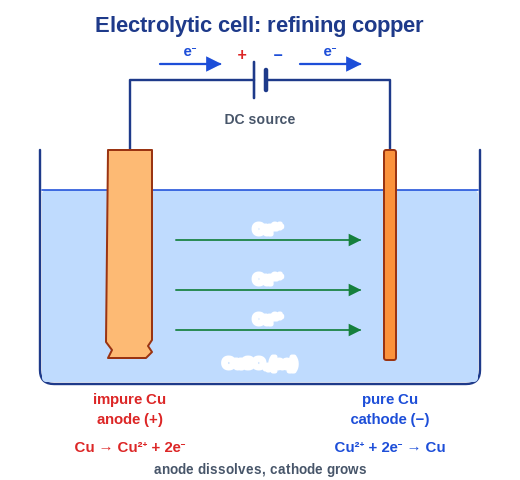
In a galvanic cell a reaction makes electricity. In an electrolytic cell it is the other way round: an outside source of voltage drives a reaction that would not happen by itself. Oxidation still happens at the anode and reduction at the cathode, but now the anode is joined to the positive terminal of the source and the cathode to the negative terminal.
A simple example is two copper strips in copper sulphate solution. With a DC voltage across them:
- Cathode (−): Cu²⁺(aq) + 2e⁻ → Cu(s), so copper is deposited
- Anode (+): Cu(s) → Cu²⁺(aq) + 2e⁻, so copper dissolves
Make the anode out of impure copper and the cathode a thin sheet of pure copper, and pure copper builds up on the cathode as the anode wastes away. This is how copper is refined. Metals with no suitable chemical reducing agent are made by electrolysis too: sodium and magnesium from their molten chlorides, aluminium from aluminium oxide with cryolite.
What are Faraday’s two laws?
After studying the electrolysis of many solutions and melts, Michael Faraday stated two laws (1833–34):
- First law: the amount of chemical change at an electrode is proportional to the charge that flows through the cell.
- Second law: the same quantity of electricity liberates different substances in amounts proportional to their chemical equivalent weights, the molar mass of the metal divided by the number of electrons needed to reduce its ion.
How much charge is one faraday?
The charge passed is Q = It: amperes × seconds gives coulombs. One electron carries 1.6021 × 10⁻¹⁹ C, so one mole of electrons carries
6.02 × 10²³ mol⁻¹ × 1.6021 × 10⁻¹⁹ C = 96487 C mol⁻¹
This is the faraday, F. In rough calculations 1 F ≈ 96500 C mol⁻¹. The electrode equation tells how many faradays one mole of product needs:
- Ag⁺ + e⁻ → Ag: 1 F per mole of silver
- Mg²⁺ + 2e⁻ → Mg: 2 F per mole of magnesium
- Al³⁺ + 3e⁻ → Al: 3 F per mole of aluminium
So the mass deposited is m = M × Q ÷ (nF). Industry uses currents as large as 50,000 A, about 0.518 F every second.
Our own example. A spoon is silver-plated with a current of 2.0 A for 30 minutes.
t = 30 × 60 = 1800 s; Q = 2.0 × 1800 = 3600 C
Moles of electrons = 3600 ÷ 96487 = 0.0373 mol
Ag⁺ + e⁻ → Ag, so 0.0373 mol of silver = 0.0373 × 108 = 4.03 g
How does the second law work in practice?
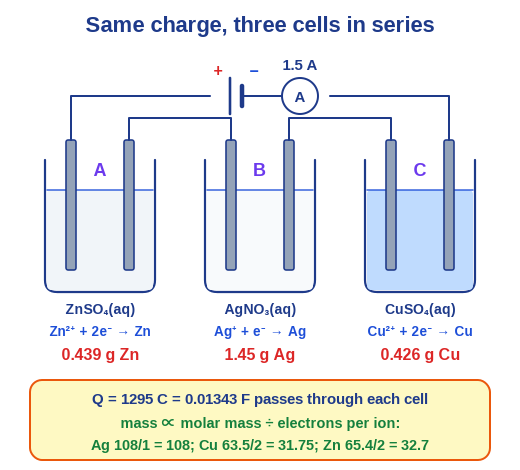
Join cells in series and the same charge passes through each. Every mole of electrons deposits 108 g of silver (108/1), 31.75 g of copper (63.5/2) or 32.7 g of zinc (65.4/2). So the masses deposited stand in the ratio of M/n, exactly as the second law says. Exercise 2.16 of the book works this out for three cells in series.
What decides the products of electrolysis?
The products depend on the substance being electrolysed and on the electrodes. An inert electrode, such as platinum or gold, only supplies or takes electrons. A reactive electrode, such as the copper anode above, can itself be oxidised. When several species could react at an electrode:
- at the cathode, the reduction with the higher E° happens first;
- at the anode, the oxidation of the couple with the lower E° happens first;
- a reaction that is too slow needs an extra voltage, the overpotential, which can change the result. E° values are also corrected for concentration with the Nernst equation.
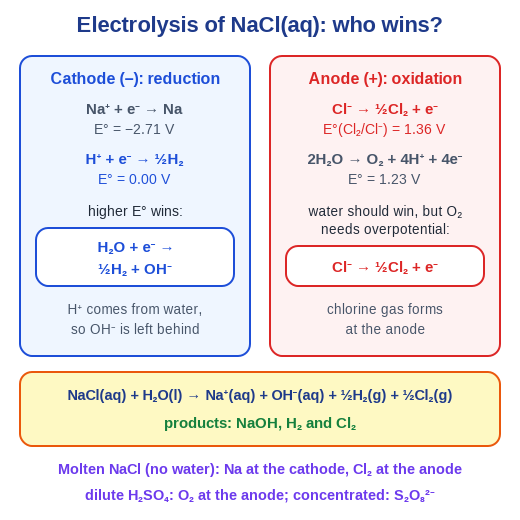
Molten NaCl has only Na⁺ and Cl⁻: sodium forms at the cathode (Na⁺ + e⁻ → Na) and chlorine at the anode (Cl⁻ → ½Cl₂ + e⁻).
Aqueous NaCl also has water. At the cathode, H⁺ + e⁻ → ½H₂ (E° = 0.00 V) beats Na⁺ + e⁻ → Na (−2.71 V); since the H⁺ comes from water, the net cathode reaction is H₂O(l) + e⁻ → ½H₂(g) + OH⁻(aq). At the anode, water (E° = 1.23 V) should be oxidised before Cl⁻ (1.36 V), but oxygen has a large overpotential, so chlorine forms. Overall:
NaCl(aq) + H₂O(l) → Na⁺(aq) + OH⁻(aq) + ½H₂(g) + ½Cl₂(g)
so the products are NaOH, H₂ and Cl₂.
Sulphuric acid: with dilute acid, water is oxidised to O₂ at the anode; with concentrated acid, sulphate ions are oxidised to peroxodisulphate, 2SO₄²⁻(aq) → S₂O₈²⁻(aq) + 2e⁻ (E° = 1.96 V).
Stay safe
Electrolysis of salt water gives off chlorine, a poisonous gas, and hydrogen, which burns. Try electrolysis only in the school laboratory with your teacher.
Previous topic: conductance and Kohlrausch’s law. See also the chapter notes and the NCERT solutions.
Practice
-
How much charge deposits 1 mol of silver from Ag⁺?
Show answer
Answer: (a) 96487 C
-
In the electrolysis of aqueous CuSO₄ with copper electrodes, the anode:
Show answer
Answer: (c) dissolves as Cu²⁺
-
The same charge passes through AgNO₃ and CuSO₄ solutions in series. The ratio of masses of Ag to Cu deposited is about:
Show answer
Answer: (b) 108 : 31.75
-
A current of 1.0 A flows through CuSO₄ solution for 965 s. What mass of copper is deposited? (Cu = 63.5 g mol⁻¹)
Show answer
Answer: Q = 1.0 × 965 = 965 C; m = 63.5 × 965 ÷ (2 × 96487) = 0.318 g.
-
Why does electrolysis of aqueous NaCl not give sodium metal at the cathode?
Show answer
Answer: Water is reduced first: H⁺/H₂ has E° = 0.00 V, far above −2.71 V for Na⁺/Na, so hydrogen forms and OH⁻ is left in the solution.
Questions students ask
What is Faraday’s first law of electrolysis?
The mass of a substance deposited or dissolved at an electrode is proportional to the charge passed through the solution or melt. Double the charge and you double the mass deposited.
What is Faraday’s second law of electrolysis?
When the same quantity of electricity passes through different electrolytes, the amounts of substances liberated are proportional to their chemical equivalent weights, that is, molar mass divided by the number of electrons needed per ion.
What is one faraday?
One faraday is the charge on one mole of electrons: 6.02 × 10²³ × 1.6021 × 10⁻¹⁹ C = 96487 C mol⁻¹. For rough work it is taken as 96500 C mol⁻¹.
Which metals are extracted by electrolysis?
Metals with no suitable chemical reducing agent: sodium and magnesium from their molten chlorides, and aluminium from aluminium oxide dissolved in cryolite. Copper is purified by electrolysis too.
Stuck on a question?
Take a photo and Lagnever AI explains it step by step. Try it for 7 days for ₹2.
Get it on Google Play Open in browser
For parents: after the trial, the plan renews monthly by UPI or card autopay. You can cancel anytime in the app.